VR Headset (Standalone) Processor & Display Driver Market Insights
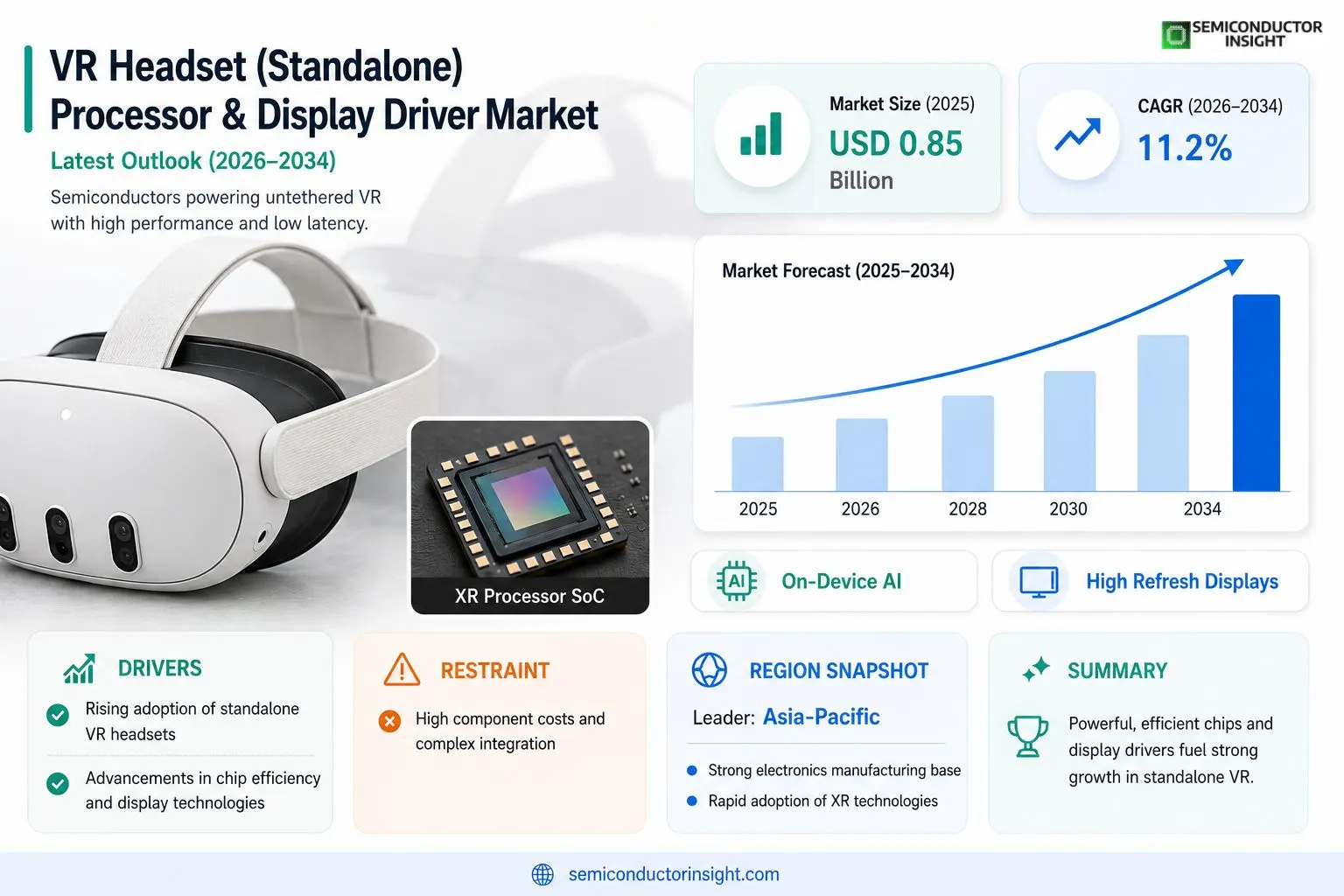
Global VR Headset (Standalone) Processor & Display Driver Market size was valued at USD 0.85 billion in 2025. The market is projected to grow from USD 0.92 billion in 2026 to USD 2.15 billion by 2034, exhibiting a CAGR of 11.2% during the forecast period.
Standalone VR headset processors and display drivers are specialized semiconductor components essential for delivering high-performance, untethered virtual reality experiences. These processors, such as system-on-chip solutions optimized for XR applications, handle intensive graphics rendering, sensor fusion, AI processing, and power management within compact, battery-powered devices. Display drivers complement them by managing high-resolution panels, ensuring low-latency image output, high refresh rates, and efficient power consumption to minimize motion sickness and maximize immersion.
The market is experiencing robust growth due to several factors, including surging consumer adoption of standalone VR devices for gaming and entertainment, expanding enterprise applications in training and simulation, and continuous technological advancements in chip efficiency and display technologies. Rising demand for higher resolution micro-OLED and pancake lens setups further accelerates the need for sophisticated drivers capable of supporting elevated frame rates and color accuracy. Initiatives by key players in the market are also expected to fuel the market growth. For instance, advancements in next-generation XR platforms have enabled enhanced on-device AI and improved passthrough capabilities in leading headsets. Qualcomm, alongside specialized display IC providers like Synaptics, are some of the key players that operate in the market with a wide range of portfolios.
MARKET DRIVERS
Advancements in Integrated Chipsets for Standalone Performance
VR Headset (Standalone) Processor & Display Driver Market is propelled by rapid improvements in mobile-grade processors optimized for XR applications. Qualcomm’s Snapdragon XR2 series, including the XR2+ Gen 2, delivers significant gains in rendering performance, supporting higher resolutions and smoother frame rates while maintaining power efficiency essential for untethered devices. These processors enable console-like visuals in compact form factors, directly supporting the dominance of standalone headsets in consumer and enterprise segments.
Rising Demand for Portable and Affordable VR Solutions
Standalone VR headsets have captured substantial market share, exceeding 40% in recent years, driven by their all-in-one design that eliminates the need for external PCs or consoles. This portability has accelerated adoption across gaming, training, and fitness applications. Enhanced display drivers paired with advanced optics, such as pancake lenses and high-refresh-rate panels, improve visual fidelity and reduce user discomfort, broadening the addressable market.
➤ Integration of AI capabilities in next-generation processors further enhances real-time rendering and interaction features, positioning standalone devices as versatile platforms for immersive experiences.
Overall, the combination of powerful yet efficient processors and sophisticated display drivers continues to lower barriers to entry while elevating user experiences, fueling sustained growth in this specialized component market.
MARKET CHALLENGES
Technical Limitations in Power and Thermal Management
Standalone VR systems face inherent constraints in balancing high-performance processing with battery life and heat dissipation. Demanding graphical workloads from advanced display drivers can strain integrated batteries, limiting session times and requiring ongoing engineering trade-offs between performance and portability.
Other Challenges
High Development Costs and Ecosystem Dependencies
Reliance on a limited number of leading chipset providers creates supply chain vulnerabilities and elevates component costs, particularly for premium display drivers supporting high resolutions and refresh rates. Content optimization for specific processor architectures adds complexity for developers.
User Comfort and Adoption Barriers
Motion sickness remains a notable issue despite hardware improvements, while the need for precise calibration between processors, sensors, and displays can impact overall reliability and user satisfaction in mass-market deployments.
MARKET RESTRAINTS
High Component Costs and Integration Complexity
Premium processors and advanced display drivers required for competitive standalone VR headsets contribute to elevated manufacturing costs, which can slow price reductions and limit penetration in price-sensitive emerging markets. The technical challenge of seamlessly integrating these components with sensors and batteries further constrains rapid scaling. Additionally, the specialized nature of XR-optimized silicon creates a concentrated supply base, exposing the market to potential delays or pricing pressures from key semiconductor suppliers.
MARKET OPPORTUNITIES
Expansion into Enterprise and Specialized Applications
Standalone VR headsets powered by increasingly capable processors and display drivers present strong growth potential in training, healthcare, education, and industrial simulation. These sectors benefit from wireless mobility and high-fidelity visuals, driving demand for tailored component solutions that deliver reliable performance in professional environments.Continued innovation in power-efficient chipsets and next-generation display technologies, such as higher-resolution micro-OLED panels, opens avenues for premium mixed-reality experiences and broader consumer accessibility. Partnerships between chipset manufacturers and headset brands are accelerating the development of differentiated solutions.
VR Headset (Standalone) Processor & Display Driver Market Trends
Advancements in Chip Efficiency and On-Device AI Integration
VR Headset (Standalone) Processor & Display Driver Market is witnessing significant momentum driven by rapid advancements in semiconductor solutions optimized for untethered virtual reality experiences. Specialized system-on-chip processors are increasingly incorporating enhanced AI capabilities directly on-device, enabling sophisticated sensor fusion, real-time graphics rendering, and intelligent power management within compact battery-powered form factors. These processors work in tandem with advanced display drivers to deliver low-latency performance critical for maintaining immersion in standalone VR headsets.
Other Trends
Rising Demand for High-Resolution Display Support
Display drivers in VR Headset (Standalone) Processor & Display Driver Market are evolving to support higher resolution micro-OLED panels and advanced optical setups such as pancake lenses. This trend addresses the need for superior color accuracy, elevated refresh rates, and reduced motion sickness, which are essential for both consumer entertainment applications and professional use cases. Manufacturers are focusing on driver ICs that optimize power consumption while handling intensive visual workloads in standalone devices.
Expanding Applications Across Consumer and Enterprise Segments
Standalone VR headsets are gaining traction in gaming and entertainment among consumers, creating sustained demand for powerful yet energy-efficient processors and display drivers. Simultaneously, enterprise adoption in training, simulation, and industrial applications is accelerating the need for reliable, high-performance components capable of delivering consistent results in demanding environments. Enhanced passthrough capabilities in next-generation XR platforms are further supported by improvements in these semiconductor solutions, allowing seamless blending of virtual and real-world elements.
Key industry participants including Qualcomm are driving innovation through next-generation XR platforms that integrate advanced processing architectures. Specialized display IC providers like Synaptics are contributing with solutions that prioritize high frame rates and efficient thermal management, essential for prolonged usage in standalone VR headsets. These developments underscore the dynamic nature of VR Headset (Standalone) Processor & Display Driver Market as it adapts to evolving performance requirements and user expectations for premium untethered experiences.
COMPETITIVE LANDSCAPEKey Industry Players
VR Headset (Standalone) Processor & Display Driver Market Competitive Analysis
Qualcomm dominates VR Headset (Standalone) Processor & Display Driver Market with its Snapdragon XR series chipsets, which serve as the primary SoC solution powering the majority of leading standalone devices. The company maintains a strong market position through optimized platforms that integrate advanced graphics rendering, sensor fusion, AI capabilities, and power-efficient architectures tailored for untethered XR experiences. This leadership is supported by extensive ecosystem partnerships and reference designs that accelerate adoption across consumer gaming and enterprise applications.
Several specialized players complement the competitive structure by focusing on display driver ICs and niche semiconductor solutions. Synaptics stands out with its high-performance VR-specific display drivers supporting high-resolution micro-OLED and high refresh rate panels. Other participants, including emerging fabless semiconductor firms, contribute targeted innovations in display interfaces and power management, fostering a dynamic supplier landscape amid rapid technological advancements in resolution, latency reduction, and thermal efficiency.
List of Key VR Headset Processor & Display Driver Companies Profiled
- Qualcomm
- Synaptics
- MediaTek
- Analogix Semiconductor
- Chipone
- Samsung Electronics
- Novatek Microelectronics
- OMNIVISION Technologies
- Lattice Semiconductor
- STMicroelectronics
- Nordic Semiconductor
- Himax Technologies
- FocalTech
- ILI Technology (ILITEK)
- Parade Technologies
Segment Analysis:
| Segment Category | Sub-Segments | Key Insights |
| By Type |
|
High-Performance SoC Processors dominate due to their ability to handle complex graphics rendering and sensor fusion essential for immersive untethered VR experiences. These processors excel in managing real-time AI processing for enhanced environmental awareness and hand tracking. They support seamless multitasking between applications while maintaining thermal efficiency in compact designs. Power-Efficient variants complement them by extending battery life without compromising core performance, making standalone headsets more practical for prolonged use. |
| By Application |
|
Gaming and Entertainment represents the leading segment as it demands ultra-low latency display drivers and powerful processors capable of delivering high refresh rates and vibrant visuals to reduce motion discomfort. Processors in this space prioritize graphics-intensive workloads and spatial audio integration for deeper immersion. Display drivers here focus on exceptional color accuracy and fast response times to maintain presence in dynamic virtual worlds. This application drives innovation toward more responsive components that enhance overall user engagement and satisfaction. |
| By End User |
|
Enterprise and Corporate stands out as the leading segment because it requires robust, reliable processors and display drivers optimized for extended training sessions and collaborative simulations. These components emphasize stability, security features, and integration with enterprise software ecosystems. Display drivers in this category support high-fidelity visuals necessary for realistic scenario replication while processors manage multiple data streams from sensors. Consumer users benefit from more accessible, entertainment-focused solutions, yet enterprise demands push the boundaries of performance and durability in standalone VR hardware. |
| By Processing Architecture |
|
AI-Accelerated Architectures lead this segment by enabling sophisticated on-device intelligence for features like real-time environment mapping and predictive rendering. These architectures optimize power distribution between graphics, sensor processing, and machine learning tasks to sustain high performance in battery-constrained standalone devices. They facilitate advanced passthrough capabilities and natural interactions that blur boundaries between virtual and physical spaces. This approach results in more intuitive user experiences and positions processors as central hubs for next-generation XR functionalities. |
| By Display Support Capability |
|
High Refresh Rate Solutions emerge as the leading category given their critical role in minimizing latency and motion artifacts in standalone VR headsets. These display drivers ensure smooth motion rendering and sharp image quality even during rapid head movements, significantly enhancing comfort during immersive sessions. They work in tandem with processors to maintain consistent performance across varying scene complexities. This capability supports the adoption of advanced optics and panels, delivering superior visual fidelity that meets the expectations of both casual and professional users seeking premium experiences. |
Regional Analysis: VR Headset (Standalone) Processor & Display Driver Market
Asia-Pacific
Asia-Pacific stands as the leading region in VR Headset (Standalone) Processor & Display Driver Market, driven by its robust ecosystem of semiconductor manufacturing, rapid technological innovation, and strong consumer adoption of immersive technologies. The region benefits from concentrated expertise in advanced chip design and display driver integration, particularly for power-efficient standalone solutions that deliver high-performance graphics without tethering. Countries like China, South Korea, Japan, and Taiwan play pivotal roles through specialized foundries and R&D hubs focused on optimizing processors for thermal management and extended battery life in VR devices.Display driver technologies in the region emphasize high refresh rates and low-latency pixel rendering, essential for reducing motion sickness in standalone headsets. Local manufacturers collaborate closely with global VR brands to customize silicon solutions that balance computational power with energy constraints. The market dynamics here reflect a seamless blend of hardware innovation and software optimization, enabling more accessible standalone VR experiences. Supply chain efficiencies and vertical integration further strengthen Asia-Pacific’s position, allowing faster iteration cycles from prototype to mass production. This environment fosters continuous advancements in AI-enhanced processing and adaptive display drivers tailored specifically for untethered VR applications.
Asia-Pacific hosts world-class innovation centers specializing in next-generation processors optimized for standalone VR headsets. These hubs drive breakthroughs in multi-core architectures and efficient display drivers that support crisp visuals while maintaining thermal stability during prolonged sessions.
The region’s integrated semiconductor supply chain enables rapid development and scaling of VR-specific processors and display components. Strategic partnerships between chip designers and display manufacturers accelerate the delivery of customized solutions for standalone VR requirements.
Growing enthusiasm for immersive entertainment, gaming, and professional training applications fuels demand for advanced standalone VR processors. Regional preferences for lightweight, high-performance devices shape the evolution of energy-efficient display drivers.
Significant investments in R&D for VR silicon solutions position Asia-Pacific at the forefront. Focus areas include edge computing capabilities within headsets and sophisticated driver technologies that enhance visual fidelity without external dependencies.
North America
North America maintains a strong presence in VR Headset (Standalone) Processor & Display Driver Market through leadership in software-hardware integration and ecosystem development. The region excels in designing high-performance processors that incorporate advanced AI capabilities for real-time rendering and user interaction in standalone devices. Innovative display driver solutions focus on delivering premium visual experiences with emphasis on color accuracy and sharpness. Tech hubs in the United States drive collaborative efforts between semiconductor firms and VR content creators, resulting in optimized architectures tailored for diverse applications ranging from enterprise training to consumer entertainment. The market benefits from a culture of early technology adoption and substantial venture support for cutting-edge processor innovations.
Europe
Europe demonstrates steady growth in VR Headset (Standalone) Processor & Display Driver Market, characterized by a focus on regulatory compliance, sustainability, and specialized industrial applications. The region prioritizes energy-efficient processors and display drivers that align with environmental standards while delivering reliable performance. Collaborative research initiatives across countries enhance capabilities in low-power design and thermal optimization essential for comfortable standalone VR usage. European manufacturers emphasize quality and precision engineering, contributing unique advancements in display driver calibration for professional and medical VR solutions. The market dynamics reflect a balanced approach combining technological sophistication with user-centric design principles.
South America
South America is emerging as a promising region in VR Headset (Standalone) Processor & Display Driver Market with increasing interest in educational and entertainment applications. Local initiatives aim to adapt global processor and display driver technologies to regional infrastructure needs, focusing on cost-effective solutions for standalone devices. Growing digital transformation efforts create opportunities for tailored VR hardware that supports workforce development and cultural experiences. While still developing its manufacturing base, the region benefits from partnerships that introduce advanced processing capabilities suited to diverse environmental conditions and user requirements.
Middle East & Africa
The Middle East & Africa region shows developing potential in VR Headset (Standalone) Processor & Display Driver Market, primarily through government-led smart city and digital economy initiatives. Interest centers on processors and display drivers that enable robust standalone VR for training, tourism, and infrastructure planning. The market adapts international technologies to local needs with emphasis on durability and performance in challenging climates. Strategic investments in technology infrastructure support gradual adoption of advanced display solutions, positioning the region for future expansion as standalone VR applications expand across key sectors.
Report Scope
This market research report provides a comprehensive analysis of the VR Headset (Standalone) Processor & Display Driver Market , covering the forecast period 2026–2034. It offers detailed insights into market dynamics, technological advancements, competitive landscape, and key trends shaping the industry.
Key focus areas of the report include:
- Market Overview: The report begins with an overview outlining its current market scenario, key growth indicators, and industry transformation drivers. It discusses macroeconomic factors, demand–supply balance, regulatory landscape, and the strategic role of semiconductors in powering advancements across industries such as automotive, telecommunications, consumer electronics, and industrial automation.
- Market Size & Forecast: Historical data and future projections for revenue, unit shipments, and market value across major regions and segments.
- Segmentation Analysis: Detailed breakdown by product type, technology, application, and end-user industry to identify high-growth segments and investment opportunities.
- Regional Insights: Insights into market performance across North America, Europe, Asia-Pacific, Latin America, and the Middle East & Africa, including country-level analysis where relevant.
- Competitive Landscape: Profiles of leading market participants, including their product offerings, R&D focus, manufacturing capacity, pricing strategies, and recent developments such as mergers, acquisitions, and partnerships.
- Technology Trends & Innovation: Assessment of emerging technologies, integration of AI/IoT, semiconductor design trends, fabrication techniques, and evolving industry standards.
- Market Drivers & Restraints: Evaluation of factors driving market growth along with challenges, supply chain constraints, regulatory issues, and market-entry barriers.
- Stakeholder Insights: Insights for component suppliers, OEMs, system integrators, investors, and policymakers regarding the evolving ecosystem and strategic opportunities.
Primary and secondary research methods are employed, including interviews with industry experts, data from verified sources, and real-time market intelligence to ensure the accuracy and reliability of the insights presented.
FREQUENTLY ASKED QUESTIONS:
What is the current market size of VR Headset (Standalone) Processor & Display Driver Market?
-> VR Headset (Standalone) Processor & Display Driver Market was valued at USD 0.85 billion in 2025 and is expected to reach USD 2.15 billion by 2034.
Which key companies operate in VR Headset (Standalone) Processor & Display Driver Market?
-> Key players include Qualcomm, Synaptics, among others.
What are the key growth drivers?
-> Key growth drivers include surging consumer adoption of standalone VR devices for gaming and entertainment, expanding enterprise applications in training and simulation, and continuous technological advancements in chip efficiency and display technologies.
Which region dominates the market?
-> Asia-Pacific is the fastest-growing region with strong demand for advanced XR solutions.
What are the emerging trends?
-> Emerging trends include higher resolution micro-OLED displays, on-device AI processing, improved passthrough capabilities, and sophisticated display drivers for high refresh rates.

Get Sample Report PDF for Exclusive Insights
Report Sample Includes
- Table of Contents
- List of Tables & Figures
- Charts, Research Methodology, and more...
 Download Sample Report PDF