Vehicle-to-Everything (V2X) Chipset Market Insights
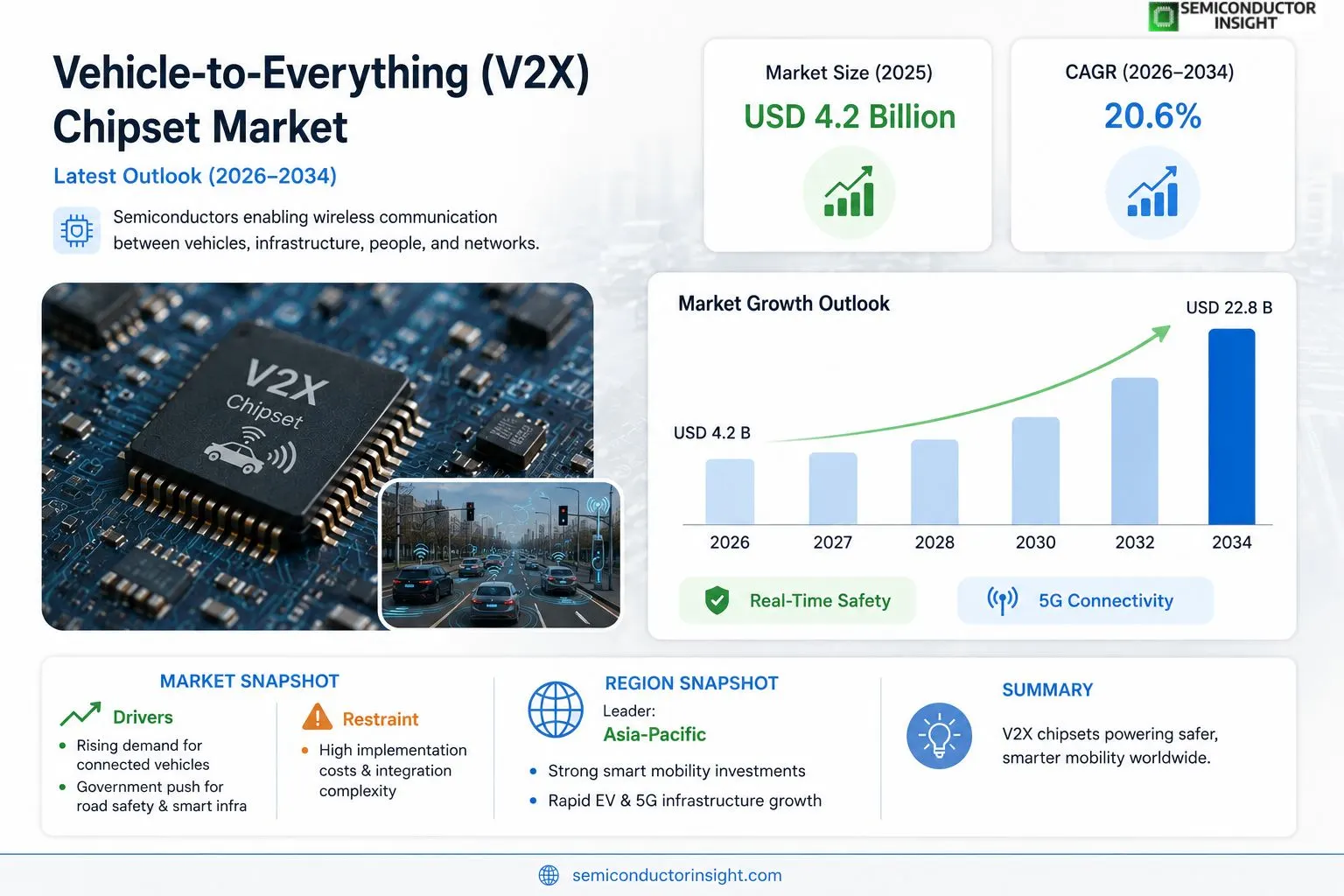
Global Vehicle-to-Everything (V2X) Chipset Market size was valued at USD 4.2 billion in 2025. The market is projected to grow from USD 4.2 billion in 2025 to USD 22.8 billion by 2034, exhibiting a CAGR of 20.6% during the forecast period.
Vehicle-to-Everything (V2X) chipsets are specialized semiconductors that enable wireless communication between vehicles and their surroundings, including other vehicles (V2V), infrastructure (V2I), pedestrians (V2P), and networks (V2N). These chipsets facilitate real-time data exchange critical for advanced driver assistance systems, collision avoidance, traffic management, and cooperative intelligent transportation systems. Key technologies supported include Dedicated Short-Range Communications (DSRC) and Cellular V2X (C-V2X), often integrating with GNSS for precise positioning and supporting both direct and network-based communication modes.
The market is experiencing rapid growth due to several factors, including rising demand for connected and autonomous vehicles, government initiatives promoting road safety and smart infrastructure, and advancements in 5G technology that deliver ultra-low latency communications. Furthermore, increasing urbanization and the need for efficient traffic management systems are accelerating adoption worldwide. Initiatives by key players continue to drive innovation and commercialization. For instance, Qualcomm Technologies completed the acquisition of Autotalks to strengthen its portfolio of production-ready V2X solutions supporting multiple global standards. Qualcomm, NXP Semiconductors, and Infineon Technologies are some of the key players that operate in the market with a wide range of portfolios.
MARKET DRIVERS
Rising Demand for Enhanced Road Safety and Connected Vehicles
Vehicle-to-Everything (V2X) Chipset Market is propelled by increasing global emphasis on reducing road accidents through real-time communication capabilities. V2X chipsets enable vehicles to exchange critical data with other vehicles, infrastructure, pedestrians, and networks, supporting advanced safety applications such as collision avoidance and cooperative perception. Integration with Advanced Driver Assistance Systems (ADAS) further amplifies demand as automakers embed these modules to improve sensor fusion accuracy.
Government Support and Regulatory Mandates
Governments worldwide are implementing policies and smart transportation initiatives to accelerate V2X adoption. Programs in the EU, US, and China promote C-V2X deployment for intelligent traffic management and Vision Zero safety targets. These regulatory frameworks create demand floors for chipset manufacturers, particularly as 5G NR-V2X standards mature and enable ultra-low latency communications. ➤ Growing integration of V2X chipsets in electric and autonomous vehicles, combined with 5G network expansion, is expected to drive significant market expansion in the coming years.
The shift toward cellular V2X (C-V2X) solutions, supported by leading semiconductor providers, positions the market for robust growth amid urbanization and connected car technology advancements.
MARKET CHALLENGES
Infrastructure Limitations and Deployment Costs
The widespread adoption of V2X chipsets faces hurdles due to insufficient supporting roadside infrastructure. V2X communication requires dense deployment of compatible units, which remains limited in many regions despite pilot programs. High costs associated with infrastructure rollout continue to slow large-scale implementation.
Other Challenges
Interoperability and Standardization Issues
Diverse protocols between DSRC and C-V2X technologies, along with varying regional standards, complicate seamless integration across vehicle platforms and ecosystems.
Cybersecurity Vulnerabilities
\Increased connectivity exposes V2X systems to potential cyber threats, raising concerns over data privacy, authenticity, and protection of safety-critical communications.
MARKET RESTRAINTS
High Implementation Costs and Supply Chain Complexities
Integration of V2X chipsets adds to the overall bill of materials for vehicles, including associated hardware, software, and testing requirements. This cost sensitivity particularly affects mass-market vehicle segments and aftermarket solutions, limiting broader penetration despite performance benefits. The ecosystem involves multiple stakeholders with varying platforms, creating integration challenges that can impact reliability and increase development timelines for chipset providers and automotive OEMs.
MARKET OPPORTUNITIES
Integration with Autonomous Driving and Smart Cities
Vehicle-to-Everything (V2X) Chipset Market presents substantial opportunities through deeper integration with autonomous vehicle systems and smart city infrastructure. As 5G networks expand, V2X chipsets will support advanced applications like cooperative platooning, dynamic traffic optimization, and vehicle-to-grid communication for electric fleets. Emerging markets in Asia-Pacific and beyond offer growth potential driven by urbanization, government investments in intelligent transportation, and rising automotive production. chipset providers can capitalize on hardware refresh cycles as regions transition to 5G NR-V2X technologies.
Vehicle-to-Everything (V2X) Chipset Market Trends
Advancements in Cellular V2X and 5G Integration
Vehicle-to-Everything (V2X) Chipset Market is witnessing significant momentum from the rapid evolution of Cellular V2X (C-V2X) technologies. These specialized semiconductors enable seamless wireless communication between vehicles and their surroundings, supporting vehicle-to-vehicle (V2V), vehicle-to-infrastructure (V2I), vehicle-to-pedestrian (V2P), and vehicle-to-network (V2N) interactions. By integrating with 5G networks, V2X chipsets deliver ultra-low latency communications essential for advanced driver assistance systems and cooperative intelligent transportation systems.Key industry participants are focusing on enhancing chipset capabilities with precise positioning through GNSS integration and support for both direct and network-based communication modes. This trend is particularly evident as manufacturers prioritize solutions that ensure reliable real-time data exchange for collision avoidance and traffic management applications.
Other Trends
Government Support for Smart Infrastructure Development
Government initiatives worldwide aimed at improving road safety and building smart transportation networks are accelerating the deployment of Vehicle-to-Everything (V2X) Chipset Market solutions. Urbanization pressures and the need for efficient traffic flow are prompting investments in infrastructure that communicates directly with equipped vehicles, fostering broader ecosystem adoption.
Strategic Industry Consolidations
Leading semiconductor companies are strengthening their positions through targeted acquisitions to expand V2X capabilities. For example, Qualcomm Technologies’ acquisition of Autotalks has enhanced its portfolio with production-ready solutions supporting multiple global standards, highlighting a broader industry movement toward comprehensive, standards-compliant offerings.
Shift Toward Connected and Autonomous Vehicle Ecosystems
The growing emphasis on connected and autonomous vehicles continues to shape demand patterns in Vehicle-to-Everything (V2X) Chipset Market. Chipsets from major players such as Qualcomm, NXP Semiconductors, and Infineon Technologies are increasingly designed to support sophisticated use cases that require robust, interoperable communication frameworks. This evolution supports safer and more efficient mobility solutions by enabling vehicles to interact intelligently with their environment.
As these technologies mature, the focus remains on delivering reliable performance across diverse operating conditions while maintaining compatibility with both DSRC and C-V2X protocols. Industry stakeholders are committed to driving innovation that addresses the complex requirements of next-generation transportation systems.
COMPETITIVE LANDSCAPE
Key Industry Players
Competitive Dynamics in Vehicle-to-Everything (V2X) Chipset Market
Vehicle-to-Everything (V2X) Chipset Market is led by Qualcomm Technologies, which has strengthened its dominant position through the acquisition of Autotalks, enhancing its portfolio of production-ready solutions supporting both DSRC and C-V2X standards. The competitive landscape features a concentrated structure among semiconductor specialists capable of delivering automotive-grade, low-latency communication chipsets integrated with GNSS positioning and 5G capabilities. High barriers to entry, stringent functional safety requirements (ASIL), and the need for extensive OEM validation favor established players with broad automotive ecosystems.
Other significant players include NXP Semiconductors, Infineon Technologies, and STMicroelectronics, which excel in integrated automotive networking solutions. Niche specialists and system integrators such as Cohda Wireless and Continental AG contribute through hardware-software combinations tailored for specific regional deployments, while Chinese vendors like Huawei expand in Asia-Pacific markets. Strategic partnerships with automakers and infrastructure providers continue to shape competition amid rapid technological evolution toward 5G NR-V2X.
List of Key V2X Chipset Companies Profiled
- Qualcomm Technologies
- NXP Semiconductors
- Infineon Technologies
- STMicroelectronics
- Autotalks Ltd.
- Continental AG
- Harman International
- Huawei Technologies
- Renesas Electronics Corporation
- Texas Instruments
- Bosch
- Denso Corporation
- Cohda Wireless
- Intel Corporation
- NVIDIA Corporation
Segment Analysis:
| Segment Category | Sub-Segments | Key Insights |
| By Type |
|
C-V2X Chipsets represent the dominant category due to their ability to leverage existing cellular infrastructure for broader coverage and lower latency communications. These chipsets excel in supporting seamless integration with 5G networks, enabling more sophisticated real-time data exchange. Key advantages include enhanced reliability in dense urban environments and superior scalability for future autonomous driving applications. They facilitate advanced features like cooperative perception where vehicles share sensor data beyond line-of-sight limitations. |
| By Application |
|
Collision Avoidance emerges as the leading application segment as V2X chipsets play a pivotal role in enhancing vehicle safety systems. They enable vehicles to communicate potential hazards instantly, supporting predictive analytics for proactive interventions. This application drives innovation in sensor fusion technologies and improves overall road safety ecosystems. Manufacturers prioritize these solutions to meet stringent safety regulations and consumer expectations for advanced driver assistance features. |
| By End User |
|
Automotive OEMs constitute the primary end user group, integrating V2X chipsets directly into next-generation vehicle platforms during manufacturing. This integration allows for optimized performance and seamless compatibility with onboard systems. OEMs benefit from early adoption advantages in competitive markets focused on connected mobility. Their involvement accelerates the development of comprehensive vehicle ecosystems that support both current and future intelligent transportation requirements. |
| By Communication Technology |
|
Network-Based Communication leads this segment by capitalizing on cellular network advancements for extended range and reliability. It supports complex data exchanges across larger geographical areas and integrates effectively with cloud computing resources. This technology enhances situational awareness through continuous connectivity and enables over-the-air updates for chipset functionality. Stakeholders value its flexibility in adapting to evolving infrastructure developments worldwide. |
| By Vehicle Type |
|
Passenger Vehicles stand out as the leading category within this segmentation. Chipsets in these vehicles focus on delivering user-centric safety and convenience features that appeal to individual consumers. The emphasis on comfort alongside protection drives continuous refinement of chipset capabilities for everyday driving scenarios. This segment fosters greater market penetration through widespread consumer adoption and serves as a foundation for broader V2X ecosystem expansion. |
Regional Analysis: Vehicle-to-Everything (V2X) Chipset Market
Asia-Pacific
Asia-Pacific hosts dynamic innovation clusters where leading semiconductor companies work alongside automotive giants to refine V2X chipset architectures. These ecosystems prioritize energy-efficient designs and multi-protocol support, enabling smoother integration with existing and emerging vehicle platforms while addressing unique regional infrastructure challenges.
Proactive government policies across key markets promote large-scale V2X deployment through dedicated funding and regulatory frameworks. This alignment accelerates chipset adoption in public transit, logistics fleets, and private vehicles, creating sustained momentum for Vehicle-to-Everything (V2X) Chipset Market throughout the forecast period.
Cross-industry alliances and joint ventures define business strategies in the region, enabling faster commercialization of advanced V2X chipsets. These models emphasize co-development with telecom operators and urban planners to ensure chipset solutions deliver tangible improvements in mobility and safety.
North America
North America maintains a strong position in Vehicle-to-Everything (V2X) Chipset Market through its focus on safety-centric innovation and premium vehicle segments. The region excels in developing chipsets with advanced security features and seamless compatibility with existing cellular and dedicated short-range communication standards. Major technology hubs drive research into AI-enhanced V2X solutions that prioritize cybersecurity and data privacy, addressing consumer concerns while supporting autonomous vehicle testing programs. Business strategies emphasize partnerships between chipset suppliers and established automakers to integrate V2X capabilities into both passenger and commercial fleets, fostering steady growth through technology differentiation rather than volume alone.
Europe
Europe demonstrates sophisticated demand for Vehicle-to-Everything (V2X) Chipset Market solutions shaped by stringent safety regulations and sustainability goals. The region leads in harmonized standards that facilitate cross-border interoperability of V2X systems, encouraging chipset manufacturers to focus on modular and upgradeable designs. Collaborative projects between countries promote the deployment of intelligent infrastructure that works in tandem with advanced chipsets, enhancing traffic management and reducing environmental impact. Business strategies in Europe often revolve around value-added services, where V2X chipsets serve as enablers for broader mobility-as-a-service platforms and connected ecosystem offerings.
South America
South America is gradually building momentum in Vehicle-to-Everything (V2X) Chipset Market with growing interest in urban mobility improvements and commercial vehicle connectivity. Select markets are exploring V2X applications for traffic congestion management and fleet optimization, creating opportunities for cost-effective chipset solutions tailored to regional infrastructure realities. While adoption remains emerging, strategic investments in pilot projects and international technology transfers are laying the foundation for future expansion. Local business strategies focus on adapting global V2X technologies to address specific challenges such as varied terrain and mixed traffic environments.
Middle East & Africa
The Middle East and Africa region shows promising potential in Vehicle-to-Everything (V2X) Chipset Market, particularly in smart city developments and logistics corridors. Ambitious infrastructure projects incorporate V2X capabilities to support safe and efficient transportation networks in rapidly urbanizing areas. Chipset providers are tailoring solutions to withstand harsh environmental conditions while delivering reliable performance. Business strategies center on government-led initiatives and partnerships that position V2X technology as a key pillar of economic diversification and modernization efforts across key markets.
Report Scope
This market research report provides a comprehensive analysis of the Vehicle-to-Everything (V2X) Chipset Market , covering the forecast period 2026–2034. It offers detailed insights into market dynamics, technological advancements, competitive landscape, and key trends shaping the industry.
Key focus areas of the report include:
- Market Overview: The report begins with an overview outlining its current market scenario, key growth indicators, and industry transformation drivers. It discusses macroeconomic factors, demand–supply balance, regulatory landscape, and the strategic role of semiconductors in powering advancements across industries such as automotive, telecommunications, consumer electronics, and industrial automation.
- Market Size & Forecast: Historical data and future projections for revenue, unit shipments, and market value across major regions and segments.
- Segmentation Analysis: Detailed breakdown by product type, technology, application, and end-user industry to identify high-growth segments and investment opportunities.
- Regional Insights: Insights into market performance across North America, Europe, Asia-Pacific, Latin America, and the Middle East & Africa, including country-level analysis where relevant.
- Competitive Landscape: Profiles of leading market participants, including their product offerings, R&D focus, manufacturing capacity, pricing strategies, and recent developments such as mergers, acquisitions, and partnerships.
- Technology Trends & Innovation: Assessment of emerging technologies, integration of AI/IoT, semiconductor design trends, fabrication techniques, and evolving industry standards.
- Market Drivers & Restraints: Evaluation of factors driving market growth along with challenges, supply chain constraints, regulatory issues, and market-entry barriers.
- Stakeholder Insights: Insights for component suppliers, OEMs, system integrators, investors, and policymakers regarding the evolving ecosystem and strategic opportunities.
Primary and secondary research methods are employed, including interviews with industry experts, data from verified sources, and real-time market intelligence to ensure the accuracy and reliability of the insights presented.
FREQUENTLY ASKED QUESTIONS:
What is the current market size of Vehicle-to-Everything (V2X) Chipset Market?
-> Vehicle-to-Everything (V2X) Chipset Market was valued at USD 4.2 billion in 2025 and is expected to reach USD 22.8 billion by 2034.
Which key companies operate in Vehicle-to-Everything (V2X) Chipset Market?
-> Key players include Qualcomm, NXP Semiconductors, and Infineon Technologies, among others.
What are the key growth drivers?
-> Key growth drivers include rising demand for connected and autonomous vehicles, government initiatives promoting road safety and smart infrastructure, and advancements in 5G technology.
Which region dominates the market?
-> Asia-Pacific is the fastest-growing region, while North America remains a dominant market.
What are the emerging trends?
-> Emerging trends include C-V2X and DSRC integration, 5G ultra-low latency communications, and strategic acquisitions for technology expansion.

Get Sample Report PDF for Exclusive Insights
Report Sample Includes
- Table of Contents
- List of Tables & Figures
- Charts, Research Methodology, and more...
 Download Sample Report PDF