Ultra-Fine Coaxial Cable Market Insights
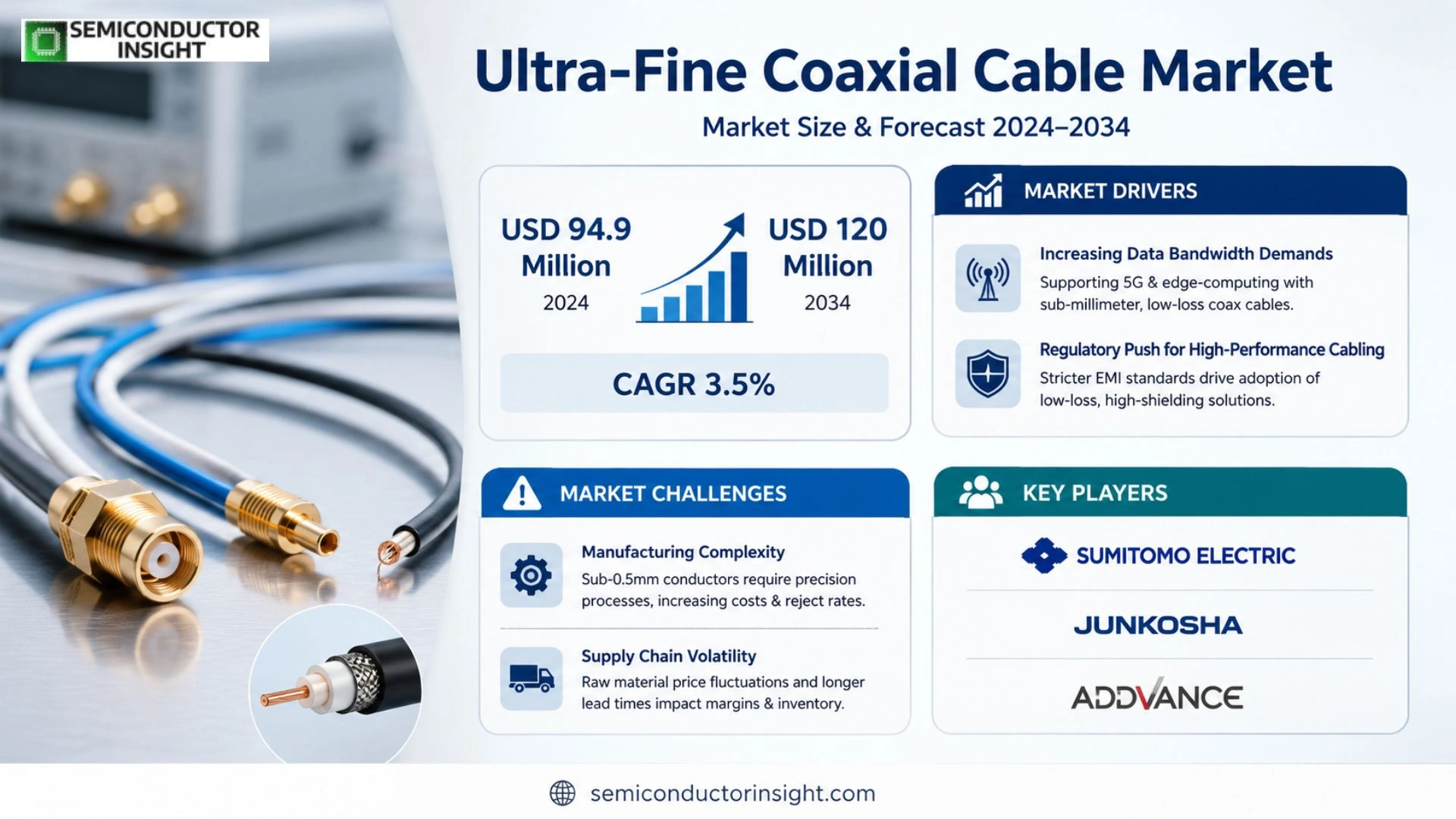
Global Ultra-Fine Coaxial Cable market was valued at USD 94.9 million in 2024 and forecasts show it will reach USD 120 million by 2034, implying a compound annual growth rate of roughly 3.5 % over the period.
“Ultra‑fine coaxial cable” refers to a communication wire whose outer diameter ranges between 0.20 mm and 0.35 mm. Its slim profile makes it indispensable for compact devices such as smartphones and laptops, while its construction supports high‑speed signal transmission and excellent bendability.
The upward trend stems from rising requirements for high‑frequency data links in consumer electronics and emerging communication standards. As 5G networks expand and the Internet of Things proliferates, designers favour cables that combine low loss with lightweight flexibility. Manufacturers,including Junkosha, Sumitomo Electric, Yoshinogawa Electric Wire & Cable, LTK Cable and Shenyu Communication,are expanding portfolios to meet tighter connector constraints and faster throughput needs.
MARKET DRIVERS
Increasing Data Bandwidth Demands
Enterprises are upgrading legacy infrastructure to support 5G and edge‑computing workloads that push frequencies beyond 6 GHz. Ultra‑Fine Coaxial Cable Market suppliers that can deliver sub‑millimeter outer diameters with loss figures under 0.15 dB/m are gaining traction because they enable dense antenna arrays without sacrificing signal integrity. The shift reflects a broader industry move from bulk copper lines toward compact transmission media that fit within constrained equipment bays.
Regulatory Push for High‑Performance Cabling
New electromagnetic‑emission standards in Europe and North America require tighter shielding and lower dielectric constants. Manufacturers that adopt low‑loss fluoropolymer jackets are better positioned to meet those thresholds, turning compliance into a competitive advantage. This regulatory pressure forces design houses to reassess bill‑of‑materials, often substituting traditional coax with ultra‑fine variants that deliver the necessary attenuation performance.
➤ “The drive toward miniaturized antennas is reshaping the cabling ecosystem, making ultra‑fine coax indispensable for next‑gen networks.”
For OEMs, the ripple effect is clear: design cycles shorten as component selection aligns with both performance and compliance goals. Companies that embed ultra‑fine coax early in the product roadmap can lock in supply contracts, reduce re‑engineering costs, and capture premium pricing for high‑efficiency devices.
MARKET CHALLENGES
Manufacturing Complexity
Producing conductors with diameters below 0.5 mm demands precision extrusion and annealing processes that increase capital outlay. Even minor variations in concentricity can cause impedance mismatch, leading to higher reject rates. Consequently, many midsize producers face margin compression while attempting to meet stringent quality specifications.
Other Challenges
Supply Chain Volatility
Fluctuations in copper and specialty polymer prices erode forecast accuracy. End‑users report lead times extending from six to twelve weeks during peak demand periods, prompting firms to hold larger safety stocks that inflate working capital.
MARKET RESTRAINTS
High Material Costs
The premium alloys and low‑dielectric‑constant polymers required for ultra‑fine constructions command prices 30 % higher than conventional coax. When project budgets are constrained, specifiers often revert to standard‑size cables, slowing overall market adoption.
In addition, the skilled labor needed for clean‑room assembly is scarce in many regions. Training programs have not kept pace with the accelerated adoption curve, creating a bottleneck that restricts volume scaling.
MARKET OPPORTUNITIES
Emerging Applications in Autonomous Vehicles
Advanced driver‑assistance systems rely on high‑frequency radar modules that operate in the 77 GHz band. Ultra‑fine coax provides the low‑loss pathways necessary to maintain signal fidelity within the confined chassis of electric vehicles, opening a sizable revenue stream for cable manufacturers that can certify automotive‑grade performance.
Wearable IoT devices and aerospace instrumentation are also embracing ultra‑fine coax to connect antenna arrays where weight and space are at a premium. The ability to achieve sub‑decibel loss over short runs translates into longer battery life and reduced payload, an advantage that designers are eager to exploit.
Geographically, the Asia‑Pacific region is experiencing a surge in high‑speed rail and smart‑city projects that mandate dense fiber‑to‑the‑antenna architectures. Companies that establish localized production hubs stand to benefit from lower logistics costs and faster response to regional specifications.
Ultra-Fine Coaxial Cable Market Trends
High‑Frequency Connectivity in 5G and IoT Devices
Manufacturers are seeing a noticeable shift toward integrating ultra‑fine coaxial cable within next‑generation connectivity modules. The cable’s sub‑0.35 mm diameter allows designers to route signal paths through densely packed printed‑circuit boards without sacrificing mechanical robustness. As 5G radios require tighter tolerance on phase noise and attenuation, the cable’s low‑loss characteristics become a decisive element in meeting performance specifications. Equally, IoT sensors benefit from the combination of high‑speed data throughput and bendability, enabling seamless embedding in wearables and smart‑home devices where space is at a premium. This confluence of technical requirements is reshaping product roadmaps, prompting component suppliers to prioritize ultra‑fine coaxial solutions in their development pipelines.
Other Trends
Material Optimization for Signal Fidelity
Two copper‑based alloys dominate the supply chain: silver‑plated alloy copper and tinned alloy copper. Silver‑plated strands deliver superior conductivity at microwave frequencies, reducing insertion loss in high‑bandwidth applications such as high‑definition video streams. Tinned alloy, while marginally less conductive, offers enhanced corrosion resistance, which is critical for automotive and industrial installations where exposure to moisture and chemicals is routine. Recent pilot programs indicate that blending a thin silver layer over a tinned core can achieve a balanced performance profile, delivering both low loss and durability. This hybrid approach is prompting a modest re‑allocation of production capacity as manufacturers hedge against supply volatility of pure silver.
Expansion into Automotive and Medical Sectors
Vehicle electrification and autonomous driving systems demand ultra‑reliable high‑frequency links for radar, lidar, and infotainment modules. The cable’s lightweight form factor assists automotive engineers in meeting stringent weight targets while preserving electromagnetic shielding. In parallel, medical imaging equipment, particularly compact MRI and portable ultrasonography devices, leverages the cable’s flexibility to accommodate ergonomic designs without compromising signal purity. Consequently, OEMs in both sectors are revisiting BOM structures to incorporate ultra‑fine coaxial cable as a standard interconnect, a move that is likely to generate incremental volumes and stimulate niche‑specific product variants.
COMPETITIVE LANDSCAPE
Key Industry Players
Ultra‑Fine Coaxial Cable Market: Competitive Overview
Sumitomo Electric remains the dominant force in the ultra‑fine coaxial cable arena, leveraging a vertically integrated supply chain that spans raw copper refinement to high‑frequency connector manufacturing. The firm’s ability to execute large‑scale production runs while preserving tight tolerances gives it a pricing advantage that smaller rivals find hard to match. Moreover, its extensive R&D budget has yielded proprietary silver‑plated alloy strands that enhance signal integrity at frequencies demanded by 5G handsets and emerging IoT modules. This combination of scale, technology depth, and global service network shapes the market’s pricing contours and sets the benchmark for performance, compelling downstream OEMs to align their component specifications with Sumitomo’s product roadmap.
Beyond the market leader, a cluster of specialized firms competes on niche strengths. Junkosha focuses on custom‑length runs for automotive infotainment systems, while Yoshinogawa Electric Wire & Cable capitalises on its strong foothold in Japanese consumer‑electronics manufacturers. LTK Cable and Shenyu Communication differentiate through rapid prototyping services that appeal to start‑ups developing wearables. Shanghai Power Special Cable and FengTai Electronic dominate the Chinese industrial segment by bundling cable solutions with localized after‑sales support. European players such as Nexans and Prysmian Group exploit their broad distribution channels across the EU, offering bundled cable‑system packages for medical imaging equipment. Murata Manufacturing and TDK add value via integration of ultra‑fine conductors with miniature passive components, targeting high‑density mobile devices. Collectively, these companies create a fragmented yet strategically layered ecosystem where regional expertise, application‑specific engineering, and flexible logistics determine market share.
List of Key Ultra‑Fine Coaxial Cable Companies Profiled
- Sumitomo Electric
- Sumitomo Electric
- Junkosha
- Yoshinogawa Electric Wire & Cable
- LTK Cable
- Shenyu Communication
- Shanghai Power Special Cable
- FengTai Electronic
- Nexans
- Prysmian Group
- Murata Manufacturing
- TDK Corporation
- Hitachi Cable
- Corning Inc.
Segment Analysis:
| Segment Category | Sub-Segments | Key Insights |
| By Type |
|
Silver-plated Alloy Copper Stranded Wire
|
| By Application |
|
Consumer Electronics Products
|
| By End User |
|
Mobile Devices
|
| By Connectivity Requirement |
|
High‑Frequency Transmission
|
| By Design Feature |
|
Ultra‑High Flexibility
|
Regional Analysis: Ultra-Fine Coaxial Cable Market
Asia-Pacific
Governments across the region are channeling capital into fiber‑backbone extensions, yet the final “last‑mile” often relies on coaxial pathways. Ultra‑fine designs bridge this gap by offering higher frequency tolerance while fitting within existing ductwork, allowing operators to leverage legacy infrastructure without costly overhauls.
National standards bodies are revising electromagnetic compatibility rules, creating a window for cables that meet tighter emission thresholds. Manufacturers that certify compliance early gain a competitive edge as carriers scramble to align network upgrades with new mandates.
The rise of edge computing nodes and AI‑enhanced surveillance systems is driving demand for cables that sustain high‑speed links in compact cabinets. Ultra‑fine coaxial cable’s low attenuation profile makes it a natural fit for these latency‑sensitive deployments.
Localized production hubs in Taiwan and Vietnam are shortening delivery cycles. However, raw‑material bottlenecks for specialty alloys remain a concern, prompting firms to diversify sourcing strategies and explore recycled metal blends.
North America
In North America, the Ultra-Fine Coaxial Cable Market benefits from mature broadband infrastructures that are now reaching saturation points. Service providers are turning to ultra‑fine coaxial solutions to retrofit aging plant rooms where space is limited, enabling higher data rates without re‑digging. The competitive landscape is defined by a handful of large OEMs that invest heavily in R&D to improve dielectric performance, a move that aligns with the continent’s focus on energy efficiency and reduced carbon footprints. Customer demand is increasingly driven by corporate campuses that require seamless connectivity across sprawling office complexes, prompting vendors to tailor cable bundles that integrate with existing building management systems. The region’s emphasis on reliability also means that warranty and after‑sales support carry significant weight in purchasing decisions.
Europe
European markets exhibit a cautious but steady adoption of ultra‑fine coaxial cable, largely because regulatory bodies enforce strict safety and fire‑rating standards. Utilities and telecom operators in countries such as Germany and the United Kingdom are piloting the technology in dense urban districts where conduit capacity is exhausted. The prevailing narrative among European buyers is the need to balance performance gains against long‑term sustainability goals, prompting a surge in interest for cables manufactured from recyclable copper alloys. Procurement cycles are typically longer, with multi‑year framework agreements that favor suppliers demonstrating consistent quality control and transparent supply‑chain provenance. This environment encourages manufacturers to offer modular product lines that can be scaled across diverse projects, from smart‑grid installations to high‑frequency broadcasting.
South America
South America presents a patchwork of opportunities for the Ultra-Fine Coaxial Cable Market, where urban centers like São Paulo and Buenos Aires are undergoing rapid digital transformation. While macro‑economic volatility can temper capital spending, telecom operators view ultra‑fine coaxial cable as a cost‑effective bridge to meet growing consumer bandwidth expectations without extensive civil works. Local installers appreciate the cable’s reduced weight and flexibility, which simplify deployment in cramped utility tunnels common in older cities. Partnerships between multinational manufacturers and regional distributors are emerging as a pragmatic way to navigate import tariffs and provide localized technical training, thereby accelerating market penetration.
Middle East & Africa
In the Middle East & Africa, ultra‑fine coaxial cable adoption is accelerating where oil‑backed economies are diversifying into digital services and smart‑city initiatives. UAE and Saudi Arabia, in particular, are integrating the cable into high‑rise residential projects that demand slim conduit profiles yet require robust signal fidelity for IPTV and IoT platforms. African markets, though still in early stages, see the technology as a bridge to leapfrog legacy copper solutions in nascent fiber expansions. The prevailing challenge lies in establishing reliable after‑sales networks; consequently, vendors that bundle training and remote diagnostics with their products are gaining preference among regional system integrators.
Report Scope
This market research report provides a comprehensive analysis of the Ultra-Fine Coaxial Cable Market , covering the forecast period 2026–2034. It offers detailed insights into market dynamics, technological advancements, competitive landscape, and key trends shaping the industry.
Key focus areas of the report include:
- Market Overview: The report begins with an overview outlining its current market scenario, key growth indicators, and industry transformation drivers. It discusses macroeconomic factors, demand–supply balance, regulatory landscape, and the strategic role of semiconductors in powering advancements across industries such as automotive, telecommunications, consumer electronics, and industrial automation.
- Market Size & Forecast: Historical data and future projections for revenue, unit shipments, and market value across major regions and segments.
- Segmentation Analysis: Detailed breakdown by product type, technology, application, and end-user industry to identify high-growth segments and investment opportunities.
- Regional Insights: Insights into market performance across North America, Europe, Asia-Pacific, Latin America, and the Middle East & Africa, including country-level analysis where relevant.
- Competitive Landscape: Profiles of leading market participants, including their product offerings, R&D focus, manufacturing capacity, pricing strategies, and recent developments such as mergers, acquisitions, and partnerships.
- Technology Trends & Innovation: Assessment of emerging technologies, integration of AI/IoT, semiconductor design trends, fabrication techniques, and evolving industry standards.
- Market Drivers & Restraints: Evaluation of factors driving market growth along with challenges, supply chain constraints, regulatory issues, and market-entry barriers.
- Stakeholder Insights: Insights for component suppliers, OEMs, system integrators, investors, and policymakers regarding the evolving ecosystem and strategic opportunities.
Primary and secondary research methods are employed, including interviews with industry experts, data from verified sources, and real-time market intelligence to ensure the accuracy and reliability of the insights presented.
FREQUENTLY ASKED QUESTIONS:
What is the current market size of Ultra-Fine Coaxial Cable Market?
-> Global Ultra-Fine Coaxial Cable market will reach USD 120 million by 2034, implying a compound annual growth rate of roughly 3.5 % over the period.
Which key companies operate in Ultra-Fine Coaxial Cable Market?
-> Key players include Junkosha, Sumitomo Electric, Yoshinogawa Electric Wire & Cable, LTK Cable, Shenyu Communication, Shanghai power special cable, FengTai Electronic, among others.
What are the key growth drivers?
-> Key growth drivers include high‑speed data transmission demand, 5G rollout, IoT expansion, and flexible space‑saving wiring requirements.
Which region dominates the market?
-> Asia-Pacific is the fastest-growing region, while Europe remains a dominant market.
What are the emerging trends?
-> Emerging trends include high‑frequency/high‑speed connectivity, miniaturization, and integration with 5G and IoT devices.
Get Sample Report PDF for Exclusive Insights
Report Sample Includes
- Table of Contents
- List of Tables & Figures
- Charts, Research Methodology, and more...
 Download Sample Report PDF