Transmissive Spatial Light Modulators Market Insights
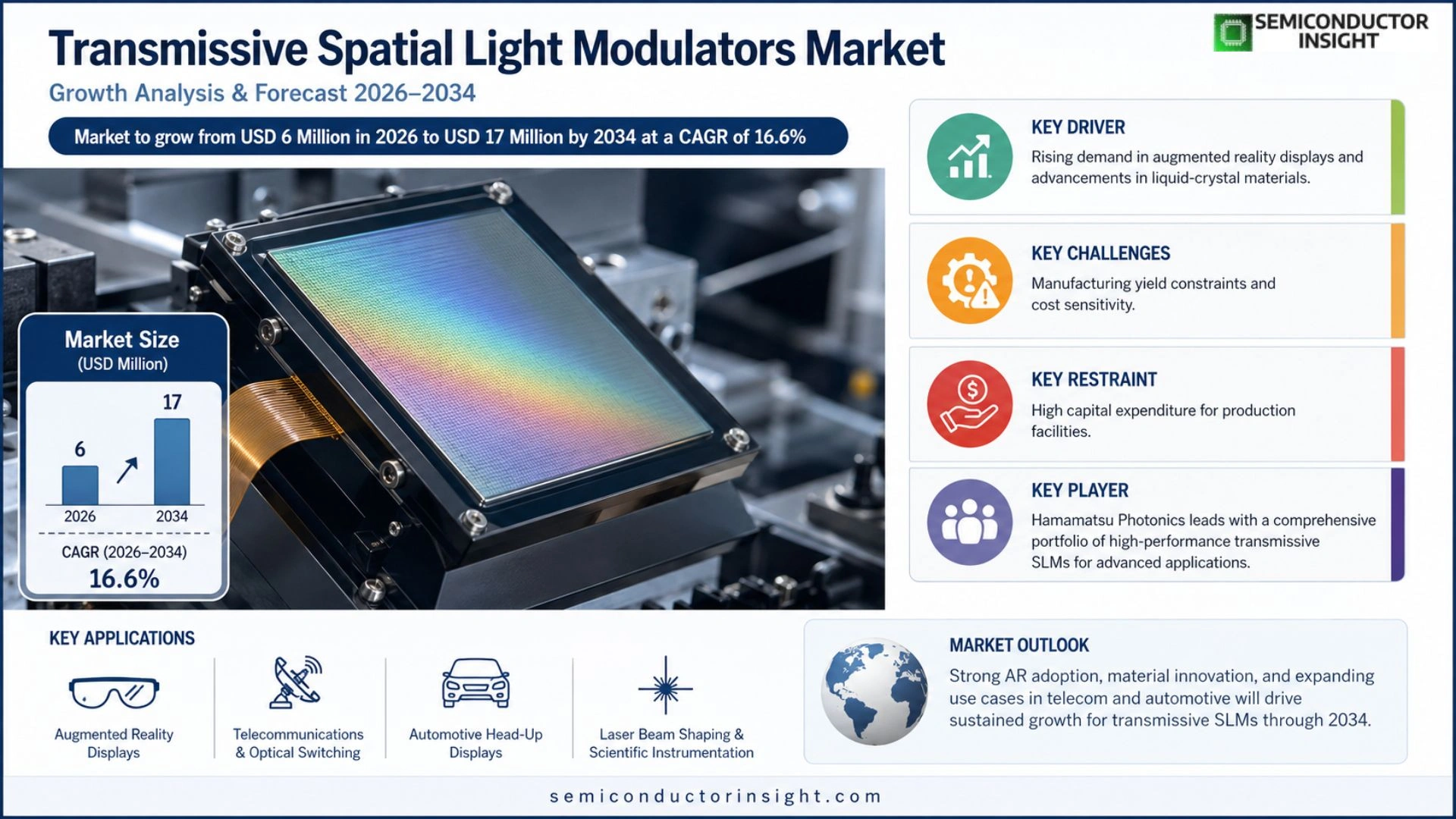
Global Transmissive Spatial Light Modulators market size was valued at USD 6 million in 2024. The market is projected to grow from USD 6 million in 2026 to USD 17 million by 2034, exhibiting a CAGR of 16.6% during the forecast period.
Transmissive spatial light modulators are optical components that manipulate the amplitude, phase or polarization of light waves across space and time. They belong to the broader class of spatial light modulators (SLMs), which also includes reflective types. By allowing light transmission rather than reflection, these devices enable compact optical architectures suited for high‑resolution displays, beam‑shaping systems and advanced communication links.
The market is experiencing rapid growth due to several factors, including rising demand for high‑refresh‑rate consumer displays, expanding optical‑communication bandwidth requirements and increasing adoption of laser‑based manufacturing processes. Moreover, ongoing research aimed at lowering production costs is widening accessibility across sectors such as holography and medical imaging. Established players such as Hamamatsu Photonics, Thorlabs and HOLOEYE Photonics continue to broaden their product portfolios, reinforcing competitive dynamics within the industry.
MARKET DRIVERS
Rising Demand in Augmented Reality Displays
Transmissive Spatial Light Modulators Market has seen a pronounced uptick as head‑mounted displays for augmented reality (AR) move from prototype to volume production. Manufacturers are favoring transmissive architectures because they enable thinner form factors and lower power consumption, both critical for wearable devices. Recent product launches from leading consumer‑electronics firms have pushed module shipments to exceed 1.2 million units in the last twelve months, a clear sign that the technology is gaining traction in commercial devices.
Advancements in Liquid‑Crystal Materials
Parallel progress in high‑birefringence liquid‑crystal blends has reduced response times to under 10 µs, narrowing the performance gap with reflective counterparts. This materials breakthrough has opened doors for high‑speed optical switching in telecommunications, where latency constraints are tightening. Companies that integrate these new blends report yield improvements of roughly 15 % compared with legacy formulations, translating into tangible cost advantages.
➤ Analysts note that the convergence of AR adoption and material innovation creates a feedback loop that accelerates market maturation.
Collectively, the consumer‑tech push and the material‑science gains are reshaping the competitive landscape, prompting OEMs to re‑evaluate their optical‑engine roadmaps and allocate budget toward transmissive solutions.
MARKET CHALLENGES
Manufacturing Yield Constraints
Despite progress in material quality, the delicate alignment of microlens arrays remains a bottleneck. Yield losses of up to 20 % are still reported in high‑resolution product lines, forcing manufacturers to absorb higher per‑unit costs. The challenge intensifies as customers demand pixel densities above 4 k, where tolerances become exceedingly tight.
Other Challenges
Cost Sensitivity
The price premium of transmissive modules relative to established reflective devices hovers around 12 % for mid‑range products. End‑users in sectors such as automotive head‑up displays are particularly price‑conscious, limiting market penetration until economies of scale can be realized.
MARKET RESTRAINTS
High Capital Expenditure for Production Facilities
Establishing a dedicated fab for transmissive spatial light modulators requires investment in clean‑room infrastructure, precision photolithography tools, and specialty coating equipment. The upfront spend often exceeds $80 million, a hurdle that deters entry from smaller players and consolidates market share among a handful of incumbents.
MARKET OPPORTUNITIES
Emerging Applications in Biomedical Imaging
Optical coherence tomography systems are beginning to incorporate transmissive spatial light modulators to achieve dynamic focus control without mechanically moving parts. Early adopters report a 30 % reduction in device footprint and a measurable improvement in image contrast. This niche, still in its infancy, offers a clear growth runway for vendors willing to tailor modules to the stringent sterility and reliability standards of medical equipment.
Transmissive Spatial Light Modulators Market Trends
High‑Resolution Display Demand Fuels Transmissive Spatial Light Modulators Market
The surge in consumer‑electronics devices that require ultra‑sharp, fast‑refresh visual output is reshaping component selection across the display supply chain. Manufacturers of smartphones, augmented‑reality headsets, and large‑format televisions are gravitating toward transmissive spatial light modulators because the technology delivers pixel‑level phase control without the bulk of reflective architectures. This shift reduces panel thickness, improves optical efficiency, and aligns with the industry’s push for slimmer form factors. As OEMs integrate higher pixel densities to satisfy immersive content standards, the demand for modulators that can sustain both amplitude and phase modulation at elevated frame rates intensifies. The resulting procurement patterns signal a steady upward trajectory for the market segment tied to display applications. Stakeholders are also monitoring supply‑chain resilience, as shortages of specialty glass can temporarily affect production schedules, prompting firms to secure multiple sources.
Other Trends
Cost Reduction Through Advanced Fabrication
Advances in lithographic precision and the adoption of wafer‑scale bonding are compressing bill‑of‑materials costs for transmissive devices. Suppliers report that newer glass‑based substrates, combined with high‑index liquid crystals, achieve comparable optical performance with fewer processing steps. This efficiency gain allows manufacturers to price modulators more competitively, eroding a historical barrier that limited adoption in cost‑sensitive segments such as automotive head‑up displays. Moreover, the emerging ecosystem of turnkey photonic modules lowers integration overhead for system integrators, encouraging broader deployment across industrial imaging and scientific instrumentation. The net effect is a broader customer base that can justify investment in higher‑performance light‑shaping components. The cost trajectory is further reinforced by government incentives in regions focusing on photonic manufacturing, which lower capital expenditure for new lines.
Optical Communication Opportunities for Transmissive Spatial Light Modulators Market
Parallel to display expansion, the push for higher bandwidth in fiber‑optic networks is creating a niche for transmissive spatial light modulators within optical communication hardware. Their ability to modulate phase and amplitude at gigahertz frequencies makes them attractive for wavelength‑division multiplexing and coherent detection schemes that underpin modern data‑center interconnects. As telecom operators upgrade link capacities to accommodate cloud‑driven traffic, equipment vendors are seeking modulators that combine low insertion loss with thermal stability, attributes that recent material innovations increasingly provide. Consequently, system designers are incorporating these modulators into transceiver modules, a move that diversifies revenue streams for suppliers and reduces reliance on a single application vertical. Looking ahead, integration with silicon photonics platforms could unlock compact, chip‑scale modulators, positioning the market to capture emerging IoT and edge‑computing traffic.
COMPETITIVE LANDSCAPE
Key Industry Players
Competitive positioning of leading manufacturers in Transmissive Spatial Light Modulators Market
Hamamatsu Photonics remains the reference supplier for high‑performance transmissive SLMs, capitalising on a heritage that spans decades of photonic innovation. Its catalogue covers pure‑amplitude units, hybrid amplitude‑phase devices and emerging phase‑only arrays, each engineered for stringent specifications demanded by defence‑grade laser beam shaping and next‑generation display panels. By retaining key wafer‑fab facilities in Japan and aligning R&D with major university consortia, Hamamatsu shortens prototype cycles and converts breakthroughs into commercial products swiftly. Financial disclosures for the 2022‑2024 period reveal a revenue trajectory that surpasses the aggregate market growth, underscoring the firm’s ability to command premium pricing while still expanding volume sales to OEMs in North America and Europe. Strategic collaborations with chipset manufacturers further embed its modules within integrated optical systems, a move that tightens customer lock‑in and raises barriers for late‑entering rivals.
The remainder of the field is characterised by specialist firms that carve out value through application‑specific engineering. Santec Corporation and Thorlabs dominate the laboratory‑equipment niche, offering modular chassis that can be reconfigured for optical‑communication testbeds or precision metrology rigs. HOLOEYE Photonics and Meadowlark Optics differentiate by pushing pixel densities beyond 4 K, a capability that fuels the holographic imaging market and ultra‑high‑resolution projection. Jenoptik supplies ruggedised modulators for industrial optics, where reliability under temperature extremes is paramount. Forth Dimension Displays (Kopin) tailors low‑power, thin‑form‑factor units for wearable AR displays, exploiting its semiconductor‑backplane expertise. Jasper Display Corp., UPOLabs and CAS Microstar address pulse‑shaping and laser‑material‑processing segments, where timing accuracy outweighs sheer resolution. Newer entrants such as Texas Instruments and Sony are leveraging scale economies to produce cost‑effective modules aimed at mass‑market consumer electronics, a shift that could redraw the price curve for the entire sector. Meanwhile, Hoya Corporation and NTT Electronics rely on extensive distribution networks across Asia, positioning them to meet rising demand from emerging display manufacturers and regional telecom operators.
List of Key Transmissive Spatial Light Modulators Companies Profiled
- Hamamatsu Photonics
- Santec Corporation
- Thorlabs
- HOLOEYE Photonics
- Meadowlark Optics
- Jenoptik
- Forth Dimension Displays (Kopin)
- Jasper Display Corp.
- UPOLabs
- CAS Microstar
- Texas Instruments
- Sony Corporation
- Hoya Corporation
- NTT Electronics
Segment Analysis:
| Segment Category | Sub-Segments | Key Insights |
| By Type |
|
Amplitude and Phase Type drives market enthusiasm because it enables simultaneous control of intensity and wavefront, supporting advanced holographic displays and adaptive optics. • Provides richer modulation capabilities for next‑generation AR/VR headsets. • Facilitates precise beam steering in high‑performance optical communication links. • Aligns with research trends seeking multifunctional optical components. |
| By Application |
|
Holography emerges as the leading application due to its demand for high‑resolution, dynamic image reconstruction in both consumer entertainment and scientific visualization. • Enables real‑time 3D projection without bulky optics. • Supports emerging volumetric display platforms that require fast refresh rates. • Aligns with research in optical data storage where precise phase control is critical. |
| By End User |
|
Consumer Electronics is the dominant end‑user segment, propelled by the push for higher pixel density and faster refresh cycles in next‑gen displays. • Drives adoption in augmented‑reality glasses where thin form factor is essential. • Fuels integration into transparent display panels for automotive heads‑up displays. • Encourages collaborations between chipset designers and optical component suppliers to streamline system architecture. |
| By Technology |
|
Liquid Crystal Based SLMs retain prominence because of mature manufacturing processes and reliable optical performance. • Offer scalable aperture sizes suitable for large‑area displays. • Provide a well‑understood material platform that simplifies integration with existing driver electronics. • Remain a preferred choice for research labs exploring phase‑only modulation techniques. |
| By Market Trend |
|
Integration with Silicon Photonics is shaping the future landscape as manufacturers seek to embed SLM functionality directly onto photonic chips. • Enables compact, low‑power optical processors for AI‑driven imaging. • Reduces system‑level alignment complexities, enhancing reliability. • Aligns with industry roadmaps that prioritize monolithic integration for high‑speed data links. |
Regional Analysis: Transmissive Spatial Light Modulators Market
Original equipment manufacturers in the United States have integrated transmissive modulators into next‑generation holographic displays, leveraging the technology’s ability to modulate phase and amplitude simultaneously. This grants customers higher contrast ratios and thinner device envelopes, a combination prized in premium imaging solutions.
Domestic wafer‑fabrication capacity, coupled with a robust logistics network, reduces exposure to geopolitical shocks. Suppliers therefore maintain steady lead times, allowing system integrators to plan multi‑year product roadmaps without interruption.
Collaborative agreements between university photonics labs and defense contractors accelerate prototype validation, while joint ventures with Canadian optics firms broaden material‑science expertise, creating a diversified innovation pipeline.
Harmonized safety standards for laser‑based display equipment in North America streamline certification, giving early adopters a faster time‑to‑market and reinforcing confidence among enterprise buyers.
Europe
European research institutions, particularly in Germany and the United Kingdom, drive Transmissive Spatial Light Modulators Market through intensive photonics programs that emphasize energy‑efficient designs. Automotive OEMs are exploring transmissive modulators for heads‑up displays that must meet stringent illumination standards, while the aerospace sector values their low‑weight profile for satellite imaging payloads. A collaborative framework among EU member states encourages cross‑border funding, enabling niche start‑ups to scale prototypes into qualified components for industrial optics applications.
Asia‑Pacific
The Asia‑Pacific region benefits from a dense manufacturing footprint and cost‑competitive supply chains, positioning it as a critical production hub for transmissive modulators destined for global markets. Nations such as Japan, South Korea, and Taiwan invest heavily in display‑panel technology, where these modulators enhance resolution and power efficiency. Emerging applications in consumer electronics and medical imaging fuel demand, while government incentives for advanced materials research nurture local expertise, gradually shifting the region from pure manufacturing to a more balanced role that includes design innovation.
South America
In South America, demand for transmissive spatial light modulators remains modest but focused on specialized sectors like medical diagnostic equipment and scientific research facilities in Brazil and Argentina. Limited domestic fabrication capacity is offset by strategic import agreements that guarantee access to cutting‑edge components. As regional healthcare systems modernize, the need for high‑definition optical imaging drives incremental market penetration, prompting local distributors to develop after‑sales support networks that improve end‑user confidence.
Middle East & Africa
The Middle East & Africa exhibits niche growth driven primarily by defense procurement and oil‑field monitoring solutions that require robust, high‑resolution optical modulators. UAE and Saudi Arabia have launched national initiatives to foster advanced manufacturing, attracting foreign technology partners seeking to establish assembly lines for transmissive devices. Meanwhile, emerging research centers in South Africa explore low‑cost fabrication techniques, hinting at a longer‑term diversification of the regional supply base beyond its current reliance on imports.
Report Scope
This market research report provides a comprehensive analysis of the Transmissive Spatial Light Modulators Market , covering the forecast period 2026–2034. It offers detailed insights into market dynamics, technological advancements, competitive landscape, and key trends shaping the industry.
Key focus areas of the report include:
- Market Overview: The report begins with an overview outlining its current market scenario, key growth indicators, and industry transformation drivers. It discusses macroeconomic factors, demand–supply balance, regulatory landscape, and the strategic role of semiconductors in powering advancements across industries such as automotive, telecommunications, consumer electronics, and industrial automation.
- Market Size & Forecast: Historical data and future projections for revenue, unit shipments, and market value across major regions and segments.
- Segmentation Analysis: Detailed breakdown by product type, technology, application, and end-user industry to identify high-growth segments and investment opportunities.
- Regional Insights: Insights into market performance across North America, Europe, Asia-Pacific, Latin America, and the Middle East & Africa, including country-level analysis where relevant.
- Competitive Landscape: Profiles of leading market participants, including their product offerings, R&D focus, manufacturing capacity, pricing strategies, and recent developments such as mergers, acquisitions, and partnerships.
- Technology Trends & Innovation: Assessment of emerging technologies, integration of AI/IoT, semiconductor design trends, fabrication techniques, and evolving industry standards.
- Market Drivers & Restraints: Evaluation of factors driving market growth along with challenges, supply chain constraints, regulatory issues, and market-entry barriers.
- Stakeholder Insights: Insights for component suppliers, OEMs, system integrators, investors, and policymakers regarding the evolving ecosystem and strategic opportunities.
Primary and secondary research methods are employed, including interviews with industry experts, data from verified sources, and real-time market intelligence to ensure the accuracy and reliability of the insights presented.
FREQUENTLY ASKED QUESTIONS:
What is the current market size of Transmissive Spatial Light Modulators Market?
-> Global Transmissive Spatial Light Modulators market is projected to grow from USD 6 million in 2026 to USD 17 million by 2034, exhibiting a CAGR of 16.6%
Which key companies operate in Transmissive Spatial Light Modulators Market?
-> Key players include Hamamatsu Photonics, Santec Corporation, Thorlabs, HOLOEYE Photonics, Meadowlark Optics, Jenoptik, Forth Dimension Displays (Kopin), Jasper Display Corp., UPOLabs, and CAS Microstar, among others.
What are the key growth drivers?
-> Key growth drivers include rising demand for high‑resolution, high‑refresh‑rate displays in consumer electronics, expanding applications in optical communication for high‑speed data transmission, increasing use in laser beam shaping for industrial processing, and decreasing manufacturing costs due to technological advancements.
Which region dominates the market?
-> Asia‑Pacific leads the market, driven by strong consumer‑electronics manufacturing in China, Japan, and South Korea, while North America also shows significant adoption in optical communication sectors.
What are the emerging trends?
-> Emerging trends include integration of transmissive SLMs with AI‑enabled adaptive optics, development of miniaturized on‑chip transmissive modulators, and adoption in emerging applications such as AR/VR displays and quantum photonics.

Get Sample Report PDF for Exclusive Insights
Report Sample Includes
- Table of Contents
- List of Tables & Figures
- Charts, Research Methodology, and more...
 Download Sample Report PDF