Key Statistics
Key Takeaways
- Smartphones remain the largest application pool because TDDI originated as a way to combine touch sensing and display driving in thin, high-volume mobile panels. The opportunity is increasingly differentiated by OLED, premium-device designs and integration depth rather than by unit growth alone.
- Automotive is the fastest-growing strategic application. Himax said in May 2026 that Q2 automotive driver IC sales, including TDDI and traditional DDIC, were expected to increase double digit sequentially, while Synaptics offers single-die automotive TDDI for displays up to 17 inches with AEC-Q100 Grade 2 support.
- Asia Pacific is the largest market because display-panel manufacturing, fabless IC design, mature-node foundry capacity and smartphone production are concentrated across Taiwan, China, South Korea, Japan and increasingly India. India reported mobile-phone production of roughly ₹5.45 lakh crore in FY2024-25 and more than 300 operational manufacturing units.
- Foundry and packaging capacity at mature process nodes is a material restraint. Himax said in Q2 2026 that AI-related memory demand was contributing to tight capacity across foundry, packaging and testing in mature nodes, putting upward pressure on cost structures.
- Integration is extending beyond conventional smartphone LCDs. Automotive TDDI, OLED touch, ultra-large touch-display integration and multi-display cockpit architectures raise content value, qualification requirements and design-in duration, creating higher-value niches even when consumer electronics demand is cyclical.
Touch and Display Driver Integration (TDDI) IC Market Overview
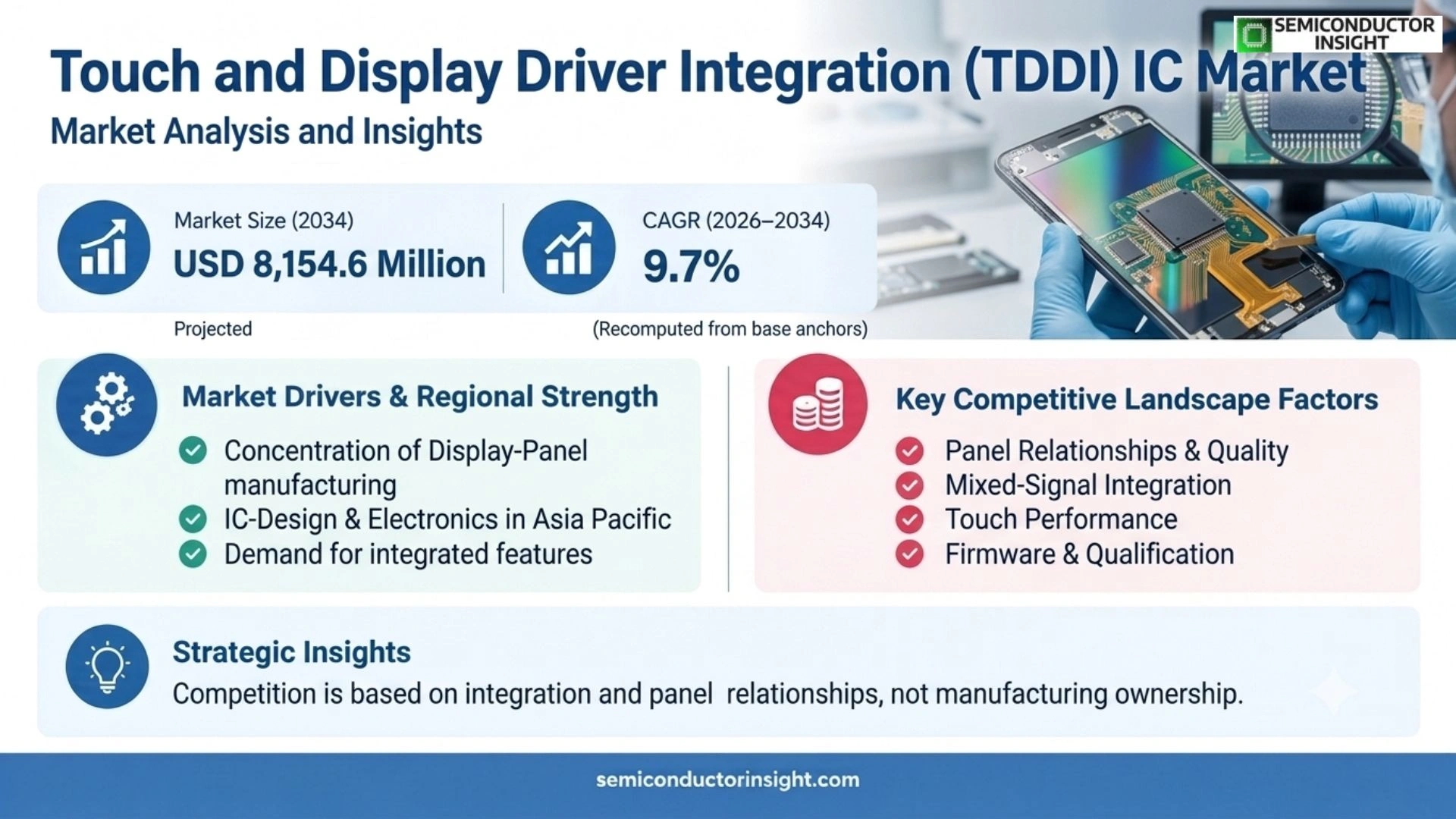
Touch and Display Driver Integration TDDI IC Market is estimated at USD 3,553.3 million in 2025 and USD 3,896.9 million in 2026. Recomputing the series from the source page’s published anchors of USD 3.24 billion in 2024 and USD 6.78 billion in 2032 produces a 9.7% CAGR for 2026–2034 and a projected USD 8,154.6 million by 2034. Asia Pacific is the largest regional market, supported by display-panel, IC-design and electronics-manufacturing concentration.
TDDI integrates the touch-controller and display-driver functions that were historically implemented as separate integrated circuits. In mobile and increasingly automotive displays, that integration can reduce component count, simplify routing, lower stack height and improve synchronization between display refresh and touch sensing. Synaptics describes its TouchView architecture as a single integrated solution for thinner, brighter displays and simpler manufacturing, while automotive versions combine the two functions on one die.
The market spans several display technologies and application environments. Smartphone and tablet devices prioritize thinness, power, cost and high-volume manufacturing. Automotive systems add much longer design cycles, wide operating conditions, electromagnetic compatibility, functional-safety expectations and rigorous qualification. Smart-home products sit between those extremes, using integrated touch displays where lower bill of materials and simpler module assembly can outweigh the need for very high display performance.
The supplier ecosystem is mainly fabless. IC designers develop mixed-signal display-driving and capacitive-touch architectures and then depend on external foundries, assembly and test partners. Himax explicitly identifies itself as a fabless display-driver supplier and has highlighted mature-node foundry, packaging and testing tightness in 2026. That makes wafer capacity, high-voltage CMOS process availability, package yield and panel qualification as commercially important as front-end chip design.
Segment Analysis: By Type
The source scope segments TDDI ICs by dot-matrix configuration into 128 × 64 dots and 128 × 32 dots. These configurations represent the report’s controlling type taxonomy; commercial selection depends on display resolution, touch-channel requirements, interface architecture, power budget and target device rather than on matrix size alone. In practice, IC vendors also differentiate through sensing noise performance, firmware, panel tuning, display timing, package configuration and qualification support.
| Type | Market position and demand characteristics |
|---|---|
| Dot Matrix: 128 × 64 Dots | The denser matrix supports applications requiring finer addressing, more touch or display control granularity and a larger active interface. Its commercial position is strongest where user-interface quality justifies additional silicon area, routing and verification. In practical design decisions, the matrix configuration is considered together with panel resolution, touch-electrode architecture, refresh timing, noise environment and the degree to which functions can be consolidated in one integrated controller. |
| Dot Matrix: 128 × 32 Dots | The lower matrix count fits cost-sensitive or less complex interfaces where integration benefits are desired without the full channel density of higher configurations. Buyers balance die cost and board simplification against panel requirements. This type can remain relevant in smart-home, control-panel and selected automotive secondary-display applications, but high-resolution smartphones and advanced cockpits increasingly place greater emphasis on broader display-driver capability, touch accuracy and system-level safety features. |
Technology and display-type context
The source page also classifies the market by capacitive, resistive and in-cell TDDI and by LCD, OLED and AMOLED display type. In-cell capacitive integration is the core commercial direction for thin, responsive consumer and automotive products because touch electrodes and display operation can be coordinated closely. OLED changes the driver architecture and power-management requirements, while automotive OLED adds qualification and temperature demands that can increase design complexity and supplier differentiation.
Segment Analysis: By Application
By application, the controlling scope is Smart Phone, Tablet, Automobile, and Smart Home. Smartphones represent the largest high-volume installed application, while automotive provides the strongest structural growth opportunity because vehicle cockpits are adding larger, higher-resolution and more numerous interactive displays with long program lives and stricter reliability requirements. Tablets and smart-home products provide additional demand pools where integration can reduce component count and simplify module assembly.
| Application | Demand characteristics |
|---|---|
| Smart Phone | Smartphones combine very high unit volumes with continuous pressure for thinner modules, narrow borders, improved touch latency and lower power. TDDI reduces discrete components and can simplify panel-module assembly. The market is increasingly segmented between mature LCD TDDI and higher-value OLED-related solutions; Himax reported new OLED solutions entering mass production for a mainstream model of a leading smartphone brand in Q1 2026, illustrating the shift toward premium display architectures. |
| Tablet | Tablets use larger display areas than smartphones and therefore place emphasis on touch uniformity, stylus or multi-finger response, display power and cost per panel. Himax reported sequential tablet IC improvement in Q1 2026 and ongoing shipments for a premium OLED tablet. TDDI adoption depends on whether the integrated solution can manage larger capacitance, noise and resolution requirements without sacrificing touch precision or panel yield. |
| Automobile | Automotive TDDI has the strongest value-growth profile because cockpit displays are becoming larger, more numerous and functionally important. Synaptics supports single-die TDDI for screens up to 17 inches with UHD resolution and AEC-Q100 Grade 2 qualification, while Himax says it has hundreds of design wins across TDDI, DDIC and Tcon. Long vehicle programs can convert a successful design-in into multi-year revenue. |
| Smart Home | Smart thermostats, appliances, security panels, hubs and other connected home interfaces use integrated touch displays where board area, component count and software simplicity matter. Volumes are more fragmented than smartphones, but the application can absorb mature-node TDDI designs with stable requirements. The commercial opportunity is strongest when suppliers provide configurable firmware, panel tuning and broad interface support that shorten development cycles for smaller OEMs. |
Regional Analysis
Asia Pacific leads the TDDI IC market because the region combines display-panel production, fabless display-IC vendors, mature-node semiconductor manufacturing, smartphone assembly and a large end-device base. North America and Europe are important design and automotive demand centers; South America is primarily a device-consumption market; and the Middle East & Africa is growing through smartphone adoption and connected-device demand from a smaller semiconductor-manufacturing base.
How does regional demand differ across the TDDI IC market?
The regional market is shaped by where panels and chips are designed and manufactured as much as by where end devices are sold. Asia Pacific captures the largest supply-chain value because Taiwan, China and South Korea host major display and semiconductor ecosystems and India has become a major smartphone manufacturing location. North America and Europe exert disproportionate influence through premium-device and automotive specifications, while Latin America and MENA import most TDDI content embedded in finished devices.
| Region | Position | Demand profile | What matters commercially |
|---|---|---|---|
| Asia Pacific | Largest | Panel, IC and device-manufacturing concentration | Taiwanese and Korean display-IC vendors, Chinese display-panel capacity and India’s rapidly expanded phone-manufacturing base give the region the strongest combined design, production and demand footprint. |
| North America | High-value design market | Premium mobile and automotive interfaces | Synaptics develops integrated touch/display solutions and U.S.-headquartered device and automotive ecosystems influence requirements for display quality, safety, software and qualification. |
| Europe | Automotive-led | Digital cockpit and premium vehicle UX | BMW and Continental continue to expand the number, size and functional role of in-vehicle displays, supporting higher semiconductor content even when regional smartphone manufacturing is limited. |
| South America | Consumption-led emerging | Smartphone replacement and 5G adoption | GSMA reports 413 million Latin American mobile-internet users at end-2024 and continuing 5G adoption, supporting device demand while most display ICs remain imported inside phones and electronics. |
| Middle East & Africa | Emerging | Smartphone adoption plus automotive digitization | MENA had 308 million mobile-internet users in 2024 and 5G adoption is accelerating; Gulf automotive investment adds a smaller but higher-value channel for integrated cockpit displays. |
Key Touch and Display Driver Integration (TDDI) IC Manufacturers and Competitive Landscape
Competition is based on panel relationships, mixed-signal integration, touch performance, display quality, foundry access, firmware and qualification rather than on wafer fabrication ownership. The source report profiles OMNIVISION, Synaptics, FocalTech, Novatek Microelectronics, Solomon Systech, LX Semicon, Himax Technologies, Silicon Works, Parade Technologies and Melfas; however, Silicon Works is the former name of LX Semicon and should not be counted as a separate current supplier.
Himax has a particularly visible automotive position. In May 2026 the company said it held more than half of the global automotive TDDI market, alongside a 40% share in automotive DDIC, and cited hundreds of design wins across automotive display IC categories. These are company-stated market shares rather than independently audited figures, but they demonstrate the strategic importance of automotive TDDI within a supplier portfolio that historically served smartphones and tablets.
Synaptics differentiates through integrated touch/display architecture, design tools and automotive qualification. Its current automotive TDDI supports screens up to 17 inches, UHD resolution, ASIL-related safety features and AEC-Q100 Grade 2. In automotive, those capabilities matter because suppliers must solve touch accuracy, display noise, sunlight readability, color consistency and long-term reliability as one system instead of optimizing a phone panel for a short consumer-product cycle.
The Taiwan and Asia-based vendor base benefits from proximity to panel makers and mature-node semiconductor capacity, but that concentration also exposes the market to foundry allocation and geopolitical considerations. Himax says it is deepening supply in Taiwan while expanding across China, Singapore, Japan, Korea and Malaysia. Competitive strength therefore includes supply-chain flexibility and ability to move qualified products across multiple manufacturing partners, not only front-end IC performance.
| Competitive tier | Companies | Strategic position |
|---|---|---|
| Automotive / high-integration leaders | Himax Technologies; Synaptics | Strong automotive TDDI portfolios, broad design-win activity, reliability features and integration with adjacent display-control functions. Himax cites more than half share in automotive TDDI; Synaptics specifies up to 17-inch automotive support and AEC-Q100 Grade 2. |
| Mobile / display-driver specialists | FocalTech; Novatek Microelectronics; LX Semicon; OMNIVISION; Solomon Systech | Competition centers on smartphone and tablet panel design-ins, touch/display integration, display-resolution support, power and cost. Proximity to Asian panel supply chains can shorten tuning and qualification cycles. |
| Interface and specialist participants | Parade Technologies; Melfas | These companies participate in touch, display or interface ecosystems where product fit varies by panel and end-market. Their competitive relevance depends on specific design wins and technology scope rather than a uniform TDDI market position. |
| Alias requiring normalization | Silicon Works / LX Semicon | LX Semicon officially moved from the Silicon Works name in 2021. The source report lists both names; a market-share or company-count analysis should treat them as one current corporate entity to avoid double counting. |
Companies profiled in the source report
OMNIVISION; Synaptics; FocalTech; Novatek Microelectronics; Solomon Systech; LX Semicon; Himax Technologies; Silicon Works; Parade Technologies; Melfas. The list is retained to match the report scope, with Silicon Works flagged as the former name of LX Semicon so that competitive analysis does not mistakenly treat the two labels as separate current suppliers.
Touch and Display Driver Integration (TDDI) IC Production Capacity Analysis
TDDI production capacity is primarily foundry capacity because major suppliers operate fabless models. The relevant constraint is availability of qualified mature-node and high-voltage mixed-signal processes, followed by assembly, test and panel qualification. Himax said in May 2026 that AI-driven pressure on memory supply was contributing to tight capacity across foundry, packaging and testing in the mature nodes where its products are anchored.
Display-driver and TDDI ICs often require process characteristics different from leading-edge logic. High-voltage output stages, analog precision, embedded touch sensing and cost targets make mature specialty nodes economically appropriate. Capacity therefore cannot be substituted freely with an advanced-node wafer start. A supplier may face shortages even while leading-edge logic capacity is expanding, because the needed process, masks, voltage devices and backend flows must already be qualified for the display product.
Himax’s manufacturing disclosures illustrate the diversified model. The company has referenced foundry and supply relationships across Taiwan, China, Singapore, Japan, Korea and Malaysia and says it is expanding geographic flexibility in response to customer and geopolitical requirements. For TDDI buyers, that diversification can reduce single-location risk, but moving production still requires electrical correlation, packaging qualification and panel-level validation before volume can shift safely.
Automotive products impose a further capacity filter. A wafer supply path that is acceptable for a consumer smartphone IC may not automatically satisfy AEC-Q100, production-part approval and long-life automotive requirements. Synaptics highlights AEC-Q100, IATF 16949-related quality and PPAP expectations, while Himax is adding automotive projects over multiple quarters. Effective automotive capacity is therefore the portion of the manufacturing network that is both physically available and fully qualified for the vehicle program.
Touch and Display Driver Integration (TDDI) IC Market Dynamics: Drivers, Restraints and Opportunities
TDDI growth is driven by greater integration in high-volume touch displays and a shift into higher-value automotive and OLED applications. The market is restrained by consumer-device cyclicality, mature-node supply tightness and the technical difficulty of combining touch sensing with increasingly complex displays. The strongest opportunities come from automotive cockpits, OLED adoption, larger integrated displays and regional diversification of electronics manufacturing.
MARKET DRIVERS
Drivers Impact Analysis*
| Drivers | Relative impact | Evidence-led commercial interpretation |
|---|---|---|
| Automotive cockpit digitization | High | Automakers are adding larger and more numerous displays, while Himax reports hundreds of design wins and Synaptics supports integrated automotive TDDI up to 17 inches. Long vehicle program lives can convert qualification into durable semiconductor revenue. |
| Touch/display integration in smartphones | High | Smartphones remain the largest device pool. Combining touch and display functions lowers component count and stack complexity, keeping TDDI economically relevant even as unit growth matures. |
| OLED and premium display migration | Medium-High | Himax reported new OLED smartphone and tablet programs in production during 2026. OLED creates new driver and touch requirements and can increase value per design, especially in premium devices and vehicles. |
| Electronics manufacturing expansion in Asia | Medium | India’s rapid mobile-phone manufacturing growth and continued Asian panel/IC concentration expand the regional ecosystem available to device makers, although local assembly does not automatically imply local TDDI wafer fabrication. |
Automotive displays add semiconductor content per vehicle
The number, size and functional importance of in-vehicle displays continue to increase. Synaptics supports automotive TDDI up to 17 inches with UHD resolution and automotive qualification, while Himax expects new automotive projects to enter mass production through 2026 and cites hundreds of secured display-IC design wins. Each additional interactive display can require touch sensing, display driving, timing and safety functions, increasing addressable IC value per vehicle.
Integration reduces component count and module complexity
The original commercial logic of TDDI remains powerful: one IC can coordinate touch and display functions that otherwise require separate controllers, reducing board area, routing and part count. Synaptics specifically markets thinner stack-up, brighter displays and simpler manufacturing. In high-volume smartphones and tablets, small reductions in components, assembly steps and tuning effort can have meaningful unit-economics impact across millions of panels.
OLED migration creates a richer design problem
OLED adoption in smartphones, tablets and vehicles changes voltage, timing, power and image-quality requirements compared with conventional LCDs. Himax reported an OLED solution entering mass production for a leading smartphone brand’s mainstream model and ongoing premium OLED tablet shipments in Q1 2026. Suppliers that can combine display driving, touch and adjacent timing functions can capture more value than a commodity single-function controller.
Asian manufacturing scale supports rapid panel-program ramps
Asia Pacific’s concentration of panel makers, fabless IC vendors, foundries and device assemblers shortens physical and commercial distance between design, tuning and production. India adds a rapidly expanding phone-assembly layer: government data show mobile-phone production increased to around ₹5.45 lakh crore in FY2024-25. The broader ecosystem supports TDDI volume, though the semiconductor itself may still be fabricated in another Asian country.
MARKET RESTRAINTS
Restraints Impact Analysis*
| Restraints | Relative impact | Evidence-led commercial interpretation |
|---|---|---|
| Mature-node foundry tightness | High | Himax said in May 2026 that foundry, packaging and testing capacity was tight in mature nodes, raising cost. TDDI suppliers cannot freely substitute leading-edge capacity because high-voltage mixed-signal processes are specialized. |
| Smartphone and tablet cyclicality | High | Consumer device inventories and replacement cycles can change quickly. Himax’s quarterly commentary shows smartphone and tablet IC revenue moving with product launches, restocking and seasonal demand. |
| Automotive qualification burden | Medium-High | AEC-Q100, PPAP, IATF quality systems, EMC and multi-year reliability requirements make automotive TDDI slower and more expensive to design in than consumer products. |
| Integration complexity and panel noise | Medium | Combining touch and display increases interaction between sensing, display refresh, electromagnetic noise and power. Poor synchronization can reduce touch accuracy or visual quality, raising tuning and validation requirements. |
Specialty mature-node capacity cannot be replaced instantly
Himax explicitly noted tight supply across foundry, packaging and testing in mature process nodes during 2026. Display ICs use high-voltage and analog capabilities that are not interchangeable with advanced digital logic processes. When a qualified specialty line is full, the supplier may have to accept higher cost, negotiate price increases or delay new programs rather than simply moving a mask set to an unrelated wafer fab.
Consumer-electronics inventory cycles create abrupt volume swings
Smartphone and tablet demand can change from quarter to quarter as OEMs launch models, clear channel inventory and respond to component prices. Himax’s Q1 2026 results showed smartphone revenue rising with a new OLED program while Q2 guidance expected smartphone revenue to decline sequentially after the initial ramp. That volatility can make TDDI capacity planning and pricing difficult even in a structurally growing market.
Automotive wins take longer to convert into revenue
Vehicle display ICs must satisfy qualification, functional-safety, electromagnetic and quality-system requirements and then remain available for long production and service periods. Synaptics lists AEC-Q100, IATF-related quality and PPAP processes among its automotive expectations. These requirements create a strong barrier to entry but also lengthen the time between engineering engagement, design win, start of production and full revenue ramp.
Integrated touch and display must manage cross-domain interference
A TDDI combines sensitive capacitive touch measurement with display-driving waveforms that can generate noise. Synaptics highlights touch/display synchronization and display-noise management as explicit product features. As panels get larger, brighter and higher resolution, the timing window and signal-integrity problem becomes harder, increasing dependence on firmware tuning and close cooperation among IC supplier, panel maker and OEM.
MARKET OPPORTUNITIES
Automotive TDDI can turn design wins into long-duration revenue
Automotive is attractive because a successful controller can remain in production for years and be reused across related vehicle platforms. Himax reports hundreds of automotive display-IC design wins and expects multiple projects to enter mass production, while Synaptics provides automotive-specific TDDI. Suppliers that combine qualification, large-display capability and global manufacturing support can earn higher value per device than in highly commoditized phone panels.
OLED touch and display integration expands premium content
OLED penetration is increasing across smartphones, premium tablets and automotive displays. Himax has already described new OLED programs entering mass production. The opportunity is to move from conventional LCD TDDI into OLED display driving, touch sensing and timing-control functions that require greater analog precision and power management, supporting higher average selling prices and deeper customer relationships.
Larger cockpit displays create new integration architectures
As dashboards move toward pillar-to-pillar, panoramic or multi-screen concepts, a single conventional TDDI may not be sufficient. That creates room for LTDI, partitioned controllers, synchronized multi-chip solutions and TDDI combined with local-dimming or timing functions. Himax says its LTDI projects have entered mass production in several car brands, demonstrating that the integrated-touch/display concept can evolve beyond smartphone-sized panels.
India and Southeast Asia offer supply-chain diversification
India’s smartphone manufacturing growth and broader electronics policy create a large device-assembly base, while semiconductor and packaging capacity continues to expand across Southeast Asia. TDDI vendors can use these locations to diversify panel-module assembly, test, customer support or future manufacturing relationships. The commercial benefit is resilience and proximity to device production, provided process qualification and cost remain competitive.
Touch and Display Driver Integration (TDDI) IC Supply Chain Analysis
Touch algorithms, display-driver circuits, high-voltage analog blocks, firmware and interface IP.
Qualified mature-node / specialty high-voltage CMOS production, masks and wafer testing.
Packaging, final test, module tuning, touch/display synchronization and panel qualification.
Smartphones, tablets, vehicles and smart-home products shipped through global channels.
IC architecture and firmware
Value creation begins with mixed-signal design: display output stages, touch sensing, analog front ends, timing, power management, noise mitigation and firmware must operate as one system. Suppliers differentiate through algorithms, panel-tuning tools, patents and application support. Because touch behavior depends on electrode geometry and display noise, software and engineering service can be as important as the bare silicon in securing a design win.
Foundry and wafer fabrication
Fabless TDDI vendors rely on external foundries that provide qualified high-voltage and mixed-signal processes. Himax’s 2026 commentary shows why this stage can become a bottleneck when mature-node capacity tightens across foundry, packaging and test. Wafer cost, yield, process stability and geographic sourcing determine gross margin and continuity, while automotive products require manufacturing routes with stronger long-term control and traceability.
Assembly, test and panel integration
After wafer fabrication, packaging and final test must preserve analog performance and manage the high pin counts or interface requirements of display applications. The IC is then tuned with a specific panel, touch sensor and firmware stack. This creates switching costs: moving to a new TDDI supplier may require changes in panel design, noise tuning, color and touch calibration, system software and reliability validation rather than a simple component substitution.
Device and vehicle OEM deployment
Smartphone OEMs value fast ramps, cost and annual model cycles; automotive OEMs value qualification, safety, long-term supply and platform reuse. Those differences feed backward into semiconductor roadmaps. A supplier serving both markets needs enough scale for consumer pricing while maintaining the development tools, quality processes and product longevity required for automotive programs. The resulting portfolio strategy shapes where TDDI margins and growth concentrate.
Recent Developments in the Touch and Display Driver Integration (TDDI) IC Market
Developments tracked through September 2026. Entries use company filings, official product pages, government releases and industry-association evidence, and are selected only when they materially affect demand, qualification, manufacturing capacity or competitive positioning. Dates reflect the source publication or reporting period, while the market interpretation separates general device or automotive trends from developments that directly influence TDDI design wins, unit content, pricing or supply.
- 15 July 2026 INDIA MANUFACTURING
India’s Press Information Bureau reported electronics production of ₹13.1 lakh crore and continued rapid mobile-phone manufacturing expansion. The country’s larger device-assembly base increases its relevance to display-module and semiconductor procurement, especially as global smartphone brands diversify production. TDDI wafer fabrication remains concentrated elsewhere, but local volume can influence sourcing, panel assembly and supplier support decisions.
Source - 7 May 2026 AUTOMOTIVE RAMP
Himax said Q2 automotive driver IC sales, including TDDI and traditional DDIC, were expected to increase double digit sequentially. The company cited hundreds of design wins across automotive display ICs and stated that TDDI sales were expected to rise with replenishment and new project ramps. This provides direct supplier evidence that automotive is becoming a larger TDDI growth engine.
Source - 7 May 2026 SUPPLY TIGHTNESS
Himax warned that tight mature-node foundry, packaging and testing capacity was putting upward pressure on costs. The company linked the pressure to broader AI-driven memory demand and said it was working with customers on pricing adjustments. TDDI suppliers are exposed because specialty high-voltage and analog processes cannot be replaced instantly with unrelated advanced-node capacity.
Source - 2026 portfolio AUTOMOTIVE TDDI
Synaptics’ current TouchView Automotive TDDI supports displays up to 17 inches and UHD resolution. The company lists AEC-Q100 Grade 2, ASIL-related safety capabilities, sunlight readability and touch/display synchronization among the design features. The portfolio illustrates the market’s expansion from mobile cost integration toward large, safety-relevant automotive user interfaces.
Source - 14 March 2025 DIGITAL COCKPIT
BMW detailed Panoramic iDrive for the Neue Klasse generation launching from late 2025. The interface combines a central touch display with panoramic vision, head-up display and Operating System X. The system is not evidence of a specific TDDI design win, but it demonstrates the expanding display and interaction content in vehicles that creates demand for advanced touch/display controllers.
Source - 20 November 2024 OLED INTEGRATION
Continental introduced an Invisible Biometrics Sensing Display for CES 2025 using a high-resolution OLED screen with sensing components placed behind the display. The concept shows how automotive modules are integrating more sensing and HMI functions into limited dashboard space, increasing the importance of compact display electronics, synchronization and robust touch/sensing performance.
Source
REPORT SCOPE & SEGMENTATION
| Attribute | Scope |
|---|---|
| Market | Touch and Display Driver Integration (TDDI) IC Market |
| Base Year | 2025 |
| Estimated Year | 2026 |
| Forecast Period | 2026–2034 |
| 2025 Market Size | USD 3,553.3 million |
| 2026 Estimated Size | USD 3,896.9 million |
| 2034 Projected Size | USD 8,154.6 million |
| CAGR | 9.7% during 2026–2034 |
| By Type | Dot Matrix: 128 x 64 Dots; Dot Matrix: 128 x 32Dots |
| By Application | Smart Phone; Tablet; Automobile; Smart Home |
| By Technology | Capacitive TDDI; Resistive TDDI; In-cell TDDI |
| By Display Type | LCD TDDI; OLED TDDI; AMOLED TDDI |
| Regions | North America; Europe; Asia Pacific; South America; Middle East & Africa |
| Companies Profiled | OMNIVISION; Synaptics; FocalTech; Novatek Microelectronics; Solomon Systech; LX Semicon; Himax Technologies; Silicon Works; Parade Technologies; Melfas |
| Customization Scope | Free report customization equivalent to up to four analyst working days with purchase, including addition or alteration of country, regional and segment scope where the requested change remains consistent with the underlying market definition. |
Frequently Asked Questions
What is the current size of the TDDI IC market?
TDDI IC market is estimated at USD 3,553.3 million in 2025 and USD 3,896.9 million in 2026. Using the source page’s published USD 3.24 billion 2024 and USD 6.78 billion 2032 anchors produces a projected USD 8,154.6 million by 2034 and a consistent 9.7% CAGR during 2026–2034. This replaces the source page’s printed 11.0% rate, which does not match its two size anchors.
Which region leads the TDDI IC market?
Asia Pacific is the largest regional market because it combines major display-panel capacity, TDDI and display-driver IC suppliers, mature-node foundries and enormous smartphone and electronics manufacturing. Taiwan, China, South Korea and Japan form the core technology ecosystem, while India’s rapidly expanded phone production adds a major device-assembly base that can influence panel and semiconductor sourcing decisions.
What is a TDDI IC?
A Touch and Display Driver Integration IC combines the functions of a touch controller and display driver in a single integrated solution. The architecture can reduce component count, simplify routing and module assembly, lower stack height and improve synchronization between touch sensing and display refresh. Modern TDDI products are used in smartphones, tablets, vehicle displays and connected smart-home interfaces.
Which application is the largest for TDDI ICs?
Smartphones remain the largest application pool because TDDI was adopted widely to reduce components and thickness in high-volume touch displays. However, the highest-value structural growth is shifting toward automotive and OLED-related designs. Supplier disclosures in 2026 show new OLED smartphone programs entering production while automotive TDDI projects are also ramping, creating a more diversified demand profile than the original LCD smartphone market.
Why is automotive TDDI growing quickly?
Automotive cockpits are adding larger and more interactive displays, and each program requires reliable touch, display-driving and noise-management functions that operate across wide temperatures and long vehicle lifecycles. Synaptics supports automotive TDDI up to 17 inches with UHD resolution and AEC-Q100 Grade 2, while Himax reports hundreds of automotive display-IC design wins and expects continuing project ramps.
What are the main production constraints for TDDI ICs?
The main production constraint is access to qualified mature-node and specialty high-voltage foundry capacity, followed by packaging, test and panel qualification. Himax said in May 2026 that capacity was tight across foundry, packaging and testing in the mature nodes where it operates, creating cost pressure. TDDI suppliers cannot simply shift to leading-edge logic fabs because the required analog and high-voltage processes differ.
How does OLED adoption affect TDDI suppliers?
OLED displays change the driver, timing, power and touch requirements and can increase semiconductor value per panel. Himax reported new OLED solutions entering mass production for a mainstream smartphone model and premium tablet shipments in 2026. In automotive, OLED adds another path for integrated display and touch solutions. Suppliers that support both LCD and OLED can follow customers as premium device and cockpit architectures change.
Who are the major companies in the TDDI IC market?
The source report profiles OMNIVISION, Synaptics, FocalTech, Novatek Microelectronics, Solomon Systech, LX Semicon, Himax Technologies, Silicon Works, Parade Technologies and Melfas. Competitive strength varies by smartphone, tablet and automotive programs. Silicon Works and LX Semicon should not be counted as separate current suppliers because LX Semicon is the company’s post-2021 name, making the source list contain a stale corporate alias.
What standards matter for automotive TDDI?
Automotive TDDI must satisfy requirements beyond consumer touch accuracy, including component qualification, quality systems, electromagnetic compatibility and long-term reliability. Synaptics lists AEC-Q100, IATF 16949-related quality processes, PPAP, ISO 11452 and CISPR 25 among its automotive expectations. These requirements make design-in slower, but they also increase switching costs and support longer product lifecycles after a controller is qualified.
What will shape the TDDI IC market through 2034?
Through 2034, the market will be shaped by smartphone display integration, OLED migration, automotive cockpit digitization, the number and size of interactive vehicle displays, availability and pricing of mature-node foundry capacity, and supply-chain diversification across Asia. The strongest suppliers will combine mixed-signal IC performance with panel tuning, automotive qualification, firmware, design tools and a manufacturing network resilient enough to support long-lived global programs.
Research Sources & Evidence Base
Get Sample Report PDF for Exclusive Insights
Report Sample Includes
- Table of Contents
- List of Tables & Figures
- Charts, Research Methodology, and more...
 Download Sample Report PDF