Smart Phone Board to Board Connector Market Insights
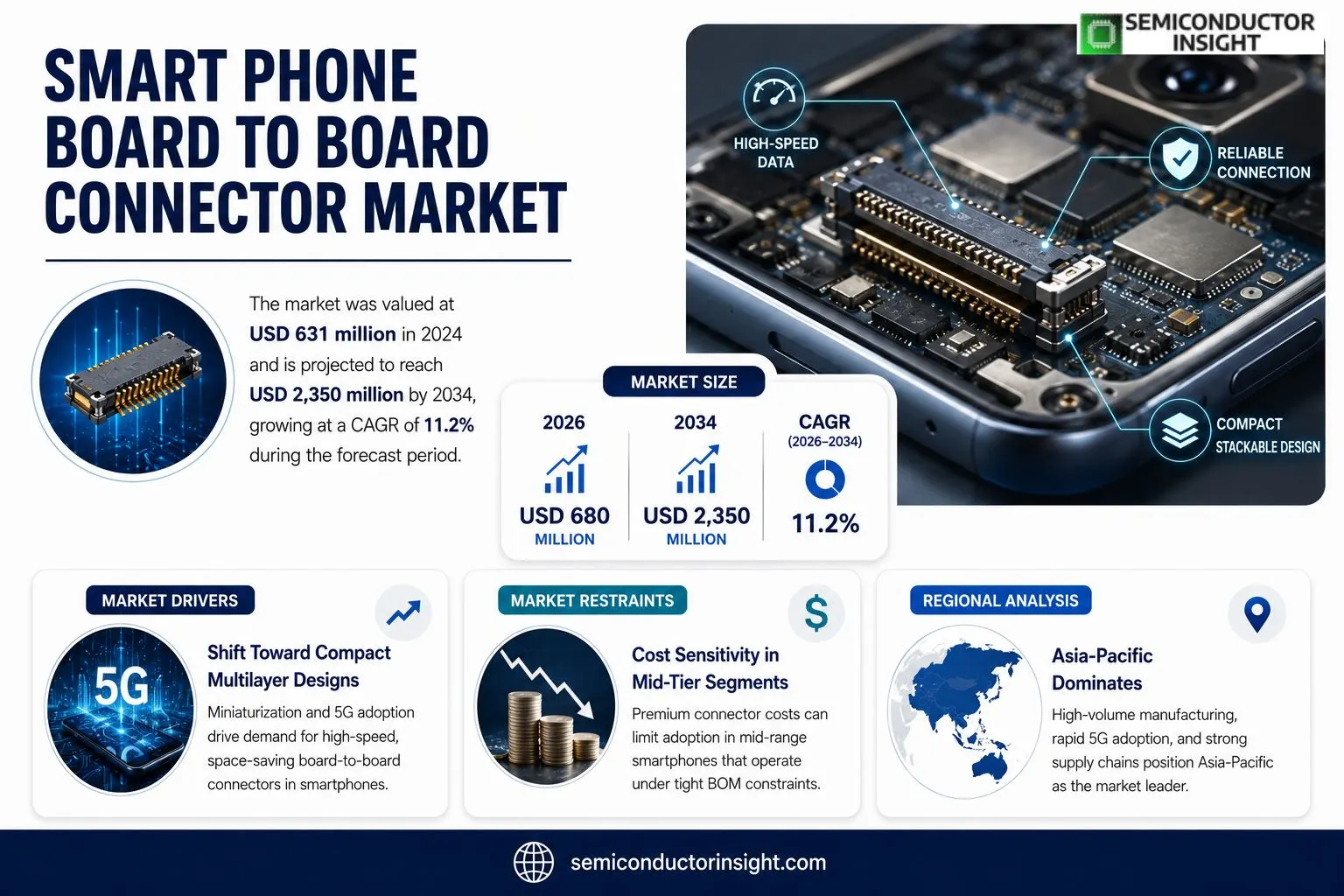
Smart Phone Board to Board Connector market was valued at USD 631 million in 2024 and is projected to reach USD 1,263 million by 2031, exhibiting a CAGR of 10.7% during the forecast period. Based on our extrapolation, the market is estimated at roughly USD 680 million in 2026 and expected to expand to about USD 2,350 million by 2034, implying an average annual growth rate of approximately 11.2% over the extended horizon.
Smart Phone Board to Board Connectors are compact, stackable interconnect solutions that join printed circuit boards within smartphones. They accommodate various PCB orientations, spacing tolerances and material selectionssuch as gold‑plated contacts or copper alloysenabling high‑speed data transmission or power delivery while satisfying stringent space constraints.
MARKET DRIVERS
Shift Toward Compact Multilayer Designs
Manufacturers are consolidating functions onto fewer layers to meet the ever‑shrinking form‑factor of flagship smartphones. This engineering choice raises the need for reliable board‑to‑board interconnects that can sustain high‑frequency signals while occupying minimal footprint. Consequently, Smart Phone Board to Board Connector Market is benefiting from design teams that prioritize dense routing without compromising signal integrity.
Growth of 5G‑Enabled Handsets
The rollout of 5G radios introduces higher data‑rate pathways and stricter electromagnetic compatibility requirements. Board‑to‑board connectors engineered for broadband performance become indispensable, prompting suppliers to expand their product portfolios with low‑loss, high‑precision solutions. This trend sustains a steady inflow of orders from OEMs racing to certify 5G models.
➤ “Design teams that integrate advanced board‑to‑board modules report up to a 20 % reduction in overall board area, accelerating time‑to‑market for premium smartphones.”
Beyond pure technical merit, the trend also aligns with cost‑optimization pressures. By replacing multiple discrete connectors with a single board‑to‑board interface, manufacturers capture material savings and simplify assembly lines, reinforcing the market’s upward trajectory.
MARKET CHALLENGES
Stringent Reliability Standards
Automotive‑grade reliability criteria have begun to filter into premium smartphone production, demanding connectors that survive repeated thermal cycles and mechanical stress. Meeting these benchmarks often involves additional testing overhead, which can deter smaller component firms lacking extensive validation infrastructure.
Other Challenges
Supply Chain Volatility
Fluctuations in raw‑material costs for metals such as copper and nickel translate into pricing pressure on connector manufacturers, compelling them to balance margin preservation with competitive pricing.
MARKET RESTRAINTS
Cost Sensitivity in Mid‑Tier Segments
Mid‑tier smartphones, which command the bulk of shipments, operate under tight bill‑of‑materials constraints. While high‑performance board‑to‑board connectors offer technical advantages, their premium price points can discourage adoption in price‑competitive models, limiting overall market penetration.
MARKET OPPORTUNITIES
Emergence of Foldable Form Factors
Foldable smartphones introduce new mechanical demands, including flexible hinge zones and repeated opening cycles. Board‑to‑board connectors engineered for durability and slim profiles are uniquely positioned to address these requirements, opening a niche yet rapidly expanding revenue stream for innovators in Smart Phone Board to Board Connector Market.
Smart Phone Board to Board Connector Market Trends
Miniaturization and High‑Speed Interconnect Demand
The market recorded a revenue of $631 million in 2024 and is on track to double that figure by 2031, reflecting a compound growth rate of roughly 10 % per annum. This trajectory is anchored in the relentless push for thinner smartphones, where designers rely on board‑to‑board connectors that occupy less than 0.7 mm of stack height. The ability to route high‑frequency signals across tightly spaced PCBs eliminates the need for additional cabling, directly supporting the rollout of 5G‑enabled devices and emerging camera modules. Consequently, OEMs are allocating a larger portion of bill‑of‑materials budgets to these components, a shift that reshapes supplier negotiations and accelerates the adoption of advanced plating techniques.
Other Trends
Material and Plating Innovations
Recent introductions of copper‑tungsten alloys and nickel‑palladium‑gold (Ni‑Pd‑Au) finishes have reduced contact resistance while enhancing thermal endurance. Manufacturers such as TE Connectivity and Molex have rolled out connector families that survive repeated flex cycles, a prerequisite for foldable phones that subject interconnects to mechanical stress. These material advances not only meet tighter electrical specifications but also open pricing levers for OEMs that previously faced a trade‑off between performance and cost.
Regional Shifts in Production Capacity
While the United States maintains a modest share of the demand, China’s manufacturing footprint is expanding, driven by local chip‑fab facilities that favor domestic supply chains. The Asian cluster now accounts for more than half of the forecasted volume, prompting European players to consider joint ventures that grant access to the region’s rapid prototyping capabilities. This geographic redistribution influences logistics strategies, inventory buffers, and risk‑management practices across the ecosystem.
COMPETITIVE LANDSCAPEKey Industry Players
Smart Phone Board‑to‑Board Connector Market – Competitive Overview
The top tier of the market is anchored by TE Connectivity, Amphenol and Molex, whose combined revenues account for a substantial share of sales. These firms leverage extensive R&D pipelines and cradle‑to‑gate supply chains that enable rapid response to OEM design cycles. Their product portfolios span high‑speed, low‑profile and power‑centric configurations, allowing smartphone manufacturers to consolidate multiple interconnect functions into a single BTB solution. The scale of these incumbents also translates into pricing power and the ability to secure long‑term contracts with major handset assemblers in both North America and Asia‑Pacific, reinforcing a market structure that favours volume‑driven differentiation.Beyond the dominant trio, a cadre of specialist suppliers adds depth to the competitive field. Panasonic and Kyocera focus on precision‑machined ceramic substrates that meet stringent thermal requirements for premium devices. Japanese player JAE excels in micro‑scale connectors tailored for foldable form‑factors, while Chinese firms such as HRS, LCN and Sunway Communication capture price‑sensitive segments through localized production and aggressive customization. Emerging entrants like YXT, Acon and CSCONN are investing in advanced plating technologies to address high‑frequency signaling, positioning themselves as niche innovators that could reshape supplier bargaining dynamics as the industry pursues ever thinner stacking heights.
List of Key Smart Phone Board to Board Connector Companies Profiled
- TE Connectivity
- Amphenol
- Molex
- Panasonic
- Kyocera
- HRS
- LCN
- JAE
- ECT
- OCN
- Sunway Communication
- YXT
- Acon
- CSCONN
Segment Analysis:
| Segment Category | Sub-Segments | Key Insights |
| By Type |
|
High‑Speed Connectors
|
| By Application |
|
Android Phones
|
| By End User |
|
OEM Device Manufacturers
|
| By Stacking Height |
|
Below 0.7 mm
|
| By Market Trend |
|
Miniaturization Drive
|
Regional Analysis: Smart Phone Board to Board Connector Market
Asia-Pacific
Manufacturers are exploiting novel substrate materials and micro‑fabrication techniques to shrink connector footprints. This shift enables slimmer smartphone chassis while maintaining high‑speed data pathways, a balance that has become a decisive factor for premium device segments.
Recent disruptions have prompted OEMs to diversify sourcing strategies, incorporating multiple tier‑1 suppliers across the region. This approach mitigates single‑point failures and sustains production continuity for high‑demand launch windows.
Governments are tightening standards around electromagnetic compatibility and material safety, urging connector makers to embed compliance testing early in the design stage. Early alignment reduces costly redesigns downstream.
The rollout of 5G‑enabled smartphones and the integration of multi‑camera arrays increase the complexity of board interconnects, prompting higher adoption rates for advanced board‑to‑board solutions across the region.
North America
In North America, Smart Phone Board to Board Connector Market is shaped by a premium‑focused consumer base that values performance and durability. Leading smartphone brands are collaborating with domestic component firms to develop connectors that meet stringent thermal management criteria, essential for devices supporting intensive gaming and augmented‑reality workloads. The region’s strong intellectual‑property framework encourages investment in proprietary connector geometries, fostering a niche of high‑value offerings that differentiate flagship models. However, higher labor costs incentivize manufacturers to source certain components from abroad, creating a hybrid supply chain that blends local design expertise with overseas production efficiencies.
Europe
European handset manufacturers prioritize sustainability, driving demand for connectors that incorporate recyclable materials and low‑toxicity processes. Compliance with the EU’s Restriction of Hazardous Substances (RoHS) directive has led suppliers to refine plating techniques, improving both environmental credentials and connector lifespan. At the same time, the region’s fragmented market structure, with a mix of players and niche innovators, encourages a competitive environment where differentiation is achieved through customized form‑factors and rapid prototyping capabilities. Emerging smart‑device categories, such as wearables with detachable modules, are extending the relevance of board‑to‑board solutions beyond traditional smartphones.
South America
South American markets are experiencing a gradual shift from cost‑centric to feature‑rich smartphones, prompting local assemblers to seek connectors that balance affordability with reliability. Manufacturers are adapting designs to accommodate the region’s diverse climatic conditions, ensuring stable performance in high humidity and temperature fluctuations. Partnerships between regional distributors and Asian suppliers are becoming more common, allowing faster access to the latest connector technologies without substantial capital outlay. This collaborative model supports a steady rise in adoption as consumer expectations evolve toward higher‑spec devices.
Middle East & Africa
In the Middle East and Africa, the market is influenced by rapid smartphone penetration among younger demographics and an increasing appetite for devices that support high‑resolution media consumption. Connectivity solutions are being tailored to address power‑efficiency concerns, as intermittent electricity supply in some areas necessitates components that minimize drain. Local OEMs are leveraging partnerships with established Asian manufacturers to import advanced connectors while customizing them for regional regulatory requirements. The strategic emphasis on durability and low‑maintenance designs positions board‑to‑board connectors as a critical enabler for the next wave of mobile technology adoption.
Report Scope
This market research report provides a comprehensive analysis of the Smart Phone Board to Board Connector Market , covering the forecast period 2026–2034. It offers detailed insights into market dynamics, technological advancements, competitive landscape, and key trends shaping the industry.
Key focus areas of the report include:
- Market Overview: The report begins with an overview outlining its current market scenario, key growth indicators, and industry transformation drivers. It discusses macroeconomic factors, demand–supply balance, regulatory landscape, and the strategic role of semiconductors in powering advancements across industries such as automotive, telecommunications, consumer electronics, and industrial automation.
- Market Size & Forecast: Historical data and future projections for revenue, unit shipments, and market value across major regions and segments.
- Segmentation Analysis: Detailed breakdown by product type, technology, application, and end-user industry to identify high-growth segments and investment opportunities.
- Regional Insights: Insights into market performance across North America, Europe, Asia-Pacific, Latin America, and the Middle East & Africa, including country-level analysis where relevant.
- Competitive Landscape: Profiles of leading market participants, including their product offerings, R&D focus, manufacturing capacity, pricing strategies, and recent developments such as mergers, acquisitions, and partnerships.
- Technology Trends & Innovation: Assessment of emerging technologies, integration of AI/IoT, semiconductor design trends, fabrication techniques, and evolving industry standards.
- Market Drivers & Restraints: Evaluation of factors driving market growth along with challenges, supply chain constraints, regulatory issues, and market-entry barriers.
- Stakeholder Insights: Insights for component suppliers, OEMs, system integrators, investors, and policymakers regarding the evolving ecosystem and strategic opportunities.
Primary and secondary research methods are employed, including interviews with industry experts, data from verified sources, and real-time market intelligence to ensure the accuracy and reliability of the insights presented.
FREQUENTLY ASKED QUESTIONS:
What is the current market size of Smart Phone Board to Board Connector Market?
-> Smart Phone Board to Board Connector Market was valued at USD 631 million in 2024 and is expected to reach USD 1,263 million by 2031, growing at a CAGR of 10.7% during the forecast period.
Which key companies operate in Smart Phone Board to Board Connector Market?
-> Key players include TE Connectivity, Amphenol, Molex, Panasonic, Kyosera, HRS, LCN, JAE, ECT, OCN, among others.
What are the key growth drivers?
-> Key growth drivers include the rapid expansion of smartphone shipments, demand for compact high‑speed interconnect solutions, and the need for flexible stackable board‑to‑board designs that support varied PCB orientations and space constraints.
Which region dominates the market?
-> The reference does not specify a dominant region.
What are the emerging trends?
-> Emerging trends include miniaturization of stackable BTB connectors, use of advanced materials and platings to meet electrical and mechanical specs, and the development of high‑speed, floating, and power‑optimized connector variants for next‑generation smartphones.
Get Sample Report PDF for Exclusive Insights
Report Sample Includes
- Table of Contents
- List of Tables & Figures
- Charts, Research Methodology, and more...
 Download Sample Report PDF