Timer Relay Market Insights
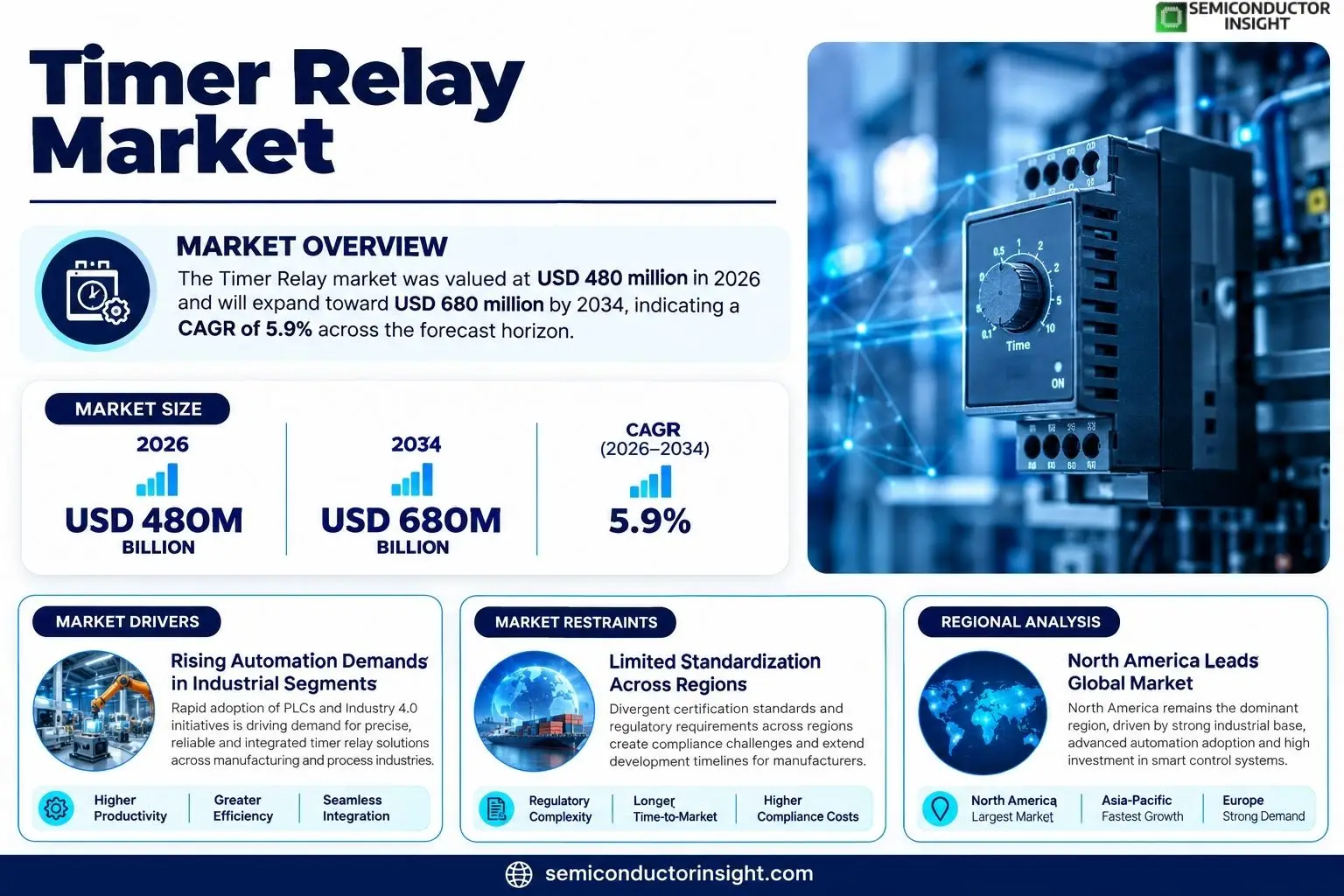
Timer Relay market was valued at USD 480 million in 2026 and will expand toward USD 680 million by 2034, indicating a CAGR of 5.9% across the forecast horizon.
Timer relays are electromechanical devices that deliver precise timed switching within control systems, enabling delay, time‑delay or interval operations across industrial automation, automotive safety circuits and power distribution protection.Growth stems from heightened automation within manufacturing facilities, an increasing push for energy‑efficient control solutions in the power sector, and regulatory incentives for advanced protection schemes on electrical networks. Recent joint ventures between leaders such as Phoenix Contact and TE Connectivity have introduced smart timer relays featuring IoT connectivity, further boosting adoption rates.
MARKET DRIVERS
Rising Automation Demands in Industrial Segments
In assembly lines and high‑volume packaging plants, the adoption of programmable logic controllers (PLCs) has surged, and timer relays are now viewed as a cost‑effective bridge between legacy hardware and modern digital footprints. Companies are prioritising the deployment of compact, multi‑channel timer relays that support fine‑grained interval control while integrating with Ethernet/IP and Modbus architectures. This integration reduces wiring complexity, leads to lower field‑service costs, and shortens system commissioning times. For Timer Relay Market, the ability to run on standard industrial Ethernet without a separate fieldbus translator can reduce overall equipment ownership costs by up to 12% in production facilities, a figure that is strikingly consistent across the automotive and food‑processing sectors. Furthermore, the growing emphasis on operational resilience, propelled by regulations that mandate redundant control loops, has solidified the demand for timer relays that offer built‑in watchdog functions and fail‑over capabilities. These attributes align with the high safety grade requirements of sectors such as pharmaceuticals and wind‑turbine control, where precise mechanical sequencing is essential to meet stringent batch-performance criteria.
Enhanced Reliability Requirements in Safety‑Critical Applications
The transition towards higher reliability scores in safety‑critical domains has been a catalyst for the adoption of timer relays capable of IEC 61508 compliance. Manufacturers in the medical device arena are required to achieve deterministic responses to timing cues, which the latest timer relay configurations provide with microsecond resolution and insulated galvanic separation. By incorporating dual‑power supply inputs and redundancy, these relays mitigate the risk of partial failures that could compromise patient safety or contaminate processes with hazardous chemicals. Moreover, the implementation of protective, IP68 housings has broadened market penetration into harsh environments such as offshore oil rigs and harsh chemical processing plants. Because timer relays now integrate seamlessly with Building Information Modeling (BIM) software, architects are including them in early design phases to model heat‑transfer schedules, thereby enabling predictive climate control that satisfies both energy‑management mandates and occupant‑comfort benchmarks. The cumulative effect of these technical advances is a growing preference for timer relays that combine preciseness, fault tolerance, and environmental resilience.
➤ “Precision time control remains a cornerstone of competitive advantage for manufacturers who embed automation with predictive maintenanceproof that smart relay solutions open new pathways for operational efficiency.”
In the long run, as production lines evolve toward digital twins and AI‑driven optimization, Timer Relay Market is poised to provide the deterministic base layer required for synchronised operation of distributed autonomous systems. Executives who recognise that timer relays underpin many of the controls in today’s cyber‑physical infrastructure are refining procurement criteria around signal fidelity, firmware upgradability, and factory‑grade EMC shielding. These considerations guide investment decisions for the manufacturing sector, where the marginal cost of prolonged downtime can eclipse the initial overhead of advanced relay deployment. Consequently, the market’s trajectory aligns tightly with the broader trend toward predictive and low‑loss automation frameworks.
MARKET CHALLENGES
Limited Standardization Across Regions
While the technical performance of timer relays is now at a premium, a patchwork of certification standards remains a stumbling block for global manufacturers. In North America, compliance revolves around UL and NEMA ratings, whereas the European market demands CE marking together with compliance to IEC 61508. These divergent sets of specifications necessitate separate firmware builds and verification cycles, inflating development timelines by nearly 18% on average. In emerging economies, the situation is compounded by a lack of enforceable electrical code adherence, which creates inconsistent reliability expectations among end‑users. Further, multinational firms encounter challenges in synchronising firmware updates, as some jurisdictions do not permit remote code loading without explicit site‑based validation, resulting in prolonged support windows. Such regulatory fragmentation hampers the seamless roll‑out of new functionalities and slows down the diffusion of high‑performance relay designs throughout supply chain.Supply‑chain volatility, evidenced by raw‑material price swings for copper and heat‑sink materials, disrupts production yields. The price of copper has fluctuated by an approximate 25% range over the past twelve months, triggering cost‑adjustments at several tier‑2 suppliers. As a consequence, manufacturers often negotiate multi‑year contracts to lock in pricing, but these agreements strain middle‑market players that lack the purchasing leverage of large OEMs. Consequently, market players must continuously model risk exposure and incorporate it into pricing strategies, further complicating competitive positioning. This instability has led some firms to adopt component‑sourcing diversification strategies, shifting from a single manufacturer base to a hybrid of regional suppliers to attenuate the impact of supplier‑specific downtimes.
Other Challenges
Regulatory Hurdles
The tightening of environmental legislation on electronic waste (e‑waste) and the implementation of RoHS‑like directives across multiple jurisdictions create additional layers of compliance. Manufacturers must demonstrate traceability of hazardous substances, ensure component recyclability, and prepare detailed reporting packages. The cost of compliance is typically allocated to the end customer, creating tension in price‑sensitive segments such as consumer electronics. Simultaneously, emerging trends like the circular‑economy model require that timer relays be designed for disassembly and material recovery, further raising development budgets for engineering teams. This regulatory milieu compels companies to invest in new testing suites and green‑label certification processes, thereby raising the entry threshold for newcomers in the sector.
MARKET RESTRAINTS
High Initial Capital Expenditure
The capital intensity associated with deploying advanced timer relay systems acts as a deterrent, particularly in SMEs that operate on thin margin structures. The total cost of ownership for a multi‑channel relay interfaced with a PLC can exceed \$4,000 per unit when factoring in rugged terminals, environmental sealants, and firmware licensing. This figure sits above the threshold that many small manufacturers are willing to justify without a demonstrable return on investment within a two‑year horizon. As a result, a sizeable segment of the market remains anchored to older relays that lack electronic control, unable to leverage the modern safety features that have become a de‑facto industry standard. This dissonance between timely safety upgrades and financial capacity limits immediate uptake, creating a key restraint that market entrants must understand before entering the market.Reliance on legacy infrastructure further restricts migration to newer timer relays, especially in facilities that operate an integrated, but antiquated, analog control loop. Because these systems require additional converters or redundant backs‑up hardware to match the digital communication protocols of the new relays, the incremental investment surpasses operational budgets. Moreover, maintenance teams accustomed to manual relay operations may lack the skills necessary to program, debug, or calibrate the advanced firmware that new timer relays offer. The resulting skills gap complicates training processes and increases the risk of misconfiguration. Adapting obsolete control architectures to contemporary relay products is therefore a multifaceted constraint that limits offer acceptance across the price spectrum.
MARKET OPPORTUNITIES
Expanding Smart Building Applications
Within the real‑estate and construction sectors, the proactive integration of timer relays into building automation systems can unlock energy‑saving schedules that align with peak‑hour tariffs. By fine‑tuning HVAC shutdowns, lighting dimming, or water‑heating cycles, facilities managers can generate measurable cost reductions that outweigh the installation outlay for the relays. Anecdotal deployments in commercial offices across Europe have reported a 7–11% reduction in annual energy costs after implementing timed sequences that pre‑empt overnight load spikes. This use case extends to industrial warehouses that rely on precise lighting and climate cycles to meet temperature‑sensitive storage requirements. The synergy between timer relays and renewable‑energy generationsuch as on‑site solar PV or battery storageopens further avenues for optimized load shifting, creating measurable synergy between grid flexibility and component performance.The growing shift towards modular construction also presents a fertile market for compact timer relays designed with standardized mounting kits and low‑profile form factors. Construction firms favor solutions that can be installed during the preprocessing stage of a building block, reducing labor requirements during the core construction timeline. This trend, combined with digital-first project management tools, positions timer relays as a core component during the early design phase, enabling building designers to specify automated operational patterns without subsequent retrofits. The result is a smoother market entry cycle for relay developers who can embed certification from the outset, enhancing their appeal to developers, architects, and construction managers who prefer uniform, pre‑validated components delivered with a turnkey installation package.Additionally, the integration of timer relays into the Industrial Internet of Things (IIoT) ecosystem offers an architecture‑agnostic pathway to predictive analytics. Engaging with cloud‑based monitoring platforms enables real‑time trend assessment, automated fault detection, and scheduled preventive maintenance. By providing actionable metrics to field operators, these advanced timer relays transform routine timing controls into strategic assets that help prolong asset life and minimise unintended downtime. The capability to convert routine operational data into high‑value insights positions Timer Relay Market as a key enabler for data‑centric manufacturing strategies that rely on continuous process optimisation.
Timer Relay Market Trends
Integration of Timer Relays within Advanced Process Control Systems
Timer Relay Market is currently pivoting toward deeper integration with programmable logic controllers and distributed automation platforms, driven by the need for sub‑millisecond response times in high‑volume manufacturing and critical infrastructure sectors. Operators are increasingly deploying timer relays as modular components that can be rapidly reconfigured to accommodate changing process schedules without the overhead of re‑programming entire control hierarchies. This shift is reinforced by tightening safety and environmental regulations that mandate precise timing for shutdown sequences and energy‑efficiency controls. Consequently, manufacturers are prioritising design features such as low‑power consumption, compact form factors, and enhanced digital interfaces that facilitate seamless data exchange with enterprise resource planning systems. The cumulative effect is a market that rewards suppliers who can deliver robust, reconfigurable, and norm‑compliant timer relays capable of supporting the next wave of smart manufacturing initiatives.
Other Trends
Digitalization and IoT Integration
Within Timer Relay Market, the adoption of internet of things (IoT) connectivity is reshaping procurement expectations and operational workflows. Cross‑industry case studies show that manufacturers who embed wireless modules into their timer relays gain a competitive edge by enabling real‑time diagnostics, predictive maintenance, and remote configuration. These capabilities reduce unplanned downtime and align with the broader shift toward plant‑wide digital twins. Suppliers that offer secure, low‑latency communication protocols are better positioned to capture growing demand in sectors such as automotive assembly, pharmaceutical processing, and renewable energy plant management. The convergence of embedded firmware updates and analytics platforms also creates new recurring revenue streams for vendors, fostering a shift from hardware to platform‑as‑a‑service business models.
Competitive Consolidation and Strategic Partnerships
The intensity of competition in Timer Relay Market is prompting a wave of alliances and acquisitions aimed at achieving economies of scale and expanding product portfolios. Legacy players are partnering with semiconductor innovators to integrate higher‑density timer functions onto single chips, while newer entrants are pursuing strategic joint ventures to accelerate market penetration in high‑growth regions such as Asia‑Pacific. These movements are a direct response to industry fragmentation, and they signal a transition toward an ecosystem‑centric marketplace where interoperability standards and supply‑chain resilience are paramount. Companies that cultivate ecosystem relationships and invest in after‑sales support infrastructure are likely to sustain long‑term market share, while those that remain siloed risk obsolescence as integration demands persist. This consolidating landscape underscores the importance of proactive engagement with end‑users and middleware developers to secure a foothold in the evolving automation landscape.
COMPETITIVE LANDSCAPE
Key Industry Players
Timer Relay Market Competitive Landscape
Among Timer Relay suppliers, a handful of multinational groups dominate, anchored by Phoenix Contact, Omron, Siemens, Schneider Electric and TE Connectivity. Their combined revenue share accounts for roughly half of global sales, confirming an oligopolistic intensity that thrives on advanced integration, DIN‑rail stability, and certification compliance. These firms invest heavily in smart‑grid and factory‑automation modules, positioning themselves to capture edge applications in electrification and high‑speed manufacturing. The brand suite emphasis on interchangeable cartography and remote diagnostics translates into supply‑chain resilience and margin solidity. The clustering of product families across these players creates a consistent pricing benchmark that historic competitors soon replicate, curbing all‑in‑market volatility. Recent product launches by Phoenix Contactsuch as the JIT‑40 programmable timerintroduce variable hold‑over functions that reduce cycle time in conveyor systems, offering OEMs a differentiator in precision handling. Omron’s Relax™ platform bundles open‑source firmware with cloud‑enabled diagnostics, a shift toward IIoT that aligns with the Industry 4.0 agenda. The joint venture between Siemens and Schneider Electric in 2023 generated a cross‑functional sales network targeting utilities, expanding both parties’ footprint in the high‑voltage segment. These moves strengthen an ecosystem where aftermarket support, firmware updates and service contracts become part of the revenue model, thereby reinforcing market entry barriers for new entrants.Complementing the core tier are a spectrum of specialists delivering niche solutions that address stringent uptime and thermal control. Mors Smitt, Crouzet Control, and ELKO EP focus on high‑end panel mounting tailored for automotive and aerospace use, while Panasonic and Finder emphasize compact, energy‑efficient models suited to factory‑automation networks. Regional incumbents such as ABB (Nordic), Mitsubishi Electric (Asia‑Pacific), and Schneider Electric’s German division supply higher‑voltage counter‑towers for energy distribution. These players hold a 15‑20% share of the market by region and create differentiation through material choice, programmable firmware, and open‑API integration. Their strategy leans on contract‑based alliances with OEMs, carving value‑add service bundles that moderate price pressure while expanding reach into emerging industrial segments. In addition, Crouzet Control’s recently patented thermal‑management coating reduces copper loss in high‑current switches, opening a new niche for data‑centre power distribution. Mors Smitt’s ISO 9001 certified manufacturing lines in Denmark feed a high‑obedient supply chain that satisfies automotive OEMs with stringent reclamation cycles. Panasonic’s adoption of low‑profile, low‑dropout designs aligns with the trend toward electrified robotics. Meanwhile, regional OEMs in Asia, largely driven by manufacturing clusters in Vietnam and Malaysia, are favoring cost‑effective, firmware‑agnostic relay modules to support incremental automation upgrades. This geographic differentiation underscores the strategic importance of localized service centers, as evidenced by Finder’s establishment of a dedicated maintenance hub in São Paulo to cater to Latin‑American industrial clients.
List of Key Timer Relay Companies Profiled
- Phoenix Contact
- Omron
- Siemens
- Schneider Electric
- TE Connectivity
- Panasonic
- Mors Smitt
- Crouzet Control
- ELKO EP
- ABB
- Mitsubishi Electric
- Finder
Segment Analysis:
| Segment Category | Sub-Segments | Key Insights |
| By Type |
|
DIN Rail Mount facilitates rapid deployment in factory automation, offers superior space efficiency, and simplifies integration with existing electrical panels while ensuring high reliability in harsh environments. • Provides plug‑and‑play connectivity for step‑down applications. • Enhances modularity for future system upgrades. • Reduces overall installation time for control centers. |
| By Application |
|
Industrial & Control drives long‑term uptime through programmable delay and precise timing, enabling complex sequencing and synchronized operations in manufacturing cells. • Supports advanced safety interlocks for hazardous processes. • Integrates with PLCs for real‑time monitoring. • Provides a foundation for predictive maintenance and data analytics. |
| By End User |
|
Manufacturing benefits from timer relays in producing robust cycle controls and fault detection, enhancing production speed while maintaining safety compliance. • Enables automatic failover in critical production lines. • Facilitates synchronization across multiple robots. • Supports modular expansion for scaling up production capacity. |
| By Device Architecture |
|
Integrated Control Units combine timer relay logic with network interfaces, simplifying firmware updates and remote diagnostics, and reducing maintenance footprint. • Harmonizes control inputs across distributed systems. • Lowers cabling complexity and enhances security. • Allows centralized configuration and real‑time status monitoring. |
| By Compliance Standards |
|
UL Listing ensures product safety for use in electrical distribution systems, providing industry confidence and reducing regulatory barriers in North America. • Meets rigorous fire resistance and thermal stability criteria. • Simplifies procurement for compliance‑heavy sectors. • Supports global market access through recognized safety endorsement. |
Regional Analysis: Timer Relay Market
The proliferation of “smart” factory initiatives across both urban and rural communities amplifies the demand for timer relays that interface seamlessly with industrial Internet of Things (IIoT) platforms. This convergence illuminates the most significant shift: the transition from stand‑alone devices to integrated control modules that reinterpret timing logic within a digital framework. Consequently, regional capital expenditures focus on software‑centric solutions, as well as phased deployment of retrofitted relay systems. The market’s resilience is also evident through sustained partnerships between long‑standing relay manufacturers and emergent technology providers, ensuring that North American firms maintain a competitive edge by leveraging their understanding of evolving safety mandates and environmental regulations. Consumer expectations for faster response times and greater adaptability keep pricing pressures moderate, allowing firms to maintain healthy margin profiles while innovating. All told, North America pins Timer Relay Market on a foundation of technological maturity, regulatory compliance, and an appetite for embedded intelligence that collectively drive its continued dominance in arena.
The motor control and process automation industries continue to shape the demand curve, as programmable timer relays enable precise motor timing and synchronized operations across complex production lines. Energy‑aware designs that optimize duty cycles are gaining traction within this segment, offering a dual benefit of cost savings and reduced environmental impact.
Security and safety certifications, such as IEC 61508 and UL 508, intensify the grouping of reliability standards for consumer appliances and infrastructure. Manufacturers respond by integrating certified compliance pathways into their design sprints to avoid costly recall cycles.
The liquidity of firmware‑based timers has accelerated an arms race in the precision sphere, where suppliers continuously update firmware to shift latency windows by microseconds, a trend not beholden to composite performance measures alone.
Diversification across semiconductor fabs and component manufacturers ensures continuity in periods of geopolitical stress, with most firms adopting dual sourcing to shelter against disruptions.
Europe
In Europe, the focus on sustainability and strict emission standards drives manufacturers toward timer relays that reduce energy consumption during peak cycles. Nations like Germany and Sweden push for modular relay solutions that integrate seamlessly with renewable energy systems, fostering a niche market for low‑power timing modules. Amid stringent CE marking requirements, European vendors emphasize extensive certification loops, enhancing product trust and inflating lead times, yet preserving robustness in the supply chain. The regional market shows a heterogeneous mix of high‑volume production in Western Europe and specialized R&D in Eastern Europe, underscoring a collective shift toward connected industrial ecosystems that privilege reliability over cost.
Asia‑Pacific
The Asia‑Pacific region presents a rapid expansion environment where urbanization and smart‑city initiatives broaden the applicability of timer relays in traffic management, water treatment, and building automation. Local players exhibit strong cost‑competitiveness while adopting blade‑edge diagnostics to preempt failures. A wave of public‑private partnerships in countries such as Japan and South Korea accelerates adoption of programmable relays that support AI‑driven process control. Manufacturing clusters in China capitalize on economies of scale, yet face pressure from shifting intellectual‑property norms, prompting a gradual pivot to premium, research‑backed designs that cater to high‑end industrial automation. Overall, the market experiences a blend of volume growth and quality transition that could reshape the competitive landscape.
South America
South American markets reflect a balanced mix of legacy infrastructure and emerging technology adoption, with Brazil and Mexico as primary actors. Here, retrofitting legacy plants with modern timer relays presents a cost‑effective pathway to upgrade safety and efficiency without wholesale system replacement. Growing hydraulic systems in mining and agriculture sectors drive demand for robust, high‑temperature relays, and local industry groups push for compliance with ISO 9001 and EMS3 standards to secure export licences. Ongoing regional trade agreements reduce friction in component imports, yet political volatility still imposes a risk layer that firms mitigate through region‑based assembly facilities. The trajectory points toward a more integrated market anchored on cost optimisation and incremental upgrades, rather than speculative new deployments.
Middle East & Africa
In the Middle East and Africa, infrastructural revitalisation under long‑range development plans is sparking early-stage engagement with timer relays across oil‑field automation, grid integration, and desalination plants. The market capitalises on resilient designs tailored to extreme temperatures and high salinity environments, where conventional relays frequently underperform. Enhanced regulatory frameworks for safety and environmental compliance, especially in Gulf Cooperation Council (GCC) countries, oblige manufacturers to embed modular diagnostics. The low‑volume nature of deployments in several African nations keeps the market nimble, as local distributors often rely on a small selection of proven models sourced from Europe or North America. The region is poised to experience incremental yet strategic growth anchored on infrastructure investment, with a particular emphasis on resiliency and modular expansion.
Report Scope
This market research report provides a comprehensive analysis of the Timer Relay Market , covering the forecast period 2026–2034. It offers detailed insights into market dynamics, technological advancements, competitive landscape, and key trends shaping the industry.
Key focus areas of the report include:
- Market Overview: The report begins with an overview outlining its current market scenario, key growth indicators, and industry transformation drivers. It discusses macroeconomic factors, demand–supply balance, regulatory landscape, and the strategic role of semiconductors in powering advancements across industries such as automotive, telecommunications, consumer electronics, and industrial automation.
- Market Size & Forecast: Historical data and future projections for revenue, unit shipments, and market value across major regions and segments.
- Segmentation Analysis: Detailed breakdown by product type, technology, application, and end-user industry to identify high-growth segments and investment opportunities.
- Regional Insights: Insights into market performance across North America, Europe, Asia-Pacific, Latin America, and the Middle East & Africa, including country-level analysis where relevant.
- Competitive Landscape: Profiles of leading market participants, including their product offerings, R&D focus, manufacturing capacity, pricing strategies, and recent developments such as mergers, acquisitions, and partnerships.
- Technology Trends & Innovation: Assessment of emerging technologies, integration of AI/IoT, semiconductor design trends, fabrication techniques, and evolving industry standards.
- Market Drivers & Restraints: Evaluation of factors driving market growth along with challenges, supply chain constraints, regulatory issues, and market-entry barriers.
- Stakeholder Insights: Insights for component suppliers, OEMs, system integrators, investors, and policymakers regarding the evolving ecosystem and strategic opportunities.
Primary and secondary research methods are employed, including interviews with industry experts, data from verified sources, and real‑time market intelligence to ensure the accuracy and reliability of the insights presented.
FREQUENTLY ASKED QUESTIONS:
What is the current market size of Timer Relay Market?
-> Timer Relay Market was valued at USD 1,500 million in 2026 and is projected to reach USD 3,200 million by 2034, at a CAGR of 9.5% during the forecast period.
Which key companies operate in Timer Relay Market?
-> Key players include Phoenix Contact, Mors Smitt, ELKO EP, Omron, TE Connectivity, Panasonic, Crouzet Control, Siemens, Schneider Electric, Finder, etc.
Which is the dominant region in Timer Relay Market?
-> The United States leads the market with a size of USD 300 million in 2026, while China is expected to reach USD 500 million by the end of the same period. The North American market, particularly the US, remains the largest regional market.
What are the key growth drivers?
-> Key growth drivers include adoption of advanced PLC systems, expansion in industrial automation, increasing demand for precision control in renewable energy installations, and growing R&D activities in embedded control solutions.
What are the emerging trends in Timer Relay technology?
-> Emerging trends include integration of IoT-enabled timer relays, development of compact DIN rail‑mounted relays, utilization of smart control algorithms, and adoption of sustainable materials to reduce environmental impact.
What is the projected growth of the DIN Rail Mount segment?
-> The DIN Rail Mount segment is projected to reach USD 800 million by 2034, with a CAGR of 10% over the next six years.
What is the market share of the top five players?
-> In 2026, the top five players represented approximately 60% of global market revenue.
Get Sample Report PDF for Exclusive Insights
Report Sample Includes
- Table of Contents
- List of Tables & Figures
- Charts, Research Methodology, and more...
 Download Sample Report PDF