Three Terminal Filter Capacitor Market Insights
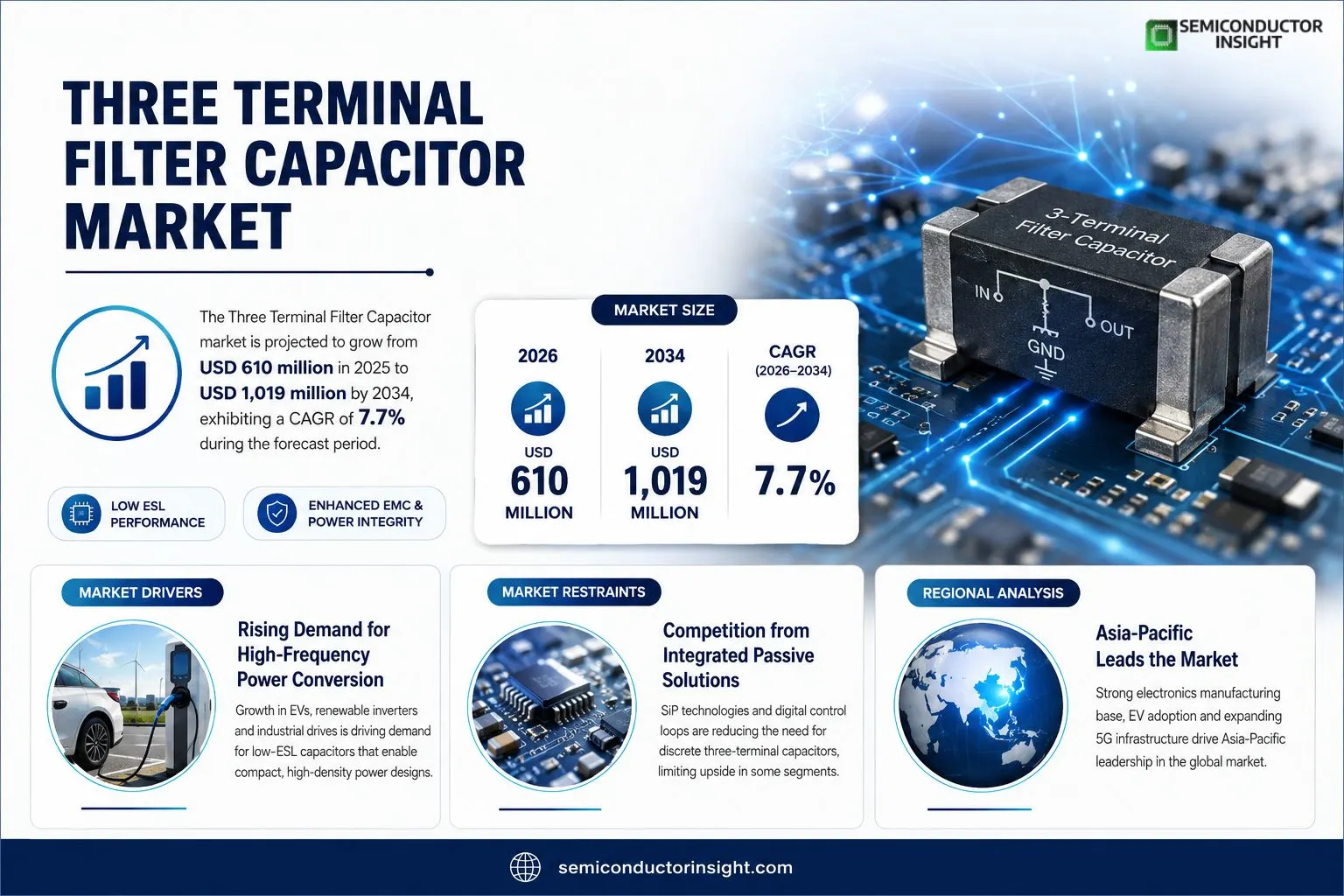
Three Terminal Filter Capacitor market was valued at USD 610 million in 2025 and will increase to USD 1,019 million by 2034, reflecting a compound annual growth rate of 7.7 % over the forecast horizon.
Three terminal filter capacitors are low‑parasitic‑inductance components used for electromagnetic compatibility and power‑integrity design in electronic equipment. They employ input, output and ground terminals to create a feed‑through path that shunts high‑frequency noise while allowing DC or signal current to pass. Core functions include reducing ESL, raising self‑resonant frequency, improving insertion loss and minimizing the number of parallel conventional MLCCs required on a PCB. Typical formats comprise chip‑type low‑ESL multilayer ceramic devices, feed‑through MLCCs, X2Y balanced structures, surface‑mount C or Pi filters and screw‑mounted high‑current feed‑through units. Major downstream users span consumer electronics, communication gear, automotive systems, industrial control, medical devices, aerospace and defense applications.
MARKET DRIVERS
Rising Demand for High‑Frequency Power Conversion
Manufacturers of renewable inverters, electric‑vehicle chargers, and industrial drives are increasingly specifying three terminal filter capacitors to tame high‑frequency noise. Their compact size and low ESR enable tighter packaging, which in turn supports the drive toward higher power densities across Three Terminal Filter Capacitor Market.
Stringent Energy‑Efficiency Regulations
Governments worldwide are tightening efficiency standards for consumer electronics and grid‑connected equipment. Compliance often hinges on reducing harmonic distortion, a task for which three terminal filter capacitors are uniquely suited. This regulatory pressure is nudging OEMs to allocate a larger share of their component budget to these capacitors.
➤ “The convergence of tighter emissions limits and the push for miniaturized power modules is reshaping procurement patterns, placing three terminal filter capacitors at the heart of next‑generation designs.”
Beyond compliance, the cost advantage derived from the capacitor’s simplified construction is prompting cost‑conscious manufacturers to replace legacy filter solutions, thereby expanding the addressable market.
MARKET CHALLENGES
Material Supply Volatility
Fluctuations in the availability of high‑purity aluminum foil and low‑loss dielectric polymers are creating lead‑time uncertainty for capacitor producers. When supply tightens, manufacturers must either hold excess inventory or risk production delays, both of which erode profit margins.
Other Challenges
Thermal Management Constraints
As system designers push voltage and current ratings, the thermal load on filter capacitors rises sharply. Without adequate heat‑dissipation strategies, reliability can suffer, prompting some customers to revert to bulkier, lower‑performance alternatives.
MARKET RESTRAINTS
Competition from Integrated Passive Solutions
System‑in‑package (SiP) technologies are embedding passive filtering functions directly onto semiconductor substrates. These integrated approaches can eliminate the need for discrete three terminal filter capacitors, especially in space‑constrained consumer devices.The migration toward fully digital control loops also reduces reliance on traditional analog filtering, thereby limiting the upside potential for Three Terminal Filter Capacitor Market in certain high‑volume segments.Finally, the perception of a higher failure rate in harsh automotive environments, where temperature extremes are common, discourages some OEMs from adopting these capacitors without extensive qualification testing.
MARKET OPPORTUNITIES
Emergence of Wide‑Bandgap Power Devices
Silicon‑carbide (SiC) and gallium‑nitride (GaN) transistors operate at switching frequencies previously unattainable with silicon. These frequencies demand highly effective noise suppression, positioning three terminal filter capacitors as a preferred solution for the next wave of high‑efficiency power converters.Growth in data‑center infrastructure, driven by cloud‑computing expansion, is also creating a niche for capacitors that can handle high ripple currents while maintaining a small footprint. Vendors that tailor their offerings to meet these specifications stand to capture a sizable slice of the market.Strategic collaborations between capacitor manufacturers and OEMs to co‑develop application‑specific designs could unlock new revenue streams, especially as designers seek to certify components that satisfy both performance and reliability criteria in emerging markets.
Three Terminal Filter Capacitor Market Trends
Shift Toward Low‑ESL Three‑Terminal Designs in High‑Speed Electronics
Three Terminal Filter Capacitor Market is being reshaped by the relentless rise in clock frequencies across processors, memory modules and communication transceivers. As signal edges sharpen, conventional two‑terminal multilayer ceramic capacitors struggle to suppress noise beyond a few hundred megahertz because their parasitic inductance creates a bottleneck. By routing high‑frequency currents through a dedicated ground terminal, three‑terminal devices achieve markedly lower ESL, pushing self‑resonant frequencies into the gigahertz range. This technical advantage translates into smaller component footprints on dense printed‑circuit boards, a benefit that designers of smartphones, base‑stations and next‑generation infotainment systems prize highly. The result is a noticeable migration from parallel arrays of standard MLCCs toward single, purpose‑built three‑terminal parts that simultaneously address insertion loss, EMI compliance and space constraints.
Other Trends
Automotive Power‑Integrity Demands
Electrified vehicle architectures now host multiple DC‑DC converters, high‑power inverters and sophisticated driver‑assist sensors. Each of these subsystems injects rapid voltage transients that can destabilize sensitive microcontrollers if not properly filtered. Three‑terminal filter capacitors, especially the chip‑type low‑ESL offerings from Japanese manufacturers, provide the necessary decoupling while surviving the harsh temperature cycles of automotive environments. Their ability to combine high current rating with a feedthrough configuration reduces the part count on power‑train boards, thereby simplifying routing and improving reliabilitya decisive factor for OEMs seeking to meet both cost and safety targets.
Regional Competitive Realignment and Custom High‑Reliability Offerings
Strategic positioning across Asia, Europe and North America is undergoing a subtle shift. Japanese firms continue to dominate catalog‑grade low‑ESL products, leveraging mature fabrication lines and extensive automotive certifications. Chinese manufacturers have accelerated entry into mid‑tier and defence‑grade segments, offering locally sourced alternatives that erode import reliance for high‑volume consumer electronics. Meanwhile, U.S. companies focus on bespoke high‑voltage feedthrough and high‑current filter solutions tailored to aerospace, medical and industrial control markets. This tiered landscape encourages system integrators to blend standard components with custom‑engineered parts, fostering a supply chain that balances cost efficiency with performance certainty. For Three Terminal Filter Capacitor Market, the implication is a broadening of revenue sources that no longer hinge on a single end‑use but instead draw from a diversified portfolio of high‑frequency power‑integrity challenges.
COMPETITIVE LANDSCAPEKey Industry Players
Three‑Terminal Filter Capacitor Market – Competitive Overview
The segment is spearheaded by Japanese firms that command the majority of catalog‑based, low‑ESL chip offerings. Murata’s NFM series, TDK’s YFF line, and MARUWA’s X‑type devices combine ultra‑low parasitic inductance with a three‑terminal architecture, making them the default choice for high‑speed digital platforms and automotive power‑train modules. Their extensive distribution networks and established automotive qualification programs reinforce a tiered market structure where standard‑grade parts dominate volume, while premium, high‑reliability variants serve aerospace and defense programs. This hierarchy pushes downstream designers to prioritize structural performance over raw capacitance, reshaping procurement criteria across the ecosystem.Beyond the Japanese core, Chinese manufacturers such as Fenghua Advanced Technology and Torch Electron have accelerated entry into both mass‑market and military‑grade niches, leveraging cost‑effective fabrication and localized supply chains. U.S. playersincluding Spectrum Control, Knowles, and Captordifferentiate through custom‑engineered SMD C‑filters and high‑current feedthrough modules tailored for defense, medical, and industrial applications. Korean supplier Samsung Electro‑Mechanics supplies a compact low‑ESL family that targets space‑constrained smartphones and network equipment. The competitive map therefore resembles a multi‑layered mosaic: Japanese firms dominate high‑volume catalog segments, Chinese companies erode price sensitivity while expanding reliability portfolios, and Western firms capture specialized, high‑value contracts.
List of Key Three Terminal Filter Capacitor Companies Profiled
- Murata Manufacturing Co., Ltd.
- TDK Corporation
- MARUWA Co., Ltd.
- KYOCERA Corporation
- TAIYO YUDEN CO., LTD.
- Samsung Electro‑Mechanics Co., Ltd.
- Guangdong Fenghua Advanced Technology (Holding) Co., Ltd.
- Fujian Torch Electron Technology Co., Ltd.
- Beijing Yuanliu Hongyuan Electronic Technology Co., Ltd.
- YAGEO Corporation
- Walsin Technology Corporation
- Knowles Corporation
- Spectrum Control, Inc.
- Johanson Dielectrics, Inc.
- Vishay Intertechnology, Inc.
- Presidio Components, Inc.
- Captor Corporation
Segment Analysis:
| Segment Category | Sub-Segments | Key Insights |
| By Type |
|
Chip‑type Low‑ESL
|
| By Application |
|
Automotive Electronics
|
| By End User |
|
Device Designers
|
| By Performance Positioning |
|
Low ESL Positioning
|
| By Reliability Grade |
|
Automotive Grade
|
Regional Analysis: Three Terminal Filter Capacitor Market
North America
Recent component shortages have spurred North American firms to diversify sourcing, establishing strategic alliances with domestic alumina and electrolyte producers. This reduces dependency on Asian ports, shortens transit windows, and enables rapid response to fluctuations in vehicle assembly schedules.
Federal safety standards and UL/ECE certifications demand stringent dielectric performance, compelling manufacturers to invest in advanced testing labs. Compliance becomes a market differentiator, allowing compliant suppliers to command premium pricing and secure long‑term contracts.
Concentrations of expertise in Michigan and California foster collaborative projects between universities and industry, accelerating the rollout of ultra‑low ESR designs that meet the thermal challenges of next‑generation EV inverters.
Tier‑1 automotive buyers prioritize long‑term reliability and minimal footprint, driving demand for three‑terminal filters that integrate seamlessly into compact power modules while offering extended service intervals.
Europe
European manufacturers leverage a strong heritage in precision engineering to tailor three‑terminal filter capacitors for high‑speed rail and renewable‑energy converters. The market is shaped by stringent EU directives on energy efficiency, prompting OEMs to seek components with lower parasitic losses. Collaborative research clusters in Germany and France are experimenting with bio‑based dielectric polymers, a response to sustainability mandates that could redefine material selection criteria. While supply constraints persist, cross‑border logistics facilitated by the EU’s single‑market framework help mitigate disruptions, allowing firms to maintain consistent delivery schedules for automotive and industrial clients.
Asia‑Pacific
Asia‑Pacific’s rapid electrification of transportation and aggressive expansion of consumer electronics create a sizable demand base for three‑terminal filter capacitors. Local producers benefit from cost‑effective manufacturing bases, yet they face pressure to elevate quality standards to match the expectations of Tier‑1 buyers. Emerging standards in China and India emphasize higher voltage ratings, prompting a shift toward ceramic‑enhanced dielectric stacks. Regional trade agreements are streamlining component flow, but geopolitical tensions occasionally introduce tariff volatility, compelling firms to diversify export channels and invest in flexible production lines.
South America
In South America, the market is anchored by expanding automotive assembly plants in Brazil and Argentina, where manufacturers are adopting three‑terminal filters to improve power‑train resilience in tropical climates. Local suppliers are capitalising on proximity to raw‑material deposits, reducing import reliance. However, infrastructural bottlenecks and currency fluctuations necessitate agile pricing strategies. Partnerships with North American firms are emerging, allowing technology transfer that elevates product performance while preserving cost competitiveness for regional OEMs.
Middle East & Africa
The Middle East & Africa region is witnessing a modest uptick in demand driven by infrastructure projects that integrate renewable‑energy inverters and aerospace maintenance hubs. High ambient temperatures push customers to require capacitors with superior thermal stability, encouraging suppliers to adopt advanced encapsulation techniques. While market size remains limited, the region’s strategic positioning as a logistics gateway between Europe and Asia creates opportunities for distribution centers that can serve both continents efficiently.
Report Scope
This market research report provides a comprehensive analysis of the Three Terminal Filter Capacitor Market , covering the forecast period 2026–2034. It offers detailed insights into market dynamics, technological advancements, competitive landscape, and key trends shaping the industry.
Key focus areas of the report include:
- Market Overview: The report begins with an overview outlining its current market scenario, key growth indicators, and industry transformation drivers. It discusses macroeconomic factors, demand–supply balance, regulatory landscape, and the strategic role of semiconductors in powering advancements across industries such as automotive, telecommunications, consumer electronics, and industrial automation.
- Market Size & Forecast: Historical data and future projections for revenue, unit shipments, and market value across major regions and segments.
- Segmentation Analysis: Detailed breakdown by product type, technology, application, and end-user industry to identify high-growth segments and investment opportunities.
- Regional Insights: Insights into market performance across North America, Europe, Asia-Pacific, Latin America, and the Middle East & Africa, including country-level analysis where relevant.
- Competitive Landscape: Profiles of leading market participants, including their product offerings, R&D focus, manufacturing capacity, pricing strategies, and recent developments such as mergers, acquisitions, and partnerships.
- Technology Trends & Innovation: Assessment of emerging technologies, integration of AI/IoT, semiconductor design trends, fabrication techniques, and evolving industry standards.
- Market Drivers & Restraints: Evaluation of factors driving market growth along with challenges, supply chain constraints, regulatory issues, and market-entry barriers.
- Stakeholder Insights: Insights for component suppliers, OEMs, system integrators, investors, and policymakers regarding the evolving ecosystem and strategic opportunities.
Primary and secondary research methods are employed, including interviews with industry experts, data from verified sources, and real-time market intelligence to ensure the accuracy and reliability of the insights presented.
FREQUENTLY ASKED QUESTIONS:
What is the current market size of Three Terminal Filter Capacitor Market?
-> Three Terminal Filter Capacitor Market was valued at USD 610 million in 2025 and is expected to reach USD 1,019 million by 2034, at a CAGR of 7.7% during the forecast period.
Which key companies operate in Three Terminal Filter Capacitor Market?
-> Key players include Murata, TDK Corporation, MARUWA, KYOCERA Corporation, Samsung Electro-Mechanics, Guangdong Fenghua Advanced Technology, Fujian Torch Electron, Beijing Yuanliu Hongyuan, YAGEO, Walsin Technology, Knowles, Spectrum Control, Johanson Dielectrics, Vishay Intertechnology, Presidio Components, Captor.
What are the key growth drivers?
-> Key growth drivers include increasing demand for high‑speed digital and automotive electronics, rising need for low‑ESL/low‑ESR solutions, proliferation of 5G and IoT devices, and stricter EMC regulations.
Which region dominates the market?
-> Asia‑Pacific is the leading region, driven by strong production capacity in Japan, China, and South Korea, while Europe remains a significant market.
What are the emerging trends?
-> Emerging trends include integration of three‑terminal capacitors into system‑in‑package modules, development of high‑current feedthrough designs, and expansion into electric‑vehicle powertrain applications.
Get Sample Report PDF for Exclusive Insights
Report Sample Includes
- Table of Contents
- List of Tables & Figures
- Charts, Research Methodology, and more...
 Download Sample Report PDF