Common Mode EMI Filter Market Insights
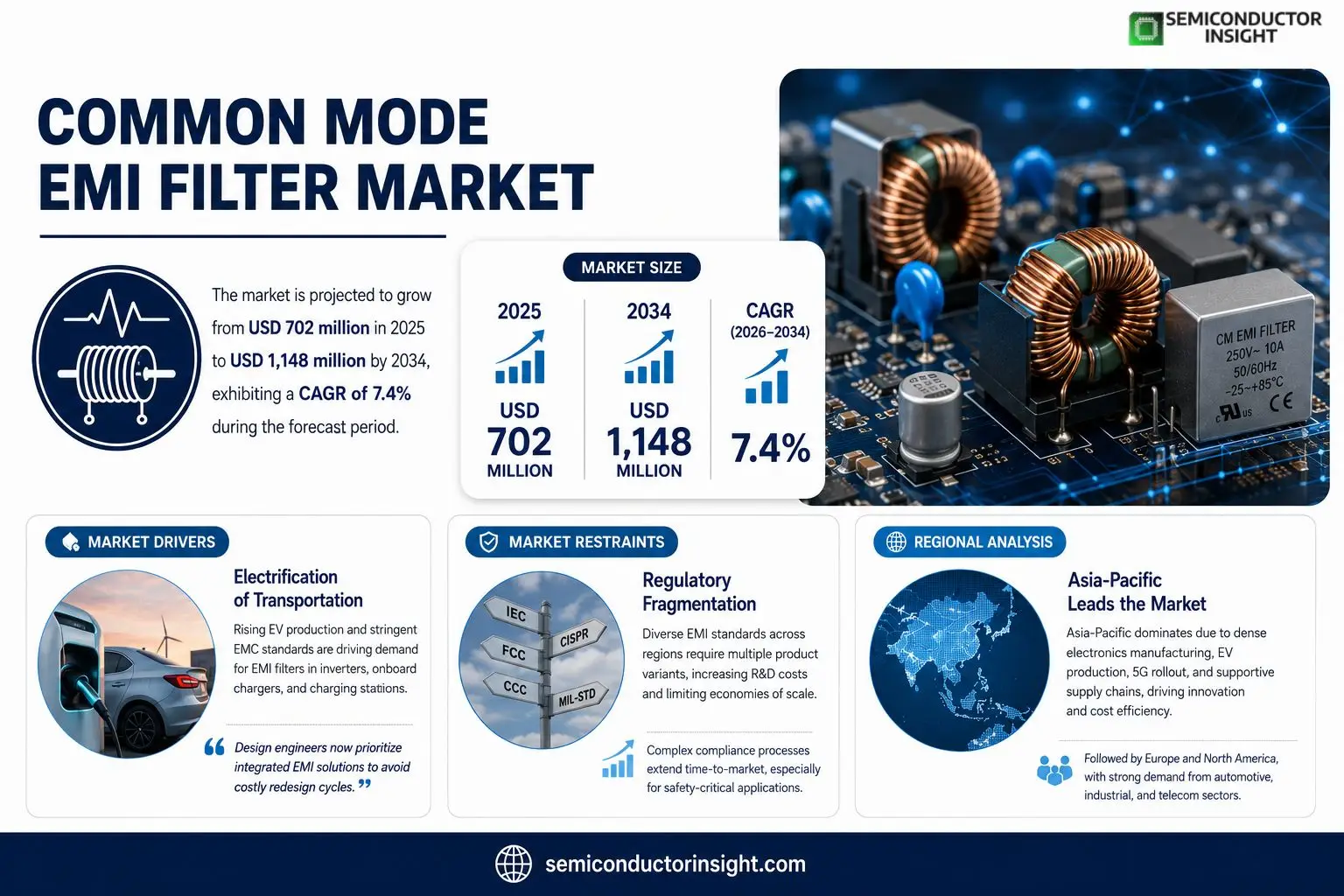
Common Mode EMI Filter market size was valued at USD 702 million in 2025. The market is projected to grow from USD 702 million in 2025 to USD 1,148 million by 2034, exhibiting a CAGR of 7.4 % during the forecast period.
A Common Mode EMI (Electromagnetic Interference) Filter is a passive component that suppresses common‑mode noiseunwanted signals that appear simultaneously on both conductors of a circuit. By presenting high impedance to common‑mode currents while allowing differential‑mode signals to pass, these filters preserve signal integrity, satisfy EMC regulations, and improve overall system reliability.The upward trend is driven by the proliferation of high‑speed data interfaces, rapid adoption of electric vehicles, deployment of 5G networks, and expansion of industrial automationall creating higher‑frequency electromagnetic disturbances that necessitate robust filtering solutions.
MARKET DRIVERS
Electrification of Transportation
Growth in electric‑vehicle production has pushed OEMs to tighten electromagnetic compatibility standards. Common Mode EMI Filter Market suppliers are witnessing heightened demand as manufacturers integrate filters directly into inverters and charging stations to meet stringent regulatory limits.
Industrial Automation Expansion
Factories adopting robotics and high‑speed drives generate dense current loops that aggravate common‑mode noise. The resulting need for reliable suppression solutions is encouraging capital allocation toward advanced filter designs, especially those offering compact form factors for space‑constrained panels.
➤ “Design engineers now prioritize integrated EMI solutions to avoid costly redesign cycles,” notes a senior product manager at a leading filter manufacturer.
Finally, the rollout of 5G infrastructure demands stringent EMI control across a broader frequency spectrum. Common Mode EMI Filter Market participants that can deliver broadband performance are positioned to capture a share of telecom‑related projects, reinforcing the upward trajectory of the sector.
MARKET CHALLENGES
Cost Sensitivity in Consumer Electronics
Mass‑market devices operate under tight Bill‑of‑Materials constraints. Even modest price increases for high‑performance filters can deter adoption, prompting manufacturers to seek low‑cost alternatives that may sacrifice long‑term reliability.
Other Challenges
Supply Chain Volatility
The reliance on specialty alloys and ceramic substrates makes Common Mode EMI Filter Market vulnerable to raw‑material shortages, leading to lead‑time extensions that can jeopardize time‑to‑market for new product launches.
MARKET RESTRAINTS
Regulatory Fragmentation
Diverse EMI standards across regions force suppliers to maintain multiple product variants. This complexity inflates R&D expenses and dilutes economies of scale, constraining overall market growth.Moreover, the certification process for safety‑critical applications such as aerospace can extend product introduction timelines by several months, discouraging smaller firms from entering Common Mode EMI Filter Market.Another restraint stems from the perception that passive filtering alone cannot meet emerging high‑frequency challenges, prompting end‑users to explore active mitigation techniques that bypass traditional filter offerings.
MARKET OPPORTUNITIES
Integration with Smart Grid Technologies
The transition toward resilient, digitally managed power distribution introduces new interfaces where common‑mode disturbances are prevalent. Companies that embed monitoring capabilities within filters can differentiate themselves and tap into utility‑scale contracts.Additionally, the surge in renewable‑energy installationsparticularly offshore wind farmscreates a niche for corrosion‑resistant, high‑temperature filters capable of operating in harsh environments, a segment currently undersupplied.Finally, partnerships with semiconductor firms developing GaN and SiC power devices present a pathway to co‑engineer filter solutions that align with the next generation of high‑efficiency converters, unlocking a forward‑looking revenue stream for Common Mode EMI Filter Market.
Common Mode EMI Filter Market Trends
High‑Speed Data Interfaces Elevate Filter Requirements
The surge of USB 3.x/4, HDMI 2.1, Thunderbolt 3/4 and Automotive Ethernet standards has turned data‑line design into a high‑frequency challenge. Each protocol operates at gigabit rates, where even modest common‑mode disturbances can corrupt packets or trigger latency spikes. Manufacturers therefore integrate specially tuned Common Mode EMI Filter components that present a steep impedance curve precisely around the critical frequency bands. This practice not only safeguards signal integrity but also reduces board‑level redesign cycles, a cost advantage that reverberates through consumer‑electronics OEMs and Tier‑1 automotive suppliers alike. The underlying driver is the market’s insistence on thinner profiles and higher port densities, which leaves little room for oversized passive solutions.
Other Trends
Automotive Electrification and Safety Systems
Electric‑vehicle powertrains now routinely employ 400 V to 800 V architectures, and inverter switching frequencies exceed 20 kHz. Such environments generate intense common‑mode currents that jeopardize radar, LiDAR, camera modules and CAN/LIN/Ethernet networks essential for ADAS functionality. Deploying high‑current, low‑profile common‑mode chokes directly at the inverter output mitigates cross‑talk between power and safety domains, enabling compliance with stringent automotive EMC standards. Suppliers that can guarantee temperature stability up to 150 °C while maintaining low insertion loss are gaining preferential treatment in EV platform selections, translating into a clear competitive edge for component makers.
5G Rollout and Smart Manufacturing
The expansion of 5G infrastructure introduces millimeter‑wave front‑ends and dense small‑cell deployments that push filter design toward the 24 GHz and 60 GHz windows. In tandem, Industry 4.0 factories are populated with variable‑frequency drives, robotic arms and high‑power welding stations, each a potent source of electromagnetic noise. By embedding broadband Common Mode EMI Filter modules into power distribution units and sensor gateway boards, system integrators can preserve deterministic control loops and meet increasingly tight emission limits. The convergence of these two forcestelecom‑grade filtering and ruggedized industrial solutionscreates a dual‑track growth path that encourages cross‑segmentation product development and allocates additional R&D budget across the supply chain.
COMPETITIVE LANDSCAPE
Key Industry Players
Competitive Landscape of the Common Mode EMI Filter Market
The market is heavily anchored by a small cohort of Japanese manufacturers whose product portfolios span the full spectrum of filter topologies, from low‑frequency power‑line chokes to high‑frequency surface‑mount devices for 5G base‑station modules. Murata and TDK together account for a sizable share of worldwide shipments, leveraging deep R&D capabilities and a supply chain that satisfies automotive OEMs, telecom equipment makers, and consumer‑electronics assemblers alike. Their dominance reflects a strategic emphasis on miniaturization and materials innovationefforts that translate into higher impedance per unit volume and enable compliance with tightening EMC regulations across major regions.Beyond the two titans, a constellation of specialized firms competes on niche performance attributes or regional market access. Companies such as YAGEO, Würth Elektronik, and Bourns focus on high‑frequency SMD solutions tailored for data‑center interconnects, while Pulse Electronics and Coilcraft excel in custom‑wound power‑line chokes that meet the stringent noise‑suppression requirements of electric‑vehicle drivetrains. Meanwhile, KYOCERA AVX, Laird Performance Materials, Nexperia, STMicroelectronics, and TAIYO YUDEN diversify the field with offerings that blend ferrite‑core advances with automotive‑grade reliability, allowing them to capture segments that demand both ruggedness and compact form factor.
List of Key Common Mode EMI Filter Companies Profiled
- Murata Manufacturing Co., Ltd.
- TDK Corporation
- YAGEO Corporation
- Würth Elektronik Group
- TAIYO YUDEN Co., Ltd.
- Bourns, Inc.
- Pulse Electronics Corp.
- Coilcraft Inc.
- KYOCERA AVX Corporation
- Laird Performance Materials Ltd.
- Nexperia NV
- STMicroelectronics N.V.
Segment Analysis:
| Segment Category | Sub-Segments | Key Insights |
| By Type |
|
Data Line
|
| By Application |
|
Telecommunications
|
| By End User |
|
Automotive
|
| By Mounting Type |
|
Surface Mount (SMD)
|
| By Material Type |
|
Ferrite Core
|
Regional Analysis: Common Mode EMI Filter Market
Asia-Pacific
High‑mix, low‑volume production lines in Vietnam and Malaysia generate steady orders for compact filter modules, while high‑throughput fabs in Taiwan focus on wafer‑level integration, allowing suppliers to address both mass‑market and niche applications without sacrificing economies of scale.
Recent revisions to IEC 61000‑4‑6 in the region have lowered permissible emission limits for automotive infotainment units, compelling manufacturers to source filters with tighter attenuation curves, thereby elevating the technical bar across the supply chain.
Proximity between raw‑material miners in Indonesia and assembly plants in China shortens lead times, while diversified sourcing strategies mitigate the impact of geopolitical disruptions, ensuring continuity for critical filter components.
Growth in renewable‑energy inverters and high‑speed rail electrification across the region creates new demand vectors for rugged, high‑frequency filters that can operate under elevated temperature and vibration profiles.
North America
In the United States and Canada, Common Mode EMI Filter Market is shaped by a mature automotive sector that increasingly adopts electric‑vehicle platforms. OEMs are integrating filters earlier in the vehicle architecture to satisfy federal EMC directives, a shift that lifts the bar for component reliability. Meanwhile, the industrial automation segment leans on filters to safeguard high‑precision robotics from transient interference. Innovation clusters in Michigan and California provide a pipeline of design‑for‑compliance tools, encouraging suppliers to deliver performance‑optimized solutions that align with the continent’s emphasis on safety‑critical applications. The competitive landscape is fragmented, with several mid‑size firms differentiating through rapid prototyping capabilities and strategic partnerships with silicon‑chip designers.
Europe
European manufacturers confront a rigorous regulatory framework, notably the EU EMC Directive, which compels tighter control over radiated emissions in both consumer electronics and railway signalling equipment. This environment fuels demand for filters that can be seamlessly embedded into compact printed‑circuit‑board footprints. German and French automotive suppliers are pursuing platform‑agnostic designs to reduce redesign costs across multiple vehicle models, prompting filter vendors to offer modular product families. Sustainability pressures also drive interest in recyclable filter housings, nudging the market toward environmentally conscious solutions without compromising attenuation performance.
South America
In Brazil and Argentina, expanding renewable‑energy projects and a gradual shift toward electric public transport are the primary catalysts for filter adoption. Local OEMs, while still price‑sensitive, recognize that integrating high‑quality filters early can mitigate warranty claims linked to electromagnetic disturbances. Government incentives for clean‑energy infrastructure encourage manufacturers to source components domestically, creating an emerging ecosystem of niche filter producers that focus on low‑frequency suppression suitable for power‑conversion equipment.
Middle East & Africa
The Middle East’s fast‑growing data‑center footprint, coupled with large‑scale oil‑field automation, creates a distinctive demand profile for Common Mode EMI Filter Market. Operators prioritize filters that can endure high ambient temperatures and dust‑laden environments, leading suppliers to develop ruggedized enclosures. In Africa, nascent telecom roll‑outs and renewable‑energy micro‑grids generate modest but steady orders, with an emphasis on cost‑effective solutions that still meet basic EMC standards. Regional trade agreements are beginning to lower tariffs, allowing a broader range of filter technologies to enter these markets.
Report Scope
This market research report provides a comprehensive analysis of the Common Mode EMI Filter Market , covering the forecast period 2026–2034. It offers detailed insights into market dynamics, technological advancements, competitive landscape, and key trends shaping the industry.
Key focus areas of the report include:
- Market Overview: The report begins with an overview outlining its current market scenario, key growth indicators, and industry transformation drivers. It discusses macroeconomic factors, demand–supply balance, regulatory landscape, and the strategic role of semiconductors in powering advancements across industries such as automotive, telecommunications, consumer electronics, and industrial automation.
- Market Size & Forecast: Historical data and future projections for revenue, unit shipments, and market value across major regions and segments.
- Segmentation Analysis: Detailed breakdown by product type, technology, application, and end-user industry to identify high-growth segments and investment opportunities.
- Regional Insights: Insights into market performance across North America, Europe, Asia-Pacific, Latin America, and the Middle East & Africa, including country-level analysis where relevant.
- Competitive Landscape: Profiles of leading market participants, including their product offerings, R&D focus, manufacturing capacity, pricing strategies, and recent developments such as mergers, acquisitions, and partnerships.
- Technology Trends & Innovation: Assessment of emerging technologies, integration of AI/IoT, semiconductor design trends, fabrication techniques, and evolving industry standards.
- Market Drivers & Restraints: Evaluation of factors driving market growth along with challenges, supply chain constraints, regulatory issues, and market-entry barriers.
- Stakeholder Insights: Insights for component suppliers, OEMs, system integrators, investors, and policymakers regarding the evolving ecosystem and strategic opportunities.
Primary and secondary research methods are employed, including interviews with industry experts, data from verified sources, and real-time market intelligence to ensure the accuracy and reliability of the insights presented.
FREQUENTLY ASKED QUESTIONS:
What is the current market size of Common Mode EMI Filter Market?
-> Common Mode EMI Filter Market was valued at USD 702 million in 2025 and is expected to reach USD 1,148 million by 2034, at a CAGR of 7.4%.
Which key companies operate in Common Mode EMI Filter Market?
-> Key players include Murata, TDK, YAGEO, Würth Elektronik, TAIYO YUDEN, Bourns, Pulse Electronics, Coilcraft, KYOCERA AVX, Laird Performance Materials, Nexperia, and STMicroelectronics, among others.
What are the key growth drivers?
-> Key growth drivers include the rapid adoption of high‑speed data interfaces (USB 3.x/4, HDMI 2.1, Thunderbolt, Automotive Ethernet), the transition to electric and hybrid vehicles with high‑voltage powertrains, the rollout of 5G networks, and the expansion of industrial automation and Industry 4.0 deployments.
Which region dominates the market?
-> Asia‑Pacific is the fastest‑growing region and holds the largest market share, while Europe remains a dominant market in terms of mature applications.
What are the emerging trends?
-> Emerging trends include miniaturized surface‑mount (SMD) filter designs for compact consumer electronics, stricter EMC regulatory standards driving higher performance requirements, and the proliferation of IoT devices that increase demand for efficient, low‑power common mode filtering solutions.
Get Sample Report PDF for Exclusive Insights
Report Sample Includes
- Table of Contents
- List of Tables & Figures
- Charts, Research Methodology, and more...
 Download Sample Report PDF