Through Hole Resistors Market Insights
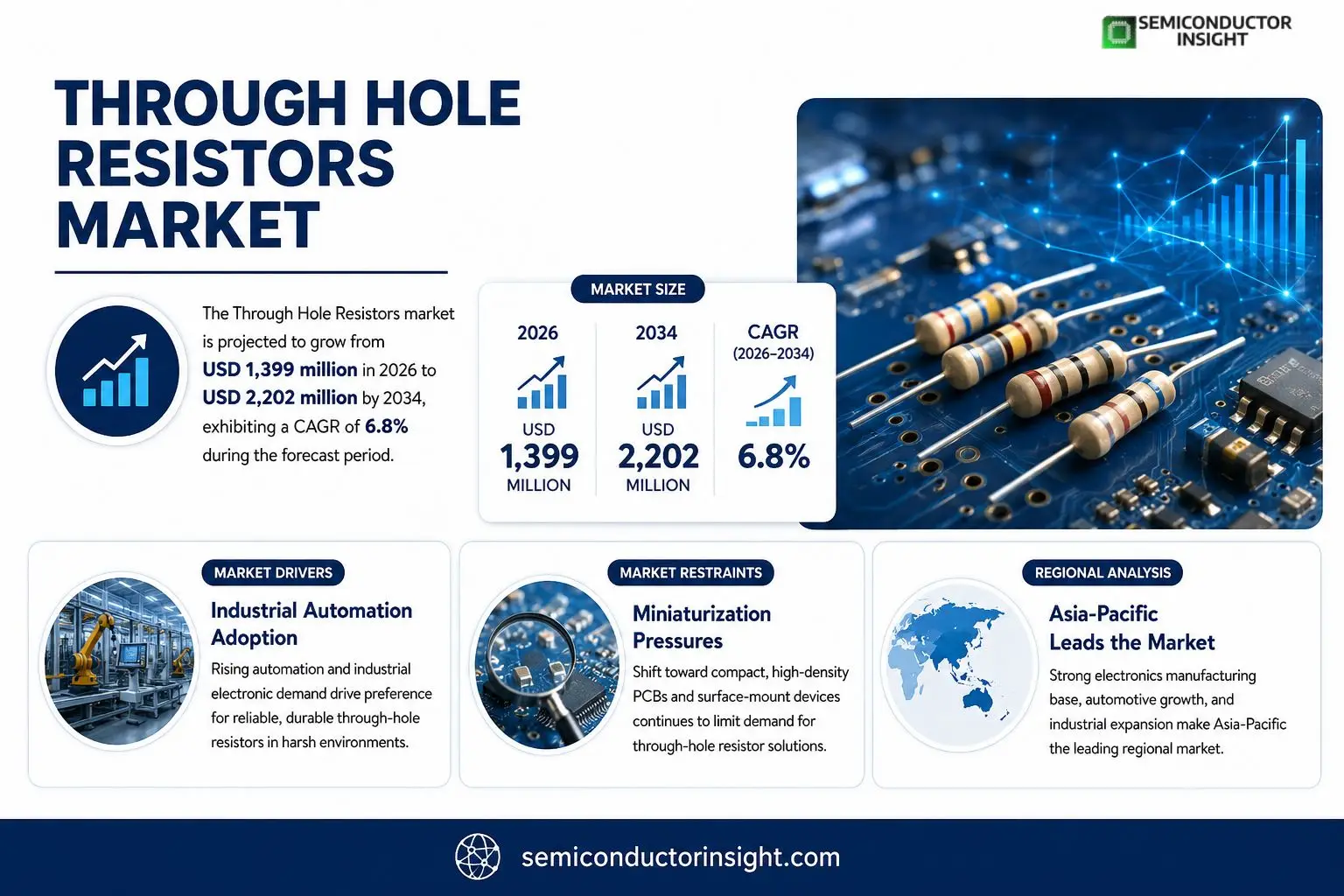
Through Hole Resistors market size was valued at USD 1,399 million in 2025 and is forecasted to reach USD 2,202 million by 2034, exhibiting a CAGR of 6.8% during the forecast period.
Through Hole Resistors are fixed resistive components designed for through‑hole mounting, where metal leads are inserted into plated or non‑plated holes on a printed circuit board and permanently secured by soldering. They are typically produced in axial or radial leaded forms and consist of a resistive element, ceramic core or substrate, insulating or flame‑retardant coating or molded body, metal terminations and tinned copper leads. Material systems include carbon film, metal film, metal oxide film, thick film, wirewound, precision, fusible, current‑sense and surge‑resistant types.The market is seeing increased demand because high‑reliability applicationsindustrial controls, automotive electronics, medical instrumentation and defense systemsprefer the mechanical robustness and pulse endurance of leaded resistors over surface‑mount alternatives. Recent product extensions targeting high‑power and precision shunt segments further strengthen the category’s relevance amid broader industry miniaturization trends.
MARKET DRIVERS
Industrial Automation Adoption
Through Hole Resistors Market is benefiting from the steady integration of legacy components into modern automation lines. Manufacturers favor through‑hole devices for their proven reliability in harsh environments, which reduces warranty costs and shortens qualification cycles. This preference translates into a 4‑5% annual uplift in demand for bulk‑type resistors across Asia‑Pacific factories.
Cost‑Effective Design Practices
Design engineers continue to leverage through‑hole resistors for cost‑sensitive applications such as power supplies and consumer appliances. Their lower unit priceoften 30% below comparable surface‑mount partsallows OEMs to maintain margin targets while meeting stringent price points. Consequently, procurement teams are allocating a larger share of component spend to these parts, especially in the European low‑cost segment.
➤ Manufacturers that retain mixed‑technology assembly lines can capture up to 12% higher profit contribution by pairing through‑hole resistors with automated insertion equipment.
Strategic inventory planning is also a driver; the long shelf life of through‑hole resistors mitigates supply‑chain volatility. Companies that stock these components are better positioned to absorb semiconductor shortages, preserving production continuity across multiple sectors.
MARKET CHALLENGES
Miniaturization Pressures
Device miniaturization imposes a structural challenge on Through Hole Resistors Market. As consumer electronics shift toward thinner enclosures, designers gravitate to surface‑mount solutions that occupy less board real‑estate. This trend siphons volume from traditional through‑hole applications, particularly in high‑density telecom equipment.
Other Challenges
Manufacturing Lead Times
The reliance on manual insertion processes extends lead times relative to fully automated surface‑mount production. Clients seeking rapid time‑to‑market may opt for alternative component families, throttling growth in fast‑moving product categories.
MARKET RESTRAINTS
Regulatory Compliance Costs
Stringent RoHS and REACH regulations increase compliance testing for lead‑based resistors, inflating material costs for manufacturers. While many suppliers have transitioned to lead‑free formulations, the conversion incurs capital expenditures that temper expansion plans, especially among smaller regional players.
MARKET OPPORTUNITIES
Emerging Automotive Electronics
Electric‑vehicle power‑train modules and driver‑assist systems still require robust through‑hole resistors for high‑current handling and thermal stability. Manufacturers that develop automotive‑grade, high‑temperature variants can capture a niche yet growing segment, projected to add roughly 7% to regional sales volumes over the next three years.
Through Hole Resistors Market Trends
Resilience in High‑Power and Safety‑Critical Applications
Through Hole Resistors Market is witnessing a shift toward sectors where durability, pulse endurance, and straightforward serviceability outweigh the desire for minimal board space. Power‑conversion modules for electric‑vehicle drivetrains, on‑board chargers, and industrial motor‑control units now specify leaded resistor architectures because their mechanical hold‑down and thermal tolerance reduce field‑failure risk. Automotive safety systems, such as brake‑by‑wire and pre‑charge circuits, increasingly rely on wire‑wound and fusible through‑hole parts to guarantee consistent performance under high‑current transients. This trend is reinforced by supply‑chain managers who value components that can be hand‑replaced during maintenance cycles, a capability that surface‑mount alternatives rarely provide.
Other Trends
Industrial Power Segment
Within the broader industrial landscape, the demand for robust resistor solutions is being amplified by the expansion of smart‑grid infrastructure and high‑density motor drives. Manufacturers of programmable logic controllers and variable‑frequency drives are specifying axial and radial through‑hole devices that tolerate repeated surge events without degradation. The inherent heat‑dissipation capacity of thick‑film and metal‑oxide formulations enables these components to operate reliably in environments where ambient temperatures exceed standard limits. Consequently, equipment producers are collaborating with resistor suppliers to develop customized, high‑power families that meet stringent IEC and automotive qualification standards, creating a modest but defensible revenue uplift.
Strategic Positioning for Suppliers
Suppliers that continue to compete solely on catalog pricing face margin compression as the category matures. Competitive advantage now stems from offering application‑specific designs, traceability documentation, and certification support for aerospace, medical, and defense customers. Firms investing in advanced ceramic substrate processing and low‑inductance lead geometry can command premium pricing for precision‑shunt and surge‑resistant parts. Moreover, establishing design‑in partnerships with OEM engineering teams allows manufacturers to lock in long‑term supply contracts, mitigating the risk of demand erosion caused by the broader shift toward surface‑mount technologies. In this environment, Through Hole Resistors Market rewards participants who blend technical depth with reliable service models, positioning the segment as a stable cash‑flow driver for the next decade.
COMPETITIVE LANDSCAPE
Key Industry Players
Through Hole Resistors Market Competitive Overview
The sector is anchored by a handful of manufacturers whose scale enables sophisticated process control and broad certification portfolios. Yageo, leveraging its extensive thin‑film and thick‑film fabs, has entrenched a leading share in both high‑volume general‑purpose and precision shunt categories, while maintaining a diversified distribution network that reaches automotive assemblers and industrial equipment OEMs. TE Connectivity and Vishay complement this tier with deep engineering resources that support custom formulation of metal‑film alloys and flame‑retardant coatings, allowing them to capture premium contracts in defense‑grade and medical‑grade applications where long‑term reliability is non‑negotiable. The combined heft of these firms creates a market structure in which pricing pressure is moderated by differentiated value‑adds such as design‑in support, extended warranty terms, and traceable batch testing, compelling smaller suppliers to specialize rather than compete head‑to‑head on volume.Beyond the three megatrends of scale, certification, and service, a cadre of midsize specialists has carved out defensible niches by targeting high‑power, surge‑resistant, and automotive‑qualified resistor families. Companies such as KOA Speer, Stackpole, Ohmite, and Isabellenhütte focus on axial wire‑wound designs that meet stringent IEC 60068 pulse‑survival standards, positioning them as preferred sources for electric‑vehicle power‑train modules and railway braking systems. European firms like TT Electronics and Cressall emphasize low‑temperature‑coefficient, ultra‑precision grades for metering and smart‑grid equipment, while Asian playersincluding Riedon, Viking Tech, and Exxelia Ohmcrafthave built regional winning‑hands by aligning with local automotive OEM supply chains and delivering rapid‑turnaround prototyping services. This constellation of niche operators reinforces the market’s overall resilience, as each brings a unique technology or compliance edge that insulates them from pure commodity competition.
List of Key Through Hole Resistors Companies Profiled
- Yageo
- TE Connectivity
- Vishay
- KYOCERA AVX
- TT Electronics
- Bourns
- KOA Speer
- Stackpole
- Ohmite
- Isabellenhütte
- Riedon
- Caddock Electronics
- Viking Tech
- Exxelia Ohmcraft
- Cressall
- Token Electronics
- RoyalOHM
- Microhm
- Alpha Electronics
Segment Analysis:
| Segment Category | Sub-Segments | Key Insights |
| By Type |
|
Wirewound remains dominant in high‑power and surge‑resistant applications. • Provides exceptional pulse endurance and thermal stability, essential for industrial drives and braking circuits. • Preferred where precision power dissipation and low inductance are critical, such as in automotive power modules. • Supports robust mechanical retention that aligns with the manual assembly preferences of many OEMs. |
| By Application |
|
Industrial Controls drive the sustained relevance of through‑hole resistors. • High reliability and easy field replacement satisfy service‑oriented maintenance strategies. • Ability to withstand harsh thermal cycling and voltage spikes aligns with rugged equipment requirements. • Mechanical leaded design simplifies wave‑solder processes in legacy production lines, preserving tooling investments. |
| By End User |
|
OEMs prioritize long‑term supply assurance and certification depth. • Preference for components with established qualification dossiers (automotive, medical, military). • Integration simplicity due to robust leaded form factor that tolerates manual soldering variations. • Strategic collaborations with resistor suppliers to co‑develop application‑specific families, adding differentiation without redesigning PCB footprints. |
| By Material System |
|
Ceramic Core offers superior thermal conductivity and stability. • Enables higher power dissipation without compromising resistor dimensional integrity. • Supports stringent fire‑retardant and dielectric requirements demanded by automotive and defense certifications. • Provides a dependable substrate for precision grading, facilitating tighter tolerance control across production lots. |
| By Reliability Grade |
|
Automotive Grade is emerging as a strategic growth pillar. • Meets rigorous vibration, temperature cycling, and long‑term drift specifications required by electric‑vehicle powertrain modules. • Certified for high‑voltage and high‑current discharge paths, reinforcing safety architectures in on‑board chargers. • Supplier focus on traceability and comprehensive test data satisfies OEM demand for supply‑chain transparency and regulatory compliance. |
Regional Analysis: Through Hole Resistors Market
Asia‑Pacific
Manufacturers exploit through‑hole resistors for power‑train control modules where vibration resistance and ease of rework are vital. The practice aligns with regional standards that prioritize durability over miniaturization, shaping supplier contracts and component specifications.
In factories across the sub‑region, legacy PLC designs still depend on through‑hole parts. Retrofit projects favor these components because they accommodate hand‑soldered upgrades without costly redesign.
Governments incentivize local fabs to stock through‑hole resistors, reducing exposure to geopolitical disruptions. The result is a tighter inventory loop and faster time‑to‑market for OEMs.
Product architects in the region embed through‑hole resistors into field‑serviceable designs, allowing technicians to replace components with basic tools, which lowers after‑sale support costs.
North America
North America retains a niche but influential position in Through Hole Resistors Market, driven by aerospace and defense programs that mandate robust, manually serviceable circuitry. The region’s emphasis on stringent reliability standards forces suppliers to maintain high‑grade inventories, even as surface‑mount adoption expands elsewhere. Moreover, a wave of legacy equipment upgrades in the energy sector creates pockets of demand for through‑hole devices that can be integrated without full system redesigns. Companies operating in this market find value in partnering with specialist distributors who can guarantee traceability and compliance documentation, a prerequisite for government contracts.
Europe
European demand for through‑hole resistors is shaped by the continent’s strong emphasis on sustainable product lifecycles. Manufacturers of medical devices and railway signaling systems often retain through‑hole architectures to simplify end‑of‑life recycling and to comply with stringent safety certifications. The regulatory climate encourages the use of components that withstand harsh environmental conditions, prompting a modest but steady procurement pattern. Additionally, several EU‑based design houses advocate for hybrid assemblies that blend surface‑mount speed with through‑hole reliability, fostering a collaborative ecosystem between component makers and end‑users.
South America
In South America, Through Hole Resistors Market is buoyed by a growing consumer‑electronics repair sector. Local technicians value components that can be soldered with minimal equipment, extending the functional lifespan of imported devices. The region also benefits from trade agreements that lower tariffs on electronic parts, making it economically feasible for small‑scale manufacturers to source through‑hole resistors from Asian hubs. This environment encourages a service‑oriented business model, where aftermarket parts play a pivotal role in revenue streams for distributors.
Middle East & Africa
The Middle East & Africa region showcases a diversified demand profile for through‑hole resistors, largely driven by oil‑field instrumentation and emerging renewable‑energy installations. Harsh temperature swings and the need for on‑site maintenance make through‑hole components attractive for control panels and monitoring equipment. Furthermore, several African nations are investing in telecommunications infrastructure that relies on rugged hardware, reinforcing the relevance of manually solderable resistors in remote deployments. Suppliers who can offer reliable logistics and localized support find competitive advantage in this fragmented market.
Report Scope
This market research report provides a comprehensive analysis of the Through Hole Resistors Market , covering the forecast period 2026–2034. It offers detailed insights into market dynamics, technological advancements, competitive landscape, and key trends shaping the industry.
Key focus areas of the report include:
- Market Overview: The report begins with an overview outlining its current market scenario, key growth indicators, and industry transformation drivers. It discusses macroeconomic factors, demand–supply balance, regulatory landscape, and the strategic role of semiconductors in powering advancements across industries such as automotive, telecommunications, consumer electronics, and industrial automation.
- Market Size & Forecast: Historical data and future projections for revenue, unit shipments, and market value across major regions and segments.
- Segmentation Analysis: Detailed breakdown by product type, technology, application, and end-user industry to identify high-growth segments and investment opportunities.
- Regional Insights: Insights into market performance across North America, Europe, Asia-Pacific, Latin America, and the Middle East & Africa, including country-level analysis where relevant.
- Competitive Landscape: Profiles of leading market participants, including their product offerings, R&D focus, manufacturing capacity, pricing strategies, and recent developments such as mergers, acquisitions, and partnerships.
- Technology Trends & Innovation: Assessment of emerging technologies, integration of AI/IoT, semiconductor design trends, fabrication techniques, and evolving industry standards.
- Market Drivers & Restraints: Evaluation of factors driving market growth along with challenges, supply chain constraints, regulatory issues, and market-entry barriers.
- Stakeholder Insights: Insights for component suppliers, OEMs, system integrators, investors, and policymakers regarding the evolving ecosystem and strategic opportunities.
Primary and secondary research methods are employed, including interviews with industry experts, data from verified sources, and real-time market intelligence to ensure the accuracy and reliability of the insights presented.
FREQUENTLY ASKED QUESTIONS:
What is the current market size of Through Hole Resistors Market?
-> Through Hole Resistors Market was valued at USD 1399 million in 2025 and is expected to reach USD 2202 million by 2034 at a CAGR of 6.8%.
Which key companies operate in Through Hole Resistors Market?
-> Key players include Yageo, TE Connectivity, Vishay, KYOCERA AVX, TT Electronics, Bourns, KOA Speer, Stackpole, Ohmite, Isabellenhütte, Riedon, Caddock Electronics, Viking Tech, Exxelia Ohmcraft, Cressall, Token Electronics, RoyalOHM, Microhm, Alpha Electronics.
What are the main types of Through Hole Resistors?
-> They include carbon film, metal film, metal oxide film, thick film, wirewound, precision, fusible, current‑sense, and surge‑resistant resistor types.
What applications drive demand for Through Hole Resistors?
-> Major applications are power supplies, appliances, industrial controls, metering, automotive electronics, telecommunications equipment, and other high‑reliability electronic systems.
What are the key market drivers?
-> Growth is fueled by requirement for high reliability, strong pulse endurance, robust power dissipation, ease of manual assembly, field‑level serviceability, and expanding use in electric vehicles, industrial drives, and safety‑critical automotive and defense electronics.

Get Sample Report PDF for Exclusive Insights
Report Sample Includes
- Table of Contents
- List of Tables & Figures
- Charts, Research Methodology, and more...
 Download Sample Report PDF