Power Bead Inductors Market Insights
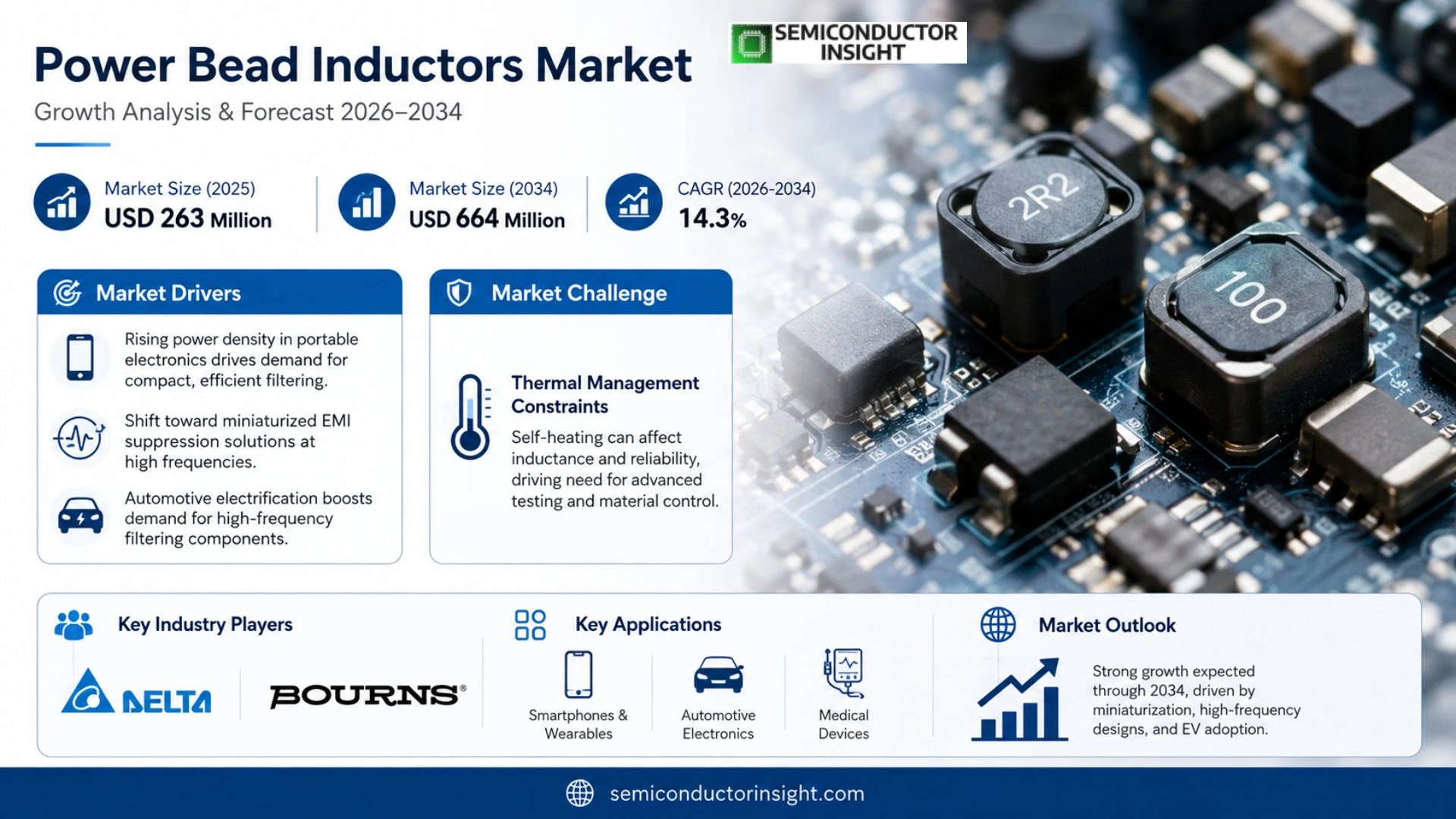
Power Bead Inductors market size was valued at USD 263 million in 2025 and is projected to reach USD 664 million by 2034, exhibiting a CAGR of 14.3% during the forecast period.
Power bead inductors are low‑inductance, low‑DC‑resistance magnetic components engineered for high‑current paths. They store energy, smooth current, suppress ripple and electromagnetic interference, and are deployed in multiphase buck converters, voltage‑regulator modules, point‑of‑load supplies and high‑frequency DC‑DC converters across CPUs, GPUs, ASICs, FPGAs, memory modules and automotive power systems. Designs typically combine ferrite or metal‑composite cores with winding, flat‑wire or dual‑winding structures, emphasizing ultra‑low DCR, high saturation current and compact surface‑mount packages.
The expansion of AI servers, data‑center accelerators and high‑performance graphics platforms fuels demand for these inductors because higher current density amplifies losses if conventional parts are used. Major suppliers such as Delta Electronics, Bourns, TDK and Murata have broadened their portfolios with TLVR‑compatible series and introduced materials that lower AC loss while supporting higher temperature rise currents. Automotive electrification and industrial power supplies add a steady downstream pull, prompting manufacturers to pursue AEC‑Q200 certification and customized design services.
MARKET DRIVERS
Increasing Power Density Requirements in Portable Electronics
The surge in high‑performance smartphones, wearables, and compact medical devices forces designers to pack more functionality into tighter footprints. As battery chemistry improves, manufacturers push circuits to operate at higher voltages while maintaining low‑profile form factors. Power Bead Inductors become indispensable because they combine filtering and size reduction in a single component, allowing system‑level engineers to meet aggressive power‑density targets without sacrificing reliability.
Shift Toward Miniaturized EMI Suppression Solutions
Electromagnetic interference (EMI) concerns have migrated from legacy board‑level chokes to component‑level beads as frequencies climb into the gigahertz range. Miniaturized inductive beads provide localized suppression, reduce loop area, and simplify layout verification. This transition fuels demand for specially formulated ferrite powders that retain inductance at high frequencies, prompting several OEMs to redesign product lines around these newer beads.
➤ Automotive electrification, especially in electric‑vehicle power‑train modules, accelerates the integration of high‑frequency filtering components.
Beyond consumer gadgets, the automotive sector’s move toward 48 V architectures and on‑board chargers creates a parallel need for compact, high‑current beads. Suppliers that can deliver temperature‑stable performance under automotive load‑cycle conditions are positioned to capture a growing slice of Power Bead Inductors Market.
MARKET CHALLENGES
Thermal Management Constraints
When inductive beads carry several amperes of current, self‑heating becomes a critical design variable. Excess temperature not only shifts inductance values but can also accelerate ferrite degradation, leading to premature failure. Engineers therefore demand detailed thermal characterisation, which pushes manufacturers to invest in advanced testing rigs and tighter material controls.
Other Challenges
Supply Chain Volatility
Global shortages of high‑purity ferrite powders and copper conductors have introduced lead‑time uncertainty. Companies that maintain diversified sourcing strategies or develop in‑house powder synthesis capabilities can mitigate these disruptions, while others risk losing price competitiveness.
MARKET RESTRAINTS
High Material Cost Sensitivity
The premium alloys and specialty ferrites required for high‑frequency, high‑current beads drive unit costs upward. End‑users operating under tight Bill‑of‑Materials (BOM) constraints frequently favor cheaper alternative topologies, such as planar shields or integrated filter ICs, thereby throttling overall market expansion.
MARKET OPPORTUNITIES
Adoption of Wide‑Bandgap Materials
Emerging wide‑bandgap semiconductor platforms (SiC, GaN) operate at higher switching frequencies, exposing new EMI challenges that conventional beads struggle to address. Developing beads compatible with these frequencies, through nano‑engineered ferrite composites or hybrid ceramic‑metal structures, opens a lucrative niche. Early entrants that secure patents on such materials stand to gain a decisive advantage in the evolving Power Bead Inductors Market.
Power Bead Inductors Market Trends
Efficiency‑Focused Design for High‑Current Platforms
The surge in AI‑driven data‑center deployments has reshaped component selection criteria across Power Bead Inductors Market. Engineers now prioritize inductors that combine ultra‑low DCR with high saturation currents to curb conduction losses in multi‑phase buck converters powering GPUs and ASICs. By minimizing voltage drop at the component level, system‑level efficiency improves, allowing higher compute density within the same thermal envelope. This shift is not merely a cost‑optimization exercise; it directly influences server rack power budgets and cooling infrastructure sizing. As a result, suppliers that can certify low‑loss ferrite or metal‑composite cores while maintaining a compact, surface‑mount footprint are gaining preferred‑vendor status among hyperscale OEMs.
Other Trends
Automotive Power‑Electronics Migration
Electrified vehicle architectures are expanding the addressable volume for Power Bead Inductors Market beyond traditional computing. On‑board DC‑DC converters for traction inverters and high‑voltage battery management systems now demand inductors that survive extended temperature cycles and meet AEC‑Q200 reliability standards. Manufacturers responding with automotive‑grade packaging, such as extended‑temperature epoxy encapsulation and RoHS‑compliant alloys, are positioning themselves to capture this emerging segment. The transition also forces design teams to balance magnetic shielding against electromagnetic compatibility requirements, creating a niche where material science and reliability testing become decisive differentiators.
Supply‑Chain Diversification and Material Innovation
Geopolitical pressures and recent semiconductor shortages have prompted key players in Power Bead Inductors Market to broaden their manufacturing footprint. Facilities in Southeast Asia are being upgraded to support both ferrite‑core and metal‑composite production lines, reducing lead‑time exposure for North American and European customers. Concurrently, research collaborations with university labs are accelerating the adoption of nanocrystalline alloys that promise lower AC loss without sacrificing saturation current. These material advances enable thinner profiles suitable for high‑frequency DC‑DC converters in compact edge‑computing devices, while the more resilient supply network mitigates the risk of single‑source dependencies. Companies that integrate these innovations into their portfolio are likely to secure design‑win opportunities across data‑center, automotive, and industrial applications.
COMPETITIVE LANDSCAPE
Key Industry Players
Power Bead Inductors: Competitive Dynamics in High‑Current Power Architecture
Delta Electronics and Bourns dominate the upper tier of the Power‑Bead market by coupling extensive ferrite‑core libraries with aggressive low‑DCR material programs. Their ability to qualify components under automotive AEC‑Q200 and data‑center IATF16949 standards gives them preferred‑supplier status among OEMs that design multi‑phase buck converters for AI servers and high‑performance GPUs. TDK and Murata complement this core with sophisticated metal‑composite cores that enable sub‑millimeter footprints while sustaining currents above 30 A, a critical factor for board‑space constrained VRM modules. These four firms leverage global distribution networks, maintain design‑win teams embedded in major silicon vendors, and offer volume‑ramp guarantees that lower total‑cost‑of‑ownership for end‑users. Consequently, the market exhibits a tiered structure where the top quartile captures the bulk of high‑value contracts, leaving margin‑sensitive applications to specialized suppliers.
Beyond the tier‑one cluster, a constellation of niche manufacturers supplies differentiated solutions that address emerging segments such as automotive electrification, industrial drives, and edge‑computing platforms. YAGEO, ABC ATEC, and Mentech focus on custom‑wound, shielded beads that meet stringent temperature‑rise and lifetime specifications demanded by EV on‑board DC‑DC converters. Gotrend and Feng‑Jui target the Chinese and Taiwanese motherboard ecosystem, offering cost‑effective flat‑wire designs that fit dense power‑plane layouts. GB International and Shenzhen Codaca expand the addressable pool by certifying products for IEC‑60730 and RoHS, positioning themselves for renewable‑energy storage and communication‑infrastructure deployments. These players differentiate through rapid prototyping, localized support, and flexible lot‑size agreements, allowing them to capture projects where the top tier’s scale‑focused offerings are less competitive.
List of Key Power Bead Inductors Companies Profiled
- Delta Electronics, Inc.
- Bourns, Inc.
- TDK Corporation
- Murata Manufacturing Co., Ltd.
- TAIYO YUDEN CO., LTD.
- Samsung Electro‑Mechanics Co., Ltd.
- Coilcraft, Inc.
- Abracon LLC
- YAGEO Corporation
- ABC ATEC
- Mentech (Dongguan Mentech Optical & Magnetic Co., Ltd.)
- Feng‑Jui Technology Co., Ltd.
- GB International
- Shenzhen Codaca Electronic Co., Ltd.
- GOTREND Technology Co., Ltd.
Segment Analysis:
| Segment Category | Sub-Segments | Key Insights |
| By Type |
|
Standard Power Bead Inductor
|
| By Application |
|
Server & AI Data Center
|
| By End User |
|
Data Center Operators
|
| By Material |
|
Ferrite Core
|
| By Architecture |
|
Dual‑Winding TLVR
|
Regional Analysis: Power Bead Inductors Market
Europe
The German and Czech valleys host clusters where precision winding equipment and automated testing stations operate at scale, delivering low‑loss beads that satisfy high‑frequency demands. Proximity to key component suppliers shortens lead times, allowing regional firms to respond swiftly to design tweaks.
EU directives on electromagnetic compatibility compel designers to integrate power‑bead solutions that mitigate conducted emissions. Compliance pressures have turned the component into a default design element rather than an after‑thought, expanding its scope across multiple product families.
Beyond automotive, the market draws vigor from renewable‑energy inverters and high‑density data‑center power modules. Each segment values the bead’s ability to combine filtering and inductance within a minimal footprint, which aligns with the region’s push toward compact, efficient hardware.
Recent geopolitical shifts prompted European producers to diversify raw‑material sources, mitigating reliance on single‑origin copper imports. This strategic sourcing safeguards production continuity and reassures customers of stable component availability.
North America
In North America, Power Bead Inductors landscape is shaped by a confluence of advanced semiconductor integration and a rapidly evolving consumer‑tech sector. U.S. design firms prioritize components that can be embedded within multilayer PCBs, a requirement driven by the proliferation of wearables and edge‑computing devices. The regulatory environment, while less prescriptive than the EU, still demands robust EMI mitigation, prompting engineers to adopt power‑bead architectures early in the schematic stage. Market participants that maintain close collaborations with tier‑1 manufacturers gain privileged insight into upcoming product roadmaps, enabling them to pre‑empt design shifts and secure future supply contracts. The overall atmosphere encourages a balance between cost efficiency and performance, compelling vendors to refine manufacturing processes without sacrificing the high‑frequency characteristics prized by the region’s innovators.
Asia‑Pacific
Asia‑Pacific’s momentum stems from its status as the world’s largest producer of electronic assemblies, where volume drives an appetite for cost‑effective yet reliable power‑bead solutions. Manufacturers in China, South Korea, and Taiwan have invested heavily in high‑throughput reel‑to‑reel equipment, allowing them to meet the exacting tolerances of mobile‑device makers while keeping unit costs competitive. Simultaneously, the region’s burgeoning electric‑vehicle ecosystem is creating a new demand vector, as vehicle‑to‑grid converters require compact inductive filtering to manage bidirectional power flow. Local standards bodies are gradually tightening emission thresholds, nudging designers toward more sophisticated bead selections. Companies that can align their product catalogs with these evolving specifications stand to capture a sizable share of the upcoming design cycles.
South America
South America presents a nuanced picture, where emerging telecom infrastructure projects and modest growth in renewable‑energy installations are the primary catalysts for Power Bead Inductors adoption. Brazilian manufacturers are increasingly sourcing beads that can endure higher ambient temperatures, reflecting the region’s climatic realities. Meanwhile, a modest but steady rise in local electronics OEMs is prompting a shift from imported to domestically assembled solutions, fostering a nascent supply network. Stakeholders that invest in regional testing facilities and develop temperature‑compensated formulations will likely benefit from early‑stage partnerships with telecom operators seeking to harden network equipment against environmental stressors.
Middle East & Africa
In the Middle East & Africa, the market is influenced by large‑scale solar‑farm deployments and a growing appetite for intelligent building systems. Power‑bead components are favored for their ability to integrate filtering directly into power‑conversion modules, a feature that simplifies the design of off‑grid energy storage solutions prevalent in desert installations. Moreover, the region’s push toward digital transformation in oil‑and‑gas monitoring equipment creates a demand for compact inductors that can survive vibration and temperature extremes. Companies that tailor their product lineups to meet both the ruggedness required by extractive industries and the efficiency sought by renewable projects will find a compelling niche across the diverse economic landscape.
Report Scope
This market research report provides a comprehensive analysis of the Power Bead Inductors Market , covering the forecast period 2026–2034. It offers detailed insights into market dynamics, technological advancements, competitive landscape, and key trends shaping the industry.
Key focus areas of the report include:
- Market Overview: The report begins with an overview outlining its current market scenario, key growth indicators, and industry transformation drivers. It discusses macroeconomic factors, demand–supply balance, regulatory landscape, and the strategic role of semiconductors in powering advancements across industries such as automotive, telecommunications, consumer electronics, and industrial automation.
- Market Size & Forecast: Historical data and future projections for revenue, unit shipments, and market value across major regions and segments.
- Segmentation Analysis: Detailed breakdown by product type, technology, application, and end-user industry to identify high-growth segments and investment opportunities.
- Regional Insights: Insights into market performance across North America, Europe, Asia-Pacific, Latin America, and the Middle East & Africa, including country-level analysis where relevant.
- Competitive Landscape: Profiles of leading market participants, including their product offerings, R&D focus, manufacturing capacity, pricing strategies, and recent developments such as mergers, acquisitions, and partnerships.
- Technology Trends & Innovation: Assessment of emerging technologies, integration of AI/IoT, semiconductor design trends, fabrication techniques, and evolving industry standards.
- Market Drivers & Restraints: Evaluation of factors driving market growth along with challenges, supply chain constraints, regulatory issues, and market-entry barriers.
- Stakeholder Insights: Insights for component suppliers, OEMs, system integrators, investors, and policymakers regarding the evolving ecosystem and strategic opportunities.
Primary and secondary research methods are employed, including interviews with industry experts, data from verified sources, and real-time market intelligence to ensure the accuracy and reliability of the insights presented.
FREQUENTLY ASKED QUESTIONS:
What is the current market size of Power Bead Inductors Market?
-> Power Bead Inductors market is projected to reach USD 664 million by 2034, exhibiting a CAGR of 14.3% during the forecast period.
Which key companies operate in Power Bead Inductors Market?
-> Key players include Delta Electronics, Inc.; YAGEO Corporation; Bourns, Inc.; ITG Electronics, Inc.; Eaton Corporation plc; Murata Manufacturing Co., Ltd.; TDK Corporation; TAIYO YUDEN CO., LTD.; Samsung Electro‑Mechanics Co., Ltd.; CoilMaster Co., Ltd.; GB International; Shanghai Meisongbei Electronics Co., Ltd.; Feng‑Jui Technology Co., Ltd.; Dongguan Mentech Optical & Magnetic Co., Ltd.; ABC Taiwan Electronics Corp.; GOTREND Technology Co., Ltd.; Coilcraft, Inc.; Abracon LLC; Shenzhen Codaca Electronic Co., Ltd.
What are the key growth drivers?
-> Key growth drivers include rising current density in CPUs, GPUs, ASICs and FPGAs; expanding AI‑driven data‑center and server deployments; increasing demand for high‑efficiency power delivery in automotive and industrial electrification; and the need for low‑DCR, high‑saturation current components to manage thermal losses and board‑space constraints.
Which region dominates the market?
-> North America is a leading region due to high‑performance computing and data‑center investments, while Asia‑Pacific provides strong manufacturing capacity and emerging automotive electrification demand.
What are the emerging trends?
-> Emerging trends include integration of Power Bead Inductors into Trans‑Inductor Voltage Regulator (TLVR) architectures, development of ultra‑low DCR magnetic materials, greater emphasis on automotive‑grade reliability (AEC‑Q200, IATF16949), and co‑design of inductors for immersion‑cooling and high‑density AI accelerator platforms.
Get Sample Report PDF for Exclusive Insights
Report Sample Includes
- Table of Contents
- List of Tables & Figures
- Charts, Research Methodology, and more...
 Download Sample Report PDF