Ceramic Resistors Market Insights
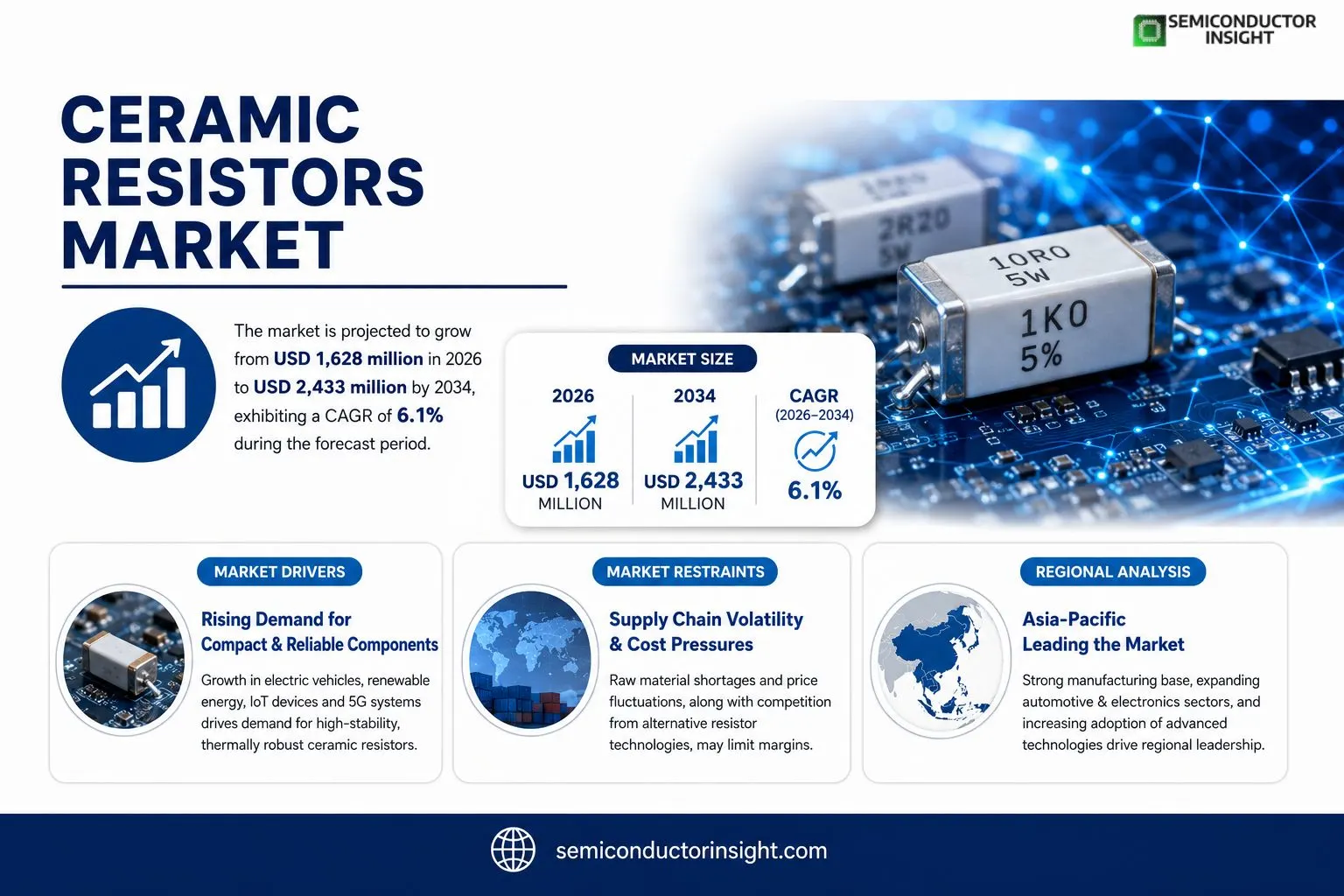
Ceramic Resistors market size was valued at USD 1625 million in 2025. The market is projected to grow from USD 1628 million in 2025 to USD 2433 million by 2034, exhibiting a CAGR of 6.1% during the forecast period.
Ceramic resistors are passive electronic components that provide precise resistance while dissipating heat efficiently. Built on a ceramic substrate with a resistive film, they deliver high stability, strong temperature resistance, and reliable performance in harsh environments, serving power electronics, automotive systems, industrial control, consumer devices and communication gear.The expansion is driven by rising demand for compact, thermally stable components across electric‑vehicle platforms, renewable‑energy converters and IoT devices. Manufacturers are advancing material science and miniaturization to improve tolerance and durability, while key players such as Ohmite, Vishay, KOA Corporation and YAGEO continue expanding product portfolios.
MARKET DRIVERS
Electrification of Consumer Devices
The surge in portable electronicssmartphones, wearables, and IoT sensorshas forced component makers to prioritize parts that occupy minimal board space while delivering stable performance. Ceramic Resistors Market participants benefit because ceramic elements combine temperature stability with a compact form factor, meeting OEM pressure for thinner designs.
Automotive Electrification Trends
Hybrid and electric vehicle architectures demand high‑reliability passive components capable of withstanding harsh thermal cycles. Manufacturers are increasingly specifying ceramic resistors for power‑train control modules, a shift that adds a substantive layer of demand beyond traditional automotive applications.
➤ Design engineers cite the low parasitic inductance of ceramic resistors as a decisive factor when tuning high‑frequency power‑conversion circuits.
In parallel, regulatory pushes for energy‑efficient products are prompting stricter compliance standards. Ceramic resistors, with their predictable tolerance bands, enable designers to certify devices faster, further embedding these components in the supply chain.
MARKET CHALLENGES
Supply‑Chain Volatility
Raw material shortagesparticularly high‑purity aluminahave caused intermittent bottlenecks. While manufacturers have diversified sources, price swings remain, eroding margins for mid‑tier suppliers and creating uncertainty for downstream assemblers.
Other Challenges
Manufacturing Yield Consistency
Achieving uniform resistance values across large batch volumes requires tight control of firing temperatures. Minor deviations can result in extended rework cycles, inflating production costs and slowing time‑to‑market.
MARKET RESTRAINTS
Competing Passive‑Component Technologies
Thin‑film and metal‑oxide resistors have made inroads in applications where ultra‑low noise or specific voltage coefficients are paramount. Their ability to be fabricated on flexible substrates introduces a niche that can divert orders away from ceramic solutions.Furthermore, the incremental cost premium of ceramic resistorsdriven by higher material purity and tighter tolerance specificationscan deter price‑sensitive market segments, especially in mass‑produced consumer gadgets where cost compression is relentless.Finally, the growing adoption of integrated passive‑component modules reduces the number of discrete resistors required on a board, limiting volume growth for traditional ceramic resistor manufacturers.
MARKET OPPORTUNITIES
Emerging High‑Frequency Applications
5G base stations and millimeter‑wave radar systems rely on components that maintain stability at gigahertz frequencies. Ceramic resistors, with minimal inductive reactance, are uniquely positioned to meet these specifications, opening a lucrative corridor for vendors who can certify their products for telecom standards.
The rise of edge‑computing hardware, which consolidates processing power in constrained enclosures, also drives demand for compact, high‑reliability passive components. Suppliers that bundle ceramic resistors with complementary passive devices into modular kits can capture added value from system integrators.
Lastly, sustainability initiatives encourage manufacturers to adopt components with longer lifecycles. The inherent durability of ceramic resistors reduces replacement rates, aligning with corporate ESG goals and presenting a compelling selling point for eco‑conscious OEMs.
Ceramic Resistors Market Trends
Thermal Stability as a Core Competitive Edge
Ceramic Resistors Market is seeing a pronounced shift toward components that can sustain higher temperatures without performance drift. Manufacturers are investing in ceramic formulations that retain resistance values across a broad thermal envelope, a response to the escalating power densities in modern converters and in‑vehicle power modules. This focus on heat tolerance reduces failure rates in harsh environments, translating into lower warranty costs for OEMs and stronger brand credibility for component suppliers. The ripple effect is evident in procurement specifications, where design engineers increasingly prioritize thermal stability over legacy cost metrics, reshaping the value chain from raw‑material sourcing to final testing.
Other Trends
Miniaturization and Integration Pressure
Device footprints continue to shrink, especially in IoT and 5G infrastructure, compelling resistor makers to deliver smaller packages without compromising electrical precision. Advances in thin‑film coating and laser trimming have enabled axial and surface‑mount ceramic resistors to occupy less board area while meeting tighter tolerance windows. This trend is prompting a re‑engineering of production lines, with greater automation and real‑time metrology to uphold quality at higher throughput. Companies that can fuse miniaturization with consistent performance are gaining preferential access to high‑volume contracts in consumer wearables and automotive telematics.
Supply Chain Consolidation and Regional Localization
Recent years have witnessed a consolidation of raw‑material suppliers, particularly for high‑purity ceramic powders and conductive coatings. Vertical integration efforts aim to lock in supply certainty and buffer against geopolitical disruptions. Simultaneously, several leading players are establishing manufacturing hubs in Asia and Eastern Europe to reduce lead times for automotive and industrial customers. This dual strategytightening upstream control while localizing downstream capacitycreates a more resilient ecosystem and allows firms to respond swiftly to fluctuating demand cycles across diverse end‑use sectors.
COMPETITIVE LANDSCAPE
Key Industry Players
Competitive Overview of the Ceramic Resistors Sector
Vishay dominates the high‑power segment, leveraging a vertically integrated supply chain that stretches from ceramic substrate fabs to final test laboratories. Its breadth of product familiessolid‑disk, slab and tubular designslets the company serve automotive power modules, renewable‑energy converters and industrial‑automation controllers alike. By holding roughly a quarter of worldwide sales volume, Vishay sets price benchmarks and influences qualification standards, compelling downstream OEMs to align design tolerances with its specifications. The firm’s focus on precision coating technologies has narrowed tolerance bands, a factor that underpins its ability to claim gross margins at the upper end of the industry range. This concentration of capability creates a de‑facto gate‑keeping role, prompting midsize manufacturers to either partner with Vishay for high‑volume contracts or carve niches in ultra‑low‑inductance or specialty‑size categories.Beyond the flagship tier, a collection of regional specialists sustains competitive vigor. Ohmite and KOA Corporation excel in ruggedized resistance solutions for military and aerospace applications, where long‑term reliability outweighs unit cost. Yageo and HVR International Ltd. have expanded their footprint in consumer‑electronics through aggressive capacity upgrades in surface‑mount formats, capitalising on the proliferation of IoT devices. Smaller players such as Viking, Liean‑Gimn and Tepro Vamistor focus on niche power‑rating bandsparticularly sub‑5 W axial unitsserving legacy equipment manufacturers in emerging markets. Their agility in customizing lead finishes and packaging options allows them to capture orders that larger firms deem unprofitable, thereby preserving a diversified supplier ecosystem and mitigating concentration risk for end‑users.
List of Key Ceramic Resistors Companies Profiled
- Ohmite
- HVR International Ltd.
- KOA Corporation
- Vishay
- Hong Kong Resistors
- YAGEO
- Hokuriku Electric Industry
- Viking
- Kunshan Housheng Electronic Industry Co., Ltd.
- Liean‑Gimn
- TY‑OHM
- Tepro Vamistor
- Reidon
- Miba
- HVP High Voltage Products GmbH
- U.S. Resistor
- Tokai Konetsu Kogyo Co.,LTD.
- RARA Electronics LLC
- Electrotechnik Industries, Inc.
- Zenithsun
Segment Analysis:
| Segment Category | Sub-Segments | Key Insights |
| By Type |
|
Solid Disk Resistors dominate due to their compact footprint and superior heat dissipation. – Preferred for high‑frequency circuits where low inductance is critical. – Offer consistent tolerance across temperature extremes, reinforcing reliability in automotive and industrial power modules. – Manufacturers focus on material purity to extend lifecycle under harsh thermal cycling. |
| By Application |
|
Power Electronics represent the most demanding application environment. – Ceramic resistors are chosen for their ability to withstand high surge currents during inrush events. – Their thermal stability supports dense power‑converter designs, reducing board space. – The shift toward electric vehicles amplifies the need for components that maintain performance under wide temperature ranges. |
| By End User |
|
OEMs drive specification rigor and long‑term component reliability. – Their design cycles demand components that can be sourced consistently across multiple production runs. – Emphasis on low inductance and tight tolerance aligns with trends in miniaturized circuitry. – Collaborative development programs with resistor manufacturers accelerate material innovation for emerging standards. |
| By Power Rating |
|
Above 10W segment is gaining focus as power density in electronic modules rises. – High‑power ceramic resistors enable robust over‑voltage protection without excessive board area. – Advances in ceramic formulations improve thermal conductivity, allowing higher dissipation. – Designers preferentially select these for renewable energy converters and high‑current automotive modules. |
| By Mounting Style |
|
Surface‑Mount is becoming the preferred mounting style for modern compact designs. – Enables automated placement, reducing assembly cost and time. – Offers improved vibration resistance, crucial for automotive and industrial environments. – Manufacturers are optimizing lead‑frame designs to preserve the thermal advantages of ceramic substrates while meeting space constraints. |
Regional Analysis: Ceramic Resistors Market
Asia-Pacific
The clustering of fabs in coastal megacities creates economies of scale that compress per‑unit cost, while shared logistics hubs streamline distribution to automotive and consumer‑electronics assemblers across the region.
Recent disruptions prompted manufacturers to diversify raw‑material sources, embedding buffer stocks of alumina and glass‑ceramic powders to protect production continuity amid geopolitical flux.
Investment is channeled toward high‑temperature stability and miniaturisation, enabling components that meet the stringent thermal budgets of next‑generation power‑conversion modules.
Emerging environmental directives encourage the phase‑out of lead‑based pastes, accelerating the shift to fully ceramic formulations and opening niche opportunities for premium‑grade products.
North America
North America retains a strong design and verification capability, with many original equipment manufacturers maintaining in‑house engineering teams that specify performance‑critical ceramic resistors. The region’s emphasis on reliability for aerospace and defense applications elevates demand for components that can withstand extreme thermal cycling. While domestic production volumes are modest compared with Asia‑Pacific, strategic sourcing agreements and a focus on low‑defect rates enable North American firms to command premium pricing within niche sectors of Ceramic Resistors Market.
Europe
European manufacturers benefit from a mature standards ecosystem that drives consistent product specifications across automotive and industrial automation. The bloc’s rigorous conformity assessment processes ensure that ceramic resistors meet stringent safety and electromagnetic compatibility criteria, fostering trust among end‑users. Moreover, sustainability initiatives encourage the adoption of lead‑free materials, nudging the market toward higher‑grade ceramic compositions. These dynamics reinforce Europe’s position as a demanding yet influential consumer of high‑performance resistors.
South America
South America’s growth trajectory is anchored by expanding consumer‑electronics assembly plants in Brazil and Mexico’s proximity to the region. Local distributors are increasingly seeking reliable ceramic resistor sources to support demand from the automotive sector’s shift toward hybrid powertrains. Although volume is limited, the market exhibits a willingness to import premium components, creating openings for suppliers that can balance cost efficiency with compliance to regional certification regimes.
Middle East & Africa
The Middle East & Africa region is characterised by burgeoning renewable‑energy projects and telecommunications roll‑outs, both of which require robust passive components. While indigenous manufacturing is sparse, the strategic location of ports in the Gulf facilitates rapid importation of ceramic resistors from Asian hubs. Emerging standards around energy‑efficiency are prompting OEMs to specify components with tighter tolerance, nudging the market toward higher‑quality offerings despite overall modest consumption levels.
Report Scope
This market research report provides a comprehensive analysis of the Ceramic Resistors Market , covering the forecast period 2026–2034. It offers detailed insights into market dynamics, technological advancements, competitive landscape, and key trends shaping the industry.
Key focus areas of the report include:
- Market Overview: The report begins with an overview outlining its current market scenario, key growth indicators, and industry transformation drivers. It discusses macroeconomic factors, demand–supply balance, regulatory landscape, and the strategic role of semiconductors in powering advancements across industries such as automotive, telecommunications, consumer electronics, and industrial automation.
- Market Size & Forecast: Historical data and future projections for revenue, unit shipments, and market value across major regions and segments.
- Segmentation Analysis: Detailed breakdown by product type, technology, application, and end-user industry to identify high-growth segments and investment opportunities.
- Regional Insights: Insights into market performance across North America, Europe, Asia-Pacific, Latin America, and the Middle East & Africa, including country-level analysis where relevant.
- Competitive Landscape: Profiles of leading market participants, including their product offerings, R&D focus, manufacturing capacity, pricing strategies, and recent developments such as mergers, acquisitions, and partnerships.
- Technology Trends & Innovation: Assessment of emerging technologies, integration of AI/IoT, semiconductor design trends, fabrication techniques, and evolving industry standards.
- Market Drivers & Restraints: Evaluation of factors driving market growth along with challenges, supply chain constraints, regulatory issues, and market-entry barriers.
- Stakeholder Insights: Insights for component suppliers, OEMs, system integrators, investors, and policymakers regarding the evolving ecosystem and strategic opportunities.
Primary and secondary research methods are employed, including interviews with industry experts, data from verified sources, and real-time market intelligence to ensure the accuracy and reliability of the insights presented.
FREQUENTLY ASKED QUESTIONS:
What is the current market size of Ceramic Resistors Market?
-> Ceramic Resistors Market was valued at USD 1,625 million in 2025 and is expected to reach USD 2,433 million by 2034, growing at a CAGR of 6.1%.
Which key companies operate in Ceramic Resistors Market?
-> Key players include Ohmite, HVR International Ltd., KOA Corporation, Vishay, Hong Kong Resistors, YAGEO, Hokuriku Electric Industry, Viking, Kunshan Housheng Electronic Industry Co., Ltd., Liean‑Gimn, TY‑OHM, Tepro Vamistor, Reidon, Miba, HVP High Voltage Products GmbH, U.S. Resistor, Tokai Konetsu Kogyo Co.,LTD., RARA Electronics LLC, Electrotechnik Industries, Inc., Zenithsun.
What are the key growth drivers?
-> Key growth drivers include rising demand for compact, thermally stable components in power electronics, automotive systems, industrial automation, consumer devices and communication equipment; expansion of electric vehicles, renewable energy and smart electronics; advances in ceramic materials, precision manufacturing and miniaturization; and increasing adoption of IoT devices and 5G communications.
Which region dominates the market?
-> Asia‑Pacific is the fastest‑growing and largest region, driven by strong automotive, consumer electronics and industrial automation demand.
What are the emerging trends?
-> Emerging trends include integration of ceramic resistors in IoT and 5G devices, development of ultra‑miniature high‑power resistors for electric vehicles, use of advanced high‑temperature ceramic materials, and increased focus on sustainable, low‑cost manufacturing processes.

Get Sample Report PDF for Exclusive Insights
Report Sample Includes
- Table of Contents
- List of Tables & Figures
- Charts, Research Methodology, and more...
 Download Sample Report PDF