Disk Resistors Market Insights
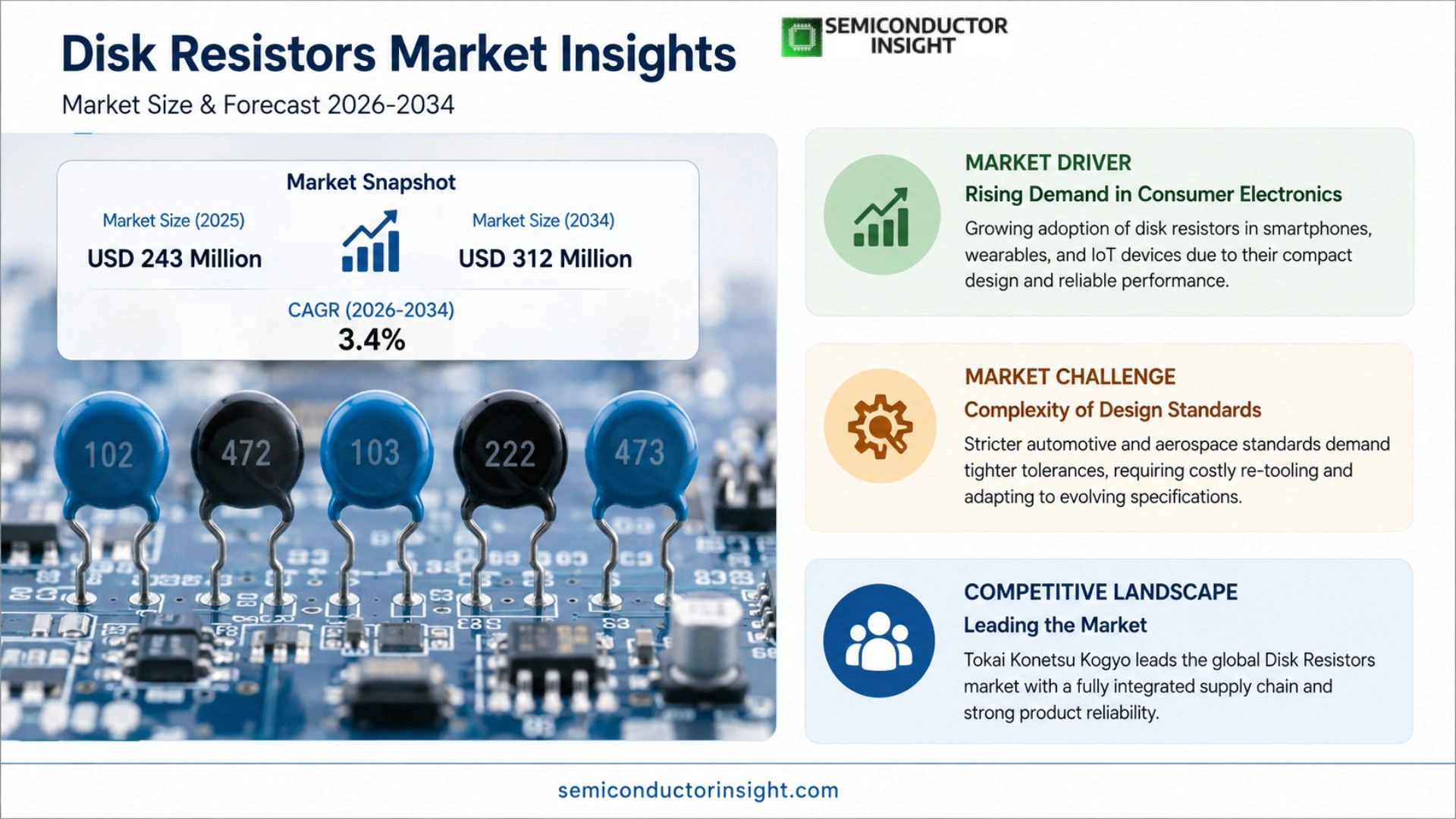
Disk Resistors market was valued at USD 243 million in 2025 and expands to USD 312 million by 2034, reflecting a CAGR of 3.4 % over the forecast period.
Disk Resistors are radial‑lead electronic components with a flat, disk‑shaped body typically built from ceramic substrates combined with resistive elements such as NTC and PTC thermistors or varistors. Their compact size, low cost and strong energy‑absorption capability make them ideal for current limiting, temperature sensing, inrush‑current suppression and surge protection in power supplies, household appliances, industrial equipment and automotive systems.
The market expands because electronic devices are becoming more compact and power‑dense, raising demand for reliable circuit‑protection parts. Growth is further supported by automotive electrification and renewable‑energy installations that require robust temperature sensing and over‑voltage protection. Ongoing technical work targets higher energy absorption capacity and better thermal stability, while pricing pressure from alternative protection components remains a notable challenge.
MARKET DRIVERS
Rising Demand in Consumer Electronics
Disk Resistors market is benefitting from a pronounced uptick in portable device shipments. Manufacturers are opting for disk‑type resistors because their low profile and reliable tolerance characteristics align well with the space‑constrained designs of smartphones, wearables, and compact IoT gateways. This alignment reduces board real‑estate pressure and shortens time‑to‑market, giving suppliers a tangible competitive edge.
Shift Toward Miniaturization Across Automotive Systems
Modern vehicle architectures are migrating from discrete modules to integrated electronic control units, a trend that directly fuels the need for smaller passive components. Disk resistors, with their thin‑film construction, satisfy the automotive sector’s stringent reliability criteria while supporting the aggressive packaging targets set by OEMs. The result is a steady flow of procurement contracts that reinforce market momentum.
➤ “Design engineers cite the balance of size, performance, and cost as the decisive factor when selecting disk resistors for next‑gen platforms.”
Beyond product‑level considerations, regulatory pressure for energy‑efficient designs prompts manufacturers to replace older, bulkier resistor families with disk variants that dissipate heat more effectively. This regulatory push, coupled with the upside of lower material consumption, solidifies a robust demand foundation for Disk Resistors market.
MARKET CHALLENGES
Complexity of Design Standards
Global design standards for automotive and aerospace applications have evolved to demand tighter tolerance bands and stricter temperature coefficients. For suppliers, meeting these specifications often requires costly re‑tooling of production lines, which can erode margin if volume forecasts are uncertain. Companies that cannot quickly adapt risk losing tier‑one contracts to more agile competitors.
Other Challenges
Supply Chain Volatility
The recent scarcity of high‑purity ceramic substrates has introduced price volatility into the cost structure of disk resistor fabrication. Because the component’s performance is tightly linked to substrate quality, manufacturers are forced to hold higher safety stocks, tying up capital and complicating demand‑planning cycles.
Moreover, geopolitical tensions affecting key raw‑material exporters add an additional layer of uncertainty. End‑users increasingly demand transparent sourcing, which pushes suppliers to diversify their material base,a process that can be both time‑consuming and capital‑intensive.
MARKET RESTRAINTS
Thermal Management Constraints
Disk resistors exhibit limited power‑handling capacity compared with larger wire‑wound alternatives. In high‑power applications, excessive heat buildup can trigger derating, compelling designers to revert to bulkier components. This technical limitation narrows the scope of projects where disk resistors can be the default choice.
Attempts to mitigate thermal stress through advanced packaging add complexity and cost, which may deter price‑sensitive buyers from adopting newer product variants.
Consequently, sectors that prioritize high current handling,such as power‑train modules,remain cautious, tempering overall market expansion.
MARKET OPPORTUNITIES
Emerging Opportunities in Renewable Energy
The drive toward decentralized renewable‑energy installations creates a niche where compact, reliable resistors are prized. In solar inverters and wind‑turbine control boards, disk resistors provide precise voltage division without inflating PCB footprints, supporting higher integration densities.
Additionally, the push for greener manufacturing processes encourages the adoption of thin‑film technologies that generate less waste. Disk resistor producers that can certify low‑environmental‑impact production are likely to capture a share of contracts earmarked for sustainable components.
Finally, the rapid rollout of 5G micro‑cells and edge‑computing nodes,both of which rely on dense electronic assemblies,offers a fresh avenue for Disk Resistors market. Suppliers that align product roadmaps with these emerging network infrastructures stand to benefit from a steady pipeline of design wins.
Disk Resistors Market Trends
Surge‑Protection Demand Fuels Component Uptick
Manufacturers report that the rise of compact power supplies and higher‑density electronics is prompting designers to select disk‑shaped resistors for their ability to absorb transient energy in a minimal footprint. The flat ceramic construction, combined with a resistive element, delivers a reliable clamping voltage that is especially valuable in household appliances and industrial drives where inrush currents can cause premature wear. As product cycles shorten, engineers prioritize components that can be stocked in large volumes without sacrificing performance, a need that aligns with the steady output of roughly three‑hundred million units per year. The result is a modest but consistent expansion of order books across the supply chain, reinforcing the relevance of disk resistors in mainstream power‑conversion architectures.
Other Trends
Automotive Electrification Amplifies Temperature‑Sensing Roles
Electric‑vehicle power‑train modules rely on NTC thermistors for precise heat‑up control during battery charging and motor start‑up. The shift toward higher voltage platforms intensifies the temperature‑stability requirements of these devices, driving manufacturers to refine ceramic formulations that retain resistance characteristics across broader thermal ranges. Suppliers that can certify tighter tolerances are gaining preference among OEMs seeking to mitigate thermal‑runaway risks, a factor that is reshaping procurement strategies within the automotive sector.
Renewable‑Energy Integration Spurs Varistor Adoption
Grid‑connected solar inverters and wind‑turbine converters increasingly expose electronic downstream circuitry to voltage spikes originating from lightning or switching events. Varistor‑type disk resistors, with their rapid response and high energy‑absorption capacity, are becoming a default protective element in these installations. This trend is reinforced by regulatory pushes for higher reliability standards in renewable‑energy infrastructure, compelling system designers to allocate budget for robust over‑voltage protection. Consequently, the downstream market for varistors is seeing a gradual uplift, encouraging upstream players to invest in sintering processes that enhance discharge efficiency while keeping unit costs competitive.
COMPETITIVE LANDSCAPE
Key Industry Players
Competitive dynamics among leading manufacturers and emerging specialists
Tokai Konetsu Kogyo dominates the global Disk Resistors arena, leveraging a vertically integrated supply chain that spans ceramic substrate production to end‑of‑line testing. Its ability to modulate furnace cycles and fine‑tune resistive paste formulations gives it a cost advantage that translates into market share growth across power‑supply and automotive segments. The company’s recent capacity expansion in Japan, combined with a focused R&D program on high‑energy‑absorption varistors, positions it as the benchmark for performance and reliability. Parallel to Tokai, Miba Resistors and Ohmite command sizable portions of the mid‑tier market by offering broad product portfolios that cater to both high‑volume consumer appliances and specialized industrial equipment. Their extensive distribution networks in North America and Europe enable rapid order fulfilment, reinforcing a market structure where a few large firms control bulk pricing while smaller outfits compete on niche specifications and customized lead‑attachment services.
Beyond the tier‑one group, a cluster of nimble players occupies strategic niches. Shenzhen Zenithsun and Shenzhen Xinhua Xiang Electronics have built reputations for fast‑track development of thin‑film NTC thermistors, serving the burgeoning smart‑home and IoT device market where size and response time are critical. HVR International and Component General specialize in high‑temperature carbon composition disks, finding demand in legacy industrial control systems that require ruggedness over miniaturization. Regional champions such as US Resistor, Inc. and BONENS focus on compliance‑driven markets in the United States and Europe, emphasizing certification and traceability. Meanwhile, Dongguan Ruiqing Electronics and HVC Capacitor Manufacturing have entered the varistor segment with competitive pricing, targeting emerging renewable‑energy installations that need reliable over‑voltage protection. This diversified competitive landscape creates a dynamic pricing environment and pressures incumbents to innovate or acquire niche capabilities to sustain margin stability.
List of Key Disk Resistors Companies Profiled
- Tokai Konetsu Kogyo
- Miba Resistors
- Ohmite
- Shenzhen Zenithsun
- HVR International
- Component General
- RARA Electronics
- Shenzhen Xinhua Xiang Electronics
- US Resistor, Inc.
- BONENS
- HVC Capacitor Manufacturing
- Dongguan Ruiqing Electronics
Segment Analysis:
| Segment Category | Sub-Segments | Key Insights |
| By Type |
|
Ceramic Disk Resistors are the dominant type because they combine high thermal stability with excellent energy absorption. – Preferred for applications demanding reliable voltage clamping and temperature‑sensing. – Benefit from mature ceramic processing technologies which ensure consistent performance across large production volumes. – Offer a balanced cost‑to‑performance profile that satisfies both consumer and industrial designers. |
| By Application |
|
Power Supplies drive the market due to stringent surge‑protection requirements in modern electronic systems. – Disk resistors provide compact, low‑cost protection against transient over‑voltages in DC‑DC converters. – Their fast response and high energy absorption make them ideal for protecting sensitive semiconductor devices. – The growing prevalence of switching power architectures across data centers and renewable‑energy inverters reinforces their relevance. |
| By End User |
|
Industrial Equipment represents a key end‑user segment because reliability and durability are paramount. – Disk resistors are integrated into motor‑drive modules and process‑control hardware for safeguarding against inrush currents. – Their rugged ceramic construction tolerates harsh temperature cycles typical of factory environments. – Engineers favor them for easy substitution and straightforward calibration during preventive maintenance. |
| By Material |
|
High‑Purity Ceramic is emerging as the preferred material due to its superior dielectric properties. – Enables tighter tolerance on resistance values, supporting precision sensing applications. – Offers excellent thermal conductivity which aids in rapid heat dissipation during surge events. – Aligns with industry moves toward greener manufacturing by reducing the need for additional encapsulants. |
| By Function |
|
Surge Protection is the most compelling functional driver because modern power architectures are increasingly vulnerable to voltage transients. – Disk resistors provide instantaneous clamping without the need for auxiliary control circuitry. – Their compact footprint supports the trend toward miniaturized power modules in electric vehicles and renewable‑energy converters. – Continuous improvements in energy‑absorption capacity keep them competitive against newer solid‑state alternatives. |
Regional Analysis: Disk Resistors Market
Asia‑Pacific
Producers have diversified raw‑material sourcing across Southeast Asia to hedge against single‑source disruptions, enabling steadier inventory turnover and shorter procurement cycles for disk resistor blends.
Collaborative engineering programs between component makers and device designers are reducing footprint constraints, allowing tighter integration of resistors into multilayer printed circuit boards.
Harmonized safety standards across the region streamline certification procedures, accelerating time‑to‑market for new resistor families used in safety‑critical applications.
Firms are adopting low‑lead and recyclable substrate technologies, responding to both customer sustainability targets and tightening environmental regulations.
North America
In North America, Disk Resistors market is shaped by a mature aerospace and defense sector that demands exceptionally tight tolerance levels. Companies are emphasizing advanced testing protocols and traceability to meet defense‑grade specifications, while also catering to a growing renewable‑energy equipment base that requires high‑temperature stability. The region’s focus on intellectual‑property protection encourages domestic firms to retain high‑value processes in‑house, fostering a niche of premium‑priced, differentiated components.
Europe
European demand is anchored by automotive electrification and precision industrial automation. Manufacturers are responding to stringent EU environmental directives by offering disk resistors with reduced hazardous substances, aligning component choices with broader vehicle‑level compliance strategies. Collaborative research initiatives between universities and industry are accelerating the adoption of novel ceramic composites, positioning Europe as a source of high‑performance, low‑drift resistor solutions for next‑generation motor‑control systems.
South America
In South America, expanding telecommunications rollout and localized consumer‑electronics assembly are the primary drivers of resistor uptake. Despite infrastructure constraints, regional players are investing in modest-capacity fabs to serve domestic markets, thereby reducing dependence on imported parts and improving lead‑time predictability for regional system integrators. Market participants also view the sector as an entry point for broader semiconductor ecosystem development.
Middle East & Africa
The Middle East & Africa landscape is characterized by burgeoning data‑center construction and renewable‑energy projects, both of which require reliable power‑conversion hardware. Disk resistor suppliers are targeting these initiatives by offering ruggedized variants capable of withstanding harsh climatic conditions. Partnerships with local engineering firms are helping to customize solutions for oil‑and‑gas monitoring equipment, where long‑term stability under temperature fluctuations is a critical performance metric.
Report Scope
This market research report provides a comprehensive analysis of the Disk Resistors Market , covering the forecast period 2026–2034. It offers detailed insights into market dynamics, technological advancements, competitive landscape, and key trends shaping the industry.
Key focus areas of the report include:
- Market Overview: The report begins with an overview outlining its current market scenario, key growth indicators, and industry transformation drivers. It discusses macroeconomic factors, demand–supply balance, regulatory landscape, and the strategic role of semiconductors in powering advancements across industries such as automotive, telecommunications, consumer electronics, and industrial automation.
- Market Size & Forecast: Historical data and future projections for revenue, unit shipments, and market value across major regions and segments.
- Segmentation Analysis: Detailed breakdown by product type, technology, application, and end-user industry to identify high-growth segments and investment opportunities.
- Regional Insights: Insights into market performance across North America, Europe, Asia-Pacific, Latin America, and the Middle East & Africa, including country-level analysis where relevant.
- Competitive Landscape: Profiles of leading market participants, including their product offerings, R&D focus, manufacturing capacity, pricing strategies, and recent developments such as mergers, acquisitions, and partnerships.
- Technology Trends & Innovation: Assessment of emerging technologies, integration of AI/IoT, semiconductor design trends, fabrication techniques, and evolving industry standards.
- Market Drivers & Restraints: Evaluation of factors driving market growth along with challenges, supply chain constraints, regulatory issues, and market-entry barriers.
- Stakeholder Insights: Insights for component suppliers, OEMs, system integrators, investors, and policymakers regarding the evolving ecosystem and strategic opportunities.
Primary and secondary research methods are employed, including interviews with industry experts, data from verified sources, and real-time market intelligence to ensure the accuracy and reliability of the insights presented.
FREQUENTLY ASKED QUESTIONS:
What is the current market size of Disk Resistors Market?
-> Disk Resistors market expands to USD 312 million by 2034, reflecting a CAGR of 3.4 % over the forecast period.
Which key companies operate in Disk Resistors Market?
-> Key players include Tokai Konetsu Kogyo, Miba Resistors, Ohmite, Res‑Net Microwave, HVR International, Component General, RARA Electronics, Shenzhen Zenithsun, US Resistor, Inc., BONENS, HVC Capacitor Manufacturing, Shenzhen Xinhua Xiang Electronics, Dongguan Ruiqing Electronics.
What are the key growth drivers?
-> Growth is driven by expanding use of disk resistors in power electronics, home appliances, industrial equipment, automotive electrification, and renewable energy systems, alongside the need for compact, high‑energy‑absorption components for surge protection, temperature sensing and in‑rush current suppression.
Which region dominates the market?
-> Asia accounts for the largest share of Global Disk Resistors demand, supported by high production capacity in China, Japan, South Korea and growing automotive and consumer electronics markets.
What are the emerging trends?
-> Emerging trends include development of higher energy‑absorption ceramic formulations, improved thermal stability, and enhanced reliability for harsh operating conditions, as well as integration of disk resistors into smart power‑management modules for IoT and EV applications.
Get Sample Report PDF for Exclusive Insights
Report Sample Includes
- Table of Contents
- List of Tables & Figures
- Charts, Research Methodology, and more...
 Download Sample Report PDF