Power Film Capacitors for DC Link Circuit Market Insights
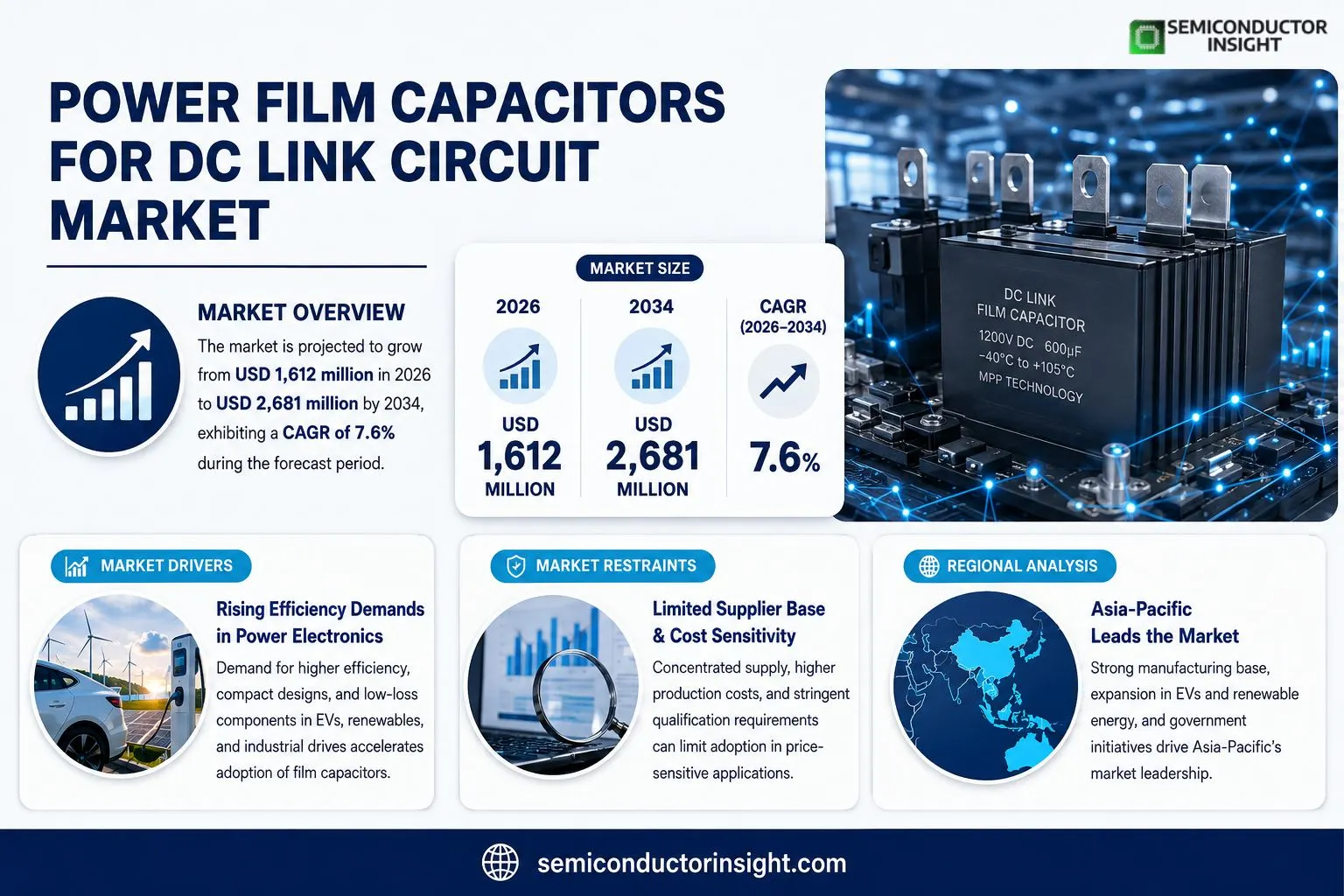
Power Film Capacitors for DC Link Circuit market was valued at USD 1,612 million in 2025 and is forecasted to reach USD 2,681 million by 2034, reflecting a CAGR of 7.6% over the period.
Power film capacitors for DC link circuits are metallized film devices installed in the DC bus or intermediate circuit of power‑electronic systems. Their core function includes energy buffering, voltage smoothing, ripple‑current absorption and transient suppression between sources such as rectifiers, batteries or photovoltaic modules and downstream inverters, converters or motor drives.The devices typically employ metallized polypropylene or high‑temperature film dielectrics with self‑healing structures, low ESR/ESL and high ripple‑current capability, enabling replacement of aluminum electrolytic capacitors in applications demanding high reliability, power density and operation under elevated temperature or humidity. Product families range from radial leaded box types and cylindrical cans to screw‑terminal and busbar‑integrated modules, covering voltage ratings from several hundred volts up to more than one kilovolt.
MARKET DRIVERS
Rising Efficiency Demands in Power Electronics
The push for higher conversion efficiency in motor‑driven systems has placed Power Film Capacitors for DC Link Circuit Market at the forefront of component selection. Designers now favor film technology because its low ESR translates directly into reduced losses, which in turn lowers operating costs for customers spanning automotive to renewable‑energy domains.
Stringent Electromagnetic Compatibility Requirements
Regulatory bodies across Europe and North America have tightened EMC standards for inverter‑based equipment. Film‑based devices, with their inherent self‑healing properties and stable capacitance under high‑frequency stress, meet these standards more reliably than older electrolytic alternatives, prompting OEMs to revise bill‑of‑materials in favor of the newer solution.
➤ “Adoption of film capacitors reduced inverter harmonic distortion by up to 30 % in recent field trials.”
Beyond compliance, the material’s superior temperature tolerance enables operation in compact enclosures, supporting the industry’s drive toward smaller, lighter power modules without sacrificing reliability.
MARKET CHALLENGES
Price Sensitivity in High‑Volume Applications
While performance advantages are clear, the cost premium of film technology remains a hurdle for manufacturers producing commodity‑grade converters. Procurement teams often balance the long‑term savings against upfront expenditure, leading to slower substitution rates in price‑driven market segments.
Other Challenges
Temperature Sensitivity
Film capacitors exhibit a modest capacitance drift at elevated temperatures. End‑users deploying them in harsh industrial environments must implement additional thermal management strategies, which can offset the simplicity gains promised by the technology.
MARKET RESTRAINTS
Limited Supplier Base
The niche nature of high‑voltage film capacitor production concentrates manufacturing capacity within a handful of specialized firms. This concentration reduces competitive pricing pressure and can extend lead times, especially during periods of sudden demand spikes.
Qualification Barriers for Emerging Markets
New entrants in the renewable‑energy sector often lack the validated testing data required to certify film capacitors for grid‑connected applications. The rigorous qualification process adds an extra layer of uncertainty, slowing market penetration.
Manufacturing Yield Constraints
Achieving consistent film thickness and dielectric uniformity at scale remains technically demanding. Yield losses during production translate to higher unit costs, which in turn restrains broader adoption across cost‑sensitive projects.
MARKET OPPORTUNITIES
Growth of Electrified Transportation Platforms
The accelerated rollout of electric buses, trucks, and two‑wheelers creates a fertile ground for film capacitors in on‑board charger architectures. Their fast charge‑discharge capability and resilience to repetitive thermal cycles align well with the duty cycles of mobility solutions.
Integration with Wide‑Bandgap Semiconductor Designs
Silicon carbide and gallium nitride devices operate at higher switching frequencies, demanding capacitors that can sustain low loss at elevated frequencies. Film capacitors meet this requirement, presenting an avenue for collaborative product development between capacitor manufacturers and semiconductor vendors.
Emerging Grid‑Edge Storage Solutions
Distributed energy resources, such as behind‑the‑meter battery systems, rely on DC link circuits that benefit from the stable voltage support provided by film technology. As utilities explore more localized storage architectures, demand for reliable DC link components is expected to rise.
Power Film Capacitors for DC Link Circuit Market Trends
Voltage Scaling in Electric Vehicles Elevates DC‑Link Capacitor Requirements
The shift from 400 V to 800 V traction platforms compels designers to select capacitors that tolerate higher stress while preserving low ESR and long life. Metallized polypropylene films, with their self‑healing capability, become the preferred dielectric as they sustain the larger ripple currents generated by SiC‑based inverters. This technical necessity translates into a noticeable uptick in orders for high‑voltage, high‑current modules from automotive OEMs and tier‑one suppliers. The consequence is a tighter coupling between capacitor manufacturers and vehicle integration teams, prompting joint validation programs and longer‑term supply contracts. As a result, firms that have already qualified their products to automotive standards (AEC‑Q200, THB) are gaining preferential access to the expanding EV power‑train pipeline.
Other Trends
Material and Process Differentiation
Advances in film extrusion and metal‑spraying techniques are reshaping product portfolios. Companies that can deliver segmented safety films and optimized end‑face connections reduce parasitic inductance, a critical factor when switching frequencies climb above 200 kHz. At the same time, the adoption of high‑temperature polyimide or fluoropolymer films expands the usable temperature window, enabling deployment in harsh‑environment rail and aerospace projects. These process innovations differentiate manufacturers beyond price, allowing them to command premium pricing for modules that meet stringent humidity‑reliability tests and exhibit superior load‑life models.
Regional Manufacturing Landscape Shifts
While Japanese firms retain leadership in automotive‑grade qualifications, Chinese producers are accelerating their presence by leveraging proximity to domestic renewable‑energy manufacturers. The rapid rollout of photovoltaic and wind inverters in Asia creates a sizable, consistent demand for medium‑voltage busbar‑integrated modules. European and North American players continue to dominate high‑power industrial drives, yet they face increasing pressure to localize supply chains amid geopolitical uncertainties. This geographic rebalancing drives collaborative R&D hubs across continents, where design‑for‑manufacturability and co‑design with inverter platforms become decisive criteria for winning long‑term contracts.
COMPETITIVE LANDSCAPEKey Industry Players
Power Film Capacitors for DC Link Circuit – Competitive Overview
The market is anchored by a cohort of multinational manufacturers whose breadth of product portfolios and depth of engineering expertise shape the overall supply chain. Japanese firms such as TDK, Panasonic, Murata and Nichicon dominate the automotive‑grade segment, leveraging long‑standing relationships with vehicle OEMs and offering AEC‑Q200 qualified modules. European specialistsincluding Vishay, WIMA, Eaton and Knowles Cornell Dubilierprovide high‑reliability solutions for industrial drives, rail traction and aerospace, where stringent humidity and lifetime testing are mandatory. These incumbents differentiate themselves through proprietary metallized film formulations, advanced metal‑spraying processes and integrated bus‑bar designs that reduce parasitic inductance. Their distribution networks and certification programs enable participation in long‑term nominated supply agreements, reinforcing a market structure where scale, technical credibility and consistent quality are decisive entry barriers.Beyond the tier‑one tier, a growing pool of regional manufacturers is expanding the competitive set. Chinese players such as Faratronic, Jianghai, Tongfeng, KQJ Technology, Safe Electronics and Sheng Ye have rapidly scaled capacity to serve photovoltaic, energy‑storage and electric‑vehicle charging ecosystems, capitalising on proximity to key customers and agile product‑development cycles. Korean firms Samwha and Sungho contribute niche film‑capacitor offerings for power‑electronics modules, while Italian Ducati Energia and French API Capacitors focus on custom‑engineered solutions for high‑voltage rail and UPS markets. These companies compete on price‑performance trade‑offs, accelerated qualification pathways and the ability to co‑design with inverter manufacturers, thereby carving out profitable slices of a market that rewards both reliability and flexibility.
List of Key Power Film Capacitor Companies Profiled
- TDK Corporation
- Panasonic Holdings Corporation
- Vishay Intertechnology, Inc.
- Murata Manufacturing Co., Ltd.
- WIMA GmbH & Co. KG
- Nichicon Corporation
- Knowles Cornell Dubilier
- Eaton Corporation plc
- Xiamen Faratronic Co., Ltd.
- Jianghai Capacitor Co., Ltd.
- Tongfeng Electronics Co., Ltd.
- KQJ Technology Co., Ltd.
- Safe Electronics Co., Ltd.
- Samwha Capacitor Co., Ltd.
- Sungho Electronics Corp.
Segment Analysis:
| Segment Category | Sub-Segments | Key Insights |
| By Type |
|
Radial Leaded Box is preferred for general‑purpose industrial drives because of its ease of mounting and proven reliability. ‑ Offers a balanced trade‑off between size and ripple‑current capability. ‑ Well‑suited for medium‑voltage DC‑link applications where space constraints are moderate. ‑ Manufacturers focus on improving self‑healing film quality to extend lifetime under thermal cycling. |
| By Application |
|
Automotive Power Electronics drives the most intense demand for high‑voltage, high‑reliability film capacitors. ‑ Electric‑vehicle traction inverters require capacitors that can tolerate 800 V platforms and high ripple currents. ‑ Robust humidity and temperature qualification (AEC‑Q200) differentiates premium suppliers. ‑ Integration with power modules is becoming a design imperative to reduce parasitic inductance. |
| By End User |
|
EV Inverter Makers prioritize long‑life, low‑ESR film capacitors to meet the strict reliability targets of automotive programs. ‑ Emphasis on modular designs that can be co‑validated with SiC power devices. ‑ Demand for customized packaging that minimizes lead inductance and supports automated assembly lines. ‑ Suppliers that can guarantee supply continuity over the vehicle program lifecycle gain strategic advantage. |
| By Voltage Class |
|
High DC Voltage segment is gaining momentum as automotive platforms migrate to 800 V systems and grid‑scale storage adopts higher bus voltages. ‑ Designers focus on film thickness and segmentation to control dielectric stress. ‑ Thermal management solutions, such as integrated heat‑sink terminals, become critical for reliability. ‑ Suppliers that can combine high voltage rating with low ESL are preferred for high‑frequency SiC converters. |
| By Packaging |
|
Resin‑Filled Plastic Case offers superior moisture resistance and mechanical robustness for harsh environments. ‑ Frequently selected for renewable energy inverter farms where long outdoor exposure is expected. ‑ Enables easier integration with busbar‑integrated modules and facilitates automated solder‑free assembly. ‑ Industry trends indicate a shift toward lighter, more compact packaging without sacrificing dielectric integrity. |
Regional Analysis: Power Film Capacitors for DC Link Circuit Market
Europe
Leading European firms are consolidating specialty dielectric lines to achieve economies of scale, yet they retain boutique processes for ultra‑high‑frequency variants. Collaboration with academic institutes accelerates pilot‑scale validation, allowing rapid iteration on film thickness and metallization patterns.
Recent geopolitical shocks have prompted manufacturers to diversify raw‑material sourcing, emphasizing domestic polymer producers. Dual‑sourcing arrangements mitigate exposure to single‑point failures while preserving just‑in‑time delivery to automotive assemblers.
The EU’s revised EcoDesign directives enforce tighter loss limits on DC link converters, indirectly steering OEMs toward film capacitors with superior ripple current capability. Compliance audits now scrutinize component provenance, raising the bar for certification processes.
Tier‑1 automotive suppliers are embedding film capacitors into next‑generation drive inverters, citing extended service life and reduced cooling requirements. Early adopters in wind‑turbine converters report measurable gains in overall system efficiency.
North America
In North America, Power Film Capacitors for DC Link Circuit Market is shaped by a strong emphasis on grid‑modernization programs and a burgeoning electric‑vehicle (EV) ecosystem. Federal incentives for renewable‑energy projects have spurred utilities to retrofit substations with high‑performance DC link solutions, where film capacitors provide the low‑loss characteristics required for long‑duration storage. Simultaneously, California’s aggressive zero‑emission vehicle mandates generate a steady stream of orders from local OEMs seeking compact, high‑reliability components for on‑board chargers. The competitive landscape features a mix of legacy capacitor producers expanding into film technology and agile startups leveraging advanced polymer chemistries to differentiate on temperature resilience. As the regulatory climate tightens, manufacturers are revising design libraries to meet upcoming UL and IEC standards specific to DC link applications.
Asia-Pacific
The Asia‑Pacific region exhibits a differentiated growth pattern for Power Film Capacitors for DC Link Circuit Market, with China’s rapid expansion of solar‑plus‑storage farms acting as a catalyst. Project developers prioritize low‑loss film capacitors to maximize round‑trip efficiency of DC‑linked inverter stations, especially in remote locales where thermal management costs dominate. Japan’s legacy in high‑voltage rail electrification also fuels demand for capacitors capable of handling high surge currents without degrading. Meanwhile, India’s emerging EV policy framework has awakened interest among domestic component makers, who are entering joint ventures with European firms to acquire film‑capacitor expertise. The region’s cost‑sensitive manufacturing base drives a focus on process automation, yet quality assurance remains paramount to satisfy international certification regimes.
South America
South America’s Power Film Capacitors for DC Link Circuit Market is largely anchored by Brazil’s ambitious hydro‑electric upgrade initiatives. Utilities seeking to replace aging electrolytic banks with film‑type solutions cite superior lifespan and lower maintenance overhead. The region’s growing interest in distributed solar installations, particularly in Chile and Argentina, creates niche demand for compact DC link modules where space constraints are acute. Local distributors are increasingly demanding technical support from suppliers to ensure compatibility with region‑specific grid codes. Although the market size remains modest, the strategic importance of film capacitors in facilitating reliable renewable integration is gaining recognition among policy‑makers.
Middle East & Africa
In the Middle East & Africa, Power Film Capacitors for DC Link Circuit Market is being shaped by megaprojects in the Gulf Cooperation Council (GCC) states, where large‑scale solar‑PV plants are paired with DC‑linked storage to smooth output fluctuations. Film capacitors are prized for their ability to operate under high ambient temperatures while maintaining low ESR, a critical factor for desert installations. South Africa’s push toward wind‑farm electrification also underscores the need for robust DC link components, prompting local manufacturers to explore technology transfer agreements with European partners. While the region’s overall procurement volume is lower than that of mature markets, the strategic emphasis on energy diversification elevates the relevance of advanced film‑capacitor solutions.
Report Scope
This market research report provides a comprehensive analysis of the Power Film Capacitors for DC Link Circuit Market , covering the forecast period 2026–2034. It offers detailed insights into market dynamics, technological advancements, competitive landscape, and key trends shaping the industry.
Key focus areas of the report include:
- Market Overview: The report begins with an overview outlining its current market scenario, key growth indicators, and industry transformation drivers. It discusses macroeconomic factors, demand–supply balance, regulatory landscape, and the strategic role of semiconductors in powering advancements across industries such as automotive, telecommunications, consumer electronics, and industrial automation.
- Market Size & Forecast: Historical data and future projections for revenue, unit shipments, and market value across major regions and segments.
- Segmentation Analysis: Detailed breakdown by product type, technology, application, and end-user industry to identify high-growth segments and investment opportunities.
- Regional Insights: Insights into market performance across North America, Europe, Asia-Pacific, Latin America, and the Middle East & Africa, including country-level analysis where relevant.
- Competitive Landscape: Profiles of leading market participants, including their product offerings, R&D focus, manufacturing capacity, pricing strategies, and recent developments such as mergers, acquisitions, and partnerships.
- Technology Trends & Innovation: Assessment of emerging technologies, integration of AI/IoT, semiconductor design trends, fabrication techniques, and evolving industry standards.
- Market Drivers & Restraints: Evaluation of factors driving market growth along with challenges, supply chain constraints, regulatory issues, and market-entry barriers.
- Stakeholder Insights: Insights for component suppliers, OEMs, system integrators, investors, and policymakers regarding the evolving ecosystem and strategic opportunities.
Primary and secondary research methods are employed, including interviews with industry experts, data from verified sources, and real-time market intelligence to ensure the accuracy and reliability of the insights presented.
FREQUENTLY ASKED QUESTIONS:
What is the current market size of Power Film Capacitors for DC Link Circuit Market?
-> Power Film Capacitors for DC Link Circuit Market was valued at USD 1,612 million in 2025 and is expected to reach USD 2,681 million by 2034, growing at a CAGR of 7.6% during the forecast period.
Which key companies operate in Power Film Capacitors for DC Link Circuit Market?
-> Key players include Panasonic Holdings Corporation, Nichicon Corporation, Vishay Intertechnology, Inc., TDK Corporation, Murata Manufacturing Co., Ltd., WIMA GmbH & Co. KG, Eaton Corporation plc, Mersen S.A., Ducati Energia S.p.A., and API Capacitors Ltd.
What are the key growth drivers?
-> Key growth drivers include the rapid adoption of electric vehicles, expansion of renewable energy (photovoltaic and wind) inverter installations, the shift to higher‑voltage platforms (800 V and above), increased use of SiC power devices, and demand for high‑reliability, high‑density energy storage in industrial automation.
Which region dominates the market?
-> Asia‑Pacific is the largest and fastest‑growing region, driven by strong manufacturing bases in China, Japan, and South Korea, while Europe remains a significant market with high‑value automotive and industrial applications.
What are the emerging trends?
-> Emerging trends include development of ultra‑high‑voltage film capacitors for 800 V+ EV platforms, integration of capacitor modules with power modules for tighter thermal management, advanced metallized polypropylene films for lower ESR/ESL, and AI‑enabled predictive reliability monitoring in power electronics systems.
Get Sample Report PDF for Exclusive Insights
Report Sample Includes
- Table of Contents
- List of Tables & Figures
- Charts, Research Methodology, and more...
 Download Sample Report PDF