High Temperature Film Capacitor for Industrial Market Insights
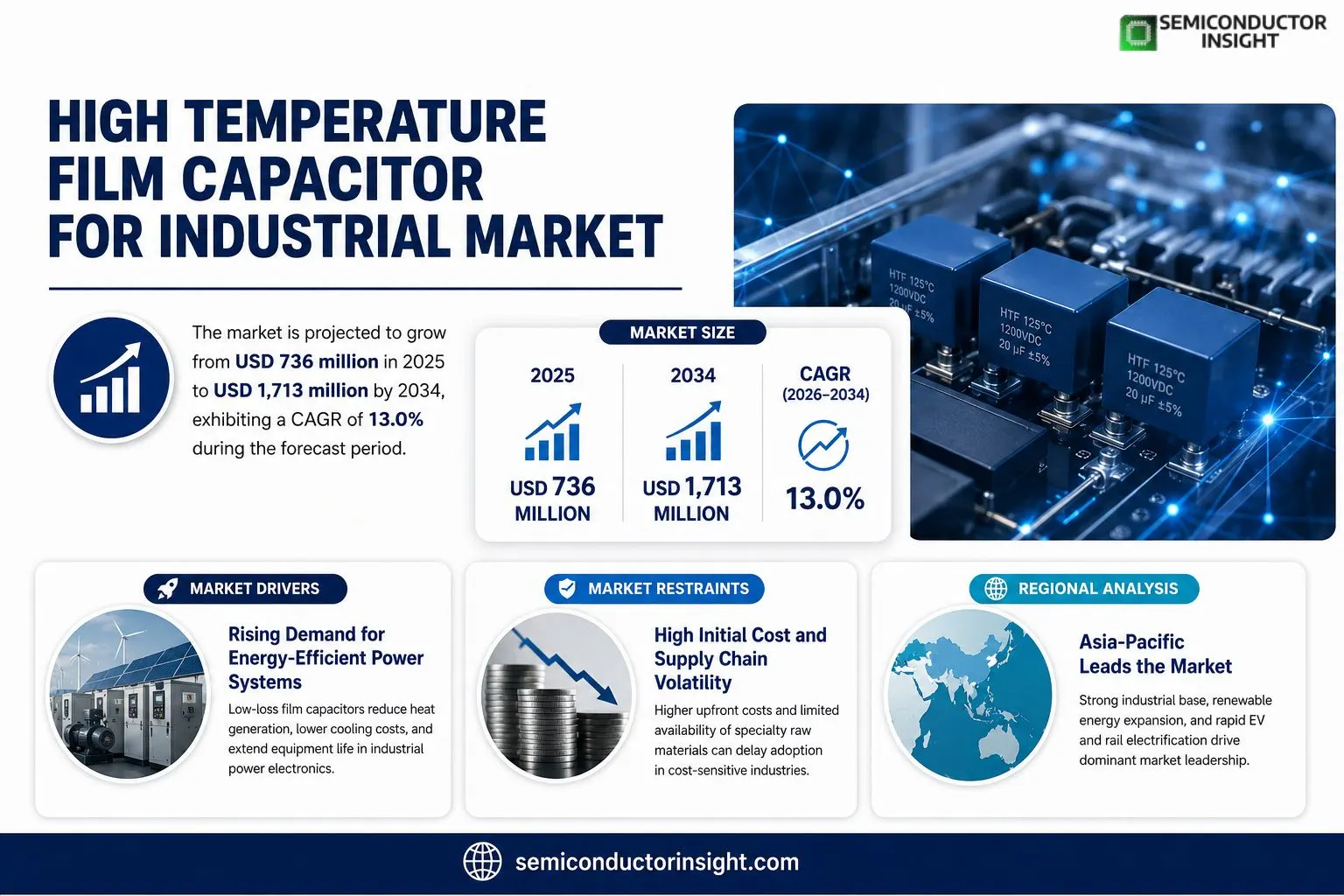
High Temperature Film Capacitor for Industrial Market size was valued at USD 736 million in 2025. It will reach USD 1,713 million by 2034, reflecting a CAGR of 13.0% during the forecast period.
Industrial high‑temperature film capacitors are passive components engineered for power‑electronics systems that must endure elevated temperatures, high voltage stresses, substantial ripple currents and extended service lives. Their primary function is stable energy storage and rapid current response in applications such as DC‑link support, snubber protection, AC filtering, resonant circuits and electromagnetic‑interference suppression across variable‑frequency drives, photovoltaic inverters, energy‑storage converters, industrial power supplies, rail transit equipment and selected electric‑vehicle charging stations.
MARKET DRIVERS
Rising Demand for Energy‑Efficient Power Systems
Industrial customers are reallocating capital toward equipment that minimizes loss and heat generation. High Temperature Film Capacitor for Industrial Market solutions meet this need by offering low dissipation factors, which translates into reduced cooling expenses and longer service intervals. The financial upside of lower operational costs is prompting OEMs to specify these capacitors in new generation motor drives and power converters.
Stringent Temperature Requirements in Harsh Environments
Manufacturing plants that operate in metal‑processing, cement, and petrochemical sectors often encounter ambient temperatures above 150 °C. Traditional dielectric materials degrade quickly under such conditions, whereas high‑temperature film variants retain capacitance stability, preventing unplanned shutdowns. This reliability advantage is becoming a decisive factor for procurement engineers seeking to avoid production downtime.
➤ “When a capacitor sustains performance at 200 °C, the downstream inverter can be designed with tighter tolerances, unlocking efficiency gains that were previously unattainable.”
Regulatory pushes toward greener manufacturing are also shaping component selection. Compliance frameworks increasingly reward plants that document reduced heat waste, and the ability of High Temperature Film Capacitor for Industrial Market parts to operate without auxiliary cooling aligns neatly with such sustainability metrics.
MARKET CHALLENGES
Cost Sensitivity in Capital‑Intensive Industries
Although the total cost of ownership favors high‑temperature film devices, their upfront price remains higher than that of conventional electrolytic equivalents. Budget‑conscious plant managers often default to cheaper parts, especially when short‑term financial targets outweigh long‑term reliability considerations.
Other Challenges
Supply‑Chain Volatility
The raw materials used for premium film formulationssuch as specialty polymers and high‑purity metallization foilsare sourced from a limited number of suppliers. Recent geopolitical tensions have introduced lead times that can extend beyond six months, complicating production planning for manufacturers reliant on steady component flow.
MARKET RESTRAINTS
Technical Familiarity Gap
Design engineers trained on legacy capacitor technologies may lack confidence in specifying high‑temperature film parts, fearing integration risks or insufficient design tools. This knowledge gap slows adoption, as firms choose to stick with familiar, albeit less efficient, components rather than invest in additional training or simulation resources.
MARKET OPPORTUNITIES
Expansion of Smart Grid Infrastructure
mart grid deployments require power electronics that can withstand temperature spikes caused by rapid load changes. Embedding High Temperature Film Capacitor for Industrial Market technology into grid‑level converters offers a pathway to extend equipment lifespan while maintaining tight voltage regulation, creating a compelling value proposition for utilities seeking to modernize their networks.
High Temperature Film Capacitor for Industrial Market Trends
Rising Demand from Power‑Electronics Infrastructure
The expansion of renewable‑energy converters, grid‑level storage systems and high‑speed industrial drives is translating into a sustained need for capacitors that can survive harsh thermal and electrical environments. designers of photovoltaic inverters and rail‑transit power supplies now specify components that operate reliably at 110 °C‑125 °C for extended lifetimes, because any premature failure directly impacts system availability and OPEX. This pressure is reflected in a clear upward trend in volume orders for film capacitors that combine low loss, high ripple‑current capability and self‑healing film technologies. Suppliers that can certify humidity resistance and long‑term aging performance are gaining preference, as these attributes reduce the total cost of ownership for large‑scale projects.
Other Trends
Temperature‑Class Diversification
Manufacturers are broadening their portfolios beyond the traditional 105 °C class. Emerging product lines featuring 125 °C and even 200 °C ratings are being introduced to serve niche segments such as offshore wind converters and high‑temperature oil‑field drives. The move away from a single‑class offering is driven by the need to match increasingly aggressive thermal designs, where higher switching frequencies raise internal heating. By providing higher‑temperature options, vendors enable system integrators to push power density without redesigning cooling infrastructures, thereby shortening development cycles and improving competitive positioning.
Shift Toward Capability‑Driven Supplier Relationships
Historically, the market revolved around catalog specificationscapacitance, voltage and form factor. Recent contracts reveal a pivot toward collaborative development models: customers now request custom dielectric formulations, low‑inductance terminations and validation services aligned with specific DC‑bus voltages and lifetime targets. This evolution rewards suppliers that maintain rigorous test labs and can deliver application‑specific certifications. Consequently, the competitive arena is less about price undercutting and more about the depth of engineering support, which creates higher entry barriers for pure‑volume manufacturers and secures longer‑term revenue streams for the more capable players.
COMPETITIVE LANDSCAPE
Key Industry Players
High‑Temperature Film Capacitors: Enabling Reliable Power Conversion in Industrial Systems
The segment is anchored by a handful of multinational manufacturers that have turned high‑temperature performance into a core competency. TDK Electronics, Murata, Vishay, and KEMET each offer metallized polypropylene families with self‑healing features, low ESR and strict lifetime guarantees that satisfy the most demanding DC‑link and snubber applications in variable‑frequency drives and grid‑scale inverters. Their extensive validation labs and global support networks create a de‑facto standard for OEM specifications, compelling system integrators to align design roadmaps with these vendors. Parallel to the global leaders, European specialists such as WIMA and Mersen provide ultra‑low loss, high‑dielectric‑constant films for niche markets that require stringent IEC compliance and high‑frequency operation. This tiered structure – global giants handling volume and baseline specifications, complemented by regional experts focusing on premium performance – defines the competitive fabric of the industrial high‑temperature film capacitor market.Beyond the headline players, a second tier of manufacturers commands considerable influence through application‑specific engineering. Chinese firms like Xiamen Faratronic, Anhui Safe Electronics and Anhui Tongfeng have leveraged rapid scaling capabilities to deliver customized box‑type and screw‑terminal modules for photovoltaic inverters and rail‑transit converters, often bundling thermal‑encapsulation services that mitigate humidity‑induced degradation. Korean and Japanese suppliers, exemplified by Samwha Capacitor Group and Shizuki Electric, emphasize ruggedized PTFE‑based dielectrics capable of withstanding continuous operation above 125 °C, a critical attribute for emerging energy‑storage converters. Companies such as Electrocube and CEFEM differentiate themselves with proprietary high‑dielectric thermosetting films that enable compact, high‑power density designs, giving them a foothold in high‑voltage DC‑bus platforms where space and thermal margin are at a premium. Their focus on collaborative development, including joint reliability testing with end‑users, translates into higher customer lock‑in and incremental market share despite a fragmented price landscape.
List of Key High Temperature Film Capacitor Companies Profiled
- Murata Manufacturing Co., Ltd.
- TDK Electronics
- Vishay Intertechnology, Inc.
- KEMET Corporation
- WIMA GmbH
- Xiamen Faratronic
- Nichicon Corporation
- Mersen
- Anhui Safe Electronics Co., Ltd.
- Anhui Tongfeng Electronics Co., Ltd.
- CEFEM Ltd.
- Samwha Capacitor Group
- Electrocube
- Shizuki Electric Co., Ltd.
- Man Yue Technology Holdings Limited
Segment Analysis:
| Segment Category | Sub-Segments | Key Insights |
| By Type |
|
Metallized Polypropylene
|
| By Application |
|
Variable‑Frequency Drives
|
| By End User |
|
Industrial Automation
|
| By Temperature Class |
|
125°C Class
|
| By Delivery Format |
|
Module Structures
|
Regional Analysis: High Temperature Film Capacitor for Industrial Market
Asia-Pacific
Domestic fabs in China, Taiwan, and South Korea have integrated advanced roll‑to‑roll film casting, enabling tighter tolerance on temperature coefficients. Partnerships with specialty resin producers shorten lead times and support rapid prototype cycles for industrial customers.
Power‑conversion gear in solar farms, high‑speed train traction systems, and heavy‑duty compressors dominate the demand map, each demanding capacitor performance that stays reliable at elevated grid temperatures.
Stricter IEC standards for thermal endurance combined with national energy‑efficiency policies push manufacturers toward components that can certify under extended temperature‑rise scenarios without sacrificing dielectric strength.
Regional logistics hubs in Singapore and Hong Kong streamline component distribution, while recent geopolitical shifts have encouraged diversification of raw‑material sources to safeguard against single‑point failures.
North America
North America’s industrial sector pursues a different trajectory, emphasizing reliability in harsh, seasonally variable climates. OEMs in the United States are retrofitting legacy motor drives with high‑temperature film capacitors to meet stricter emissions and efficiency codes, especially in petrochemical complexes. Canadian manufacturers, meanwhile, leverage the technology to support northern mining operations where ambient temperatures can fluctuate dramatically. The market is further shaped by a cautious investment climate; firms prioritize proven supplier relationships and demand rigorous long‑term performance data before scaling adoption. This prudent stance creates a stable, though slower‑moving, demand cadence compared with the rapid expansion seen in Asia‑Pacific.
Europe
European manufacturers confront a dense regulatory tapestry that mandates both environmental compliance and high safety standards. The automotive sector, especially in Germany and France, integrates high‑temperature film capacitors into electric‑vehicle power modules to reduce thermal management complexity. Energy‑intensive industries such as steel and chemicals view the components as a pathway to meet EU carbon‑reduction targets while maintaining process continuity during peak‑load periods. Market participants frequently engage in collaborative R&D consortia, leveraging the continent’s strong intellectual‑property framework to refine film compositions that sustain performance under elevated industrial furnace temperatures.
South America
In South America, the industrial rollout of high‑temperature film capacitors is closely linked to expanding mining and agribusiness infrastructure. Brazilian power‑generation projects, particularly those integrating biomass and hydro‑electric plants, require capacitors that can endure the high humidity and temperature profiles typical of the region’s low‑land facilities. Local distributors favor suppliers offering on‑site technical support, as installation environments often lack climate‑controlled chambers. The market’s growth is tempered by currency volatility, prompting multinational vendors to establish joint‑venture production lines that mitigate cost‑pass‑through pressures.
Middle East & Africa
The Middle East & Africa region presents a niche yet potent frontier for High Temperature Film Capacitor for Industrial Market. In the Gulf Cooperation Council states, aggressive desalination plant expansions and oil‑field automation projects demand components that resist temperatures exceeding 150 °C. African industrial hubs, especially in South Africa and Nigeria, are modernizing grid‑level power conversion equipment, creating early‑adopter pockets for high‑temperature solutions. However, limited local expertise in film‑technology processing leads many operators to source from established Asian manufacturers, reinforcing the continent’s role as a downstream market awaiting skill‑transfer initiatives.
Report Scope
This market research report provides a comprehensive analysis of the High Temperature Film Capacitor for Industrial Market , covering the forecast period 2026–2034. It offers detailed insights into market dynamics, technological advancements, competitive landscape, and key trends shaping the industry.
Key focus areas of the report include:
- Market Overview: The report begins with an overview outlining its current market scenario, key growth indicators, and industry transformation drivers. It discusses macroeconomic factors, demand–supply balance, regulatory landscape, and the strategic role of semiconductors in powering advancements across industries such as automotive, telecommunications, consumer electronics, and industrial automation.
- Market Size & Forecast: Historical data and future projections for revenue, unit shipments, and market value across major regions and segments.
- Segmentation Analysis: Detailed breakdown by product type, technology, application, and end-user industry to identify high-growth segments and investment opportunities.
- Regional Insights: Insights into market performance across North America, Europe, Asia-Pacific, Latin America, and the Middle East & Africa, including country-level analysis where relevant.
- Competitive Landscape: Profiles of leading market participants, including their product offerings, R&D focus, manufacturing capacity, pricing strategies, and recent developments such as mergers, acquisitions, and partnerships.
- Technology Trends & Innovation: Assessment of emerging technologies, integration of AI/IoT, semiconductor design trends, fabrication techniques, and evolving industry standards.
- Market Drivers & Restraints: Evaluation of factors driving market growth along with challenges, supply chain constraints, regulatory issues, and market-entry barriers.
- Stakeholder Insights: Insights for component suppliers, OEMs, system integrators, investors, and policymakers regarding the evolving ecosystem and strategic opportunities.
Primary and secondary research methods are employed, including interviews with industry experts, data from verified sources, and real-time market intelligence to ensure the accuracy and reliability of the insights presented.
FREQUENTLY ASKED QUESTIONS:
What is the current market size of High Temperature Film Capacitor for Industrial Market?
-> High Temperature Film Capacitor for Industrial Market was valued at USD 736 million in 2025 and is expected to reach USD 1,713 million by 2034, growing at a CAGR of 13.0% during the forecast period.
Which key companies operate in High Temperature Film Capacitor for Industrial Market?
-> Key players include Murata, Vishay, KEMET, Electrocube, Electronic Concepts, Exxelia, Kendeil, TDK Electronics, Xiamen Faratronic, Yageo, Panasonic Industry, WIMA, Shizuki Electric Co., Inc., Nichicon Corporation, Mersen, CEFEM, Wuxi CRE New Energy Technology Co., Ltd., Anhui Safe Electronics Co., Ltd., Anhui Tongfeng Electronics Co., Ltd., Samwha Capacitor Group, Sungho Electronics Co., Ltd., Man Yue Technology Holdings Limited, among others.
What are the key growth drivers?
-> Key growth drivers include the expanding adoption of power electronics in industrial automation, renewable energy conversion (photovoltaic inverters, energy storage), rail transit electrification, grid‑quality improvement projects, and increasing demand for high‑temperature, high‑reliability capacitors that can operate at 105°C‑200°C.
Which region dominates the market?
-> Asia holds the largest market share, driven by rapid growth in China, Japan, and South Korea, while Europe and North America remain strong secondary regions.
What are the emerging trends?
-> Emerging trends include the development of proprietary high‑dielectric thermosetting and PTFE film technologies, advanced low‑inductance packaging, capability‑driven collaborative product development, and increased focus on humidity resistance and ultra‑long lifetime specifications for high‑frequency, high‑power‑density applications.
Get Sample Report PDF for Exclusive Insights
Report Sample Includes
- Table of Contents
- List of Tables & Figures
- Charts, Research Methodology, and more...
 Download Sample Report PDF