High Temperature Film Capacitor Market Insights
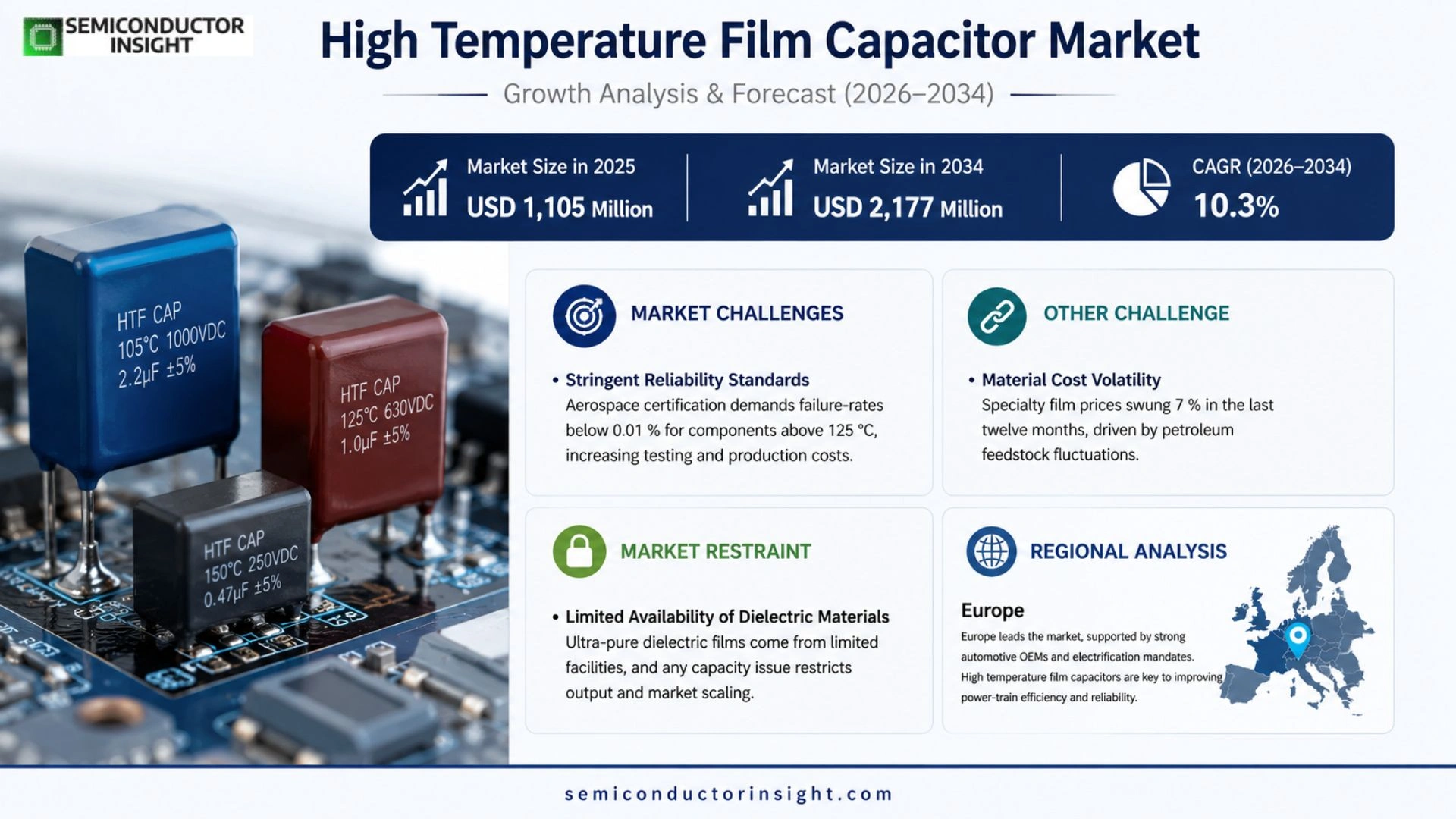
Global High Temperature Film Capacitor market size was USD 1,105 million in 2025 and is expected to reach USD 2,177 million by 2034, reflecting a CAGR of 10.3% over the forecast period.
High temperature film capacitors are passive components engineered for power‑electronics environments that demand high thermal tolerance and long service life. They overcome the limitations of conventional 105 °C film parts in applications such as electric‑vehicle drive systems, onboard chargers, DC‑DC converters, industrial and solar inverters, as well as aerospace and oil‑&‑gas equipment. Core functions include DC‑bus energy buffering, smoothing, snubber protection, AC filtering and EMI suppression; typical constructions use metallised polypropylene, PPS or PTFE films with self‑healing structures and low ESR designs capable of continuous operation from 125 °C up to 200 °C.
MARKET DRIVERS
Increasing Demand for Power‑Electronics in Renewable Energy Systems
The shift toward solar‑ and wind‑generated power has amplified the need for components that tolerate elevated temperatures while preserving dielectric stability. High Temperature Film Capacitor Market players are seeing design engineers favor film capacitors for their low loss and long‑life characteristics, especially in inverter modules that regularly exceed 125 °C. This technical advantage translates into larger procurement volumes as project developers chase higher efficiency.
Growth of Electrified Transportation Platforms
Electric‑vehicle (EV) manufacturers are integrating high‑temperature film capacitors into on‑board chargers and motor‑controller assemblies to cope with thermal spikes during rapid acceleration. The sector’s CAGR of roughly 12 % over the past three years has forced OEMs to re‑evaluate component supply chains, creating a steady flow of orders for capacitors that sustain performance at temperatures up to 150 °C.
➤ “Thermal resilience is becoming a baseline requirement rather than a niche attribute for modern power modules.”
Regulatory pressure for higher efficiency standards in industrial drives and data‑center power supplies also nudges designers toward film technology. By reducing the need for external cooling, manufacturers can cut capital expenditure on heat‑sink infrastructure, making high‑temperature film capacitors a cost‑effective solution for High Temperature Film Capacitor Market.
MARKET CHALLENGES
Stringent Reliability Standards in Aerospace Applications
Aerospace certification bodies demand failure‑rates below 0.01 % for passive components operating above 125 °C. Meeting these benchmarks requires extensive testing and tighter process control, inflating production costs for suppliers and narrowing margins for niche projects.
Other Challenges
Material Cost Volatility
The price of specialty polyimide and polypropylene films has shown a 7 % swing in the last twelve months, driven by fluctuating petroleum feedstock. This volatility hampers long‑term pricing strategies and forces buyers to adopt hedging mechanisms, which can delay contract finalization.
MARKET RESTRAINTS
Limited Availability of High‑Purity Dielectric Materials
Production of ultra‑pure dielectric films essential for low‑loss performance is concentrated in a handful of facilities. Any capacity bottleneck,such as equipment downtime or raw‑material shortages,directly throttles output, constraining the ability of High Temperature Film Capacitor Market to scale quickly.
Additionally, the industry faces talent gaps in advanced material science, slowing the rollout of next‑generation formulations that could otherwise improve temperature tolerance beyond current limits.
MARKET OPPORTUNITIES
Emergence of 5G Infrastructure Deployments
5G base stations rely on high‑power amplifiers that generate localized heat zones. Integrating high‑temperature film capacitors can reduce the need for additional thermal management, opening a sizable slice of the telecom equipment market for suppliers willing to certify devices for continuous operation at 130 °C.
The convergence of edge‑computing with rugged industrial IoT devices also creates a fertile ground for capacitors that endure harsh environments without performance drift. Companies that align product roadmaps with these use cases stand to capture incremental revenue as High Temperature Film Capacitor Market expands into new verticals.
High Temperature Film Capacitor Market Trends
Thermal‑Resilient Capacitors Become Core to Power‑Electronics Architecture
The shift from conventional 105 °C film parts to devices able to survive 125 °C‑200 °C operating windows is redefining the design envelope of modern converters. Engineers now treat temperature tolerance as a performance metric rather than a peripheral specification, because it directly influences lifetime, loss, and size. As electric‑vehicle drivetrains, solar‑inverter platforms, and aerospace power modules all target higher power density, the ability to retain low ESR and high ripple‑current capability at elevated temperatures eliminates the need for bulky heat sinks and extra cooling loops. Consequently, system‑level efficiency gains translate into lower total‑cost‑of‑ownership for OEMs, while qualifying for stringent reliability programs such as AEC‑Q200 becomes a decisive purchasing criterion.
Other Trends
Regional Competitive Landscape
Japanese firms continue to leverage early‑stage material science expertise, especially in metallized polypropylene and high‑dielectric heat‑resistant resins, securing lead time advantage for automotive platforms. European and U.S. players focus on ultra‑high‑voltage, aerospace‑grade offerings, where certification and long‑term supply security outweigh pure cost considerations. Chinese manufacturers excel in scale, delivering cost‑effective modules for large‑area solar farms and grid‑storage converters, but they are increasingly investing in proprietary self‑healing structures to move up the value chain. This geographic segmentation suggests that the market will not flatten into a price‑only arena; instead, distinct value propositions will coexist, each aligned with the priorities of its dominant end‑use sector.
Emerging Application Segments Extend the Addressable Base
Beyond the well‑known electric‑vehicle and renewable‑energy drivers, high‑temperature film caps are gaining foothold in rail‑transit traction converters and industrial drives that operate continuously at 150 °C‑180 °C. The tightening of EU CO₂ standards for commercial‑vehicle fleets and the rollout of offshore wind converters in harsh marine climates create a need for components that can endure both temperature and humidity stress without compromising dielectric strength. Suppliers that can bundle material innovation with system‑level integration services,such as custom DC‑Link modules or pre‑qualified snubber kits,are positioned to capture contract‑based revenue streams that complement traditional catalog sales.
COMPETITIVE LANDSCAPE
Key Industry Players
High Temperature Film Capacitor Market: Competitive Overview
The market is dominated by a handful of multinational firms that have cultivated deep expertise in high‑temperature dielectrics and automotive‑grade reliability programs. Murata and Vishay leverage long‑standing metallized polypropylene technologies while expanding into PPS and PTFE variants to meet the stringent demands of electric‑vehicle power modules. KEMET and TDK complement their broad passive‑component portfolios with dedicated high‑temperature lines, positioning themselves as preferred suppliers for OEMs seeking integrated DC‑Link solutions. Their global footprint, combined with certifications such as AEC‑Q200, gives them leverage in negotiating platform‑level nominations across automotive, aerospace, and industrial inverter projects. The concentration of these players creates a tiered supply chain where volume, material science, and long‑term reliability converge to shape pricing and entry barriers.
Beyond the core tier, several specialized manufacturers have carved out niches that reinforce the market’s technological depth. European firm Exxelia focuses on ultra‑high‑voltage modules for aerospace and defense, while Germany’s Kendeil supplies customized snubber capacitors to the rail‑transit sector. Asian companies such as Xiamen Faratronic, Electrocube, and NANTONG HUASING ELECTRONICS have built cost‑effective production capacities that serve the rapidly expanding renewable‑energy segment in China and Southeast Asia. Yageo, Rubycon, and Nitsuko provide a breadth of standard‑size PCB‑mounted parts that support the high‑volume consumer‑electronics and industrial‑power‑electronics supply chains. Cornell Dubilier Electronics rounds out the list with a reputation for low‑loss, high‑ripple‑current devices that appeal to high‑efficiency storage converters. These firms collectively sustain a competitive environment where material innovation, application‑specific design, and regional manufacturing strengths determine market share.
List of Key High Temperature Film Capacitor Companies Profiled
- Murata Manufacturing Co., Ltd.
- Vishay Intertechnology, Inc.
- KEMET Corporation
- TDK Electronics AG
- Exxelia
- Kendeil GmbH
- Electrocube
- Yageo Corporation
- Rubycon Corporation
- Nitsuko Electronics Co., Ltd.
- Cornell Dubilier Electronics, Inc.
- Xiamen Faratronic Co., Ltd.
- Shizuki Electric Co., Inc.
- NANTONG HUASING ELECTRONICS CO., LTD.
Segment Analysis:
| Segment Category | Sub-Segments | Key Insights |
| By Type |
|
Leading Segment
|
| By Application |
|
Leading Segment
|
| By End User |
|
Leading Segment
|
| By Material Innovation |
|
Leading Segment
|
| By Temperature Class |
|
Leading Segment
|
Regional Analysis: High Temperature Film Capacitor Market
Europe
Tier‑one European fabs leverage advanced polyimide substrates to meet the 150 °C class requirement, differentiating themselves through tighter tolerance control. Collaborative ventures between capacitor makers and automotive Tier‑1 suppliers have created co‑development labs that accelerate design‑for‑manufacture cycles, yielding lower defect rates and faster time‑to‑market.
Power‑electronics modules for electric buses and offshore wind converters dominate European adoption curves. In particular, high‑temperature film capacitors are favored in converter topologies where thermal cycling imposes strict reliability thresholds, enabling higher power density without compromising lifespan.
The EU’s updated electromagnetic‑compatibility directives compel manufacturers to adopt film capacitors with superior dielectric stability. Simultaneously, environmental directives push for lead‑free solutions, reinforcing the shift toward high‑temperature film designs that comply without performance trade‑offs.
Proximity of raw‑material producers in Germany and the Benelux region mitigates logistics bottlenecks. However, recent raw‑film resin price volatility has prompted European firms to hedge contracts and diversify sourcing to maintain margin stability.
North America
North America’s High Temperature Film Capacitor Market is shaped by incremental adoption in aerospace and data‑center power‑distribution units. The United States Defense Department’s emphasis on thermal‑robust components for next‑generation avionics has catalyzed specialized supplier programs. Concurrently, Silicon Valley’s focus on high‑frequency switching power supplies encourages innovators to experiment with film capacitors that can sustain elevated junction temperatures, reducing cooling overhead. While the market lacks the same regulatory push as Europe, voluntary compliance with IEC standards ensures a baseline of quality that appeals to multinational OEMs seeking uniform component footprints across continents.
Asia‑Pacific
In Asia‑Pacific, rapid expansion of electric‑vehicle assembly lines in China and India fuels demand for high‑temperature film capacitors capable of withstanding aggressive thermal cycling. Local manufacturers, many of which are vertically integrated, benefit from lower labor costs but are confronting tighter energy‑efficiency targets imposed by regional governments. The rise of renewable‑energy projects,particularly solar farms in Southeast Asia,creates a secondary market where inverter manufacturers rely on film capacitors to achieve durable, low‑maintenance solutions. Competitive pricing pressures, however, compel firms to balance cost against the premium dielectric properties necessary for high‑temperature operation.
South America
South America presents a niche yet growing segment for high‑temperature film capacitors, primarily driven by Brazil’s expanding industrial motor‑control sector. The country’s investment in renewable‑energy infrastructure, especially wind farms along the coastal belt, introduces applications where thermal resilience directly correlates with uptime. Local distributors are beginning to stock European‑grade film capacitors, recognizing the value proposition of longer service intervals in remote installations where maintenance logistics are challenging.
Middle East & Africa
The Middle East & Africa region is influenced by its harsh climatic conditions, which naturally align with the performance envelope of high‑temperature film capacitors. Oil‑field power‑distribution networks in the Gulf Cooperation Council countries demand components that can endure ambient temperatures exceeding 60 °C while maintaining dielectric integrity. Meanwhile, emerging solar‑power projects across North Africa leverage these capacitors to reduce cooling requirements, enhancing overall system efficiency. Market growth is modest but steady, as regional utilities prioritize reliability over cost in mission‑critical installations.
Report Scope
This market research report provides a comprehensive analysis of the High Temperature Film Capacitor Market , covering the forecast period 2026–2034. It offers detailed insights into market dynamics, technological advancements, competitive landscape, and key trends shaping the industry.
Key focus areas of the report include:
- Market Overview: The report begins with an overview outlining its current market scenario, key growth indicators, and industry transformation drivers. It discusses macroeconomic factors, demand–supply balance, regulatory landscape, and the strategic role of semiconductors in powering advancements across industries such as automotive, telecommunications, consumer electronics, and industrial automation.
- Market Size & Forecast: Historical data and future projections for revenue, unit shipments, and market value across major regions and segments.
- Segmentation Analysis: Detailed breakdown by product type, technology, application, and end-user industry to identify high-growth segments and investment opportunities.
- Regional Insights: Insights into market performance across North America, Europe, Asia-Pacific, Latin America, and the Middle East & Africa, including country-level analysis where relevant.
- Competitive Landscape: Profiles of leading market participants, including their product offerings, R&D focus, manufacturing capacity, pricing strategies, and recent developments such as mergers, acquisitions, and partnerships.
- Technology Trends & Innovation: Assessment of emerging technologies, integration of AI/IoT, semiconductor design trends, fabrication techniques, and evolving industry standards.
- Market Drivers & Restraints: Evaluation of factors driving market growth along with challenges, supply chain constraints, regulatory issues, and market-entry barriers.
- Stakeholder Insights: Insights for component suppliers, OEMs, system integrators, investors, and policymakers regarding the evolving ecosystem and strategic opportunities.
Primary and secondary research methods are employed, including interviews with industry experts, data from verified sources, and real-time market intelligence to ensure the accuracy and reliability of the insights presented.
FREQUENTLY ASKED QUESTIONS:
What is the current market size of High Temperature Film Capacitor Market?
-> High Temperature Film Capacitor market is expected to reach USD 2,177 million by 2034, reflecting a CAGR of 10.3% over the forecast period.
Which key companies operate in High Temperature Film Capacitor Market?
-> Key players include Murata, Vishay, KEMET, TDK, CDE, Kendeil, Exxelia, Electrocube, Yageo, and Cornell Dubilier, among others.
What are the key growth drivers?
-> Key growth drivers include electric vehicle adoption, renewable‑energy power electronics, stricter CO₂ emission regulations, and rising demand for high‑temperature power conversion in industrial, aerospace and oil‑&-gas applications.
Which region dominates the market?
-> Asia‑Pacific dominates the market, propelled by strong automotive and renewable‑energy supply chains, while Europe shows robust growth in high‑voltage and aerospace segments.
What are the emerging trends?
-> Emerging trends include development of 140°C‑200°C film capacitors, self‑healing dielectric technologies, miniaturized DC‑Link modules, and expanded AEC‑Q200 automotive qualification.

Get Sample Report PDF for Exclusive Insights
Report Sample Includes
- Table of Contents
- List of Tables & Figures
- Charts, Research Methodology, and more...
 Download Sample Report PDF