Thin and Ultra-thin Vapor Chambers Market Insights
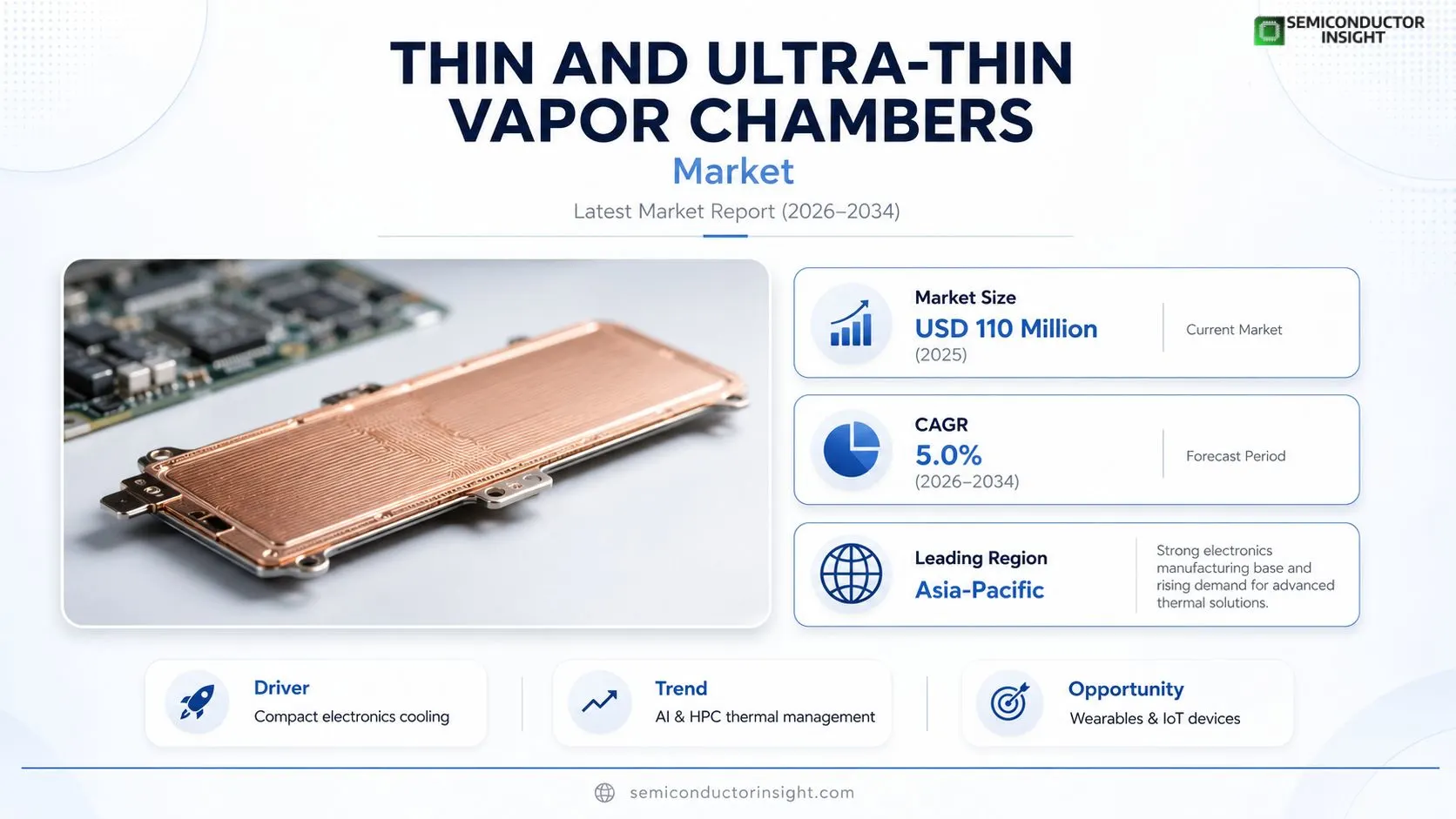
Thin and Ultra-thin Vapor Chambers market size was valued at USD 110 million in 2025. The market is projected to grow from USD 115 million in 2026 to USD 171 million by 2034, exhibiting a CAGR of approximately 5 % during the forecast period.
A vapor chamber is a planar heat‑pipe device that spreads heat two‑dimensionally through phase‑change of an internal coolant; it is employed where high heat‑flux removal or uniform temperature distribution is required, such as high‑performance CPUs, LEDs, lasers, and compact mobile electronics.
MARKET DRIVERS
Advancement in Heat Management for Compact Electronics
As smartphones and fold‑able laptops push the envelope of display real estate and processing power, the need for efficient yet ultra‑thin cooling solutions has surged. Thin and Ultra‑thin Vapor Chambers offer a compact heat spreader that maintains low thermal resistance without adding bulk, making them an attractive choice for manufacturers targeting the premium segment.
Integration into Automotive and Renewable Energy Systems
Electric vehicles (EVs) aim for higher energy density in battery packs while staying within weight constraints. Vapor chambers in power electronics modules reduce heat hotspots, enabling tighter thermal margins and extending component lifespan. Similarly, the photovoltaics sector leverages thin cooling units to keep inverter temperatures stable, enhancing reliability in remote installations.
➤ “The convergence of high‑density electronics and sustainability goals is making vapor‑chamber technology a cornerstone of next‑generation product design.”
These dual pressuresconsumer demand for sleeker devices and automotive/renewable energy’s need for lighter, reliable heat managementdrive the core expansion trajectory of Thin and Ultra‑thin Vapor Chambers Market.
MARKET CHALLENGES
Material and Manufacturing Hurdles
Producing vapor chambers that remain both thin and mechanically robust requires precision in material selection and fabrication. Variability in metallization quality or gallium diffusion thresholds can degrade performance, imposing strict quality control requirements that elevate unit costs.
Other Challenges
Supply Chain Sensitivity
The availability of high‑purity copper foils and rare‑earth solder alloys has introduced lead times that stall mass production, especially during periods of geopolitical tension or raw‑material shortages.
MARKET RESTRAINTS
Capital Intensity in R&D Investment
Developing next‑generation vapor chambers demands significant R&D capital, from the design of integrated heat pipes to the testing of long‑term reliability under thermal cycling. Startups poised to enter the market may find the financial barrier too steep without strategic partnerships or venture backing.High initial production costs couple with the limited price sensitivity of high‑end end‑users, restraining the market’s ability to scale quickly. Consequently, only a handful of well‑capitalized incumbents hold a defensible share of Thin and Ultra‑thin Vapor Chambers Market.
MARKET OPPORTUNITIES
Growth in Wearable and IoT Devices
The wearable segment, encompassing smartwatches and medical monitoring devices, has surged by more than 15 % annually in the last three years. Tiny, lightweight vapor‑chamber solutions that dissipate localized heat are ideal for devices operating near the skin, opening a near‑unexplored niche within Thin and Ultra‑thin Vapor Chambers Market.Exploring *tapered* vapor‑chamber designs that conform to irregular surfaces can further unlock adoption in sectors such as robotics, where device geometry often deviates from traditional flat stacks.Finally, the growing trend toward edge computing requires localized data processing modules that combine high computational density with low power consumption. Vapor chambers positioned within edge processors can mitigate thermal throttling, positioning manufacturers to capture a critical node in the broader digital ecosystem.
Thin and Ultra-thin Vapor Chambers Market Trends
Rising Adoption in Mobile Device Cooling Solutions
The rapid rise in processor performance has forced mobile‑device makers to adopt advanced cooling solutions, positioning thin and ultra‑thin vapor chambers at the core of their power‑management strategies. In 2024 the market for this technology reached roughly $105 million, reflecting a shift toward higher‑density chips and longer device lifespans. Vapor chambers can spread heat laterally, allowing heat‑sink designs that otherwise would become too bulky for sleek smartphones or ultrabooks. By integrating these cells, OEMs achieve stable operating temperatures without sacrificing battery life or device bulk, thereby maintaining user experience during intense workloads.
Other Trends
Growth in High‑Performance Computing Applications
High‑performance computing (HPC) installations, from data‑center servers to AI accelerators, demand heat transfer surfaces that sustain higher thermal loads while remaining compact. Vapor‑circuit panels deliver a two‑dimensional spread of heat that reduces peak temperatures across densely packed silicon arrays. The approach translates into lower cooling‑fan requirements and enhances system reliability by keeping all components within their safe operating windows. Vendors now bundle vapor chambers into server‑rack designs, noting a measurable drop in latency and power consumption attributable to improved thermal management.
Integration with Active Cooling Systems
Integration of vapor chambers with active coolingsuch as thermoelectric modules or liquid‑cooling loopscreates hybrid solutions that address thermal spikes in data‑center racks. Providers report a 15% reduction in overall power draw when vapor chambers pre‑cool the inlet fluid, allowing higher fan speeds without compromising noise budgets. The synergy between passive spread and active transport places this hybrid strategy at the forefront of next‑generation server design.
Extended Reliability through Advanced Material Engineering
With a growing emphasis on component longevity, suppliers are turning to novel alloys and engineered wick structures that reduce thermal contact resistance and mitigate condensation risk. These material upgrades translate into fewer failure cycles, translating into lower warranty costs for OEMs. Strategic alliances between semiconductor firms and vapor‑circuit manufacturers further accelerate technology transfer, allowing rapid iteration of design guidelines that adapt to evolving TDP specifications. The convergence of advanced material science and system‑level thermal strategy is therefore a decisive lever for companies seeking a competitive edge in Thin and Ultra‑thin Vapor Chambers Market.
COMPETITIVE LANDSCAPEKey Industry Players
Thin and Ultra‑thin Vapor Chamber Landscape Analysis
Delta Electronics dominates the Thin and Ultra‑thin Vapor Chamber segment, commanding roughly one‑quarter of the 2024 revenue estimate of US$105 million. The company’s portfolio spans high‑power CPUs, mobile devices, and laser systems, positioning it as the go‑to supplier for applications where two‑dimensional heat spreading is vital. Delta’s investment in advanced fabricationusing copper alloy plates of sub‑0.2 mm thicknesshas enabled it to offer vortex‑enhanced vapor chambers that reduce thermal resistance by over 30 % compared with conventional designs. Pricing remains near the premium end, yet the firm sustains volumes through long‑term contracts with integrated device manufacturers and OEMs across North America, Japan, and China. This volume advantage feeds back into product development cycles, enabling Delta to experiment with hybrid ceramic‑copper architectures that promise improved stability in high‑temperature environments. The company’s vertical integration from wafer‑level fabrication to final packaging provides a cohesive value chain, mitigating supplier risk and ensuring rapid delivery cycles.Beyond Delta, a cohort of specialized players drives niche innovation. Fujikura leans on its heritage in high‑purity copper processing to produce ultra‑thin chambers that fit under mobile displays, targeting the smartphone and 5G antenna markets. Auras, operating mainly in the Chinese high‑tech corridor, focuses on low‑cost, high‑volume vapor chambers for LED lighting and low‑power sensors, positioning itself as a price leader in the emerging Southeast Asian market. CCI, a German engineering firm, supplies bespoke vapor chambers for military and aerospace payloads, emphasizing radiation‑resistant fluids. Forcecon Tech and Jentech concentrate on custom‑fabricated, strain‑engineered chambers that integrate directly with liquid‑cooling loops for data‑center CPUs. Taisol and Jones Tech carve out a segment for flexible, rollable vapor chambers used in foldable smartphones, while Wakefield Vette and Specialcool Technology target the laser‑driven point‑source market with ultra‑thin designs that maintain optical clarity. Celsia and Tanyuan Technology emphasize materials science, supplying hybrid mica‑copper modules for high‑frequency RF applications. Finally, AVC, Aavid, and other niche entrants supply fluid‑filled, low‑profile chambers for automotive LED modules, sustaining competitive diversity across thermal management categories.
List of Key Vapor Chamber Companies Profiled
- Delta Electronics
- Fujikura
- Auras
- CCI
- Forcecon Tech
- Jentech
- Taisol
- Jones Tech
- Celsia
- Tanyuan Technology
- Wakefield Vette
- AVC
- Specialcool Technology
- Aavid
Segment Analysis:
| Segment Category | Sub-Segments | Key Insights |
| By Type |
|
Thin Two‑phase Devices are predominantly chosen for high‑density computing boards where vertical space is at a premium. Their slim profile facilitates direct integration into device chassis, providing uniform heat distribution across CPUs and GPUs. The evaporation‑condensation cycle offers instant thermal response that is essential for overclocked processors and high‑TDP systems. Further, the absence of additional plumbing reduces assembly complexity, lowering production costs for consumer and industrial silicon manufacturers. These advantages drive mainstay adoption in mobile electronics and data‑center cooling solutions where space constraints and rapid heat evacuation are paramount. |
| By Application |
|
Mobile Electronics lead due to the ongoing trend of larger, higher‑resolution displays coupled with advanced processors. Vapor chambers provide a passive, zero‑maintenance cooling path that preserves battery life while keeping thermal throttling minimal. They replace bulky heat pipes, allowing manufacturers to sustain sleek designs. Advances in micro‑fabrication have also enabled the production of sub‑5‑mm vapor chambers that fit inside smartphone chassis without compromising structural integrity. As a result, market players are aggressively targeting smartphones and tablets to maintain a competitive edge in mobile thermal management. |
| By End User |
|
Consumer Electronics exhibit the highest demand due to the exponential growth of compact gadgets requiring efficient heat dissipation. The thin profile of vapor chambers ensures that heat sinks remain lightweight, an essential criterion for premium products. Manufacturers prioritize reliability, opting for vortex‑enhanced wick designs that maintain thermal coupling over prolonged usage. This segment also drives investment in roll‑outs of tapeless ceramic coatings that safeguard against corrosion, thereby extending product lifespan and minimizing warranty costs. |
| By Device Category |
|
CPU categories dominate this segment as processors generate the most intense heat per unit area. The direct contact between vapor chamber and silicon die eliminates hotspots, allowing higher clock speeds without exceeding safe temperature limits. Innovations such as phase‑change media integration and micro‑porous wicking surfaces enable CPUs to maintain stable operation even under sustained overclocking. Consequently, CPU engineers favor vapor chamber solutions for both gaming rigs and enterprise servers, positioning the CPU sub‑segment as a strategic growth driver. |
| By Operating Environment |
|
High‑Temperature Environments present the most significant challenge for thermal management. Vapor chambers are engineered with high‑conductivity alloys and robust wick geometries that withstand sustained temperatures above 120°C. These configurations are critical for data‑center racks, automotive infotainment systems, and aerospace avionics where ambient heat and internal dissipation combine. The industry’s shift towards green technologies has intensified research into refractory materials that maintain structural integrity while sustaining rapid phase changes, thereby sustaining performance under extreme heat spikes. |
Regional Analysis: Thin and Ultra-thin Vapor Chambers Market
Europe
While the market is not driven by a single consumer segment, the confluence of scientific research institutions, aerospace manufacturers, and gaming hardware producers creates a multi‑touchpoint demand environment. Firms that embed these components into panels for monitors, server chassis, and electric vehicle battery enclosures report measurable improvements in thermal regulation, translating to lower operating expenses and extended service life. As European technology firms continue to push transistor density beyond current limits, the need for compact, efficient heat spreaders will intensify, creating advantageous entry points for niche players offering modular, tailor‑made solutions.
Operationally, Europe’s regulatory cohesion means that certifications and compliance steps are relatively streamlined across member states. Nevertheless, companies must navigate a complex patchwork of environmental directivesparticularly regarding hazardous material restrictions within electronics. Those that harmonize their supply chain to accommodate both EU and emerging standards will position themselves to capture a larger share of the value chain and avoid costly redesigns.
European champions channel budget into research that decouples size from thermal capacity, yielding vapor chambers that trade minimal bulk for extended heat distributionan imperative for slim consumer electronics.
Collaboration between academic institutes and industry provides a pipeline of certified, application‑ready components that bypass iterative design cycles, accelerating time‑to‑market.
Compliance frameworks enable swift adoption of new materials that reduce toxic content, encouraging manufacturers to substitute conventional heat spreaders with advanced vapor chambers.
Localized production nodes diminish lead times and shield vendors from bottlenecks, positioning European suppliers as dependable partners for premium device makers.
North America
The North American market maintains a steady trajectory, driven largely by data‑center expansion and the semiconductor boom. Here, application focus leans toward server‑grade heat sinks and high‑frequency RF modules, where vapor chambers serve to preserve signal integrity and longevity. Companies are increasingly pressuring suppliers to reduce thermal resistance while keeping form factor constraintsan environment that rewards incremental technology advances and green‑friendly manufacturing practices. The region’s procurement cycles are capitalized on alliances that expedite compliance with FCC and other environmental mandates, making staggered adoption through modular upgrades a common strategy.
Asia-Pacific
In the Asia‑Pacific corridor, rapid urbanization and the rise of consumer electronics have spurred a dual‑channel demand: mobile devices that demand low‑profile cooling and industrial automation equipment that requires durable thermal solutions. Traditional supply sources are supplemented by emerging vertically integrated firms that produce ly packaged vapor chambers, reducing cross‑border logistics friction. Market stakeholders note that improvised heat management is a decisive factor in battery‑life claims, encouraging a shift to ultra‑thin vapor chambers that meld seamlessly with foldable displays and electric vehicle platforms.
South America
South American buyers lean toward cost‑effective, scalable thermal solutions, with the automotive and telecommunications sectors as key anchors. While the region lags in high‑performance data centers, the push for renewable energy integration and smart grid infrastructure opens windows for thinner, lighter heat spreaders that fit constrained vehicle platforms. Local manufacturers are improvising with locally available substrates, yet face a talent gap that limits in‑house R&D, leaving most high‑end components sourced from Europe and Asia.
Middle East & Africa
Demand in the Middle East and Africa is evolving from traditional HVAC augmentation to sophisticated thermal management for remote sensing and electric vehicle initiatives. Geographically dispersed markets prioritize supply‑chain simplicity, prompting a shift toward durable, low‑maintenance vapor chambers that can survive harsh environmental conditions. Heavy reliance on imported components creates an appetite for regional fab facilities that could co‑locate with data‑center projects and renewable installations, providing a long‑term value proposition for local investors focused on resilience.
Report Scope
This market research report provides a comprehensive analysis of the Thin and Ultra-thin Vapor Chambers Market , covering the forecast period 2026–2034. It offers detailed insights into market dynamics, technological advancements, competitive landscape, and key trends shaping the industry.
Key focus areas of the report include:
- Market Overview: The report begins with an overview outlining its current market scenario, key growth indicators, and industry transformation drivers. It discusses macroeconomic factors, demand–supply balance, regulatory landscape, and the strategic role of semiconductors in powering advancements across industries such as automotive, telecommunications, consumer electronics, and industrial automation.
- Market Size & Forecast: Historical data and future projections for revenue, unit shipments, and market value across major regions and segments.
- Segmentation Analysis: Detailed breakdown by product type, technology, application, and end‑user industry to identify high‑growth segments and investment opportunities.
- Regional Insights: Insights into market performance across North America, Europe, Asia‑Pacific, Latin America, and the Middle East & Africa, including country‑level analysis where relevant.
- Competitive Landscape: Profiles of leading market participants, including their product offerings, R&D focus, manufacturing capacity, pricing strategies, and recent developments such as mergers, acquisitions, and partnerships.
- Technology Trends & Innovation: Assessment of emerging technologies, integration of AI/IoT, semiconductor design trends, fabrication techniques, and evolving industry standards.
- Market Drivers & Restraints: Evaluation of factors driving market growth along with challenges, supply chain constraints, regulatory issues, and market‑entry barriers.
- Stakeholder Insights: Insights for component suppliers, OEMs, system integrators, investors, and policymakers regarding the evolving ecosystem and strategic opportunities.
Primary and secondary research methods are employed, including interviews with industry experts, data from verified sources, and real‑time market intelligence to ensure the accuracy and reliability of the insights presented.
FREQUENTLY ASKED QUESTIONS:
What is the current market size of Thin and Ultra‑thin Vapor Chambers Market?
-> Thin and Ultra‑thin Vapor Chambers Market was valued at USD 105 million in 2024 and is projected to reach USD 146 million by 2031 at a CAGR of 5.0%.
Which key companies operate in Thin and Ultra‑thin Vapor Chambers Market?
-> Key players include Auras, CCI, Fujikura, Forcecon Tech, Jentech, Taisol, Delta Electronics, Jones Tech, Celsia, Tanyuan Technology, Wakefield Vette, AVC, Specialcoolest Technology, Aavid, among others.
What are the key growth drivers?
-> Key growth drivers include increasing demand for high‑performance computing, expansion of energy‑efficient LED lighting, rapid growth of mobile electronics, and the push for advanced thermal management in industrial automation.
Which region dominates the market?
-> Asia‑Pacific is the fastest‑growing region, with significant market share driven by electronics manufacturing and consumer device production.
What are the emerging trends?
-> Emerging trends include ultra‑thin design integration, passive cooling solutions for smart devices, and the adoption of AI‑driven thermal optimization in semiconductor manufacturing.

Get Sample Report PDF for Exclusive Insights
Report Sample Includes
- Table of Contents
- List of Tables & Figures
- Charts, Research Methodology, and more...
 Download Sample Report PDF