Temperature Probe (Digital Medical Thermometer) IC Market Insights
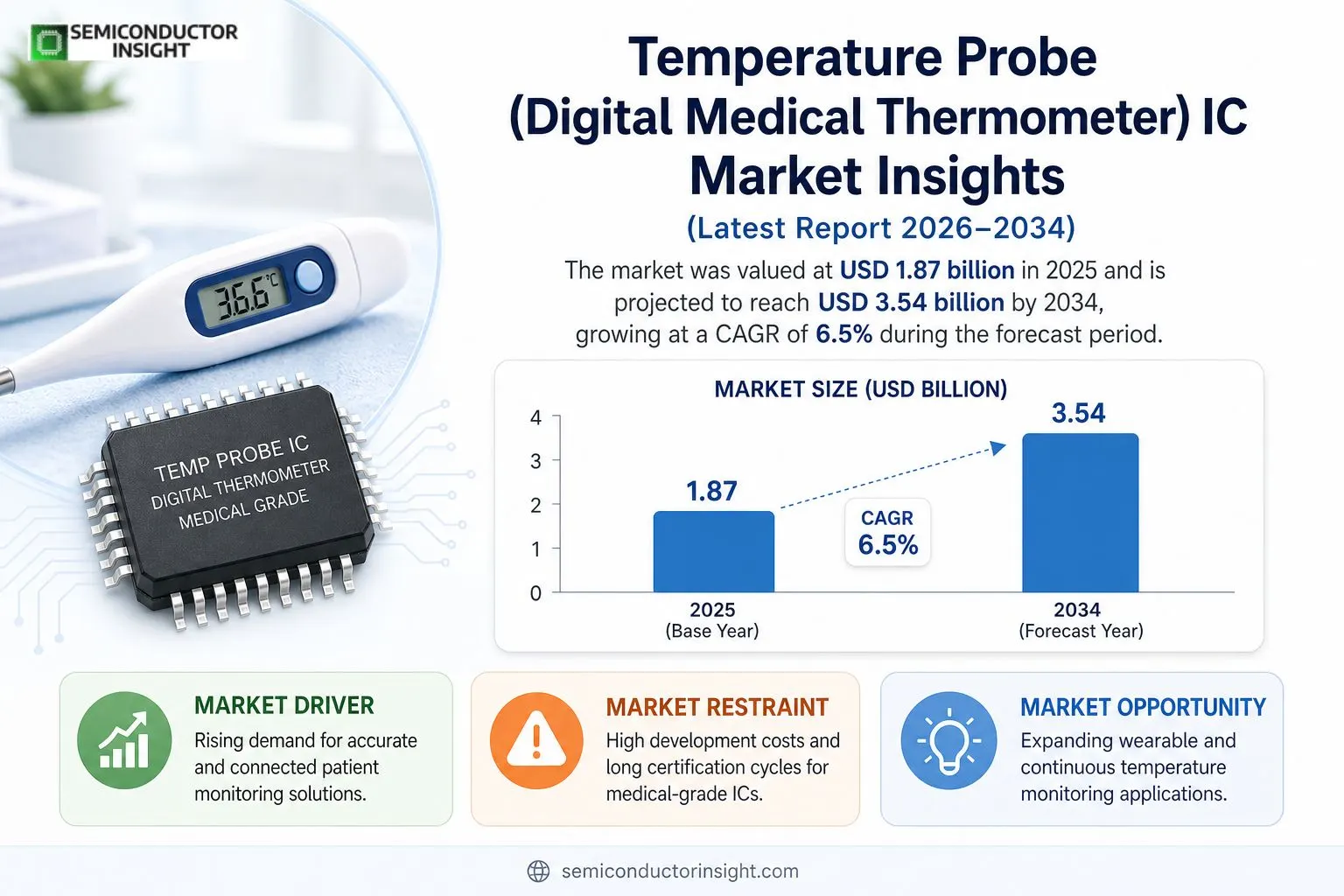
Global Temperature Probe (Digital Medical Thermometer) IC market size was valued at USD 1.87 billion in 2025. The market is projected to grow from USD 2.01 billion in 2026 to USD 3.54 billion by 2034, exhibiting a CAGR of 6.5% during the forecast period.
Temperature Probe (Digital Medical Thermometer) ICs are specialized integrated circuits designed to accurately measure and convert body temperature into digital signals for medical diagnostic purposes. These semiconductor components form the core of digital medical thermometers, enabling precise, fast, and reliable temperature readings. The IC category encompasses thermistor-based sensor interfaces, resistance temperature detector (RTD) signal conditioners, digital output temperature sensor ICs, and analog front-end processors, all engineered to meet stringent medical-grade accuracy standards typically within ±0.1°C.
The market is witnessing robust growth driven by rising global demand for home healthcare devices, increased health monitoring awareness following the COVID-19 pandemic, and the rapid adoption of connected and smart thermometry solutions. Furthermore, advancements in low-power CMOS IC design and miniaturization technologies are enabling manufacturers to develop more compact and energy-efficient thermometer ICs suited for wearable and IoT-integrated medical devices. Key players operating in this space include Texas Instruments Incorporated, Maxim Integrated (now part of Analog Devices), Microchip Technology Inc., and STMicroelectronics N.V., all of which maintain broad product portfolios catering to clinical and consumer medical thermometry applications worldwide.
MARKET DRIVERS
Rising Global Demand for Accurate and Connected Patient Monitoring Solutions
Temperature Probe (Digital Medical Thermometer) IC Market is experiencing sustained growth driven by the widespread adoption of digital health infrastructure across both developed and emerging economies. Integrated circuits (ICs) designed specifically for digital medical thermometers have become foundational components in clinical-grade patient monitoring devices, wearable health trackers, and home-use diagnostic tools. As healthcare systems worldwide prioritize early detection and continuous monitoring of patient vitals, the demand for high-precision, low-power temperature-sensing ICs continues to expand steadily. The shift from traditional mercury-based thermometers to digital alternatives has been a structural, long-term driver that continues to reinforce procurement volumes for thermometer ICs across hospital networks, diagnostic laboratories, and retail health channels.
Post-Pandemic Infrastructure Investment and Surge in Telehealth Adoption
Global health crises of the early 2020s fundamentally accelerated investment in medical diagnostic equipment, creating a durable tailwind for Temperature Probe (Digital Medical Thermometer) IC Market. Governments and private health systems in North America, Europe, and Asia-Pacific significantly expanded procurement of digital thermometers for point-of-care and remote patient monitoring applications. This demand surge prompted semiconductor manufacturers to develop more integrated, energy-efficient ICs capable of delivering clinical-grade accuracy within compact form factors. The proliferation of telehealth platforms further reinforced this trend, as connected digital thermometers with Bluetooth and IoT-enabled ICs became essential instruments for remote consultations and chronic disease management programs.
➤ The integration of NTC thermistor-based and bandgap reference ICs into next-generation digital medical thermometers is enabling measurement resolutions of ±0.1°C or better, meeting the stringent accuracy requirements set by international medical device standards such as ASTM E1112 and ISO 80601-2-56.
Miniaturization trends in semiconductor design are enabling thermometer IC manufacturers to combine signal conditioning, analog-to-digital conversion, and digital output functions into single-chip solutions, significantly reducing bill-of-materials costs for OEM device manufacturers. This level of integration is particularly beneficial for wearable and disposable thermometer applications, where form factor and unit economics are critical. As a result, Temperature Probe (Digital Medical Thermometer) IC Market is attracting increasing design-win activity from both established medical device brands and emerging digital health startups, further broadening the addressable customer base for IC suppliers operating in this segment.
MARKET CHALLENGES
Stringent Regulatory Compliance Requirements Across Multiple Jurisdictions
One of the primary challenges confronting participants in Temperature Probe (Digital Medical Thermometer) IC Market is the complexity of navigating overlapping regulatory frameworks that govern medical-grade semiconductor components. IC suppliers and device manufacturers must ensure compliance with standards issued by the U.S. Food and Drug Administration (FDA), the European Union Medical Device Regulation (EU MDR), and equivalent bodies across Asia-Pacific markets including China’s NMPA and Japan’s PMDA. Meeting these requirements demands extensive documentation, clinical validation, and quality management system certifications such as ISO 13485, which significantly extend product development timelines and increase compliance-related costs for smaller IC design firms seeking market entry.
Other Challenges
Supply Chain Volatility and Semiconductor Component Shortages
Temperature Probe (Digital Medical Thermometer) IC Market remains exposed to broader semiconductor supply chain disruptions that periodically constrain production capacity and extend lead times. Specialty analog and mixed-signal ICs used in precision temperature measurement applications are often manufactured on mature process nodes at foundries with limited capacity expansion potential. This structural constraint can lead to allocation challenges during periods of elevated demand, forcing device manufacturers to qualify alternative IC suppliers or redesign products around available components, both of which introduce cost and schedule risks.
Pricing Pressure from Low-Cost Regional Manufacturers
Increasing competition from vertically integrated IC manufacturers based in mainland China has intensified price competition within Temperature Probe (Digital Medical Thermometer) IC Market, particularly for consumer-grade and mid-tier clinical thermometer applications. Domestic Chinese suppliers benefit from government subsidies, lower operating costs, and proximity to high-volume device assembly operations, enabling them to offer competitive pricing that challenges the margin structures of international IC vendors. This dynamic compels established players to differentiate through superior accuracy specifications, extended temperature range, lower power consumption, or value-added application support rather than competing on price alone.
MARKET RESTRAINTS
High Development Costs and Long Certification Cycles for Medical-Grade ICs
The commercialization of new IC designs for Temperature Probe (Digital Medical Thermometer) IC Market is restrained by the substantial investment required to achieve and maintain medical device certification. Unlike consumer electronics ICs, temperature probe ICs intended for clinical diagnostic use must meet defined accuracy, reliability, and electromagnetic compatibility (EMC) standards that necessitate rigorous pre-market testing and ongoing post-market surveillance activities. These requirements create a significant financial and operational burden, particularly for fabless IC design companies operating with limited R&D budgets. The cost and duration of the certification lifecycle can deter innovation and slow the commercialization of next-generation IC architectures within this market.
Market Saturation in Mature Geographies and Limited Replacement Cycles
In well-established healthcare markets across Western Europe and North America, Temperature Probe (Digital Medical Thermometer) IC Market faces saturation dynamics driven by high existing penetration of digital thermometer devices and extended product replacement cycles in institutional settings. Hospitals and clinics that have invested in digital thermometry infrastructure typically operate these devices for multi-year periods before initiating replacement procurement, limiting the frequency of IC demand renewal in these geographies. This characteristic of the medical device market creates revenue predictability challenges for IC suppliers reliant on replacement-cycle volume and underscores the importance of geographic diversification toward higher-growth developing markets to sustain overall revenue momentum.
Additionally, the relatively low unit value of consumer-segment digital thermometer ICs constrains absolute revenue generation per design win, requiring IC suppliers to achieve substantial volume commitments to justify continued investment in product development and technical support for this application segment. The combination of thin per-unit margins and cyclical procurement patterns in institutional channels represents a structural restraint on profitability within Temperature Probe (Digital Medical Thermometer) IC Market, particularly for suppliers without scale advantages or broad product portfolio diversification across adjacent medical sensing applications.
MARKET OPPORTUNITIES
Expanding Wearable and Continuous Temperature Monitoring Applications
Temperature Probe (Digital Medical Thermometer) IC Market stands to benefit significantly from the rapid growth of wearable health monitoring devices that incorporate continuous skin or core body temperature tracking as a vital sign parameter. Smartwatches, fitness bands, smart patches, and clinical-grade wearable biosensors are increasingly integrating precision temperature-sensing ICs to enable fever detection, ovulation tracking, metabolic monitoring, and early-warning applications for infectious disease surveillance. This trend is driving demand for ultra-low-power, miniaturized temperature ICs with high measurement resolution and integrated wireless communication interfaces, representing a high-value growth segment for IC manufacturers capable of meeting these technical specifications.
Growing Healthcare Infrastructure Development Across Asia-Pacific and Emerging Markets
Rapid expansion of healthcare infrastructure in high-population markets including India, Southeast Asia, Latin America, and Sub-Saharan Africa presents a compelling long-term opportunity for Temperature Probe (Digital Medical Thermometer) IC Market. Rising per-capita healthcare expenditure, growing middle-class populations with increased access to consumer health products, and government-led initiatives to expand primary healthcare coverage are collectively driving procurement of digital diagnostic devices, including digital medical thermometers, across these regions. IC suppliers with competitively priced, reliable product portfolios tailored to mid-tier and value-segment device manufacturers are well-positioned to capture meaningful market share as device penetration accelerates in these geographies.
The convergence of digital health ecosystems with cloud-based patient data platforms is creating additional opportunities for value-added IC architectures within Temperature Probe (Digital Medical Thermometer) IC Market. ICs with integrated Bluetooth Low Energy (BLE) or near-field communication (NFC) capabilities enable seamless data transmission from digital thermometers to mobile health applications and electronic health record (EHR) systems, enhancing clinical utility and supporting connected care models. As healthcare providers and payers increasingly prioritize remote patient monitoring reimbursement models, demand for connected temperature probe ICs that facilitate data interoperability and compliance with digital health standards such as HL7 FHIR is expected to grow, opening new revenue streams for IC developers investing in system-level integration capabilities.
Temperature Probe (Digital Medical Thermometer) IC Market Trends
Rising Demand for Home Healthcare Devices Propelling Temperature Probe IC Adoption
Temperature Probe (Digital Medical Thermometer) IC Market is experiencing a significant upswing, largely driven by the accelerating global demand for home healthcare devices. Following the COVID-19 pandemic, health monitoring awareness among consumers has intensified considerably, prompting widespread adoption of personal medical diagnostic tools, including digital medical thermometers. This shift has placed temperature probe ICs at the center of a rapidly evolving healthcare landscape, where accuracy, speed, and reliability are non-negotiable requirements. Integrated circuits engineered to meet medical-grade accuracy standards within ±0.1°C are now considered essential components across both clinical and consumer-facing thermometry applications worldwide.
Other Trends
Advancements in Low-Power CMOS IC Design and Miniaturization
One of the most transformative trends shaping Temperature Probe (Digital Medical Thermometer) IC Market is the continued progress in low-power CMOS IC design and miniaturization technologies. Manufacturers are leveraging these advancements to develop increasingly compact and energy-efficient thermometer ICs that are well-suited for integration into wearable medical devices and IoT-connected health platforms. This technological evolution is enabling next-generation thermometers to deliver continuous, real-time temperature monitoring with minimal power consumption, making them viable for long-term patient monitoring scenarios both at home and in clinical settings.
Integration of Smart and Connected Thermometry Solutions
The rapid adoption of connected and smart thermometry solutions represents another defining trend in Temperature Probe (Digital Medical Thermometer) IC Market. Digital output temperature sensor ICs, thermistor-based sensor interfaces, and analog front-end processors are increasingly being designed to interface seamlessly with wireless communication modules, enabling data transmission to smartphones and cloud-based health management platforms. This integration supports remote patient monitoring and telemedicine applications, which have gained substantial traction in recent years as healthcare systems globally seek scalable digital health solutions.
Expanding Portfolios Among Key Industry Players
Leading semiconductor companies operating within Temperature Probe (Digital Medical Thermometer) IC Market, including Texas Instruments Incorporated, Analog Devices (which acquired Maxim Integrated), Microchip Technology Inc., and STMicroelectronics N.V., continue to expand their product portfolios to address the growing diversity of thermometry applications. These companies are focusing on developing ICs that span resistance temperature detector (RTD) signal conditioners, digital sensor interfaces, and multi-functional analog front-end processors, catering to both precision clinical instruments and cost-sensitive consumer devices. This competitive product development activity is expected to sustain innovation momentum and broaden market accessibility across emerging and developed regions alike.
COMPETITIVE LANDSCAPE
Key Industry Players
Temperature Probe (Digital Medical Thermometer) IC Market , Competitive Dynamics and Leading Innovators
Global Temperature Probe (Digital Medical Thermometer) IC market is characterized by the presence of several well-established semiconductor companies competing on the basis of measurement accuracy, power efficiency, miniaturization, and regulatory compliance. Texas Instruments Incorporated stands as one of the dominant forces in this space, offering a comprehensive portfolio of precision temperature sensor ICs and analog front-end solutions that address both clinical-grade and consumer medical thermometry requirements. Analog Devices, Inc. , which absorbed Maxim Integrated , further consolidates a significant share of the market, leveraging Maxim’s legacy high-accuracy digital temperature sensor product lines alongside Analog Devices’ own signal processing expertise. STMicroelectronics N.V. and Microchip Technology Inc. also maintain strong competitive positions, supplying thermistor interface ICs, RTD signal conditioners, and low-power digital output temperature sensors widely adopted by OEM thermometer manufacturers globally. The competitive environment is further intensified by rapid advancements in CMOS design and IoT-integrated medical device development, compelling leading players to continuously enhance their product roadmaps with smarter, more energy-efficient IC solutions.
Beyond the tier-one semiconductor giants, several niche and regional players contribute meaningfully to the competitive landscape of the Temperature Probe IC market. Companies such as NXP Semiconductors, Renesas Electronics, and onsemi (formerly ON Semiconductor) offer specialized temperature sensing and signal conditioning ICs that serve targeted clinical and wearable thermometry segments. Asian manufacturers including Seiko Epson Corporation, ABLIC Inc., and MegaChips Corporation have also carved out competitive positions, particularly in compact, low-power IC designs suited for portable and consumer medical thermometers. The post-COVID-19 era accelerated demand for rapid and accurate body temperature measurement solutions, prompting both established players and emerging fabless IC design firms to scale production capabilities and expand their medical-grade temperature IC product lines. This ongoing innovation, combined with increasing global health monitoring awareness and growing home healthcare adoption, is expected to sustain competitive intensity throughout the forecast period ending 2034.
List of Key Temperature Probe (Digital Medical Thermometer) IC Companies Profiled
- Texas Instruments Incorporated
- Analog Devices, Inc. (including Maxim Integrated)
- Microchip Technology Inc.
- STMicroelectronics N.V.
- NXP Semiconductors N.V.
- Renesas Electronics Corporation
- onsemi (formerly ON Semiconductor)
- Seiko Epson Corporation
- ABLIC Inc.
- MegaChips Corporation
- Rohm Semiconductor
- Silicon Laboratories Inc.
- Sensirion AG
Segment Analysis:
| Segment Category | Sub-Segments | Key Insights |
| By Type |
|
Digital Output Temperature Sensor ICs represent the leading segment within the type category, driven by their ability to deliver direct, microcontroller-compatible digital signals without requiring additional analog-to-digital conversion stages.
|
| By Application |
|
Forehead (Temporal) Thermometers have emerged as the leading application segment, propelled by their non-contact measurement capability and the widespread adoption of touchless screening solutions following the COVID-19 pandemic.
|
| By End User |
|
Home Healthcare Users constitute the leading and fastest-expanding end user segment, reflecting a broad global shift toward self-monitoring and preventive health management outside traditional clinical environments.
|
| By Technology Interface |
|
Wireless-Enabled ICs (Bluetooth Low Energy) are rapidly establishing leadership within the technology interface segment, underpinned by the accelerating convergence of medical thermometry with connected health ecosystems.
|
| By Device Form Factor |
|
Wearable Continuous Monitoring Devices represent the most strategically significant and high-growth form factor segment, driven by evolving clinical and consumer demand for uninterrupted, real-time physiological temperature surveillance.
|
Regional Analysis: Temperature Probe (Digital Medical Thermometer) IC Market
Asia-Pacific
Asia-Pacific hosts a deeply integrated supply chain for temperature probe IC components, with semiconductor foundries in Taiwan and South Korea operating at global scale. China’s extensive electronics manufacturing base further reduces production costs for digital medical thermometer ICs, enabling competitive pricing strategies that strengthen the region’s export dominance across both developed and emerging markets.
Rapid urbanization and government investment in public health systems across India, China, and Southeast Asia are accelerating adoption of digital medical thermometers embedded with precision IC technology. Expanding hospital networks and community health centers increasingly require certified, IC-driven temperature measurement solutions, creating sustained institutional procurement cycles within Temperature Probe (Digital Medical Thermometer) IC Market.
Heightened health consciousness following global health crises has significantly boosted retail demand for personal digital medical thermometers across Asia-Pacific. E-commerce platforms and pharmacy retail chains in China, Japan, and India have broadened product accessibility, encouraging manufacturers to develop cost-effective, IC-integrated thermometer solutions tailored to diverse consumer segments and household budgets across the region.
Leading semiconductor firms and medical device companies in Japan, South Korea, and China are actively investing in next-generation temperature probe IC designs focused on improved accuracy, miniaturization, and wireless connectivity. Collaborations between academic research institutions and industry players continue to accelerate the development of advanced digital medical thermometer IC solutions, reinforcing Asia-Pacific’s long-term competitive advantage in this specialized market segment.
North America
North America represents one of the most technologically advanced and regulatory-driven segments of Global Temperature Probe (Digital Medical Thermometer) IC Market. The United States, in particular, maintains stringent medical device standards enforced by federal regulatory bodies, compelling IC manufacturers to adhere to rigorous quality benchmarks for digital medical thermometer components. This regulatory environment has fostered a culture of innovation, with established semiconductor companies and medical technology firms consistently developing high-precision, clinically validated temperature probe IC solutions. The region’s well-established healthcare system, combined with growing consumer interest in connected health monitoring devices, is driving demand for smart digital medical thermometers featuring Bluetooth-enabled IC platforms. Canada also contributes meaningfully, with increasing healthcare digitization initiatives supporting broader adoption of IC-integrated temperature measurement tools in clinical and home-care settings throughout the forecast period.
Europe
Europe occupies a significant position in Temperature Probe (Digital Medical Thermometer) IC Market, underpinned by its advanced healthcare infrastructure, strong patient safety culture, and well-defined medical device regulatory framework. Countries including Germany, France, the United Kingdom, and the Netherlands are key contributors, with established medical technology industries that prioritize high-accuracy, clinically reliable digital medical thermometer IC components. European manufacturers are particularly focused on developing energy-efficient and compact IC designs that comply with stringent environmental and safety certifications. The region’s aging population continues to elevate demand for easy-to-use, precise digital medical thermometers in both institutional and home healthcare environments. Additionally, Europe’s emphasis on sustainable manufacturing practices is encouraging temperature probe IC developers to adopt eco-conscious production methods, aligning product development with broader regional environmental and healthcare quality objectives.
South America
South America presents a gradually evolving landscape within Temperature Probe (Digital Medical Thermometer) IC Market, characterized by increasing healthcare investment and a growing middle-class population with rising health awareness. Brazil and Argentina serve as the primary demand centers, where expanding public and private healthcare networks are progressively incorporating digital medical thermometers equipped with reliable IC technology into standard clinical protocols. Economic variability across the region influences procurement patterns, with cost-efficiency being a key purchasing criterion for both institutional buyers and individual consumers. Import dependency on IC components from Asia-Pacific and North America remains notable, though localized assembly activities in Brazil are beginning to develop. Government health programs targeting infectious disease management and maternal care are also contributing to steady demand growth for temperature probe digital medical thermometer IC solutions across South American healthcare facilities.
Middle East & Africa
The Middle East and Africa region represents an emerging but increasingly strategic segment of Global Temperature Probe (Digital Medical Thermometer) IC Market. Gulf Cooperation Council nations, particularly the United Arab Emirates and Saudi Arabia, are investing substantially in healthcare modernization, creating new procurement opportunities for advanced digital medical thermometer IC technologies within premium hospital networks and outpatient facilities. In Africa, rising awareness of preventive healthcare, supported by international health organizations and government-led initiatives, is gradually expanding access to basic medical diagnostic tools, including digital thermometers incorporating temperature probe IC components. While infrastructure limitations and budget constraints in sub-Saharan Africa continue to temper market growth, the long-term outlook remains positive as healthcare access improves and demand for affordable, reliable IC-integrated temperature measurement solutions progressively increases across the region.
Report Scope
This market research report provides a comprehensive analysis of the Temperature Probe (Digital Medical Thermometer) IC Market , covering the forecast period 2026–2034. It offers detailed insights into market dynamics, technological advancements, competitive landscape, and key trends shaping the industry.
Key focus areas of the report include:
- Market Overview: The report begins with an overview outlining its current market scenario, key growth indicators, and industry transformation drivers. It discusses macroeconomic factors, demand–supply balance, regulatory landscape, and the strategic role of semiconductors in powering advancements across industries such as automotive, telecommunications, consumer electronics, and industrial automation.
- Market Size & Forecast: Historical data and future projections for revenue, unit shipments, and market value across major regions and segments.
- Segmentation Analysis: Detailed breakdown by product type, technology, application, and end-user industry to identify high-growth segments and investment opportunities.
- Regional Insights: Insights into market performance across North America, Europe, Asia-Pacific, Latin America, and the Middle East & Africa, including country-level analysis where relevant.
- Competitive Landscape: Profiles of leading market participants, including their product offerings, R&D focus, manufacturing capacity, pricing strategies, and recent developments such as mergers, acquisitions, and partnerships.
- Technology Trends & Innovation: Assessment of emerging technologies, integration of AI/IoT, semiconductor design trends, fabrication techniques, and evolving industry standards.
- Market Drivers & Restraints: Evaluation of factors driving market growth along with challenges, supply chain constraints, regulatory issues, and market-entry barriers.
- Stakeholder Insights: Insights for component suppliers, OEMs, system integrators, investors, and policymakers regarding the evolving ecosystem and strategic opportunities.
Primary and secondary research methods are employed, including interviews with industry experts, data from verified sources, and real-time market intelligence to ensure the accuracy and reliability of the insights presented.
FREQUENTLY ASKED QUESTIONS:
What is the current market size of Temperature Probe (Digital Medical Thermometer) IC Market?
-> Global Temperature Probe (Digital Medical Thermometer) IC Market was valued at USD 1.87 billion in 2025 and is expected to reach USD 3.54 billion by 2034, growing at a CAGR of 6.5% during the forecast period from 2026 to 2034.
Which key companies operate in Temperature Probe (Digital Medical Thermometer) IC Market?
-> Key players include Texas Instruments Incorporated, Maxim Integrated (now part of Analog Devices), Microchip Technology Inc., and STMicroelectronics N.V., among others, all of which maintain broad product portfolios catering to clinical and consumer medical thermometry applications worldwide.
What are the key growth drivers?
-> Key growth drivers include rising global demand for home healthcare devices, increased health monitoring awareness following the COVID-19 pandemic, rapid adoption of connected and smart thermometry solutions, and advancements in low-power CMOS IC design and miniaturization technologies enabling more compact and energy-efficient thermometer ICs suited for wearable and IoT-integrated medical devices.
Which region dominates the market?
-> Asia-Pacific is the fastest-growing region driven by expanding healthcare infrastructure and rising consumer demand, while North America remains a significant market owing to advanced healthcare systems and high adoption of digital medical devices.
What are the emerging trends?
-> Emerging trends include integration of IoT-enabled smart thermometry solutions, development of wearable medical temperature monitoring devices, adoption of low-power CMOS IC designs, miniaturization of thermometer ICs, and incorporation of thermistor-based sensor interfaces, RTD signal conditioners, and analog front-end processors meeting stringent medical-grade accuracy standards within ±0.1°C.

Get Sample Report PDF for Exclusive Insights
Report Sample Includes
- Table of Contents
- List of Tables & Figures
- Charts, Research Methodology, and more...
 Download Sample Report PDF