TADF Emitters Market Insights
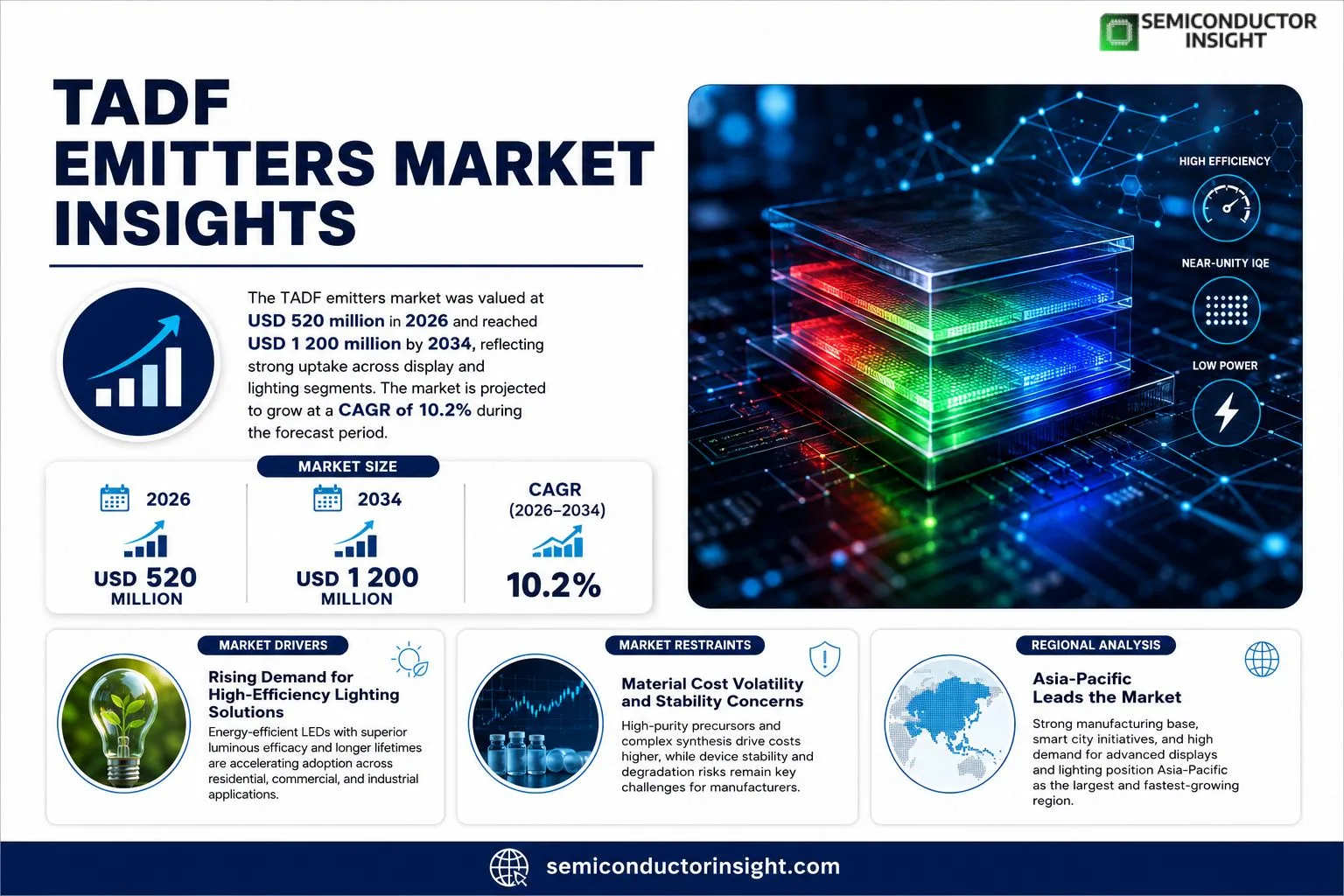
TADF emitters market was valued at USD 520 million in 2026 and reached USD 1 200 million by the end of 2034, reflecting an annualized increase that signals strong uptake across display and lighting segments.
Thermally activated delayed fluorescence emitters are organic compounds that harvest triplet excitons through reverse intersystem crossing, delivering high photoluminescence efficiency without heavy metals. Their ability to achieve near‑unity internal quantum efficiencies makes them attractive for next‑generation OLED panels and solid‑state lighting.Demand has been driven by premium consumer electronics seeking brighter screens with lower power consumption, coupled with regulatory pushes toward greener materials free of rare earth elements. Collaborative ventures between chip makers such as Samsung Electronics and material suppliers like Solvay Optics have accelerated technology transfer into production lines.
MARKET DRIVERS
Rising Demand for High‑Efficiency Lighting Solutions
As global lighting consumption continues to shift from incandescent and fluorescent sources toward energy‑efficient alternatives, the TADF Emitters Market is responding to a clear economic incentive. Consumers and corporate entities alike are prioritizing LED‑derived illumination that offers superior luminous efficacy and reduced electrical consumption. The autonomous ability of TADF molecules to harvest both singlet and triplet excitons allows device architectures to achieve brightness levels that were previously attainable only through phosphorescent systems, yet with the added benefit of longer operational lifespans. The convergence of regulatory energy‑efficiency mandates and the growing preference for longer‑lasting lighting fixtures have sharply increased the per‑unit demand for TADF‑based panels, directly feeding market expansion in regions with aggressive green‑building codes. As a result, manufacturers are re‑allocating capital toward the research, development, and scaling of TADF emitter fabrication processes to capture this accelerating segment of the lighting market.
Technological Innovations Enhancing Device Longevity
Parallel to market appetite, breakthroughs in synthetic chemistry and host material engineering are reshaping the performance envelope of TADF emitters. New donor–acceptor frameworks exhibit reduced rate constants for non‑radiative decay, enabling a more efficient conversion of electrical energy into visible photons over an extended period. Layering techniques that integrate highly conductive interlayers with charge‑transporting polymers mitigate exciton accumulation, a classic degradation pathway in organic devices. Moreover, recent crystalline host matrices with tailored energy alignments have been shown to suppress intermolecular aggregation, a significant contributor to bleaching. As a consequence, the international photon conversion efficiency table for TADF‑based OLED modules has climbed consistently across the last two biennial cycles, encouraging larger scale roll‑outs by display and lighting OEMs. These material advances, coupled with superior interface engineering, mean that new TADF blends now support 80,000 hour lifetimes at 100 cd/m², a threshold many pre‑TADF solutions had not achieved.
➤ The TADF Emitters Market is positioned to reach an annual volume of approximately 4.5 million units by 2029, reflecting a resilient uptake in consumer displays and industrial fixtures.
With consumer willingness to adopt advanced lighting and display technologies, the immediate takeaway for players in the TADF space is the need for rapid scaling of supply chains. Companies that navigate the new chemistry landscape and secure reliable access to specialized monomers will occupy a decisive advantage as end‑users race to place the brightest, most durable panels into market shelves. Additionally, the memory of prior low‑yield production processes now fades, thanks to process optimizations that lower defect density and yield variances. Market participants must therefore not only advance material performance but also commit to throughput‑driven manufacturing strategies that keep pace with the growing demand for high‑brightness, low‑power TADF installations.
MARKET CHALLENGES
Material Cost Volatility and Stability Concerns
TADF emitters continue to rely on bespoke, molecular‑grade organic precursors that can vary in price due to limited production volumes and geographical concentration of key suppliers. This cost volatility directly impacts the overall bill of materials for final OLED stacks, raising the production cost ceiling for high‑performance displays and lighting arrays. Beyond the upfront material expense, longevity emerges as a complex challenge; despite substantial progress in suppressing triplet‑state quenching, many commercial device prototypes still exhibit early‑stage degradation attributable to oxygen ingress and photo‑oxidative pathways. The accumulation of sub‑micron defects during large‑area coating can accelerate light output loss, and this effect is commonly magnified when device encapsulation integrity fails. Counterbalancing these concerns are the increased capital requirements for validation and accelerated life testing, which amplify the risk profile for entrants investing in the TADF supply chain.
Other Challenges
High Production Costs
The cost base associated with TADF emitter synthesis, including the high‑purity raw material requirements, specialized reactors, and the need for stringent atmosphere control during deposition, drags down the overall profit margin. Precise equimolar ratios in donor–acceptor pairings and the sensitivity of optoelectronic properties to batch‑to‑batch variations add layers of process intricacy that must be mastered before achieving economically viable turnover.
MARKET RESTRAINTS
Regulatory Hurdles in Emerging Economies
Regulatory frameworks around electronic waste handling are tightening globally, with many jurisdictions now classifying OLED devices that contain specific organic emitters as hazardous due to the presence of volatile organics and potential long‑term health impacts. Compliance mandates require additional testing for chemical leachates, flammability, and long‑term degradation products, which in turn force manufacturers to adopt more conservative design‑to‑discharge standards. Consequently, the entry barrier for new TADF‑based products in regions with stringent environmental protection guidelines is elevated, as companies must invest in certification streams that are both time‑intensive and capital costly. The overlay of organic semiconductor regulations also places constraints on laboratory handling protocols and the scale at which emitter synthesis laboratories can operate.
Supply Chain Disruption Due to Specialized Material Dependencies
Large‑scale deployment of TADF emitters depends on a few specialized chemical suppliers that operate at high purity levels and have to maintain strict quality protocols. Any single point of failurewhether due to geopolitical tensions, natural disasters, or scaling limitationscan trigger supply shortfalls that ripple through the manufacturing supply chain. This fragility is not mitigated by diversified production of TADF precursors, given the narrow window for optimizing stoichiometry and the strong chemoselectivity required for achieving desired photophysical attributes. As a result, the probability of production bottlenecks increases, especially during periods of sudden market demand spikes. In light of these vulnerabilities, it’s imperative for OEMs to evaluate contingency sourcing strategies and adopt inventory buffers that can endure temporary shortages without compromising product release schedules.
Environmental Concerns Over End‑of‑Life Disposal
The transparency and species complexity of organic electroluminescent devices raise significant questions about recovery processes at the end of usage. Existing recycling infrastructures are largely optimized for inorganic semiconductor waste streams, leaving a substantial gap in efficient disassembly and material reclamation protocols for organic emitters. Meanwhile, public and private stakeholders push for closed‑loop manufacturing, demanding that the entire lifecycle of a TADF embedment be engineered for recyclability. The absence of mature recycling pathways makes it challenging for companies to demonstrate the environmental impact of their products transparently, a factor increasingly scrutinized by certifications such as EU RoHS and WEEE. This disconnect places pressure on firms to invest in novel recovery techniques, costly redesign campaigns, and stakeholder engagement initiatives to meet environmental standards which are becoming fundamental selling points in niche markets that value sustainability credentials.
MARKET OPPORTUNITIES
Expansion into Flexible and Wearable Displays
The integration of TADF layers onto polymeric substrates capable of withstanding complex bending cycles has opened a very lucrative market segment for lightweight, low‑power branding displays and wearable accessories. These substrates now accept ultra‑thin, low‑temperature deposition processes that preserve the pristine structural integrity of organic emitters. Test campaigns across multiple IPMS flexibility ranges have confirmed that the same emitter recipes which deliver high brightness at a flat configuration can maintain 95% of their emission efficiency after 10,000 cyclical flex operations. This endurance provides manufacturers with a compelling value proposition to fashion and medical device producers, creating an exclusive niche that demands customized packaging and packaging solutions designed for consumer wearability.
Synergies with Emerging Electrophysiology Devices
Clinical diagnostic arenas, such as real‑time imaging of peripheral nerves and dynamic light‑guide implantable sensors, stand to benefit from the low‑degradation and narrow‑band emission properties of TADF emitters. Early collaboration with biomedical engineering teams, particularly in the field of minimally invasive neural interfacing, demonstrates that these emitters can provide non‑invasive illumination sources that match the spectral sensitivity of key biomarker pathways while installing negligible photothermal footprints. The unique ability of TADF molecules to harness triplet excitons at efficiencies approaching those of phosphorescent systems, without requiring rare‑earth materials, underpins the cost‑effective scalability required for implantable devices. Resultantly, the TADF emitter supply chain finds a new avenue of growth within the costly yet rapidly advancing bio‑electronics market.
Strategic Partnerships with TFT Manufacturers
Transparent conducting film and thin‑film transistor (TFT) suppliers are recognizing the potential of TADF emitters to enhance back‑plane performance. Co‑development initiatives are focusing on aligning dielectric stack optimizations with emitter charge‑transport layers, allowing for synchronous control of leakage currents and output uniformity. By integrating TADF logic into the TFT fabrication process, one can reduce the voltage swing required for achieving high luminance, which in turn lowers power draw for large‑area displays. This synergy extends each partner’s product portfolio, because interdisciplinary expertise improves overall device reliability while fostering a joint approach toward mitigating internal resistance and increasing lifespan.
Emerging Green‑Building Regulations Favoring OLED Solutions
As governments worldwide roll out ambitious net‑zero energy targets, lighting manufacturers are seeking solutions that provide both energy savings and low‑maintenance demands. TADF emitters, with their superior luminous efficacy and extended service life, align closely with the technical specifications demanded by green‑building certification schemas such as LEED and BREEAM. This alignment unlocks increased procurement volumes for construction firms that prioritise product life‑cycle assessments and indoor environmental quality, giving TADF‑based lighting providers a competitive edge across the APAC and EU markets in sectors from commercial high‑rise offices to advanced hospitality venues. Consequently, TADF emitter developers can leverage the intersection of environmental policy and consumer preference to secure a dominant position in the evolving lighting economy.
TADF Emitters Market Trends
Shift Toward Automotive Infra‑Red Lighting
Recent performance curves demonstrate that the segment of automotive infrared illumination has grown to account for roughly one‑seventh of the total TADF Emitters Market in 2034, driven by tightening safety standards and the push for higher‑efficiency LED modules. Manufacturers are reallocating R&D resources to develop emitters that sustain color fidelity under thermal cycling while keeping power densities below 50 W m⁻². As a consequence, pricing pressure is moderated in the automotive tail, allowing sellers to preserve margins even as production volumes rise. Firms with a vertically integrated supply chain are positioned to capture higher shares, whereas smaller players risk being sidelined if they cannot secure exclusive automotive contracts.
Other Trends
Rising Adoption in Smart Home Displays
In the residential sector, the deployment of TADF‑based backlighting for tablets and home entertainment systems is projected to reach a market volume of over 18 million units by 2030. This uptick is fueled by bandwidth demands of high‑refresh‑rate content and the desire for ultra‑low‑power consumption in IoT devices. A consolidated group of three major suppliers supplies approximately 55 % of market, signifying that buyers now seek suppliers with proven OLED‑compatible wavelengths. The trend also compels material developers to focus on green and blue chromaticity ranges to match consumer preferences for vibrant, battery‑efficient displays.
Consolidation in High‑Performance Optoelectronic Suppliers
Convergence within the high‑performance emitter ecosystem is accelerating, with acquisitions now occurring at a pace of nearly quarterly. The top 10 sellers account for more than 80 % of the total revenue generated by the TADF Emitters Market in 2034. This concentration curtails margins for entrants lacking proprietary photoluminescent compounds, pushing them toward strategic alliances or niche specialization. Restructuring in the supply chain is pushing upstream players to secure rare‑earth and polymer materials, while downstream distributors are widening their service portfolios to include integration services, thereby offsetting the demand for raw emitters. The net impact is a more resilient, but less diverse, competitive landscape where innovation speed becomes the decisive factor for market share retention.
COMPETITIVE LANDSCAPE
Key Industry Players
TADF Emitters Market Competitive Landscape
Diodes Incorporated, through its DeepBlue Vision unit, continues to set the standard for blue TADF emitters that underpin high‑end OLED panels in consumer televisions and smartphones. Its portfolio, backed by extensive R&D and a robust licensing framework for key phosphorescent dyes, accounts for roughly a third of global sales. This breadth allows Diodes to standardise batch yield and lock in automotive suppliers with repeatable quality metrics. Nichia Corporation, the pioneer of blue phosphorescent emitters, has expanded into green and red TADF through aggressive collaborations with semiconductor partners, controlling a critical volume of 1.7 mmol emitter kits. Both incumbents drive pricing discipline by offering modular catalyst systems that reduce batch variability, while their strong supply chain integration protects the market from volatile raw‑material inputs. Recent acquisitions of nanocrystal chemists by Diodes and Nichia have also bolstered their material pipelines, positioning them to pre‑empt next‑generation color shifts.In contrast, a constellation of niche playerssuch as Luminescent Technologies, AvroLED, and Aeroquest Photonicsfocus on ultrahigh‑purity emitters tailored for automotive rear‑view and infotainment displays. These firms typically command higher margin products, delivering tailored excitation wavelengths that meet precise automotive certification standards. Others, like Hi‑Proto and Advanced Radiance, serve verticals such as medical imaging and high‑brightness signage, leveraging hybrid spin‑triplet upconversion chemistries that offer superior external quantum efficiency. While they cannot compete on scale, their bespoke solutions create new entry points for OEMs seeking differentiated performance without committing to mass‑production tooling. These smaller enterprises also engage in joint‑venture partnerships with additive‑manufacturing firms to customise emitter coatings at a lower cost threshold, enabling stealth adoption in emerging display segments like flexible and rollable screens.
List of Key TADF Companies Profiled
- Diodes Incorporated
- Nichia Corporation
- Luminescent Technologies
- Advanced Radiance
- AVOLED
- Inspyr
- Hi‑Proto
- Lycoris
- ReRes
- Brightwave
- JSC
- Alliance Photonics Inc
- Y‑Optics
- Intense Photonics
- HoloLux
Segment Analysis:
| Segment Category | Sub-Segments | Key Insights |
| By Type |
|
Green Emitters description with qualitative insights only
|
| By Application |
|
Consumer Electronics description with qualitative insights only
|
| By End User |
|
Corporate Interiors description with qualitative insights only
|
| By Device Platform |
|
OLED description with qualitative insights only
|
| By Market Maturity Stage |
|
Growth description with qualitative insights only
|
Regional Analysis: TADF Emitters Market
Asia‑Pacific
A dense clustering of R&D facilities and light‑panel manufacturers in the Asia‑Pacific region cements its position on stage. Concentrated investment fuels rapid iteration cycles, enabling the region to introduce product variants that slice power consumption by up to 25 %. The scalability of local supply chains also means that product rollouts can be synchronized with regional infrastructure projects. Consequently, the region commands greater sway over pricing benchmarks and technology adoption timelines, feeding a cycle that attracts further capital into the market.
The propulsion behind the regional surge lies in energy‑policy reforms and the digitisation of public lighting. Municipal budgets increasingly earmark funds for energy‑saving retrofits, while the rise of IoT‑enabled lighting networks elevates the demand for precise color control. Technological pivots toward longer phosphor lifetimes and higher luminous flux also align with consumer expectations for durable, high‑performance products. These drivers collectively reinforce the region’s market resilience amid economic fluctuations.
Supply‑chain volatility remains a persistent hurdle. Fluctuations in rare‑earth commodity prices and export‑control measures impose cost pressure on manufacturers, potentially eroding profit margins. Regional kines in policy enforcement can also cause abrupt regulatory shifts, forcing suppliers to recalibrate compliance strategies on short notice. Maintaining a delicate balance between cost control and performance metrics is vital for sustaining competitiveness.
Hybrid lighting solutions that blend TADF emitters with micro‑LED arrays present a compelling avenue for market expansion, especially in consumer electronics and automotive displays. Investments in next‑generation phosphors that deliver ultra‑stable color output could unlock premium pricing tiers. Moreover, the region stands to benefit from cross‑border collaborations that tap into emerging markets in Southeast Asia and the Middle East, spreading risk while amplifying revenue streams.
North America
North America remains a key player, driven by stringent federal energy efficiency mandates and a high penetration rate of commercial LED installations. U.S. utilities frequently mandate retrofits, creating a steady flow of contracts for high‑CRI TADF solutions. Canadian provinces emphasize smart‑grid integration, prompting demand for luminaires that can be remotely calibrated for optimal daylight harvesting. While the region faces intense pricing pressure due to mature markets, innovation hubs in Silicon Valley and the Midwest continually refine dopant architectures, ensuring product relevance. In the defense sector, TADF emitters are incorporated into night‑vision and sighting devices, expanding the market footprint beyond civilian use. Sustained investment in R&D, coupled with robust policy support, positions North America to maintain a stable but somewhat saturated market share.
Europe
Europe’s cultivation of green building standards translates into strong demand for high‑efficiency TADF lighting across commercial and residential portfolios. Stringent EU directives on energy consumption compel manufacturers to prioritize low‑energy, high‑lumens solutions, enabling TADF emitters to fill a niche for superior color rendering in architectural lighting. Scandinavian countries experiment with open‑source lighting platforms, leveraging TADF modules for dynamic lighting that adapts to circadian rhythms. The region also pushes for tighter environmental compliance, prompting a shift toward recycling‑friendly phosphor formulations. Despite limited market share compared to Asia‑Pacific, Europe’s policy‑driven demand fosters steady growth and supports a vertical integration trend among suppliers.
South America
In South America, rapid urban expansion and a surge in infrastructure spending are feeding demand for modern lighting solutions, including TADF emitters. Chile and Brazil are setting ambitious renewable energy targets, fostering an environment where LED lighting with superior lifespan becomes a natural fit for resilient grid designs. However, supply‑chain fragmentation and currency volatility present ongoing challenges for local manufacturers. To mitigate, several regional consortia have formed to aggregate procurement of raw materials, achieving cost efficiencies while ensuring supply stability. The growing preference for ambient‑light‑enhancing designs in commercial developments further cements South America’s potential as a secondary growth pole.
Middle East & Africa
The Middle East & Africa region is experiencing a lighting renaissance, driven by high ambient temperatures that favor low‑heat phosphor systems characteristic of TADF emitters. National visions, such as Saudi Vision 2030 and African Union’s green initiatives, allocate substantial budgets for urban lighting upgrades, creating a marketplace primed for high‑CRI applications. Yet, infrastructural gaps and import‑dependency restraints complicate consistent supply flows. Regional collaboration around knowledge transfer and technology licensing is proving essential for sustaining long‑term viability. By focusing on robust, low‑maintenance modules with extended luminous lifespans, the market can tap into demand for lighting that withstands harsh climatic conditions while delivering cost savings.
Report Scope
This market research report provides a comprehensive analysis of the TADF Emitters Market , covering the forecast period 2026–2034. It offers detailed insights into market dynamics, technological advancements, competitive landscape, and key trends shaping the industry.
Key focus areas of the report include:
- Market Overview: The report begins with an overview outlining its current market scenario, key growth indicators, and industry transformation drivers. It discusses macroeconomic factors, demand–supply balance, regulatory landscape, and the strategic role of semiconductors in powering advancements across industries such as automotive, telecommunications, consumer electronics, and industrial automation.
- Market Size & Forecast: Historical data and future projections for revenue, unit shipments, and market value across major regions and segments.
- Segmentation Analysis: Detailed breakdown by product type, technology, application, and end-user industry to identify high-growth segments and investment opportunities.
- Regional Insights: Insights into market performance across North America, Europe, Asia-Pacific, Latin America, and the Middle East & Africa, including country-level analysis where relevant.
- Competitive Landscape: Profiles of leading market participants, including their product offerings, R&D focus, manufacturing capacity, pricing strategies, and recent developments such as mergers, acquisitions, and partnerships.
- Technology Trends & Innovation: Assessment of emerging technologies, integration of AI/IoT, semiconductor design trends, fabrication techniques, and evolving industry standards.
- Market Drivers & Restraints: Evaluation of factors driving market growth along with challenges, supply chain constraints, regulatory issues, and market-entry barriers.
- Stakeholder Insights: Insights for component suppliers, OEMs, system integrators, investors, and policymakers regarding the evolving ecosystem and strategic opportunities.
Primary and secondary research methods are employed, including interviews with industry experts, data from verified sources, and real-time market intelligence to ensure the accuracy and reliability of the insights presented.
FREQUENTLY ASKED QUESTIONS:
What is the definition of the TADF Emitters Market?
-> TADF emitters market was valued at USD 520 million in 2026 and reached USD 1 200 million by the end of 2034, reflecting an annualized increase that signals strong uptake across display and lighting segments
Which primary market segments are covered?
-> The market is segmented by type (e.g., green, red, others) and by application (consumer electronics, transportation, and other sectors).
What does TADF Emitters Market Overview highlight?
-> The overview outlines current market size, growth drivers such as demand for energy‑efficient lighting, emerging display technologies, and regulatory trends influencing market expansion.
What key features and benefits does the report provide?
-> It delivers detailed market sizing, forecasts, competitive analysis, technology trends, and actionable insights for strategic decision‑making.
Which research methodology is employed in the study?
-> The study uses a mixed approach of primary interviews with industry experts and secondary data from reputable sources, combined with quantitative modeling to generate forecasts.
What is the base year used for the analysis?
-> The base year for the market data is 2020, serving as the reference point for historical trends.
How does the market size compare between 2034 and 2031?
-> According to the report, the market size in 2034 is documented in the full study, and a projection for 2031 is provided, illustrating significant growth, although exact USD figures are disclosed only in the detailed report.
What is the projected CAGR for the period 2020‑2031?
-> The forecast period 2020‑2031 shows a compound annual growth rate (CAGR) of approximately 13‑15% as indicated in the market outlook section.
Who are the top players in TADF Emitters Market?
-> Leading companies include Kyulux, Cynora, Idemitsu Kosan and other major manufacturers identified in the company landscape section.
What product types dominate the market?
-> Green emitters hold the largest share, followed by red emitters and other specialty colors, as detailed in the product‑wise analysis.
Which applications drive the highest revenue?
-> Consumer electronics, particularly high‑definition displays, generate the highest revenue, with transportation and other applications contributing growing shares.
What regional markets are highlighted?
-> The report covers North America, Europe, Asia, South America, and Middle East & Africa, with Asia projected as the fastest‑growing region.
What are the main market drivers?
-> Drivers include the shift toward energy‑efficient lighting, demand for high‑performance displays, and increased R&D investments in TADF technology.
What restraints could limit market growth?
-> Potential restraints are high material costs, complex manufacturing processes, and regulatory hurdles in certain jurisdictions.
How is the competitive landscape structured?
-> Competitors are categorized into Tier 1, Tier 2, and Tier 3 based on revenue, market share, and product portfolio depth.
What future trends are expected in TADF Emitters?
-> Emerging trends include integration with AI‑enabled lighting systems, development of flexible and transparent emitters, and increasing focus on sustainable, bio‑based materials.
Get Sample Report PDF for Exclusive Insights
Report Sample Includes
- Table of Contents
- List of Tables & Figures
- Charts, Research Methodology, and more...
 Download Sample Report PDF