Tablet PC Data Cables Market Insights
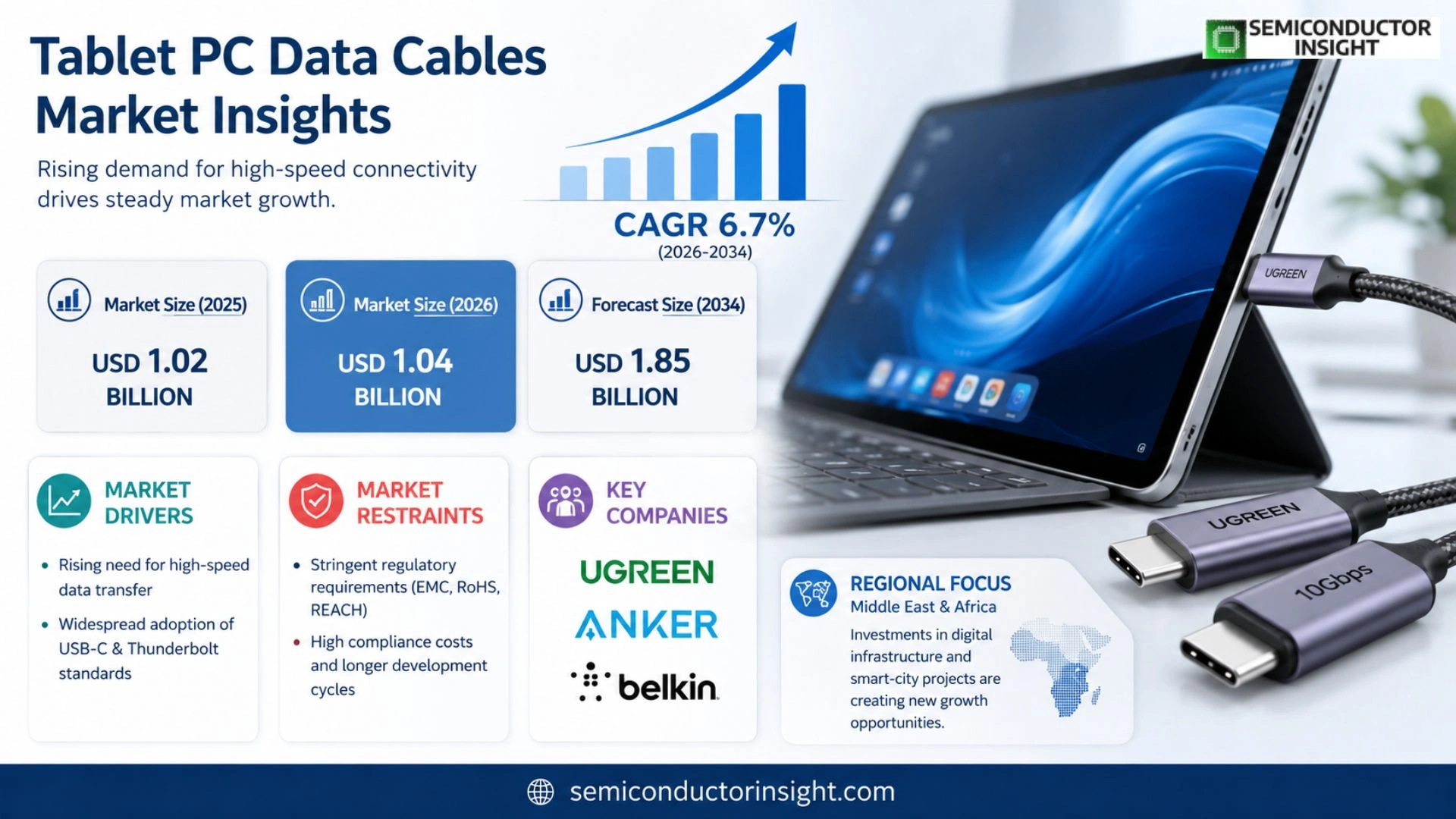
Tablet PC Data Cables market size was valued at USD 1.02 billion in 2025. The market is projected to grow from USD 1.04 billion in 2026 to USD 1.85 billion by 2034, exhibiting a CAGR of 6.7% during the forecast period.
Tablet PC Data Cables are conductive accessories designed to transmit power, video, audio and digital signals between tablets and peripheral devices such as chargers, displays, keyboards and storage units. They include connector families like USB‑C, Apple‑Lightning and proprietary multi‑function interfaces that support fast charging and high‑speed data transfer. Their evolution reflects expanding tablet usage across education, remote work and entertainment sectors, which fuels demand for reliable and versatile cabling solutions.
MARKET DRIVERS
Increasing Demand for High‑Speed Data Transfer
The proliferation of 4K video editing, cloud‑based collaboration tools, and AI‑enhanced applications on tablets has elevated the need for rapid and reliable data movement. Manufacturers are therefore prioritising cables that can sustain transfer rates above 10 Gbps, a shift that directly fuels Tablet PC Data Cables market.
Shift Toward USB‑C and Thunderbolt Standards
Tablet vendors are converging on USB‑C and Thunderbolt interfaces to reduce port diversity and streamline accessory ecosystems. This convergence compels cable suppliers to redesign product lines, creating a surge in demand for universal, high‑performance connectors within Tablet PC Data Cables market.
➤ “Standardisation around USB‑C is reshaping procurement strategies for OEMs, turning cable selection into a competitive differentiator.”
Consequently, firms that can deliver robust compliance testing, durable shielding, and scalable manufacturing processes are positioned to capture a larger share of Tablet PC Data Cables market while enabling end‑users to exploit the full bandwidth of contemporary tablets.
MARKET CHALLENGES
Compatibility Fragmentation Across Tablet Models
Despite the move toward universal ports, legacy tablets still rely on proprietary connectors, compelling cable producers to maintain parallel production lines. This fragmentation escalates inventory costs and complicates forecasting, creating a palpable hurdle for players in Tablet PC Data Cables market.
Other Challenges
Cost Pressures on OEMs
OEMs face mounting pressure to reduce bill‑of‑materials expenses while preserving performance metrics. The need to balance price with durability often forces manufacturers to negotiate tighter margins with cable suppliers, limiting the scope for premium pricing strategies.
MARKET RESTRAINTS
Stringent Regulatory Requirements
Global safety and electromagnetic compatibility (EMC) regulations demand rigorous testing for each cable batch. Compliance costs, coupled with the risk of certification delays, act as a barrier for smaller entrants seeking to tap Tablet PC Data Cables market.
In addition, evolving RoHS and REACH standards limit the choice of materials, forcing manufacturers to invest in alternative conductor alloys and flame‑retardant plastics, which can extend product development cycles.
Supply‑chain volatility, especially for copper and high‑grade polymers, further restrains the market by inflating raw‑material prices and jeopardising timely delivery commitments.
MARKET OPPORTUNITIES
Emerging Markets Fueling Volume Growth
Rapid smartphone and tablet adoption in regions such as Southeast Asia and Sub‑Saharan Africa is expanding the base of potential customers for data cables. Companies that establish local manufacturing or assemblage hubs can leverage lower labor costs and reduce lead times, unlocking a sizable upside in Tablet PC Data Cables market.
Value‑added services,such as on‑site testing, customized length options, and eco‑friendly packaging,are gaining traction among corporate procurement teams that seek differentiated supply solutions, presenting a niche yet profitable avenue for differentiation.
Finally, the rise of enterprise‑grade tablets for field service, healthcare, and education creates a demand for ruggedized cables capable of withstanding harsh environments. Suppliers that certify their products for MIL‑STD durability can command premium pricing and secure long‑term contracts.
Tablet PC Data Cables Market Trends
Shift Toward USB‑Type‑C Connectivity
Tablet PC Data Cables market is witnessing a pronounced migration from legacy connectors to USB‑Type‑C solutions. Manufacturers such as Anker, Baseus and ZMI have broadened their Type‑C line‑ups to accommodate higher power delivery and faster data rates, responding to consumer demand for a single cable that can charge, display and transfer files. This transition is not merely technical; it reshapes inventory strategies for retailers, who now prioritize universal stock over fragmented SKUs. End‑users benefit from reduced cable clutter, while OEMs gain design flexibility, allowing slimmer tablet chassis. The cumulative effect is a reallocation of spend toward premium‑priced, multifunctional cables, improving margin profiles for firms that master the Type‑C ecosystem.
Other Trends
Apple‑Lightning Segment Resilience
Despite the overall swing to USB‑Type‑C, the Apple‑Lightning niche retains robust demand because of the entrenched iPad and iPhone user base. Companies like Belkin and CE‑Link continue to innovate with braided, high‑durability Lightning cables, targeting customers who value ecosystem consistency. The segment’s ability to hold market share creates a parallel revenue stream for players that diversify across connector types. Suppliers are also leveraging the Lightning portfolio to test premium materials and premium pricing, which can later be cross‑applied to other connector families, increasing overall product elasticity.
Regional Distribution and Competitive Consolidation
Geographically, North America and China dominate Tablet PC Data Cables market, but the growth dynamics differ. In the United States, distribution channels are increasingly digital, prompting manufacturers to enhance e‑commerce logistics and direct‑to‑consumer offerings. Conversely, China’s market expands through a blend of online platforms and a revitalized offline retail network, allowing smaller brands to capture niche segments. This duality spurs consolidation: leading firms such as Ugreen and PYS are acquiring specialized startups to broaden their type‑specific portfolios, while mid‑tier players form alliances to achieve scale in production and R&D. The resulting competitive pressure incentivizes faster innovation cycles and tighter pricing structures, compelling all participants to refine their go‑to‑market strategies for sustained relevance.
COMPETITIVE LANDSCAPE
Key Industry Players
Tablet PC Data Cables – Competitive Overview
Ugreen remains the de‑facto market leader in the tablet PC data cable segment. Its expansive SKU range, spanning USB‑C, Lightning and proprietary All‑in‑One solutions, aligns with the diversification of tablet form factors. The company’s aggressive pricing strategy, combined with a supply chain that leverages Southeast Asian contract manufacturers, has enabled it to secure shelf space in both online marketplaces and brick‑and‑mortar electronics chains across North America and Europe. Moreover, Ugreen’s recent investment in high‑speed 5 Gbps rating for its Type‑C offerings addresses the growing demand for faster data transfers among professional users. This blend of product breadth, cost efficiency and channel penetration creates a barrier for newcomers and reinforces Ugreen’s position as the reference supplier for OEMs and end‑users alike.
Beyond the tier‑one tier, a cluster of specialist firms injects differentiation into the market. Anker’s focus on premium‑grade shielding and its integration with the company’s power‑bank portfolio gives it a loyal following among mobile‑first professionals. BELKIN leverages its legacy branding in North American retail to promote certified Apple‑Lightning cables that meet MFi specifications, a niche that commands a price premium. Chinese‑based brands such as PYS, Pisen, Baseus and ZMI compete on volume, offering color‑coded, braided designs that cater to the style‑conscious segment of younger consumers. Smaller but technically agile players like CE‑Link, Hank and NATIVE UNION have begun filing patents for magnetic‑lock connectors, a trend that could reshape future accessory ecosystems. Collectively, these firms sustain a competitive pressure that forces incumbents to innovate on durability, data‑rate standards and aesthetic appeal.
List of Key Tablet PC Data Cables Companies Profiled
Segment Analysis:
| Segment Category | Sub-Segments | Key Insights |
| By Type |
|
Type‑C continues to dominate due to its universal adoption and adaptability.
|
| By Application |
|
Online Sales has emerged as the leading application channel.
|
| By End User |
|
Consumer remains the primary driver of demand.
|
| By Connectivity |
|
USB 3.1/3.2 is gaining prominence.
|
| By Distribution Channel |
|
E‑commerce Platforms lead distribution due to their reach and agility.
|
Regional Analysis: Tablet PC Data Cables Market
North America
Manufacturers have re‑engineered sourcing strategies to reduce single‑source exposure, leveraging regional component farms in the Midwest to keep production fluid despite global disruptions.
Large corporations prioritize cables that meet extended temperature ranges and EMI protection, prompting vendors to certify products against industry‑specific standards for durability.
The FCC’s tightening of electromagnetic emission limits forces cable designers to incorporate advanced shielding, raising the baseline performance expectations across the board.
Emerging connector formats that combine power delivery with high‑speed data flows are gaining traction, prompting OEMs to re‑evaluate legacy cable portfolios.
Europe
European buyers place a premium on sustainability, prompting manufacturers to adopt recyclable materials and transparent supply‑chain reporting. The region’s stringent RoHS and REACH directives compel cable makers to eliminate hazardous substances, which in turn spurs investment in alternative conductive polymers. Market participants also note a growing preference for modular cable designs that can be serviced in‑situ, reducing e‑waste and supporting circular‑economy initiatives. While consumer tablet refresh cycles remain modest, the automotive and aerospace sectors are integrating tablet‑based diagnostic tools, generating a niche demand for ruggedized data cables that can survive vibration and temperature extremes. Companies that align product development with these regulatory and environmental expectations are better positioned to capture enterprise contracts across the EU.
Asia‑Pacific
The Asia‑Pacific corridor is distinguished by a high density of contract manufacturers and a fast‑moving consumer base. Production hubs in China, Vietnam, and Taiwan benefit from low‑cost labor and advanced PCB fabrication facilities, allowing rapid scaling of cable output when OEMs launch new tablet generations. At the same time, rising awareness of data security in Japan and South Korea drives a shift toward cables with built‑in encryption chips, especially for government procurement. The region’s heterogeneous market,spanning budget‑oriented devices in emerging economies to premium tablets in developed markets,creates a layered demand profile where both cost‑effective and high‑specification products coexist. Vendors that can flexibly adjust mix ratios are likely to see stronger placement in original equipment contracts.
South America
In South America, market momentum is anchored by the expansion of education and telemedicine initiatives that rely on tablet deployments in remote clinics and classrooms. Governments are prioritizing interoperable hardware solutions, which translates into a preference for cables that are certified across multiple tablet models to simplify inventory management. Economic volatility, however, necessitates a careful pricing strategy; buyers often negotiate volume discounts tied to multi‑year service agreements. Local distributors are adding value by offering on‑site testing and certification services, a move that mitigates concerns about product reliability and helps cement long‑term supplier relationships.
Middle East & Africa
The Middle East & Africa region presents a patchwork of growth pockets, with the Gulf states investing heavily in digital infrastructure for smart‑city projects. These initiatives demand high‑bandwidth, rugged cables capable of supporting continuous data streams from tablet‑based control panels. In contrast, many African markets are still in the early adoption phase, where cost constraints dominate purchasing decisions. Suppliers that can bundle core cable functionality with affordable pricing are gaining footholds through partnerships with regional value‑added resellers. Additionally, the region’s exposure to harsh climatic conditions,dust, heat, and humidity,pushes OEMs to certify cables against extended environmental standards, influencing design priorities across the market.
Report Scope
This market research report provides a comprehensive analysis of the Tablet PC Data Cables Market , covering the forecast period 2026–2034. It offers detailed insights into market dynamics, technological advancements, competitive landscape, and key trends shaping the industry.
Key focus areas of the report include:
- Market Overview: The report begins with an overview outlining its current market scenario, key growth indicators, and industry transformation drivers. It discusses macroeconomic factors, demand–supply balance, regulatory landscape, and the strategic role of semiconductors in powering advancements across industries such as automotive, telecommunications, consumer electronics, and industrial automation.
- Market Size & Forecast: Historical data and future projections for revenue, unit shipments, and market value across major regions and segments.
- Segmentation Analysis: Detailed breakdown by product type, technology, application, and end-user industry to identify high-growth segments and investment opportunities.
- Regional Insights: Insights into market performance across North America, Europe, Asia-Pacific, Latin America, and the Middle East & Africa, including country-level analysis where relevant.
- Competitive Landscape: Profiles of leading market participants, including their product offerings, R&D focus, manufacturing capacity, pricing strategies, and recent developments such as mergers, acquisitions, and partnerships.
- Technology Trends & Innovation: Assessment of emerging technologies, integration of AI/IoT, semiconductor design trends, fabrication techniques, and evolving industry standards.
- Market Drivers & Restraints: Evaluation of factors driving market growth along with challenges, supply chain constraints, regulatory issues, and market-entry barriers.
- Stakeholder Insights: Insights for component suppliers, OEMs, system integrators, investors, and policymakers regarding the evolving ecosystem and strategic opportunities.
Primary and secondary research methods are employed, including interviews with industry experts, data from verified sources, and real-time market intelligence to ensure the accuracy and reliability of the insights presented.
FREQUENTLY ASKED QUESTIONS:
What is the current market size of Tablet PC Data Cables Market?
-> Tablet PC Data Cables market is projected to grow from USD 1.04 billion in 2026 to USD 1.85 billion by 2034, exhibiting a CAGR of 6.7%
What is the projected CAGR for Tablet PC Data Cables market?
-> The market is projected to grow at a compound annual growth rate of % from 2024 to 2031.
Which regions represent the largest markets for Tablet PC Data Cables?
-> The U.S. market size is estimated at USD million in 2025, while China is projected to reach USD million in the same period.
Who are the key manufacturers operating in Tablet PC Data Cables market?
-> Key manufacturers include Ugreen, PYS, Pisen, Anker, BELKIN, DNS, ZMI, Baseus, CE-Link, Hank, and several other notable players.
What is the outlook for the Apple‑Lightning segment?
-> The Apple‑Lightning segment is expected to reach USD million by 2036, with a CAGR of % over the next ten years.

Get Sample Report PDF for Exclusive Insights
Report Sample Includes
- Table of Contents
- List of Tables & Figures
- Charts, Research Methodology, and more...
 Download Sample Report PDF