Specialty Foundry (Analog, Power, MEMS) Market Insights
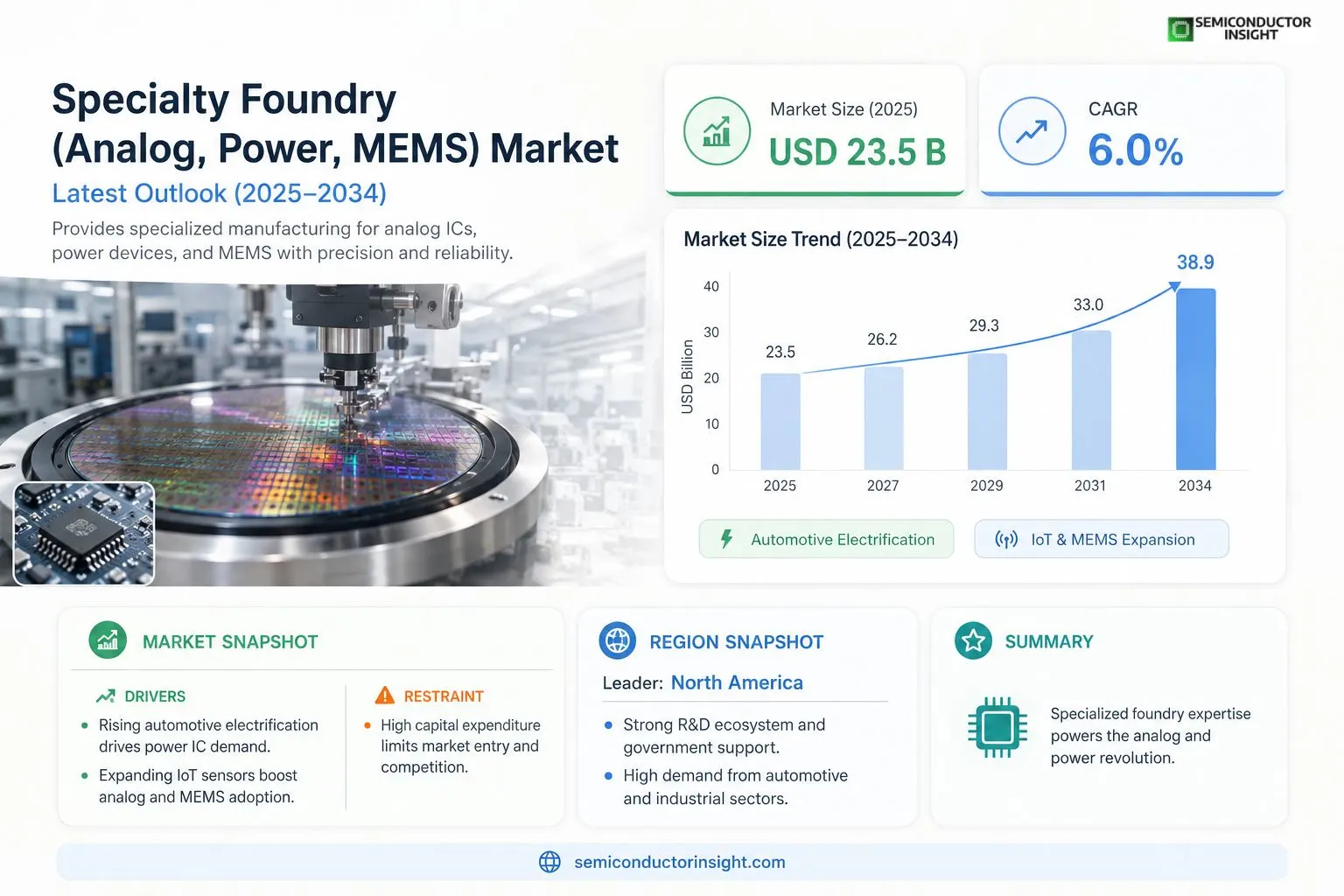
Global Specialty Foundry (Analog, Power, MEMS) market size was valued at USD 23.5 billion in 2025. The market is projected to grow from USD 23.5 billion in 2025 to USD 38.9 billion by 2034, exhibiting a CAGR of 6.0% during the forecast period.
Specialty foundries concentrate on producing analog integrated circuits, high‑voltage power devices, and micro‑electromechanical systems (MEMS). These processes demand dedicated modules such as precision analog front‑end stacks, thick‑oxide power transistors, and fine‑pitch etch steps for MEMS structures.The sector is gaining momentum because automotive electrification, IoT sensor expansion, and the surge in low‑power analog front‑ends are driving demand. Moreover, major players like TSMC’s Advanced Analog Platform,
GlobalFoundries’ PowerFab line, and SkyWater Technology’s MEMS services are expanding capacity and spurring innovation.
MARKET DRIVERS
Increasing Demand for Integrated Power Solutions
The rise of electric vehicles, renewable‑energy infrastructure, and Internet‑of‑Things (IoT) devices is pushing manufacturers to adopt highly efficient power‑management ICs. This trend fuels Specialty Foundry (Analog, Power, MEMS) Market as designers seek dedicated processes that deliver low‑loss, high‑density power transistors.
Growth of Analog and MEMS Applications
Analog front‑ends and MEMS sensors are becoming core components in smartphones, wearables, and industrial automation. Their requirement for precise analog performance and miniature form factors drives investment in specialized foundry lines that can guarantee tight tolerances and high yield.
➤ Industry analysts project a compound annual growth rate of roughly 8% for the Specialty Foundry segment through 2030, underscoring the strategic importance of differentiated process technologies.
Overall, the convergence of high‑performance computing, automotive electrification, and sensor‑centric ecosystems creates a robust pipeline of orders, reinforcing long‑term growth prospects for the market.
MARKET CHALLENGES
Technology Complexity and Cost
Developing analog and MEMS process nodes demands extensive R&D investment and sophisticated design‑for‑manufacturing (DFM) practices. Companies must balance the high upfront capital against the need to keep unit costs competitive for volume‑driven customers.
Other Challenges
Supply Chain Constraints
Global wafer shortages and limited availability of high‑purity substrates create lead‑time pressure, forcing customers to secure capacity years in advance and potentially slowing product roll‑outs.
MARKET RESTRAINTS
High Capital Expenditure
Establishing a dedicated analog or MEMS fab requires multi‑billion‑dollar investments in lithography, deposition, and testing equipment. Smaller players often lack the financial bandwidth to compete, limiting market participation and concentrating capacity among a few large foundries.
MARKET OPPORTUNITIES
Emerging Markets and Advanced Nodes
Growth in emerging economies, coupled with the rollout of 5G and edge‑computing infrastructure, creates fresh demand for low‑power analog and MEMS solutions. Foundries that can offer sub‑10 nm power devices and integrated sensor platforms are positioned to capture a sizable share of this expanding opportunity.
Specialty Foundry (Analog, Power, MEMS) Market Trends
Automotive Electrification Accelerates Analog and Power Demand
The surge in electric‑vehicle production is compelling semiconductor manufacturers to source high‑voltage power transistors and precision analog front‑end blocks from dedicated specialty foundries. These facilities provide thick‑oxide power devices that can tolerate the increased stress of automotive powertrains while maintaining low loss and high efficiency. At the same time, analog circuits that manage battery‑management systems, motor control, and sensor interfacing are becoming more intricate, requiring fine‑pitch layout capabilities that only specialty analog platforms can deliver. Leading players such as TSMC’s Advanced Analog Platform, GlobalFoundries’ PowerFab line, and SkyWater Technology’s MEMS services are expanding capacity to satisfy the growing OEM demand, embedding tighter integration between analog, power, and MEMS modules.
Other Trends
IoT Sensor Expansion Fuels MEMS Adoption
The proliferation of connected devices across consumer, industrial, and agricultural sectors is driving unprecedented demand for low‑power analog front‑ends and MEMS sensors. Specialty foundries are capitalizing on this trend by offering fine‑pitch etch steps and multi‑layer MEMS structures that enable miniature accelerometers, pressure sensors, and acoustic transducers. These components are essential for wearables, smart‑home appliances, and remote monitoring solutions where size, power consumption, and reliability are critical. By integrating MEMS fabrication with analog and power processes on a single wafer, foundries reduce bill‑of‑materials and improve signal integrity, giving OEMs a competitive edge in time‑to‑market.
Process Innovation and Capacity Expansion Strengthen Market Resilience
Specialty foundries are investing heavily in next‑generation process modules that combine high‑voltage power stacks with ultra‑low‑noise analog pathways and MEMS micro‑structures. This convergence enables system‑on‑chip solutions that address the complete value chain,from power conversion to sensor read‑out,without requiring multiple vendor engagements. Capacity upgrades, such as the addition of 300‑mm wafer lines equipped for thick‑oxide power devices and high‑resolution MEMS patterning, are mitigating supply constraints that previously hampered rapid product roll‑out. Moreover, collaborative R&D programs with automotive and IoT leaders are accelerating technology adoption cycles, ensuring that Specialty Foundry (Analog, Power, MEMS) Market remains agile and responsive to evolving industry requirements.
COMPETITIVE LANDSCAPEKey Industry Players
Specialty Foundry (Analog, Power, MEMS) Market Competitive Dynamics
The specialty foundry segment is anchored by a few large-scale manufacturers that have built dedicated platforms for analog, high‑voltage power and MEMS production. TSMC’s Advanced Analog Platform, GlobalFoundries PowerFab line, and SkyWater Technology’s MEMS services collectively control a significant share of the $23.5 billion market in 2025 and are expanding capacity to meet the projected $38.9 billion demand by 2034. These leaders benefit from deep wafer‑scale expertise, multi‑project wafer (MPW) programs, and strong customer alliances in automotive, IoT and communications, allowing them to set pricing benchmarks and drive technology road‑maps across the three sub‑markets.Beyond the tier‑one players, a cohort of niche but highly specialized foundries sustains the ecosystem by targeting specific process windows and vertical applications. TowerJazz, X‑FAB, AMS AG and Ichor Nanotech excel in fine‑pitch MEMS etch and precision analog front‑end stacks, while Bosch Sensortec, Texas Instruments, STMicroelectronics, Renesas Electronics and Dialog Semiconductor (now part of Renesas) provide complementary design‑for‑manufacturing services and mixed‑signal IP. Their agility in offering low‑volume MPW runs and rapid design‑turnaround attracts start‑ups and OEMs seeking differentiated sensor or power solutions, reinforcing a competitive landscape that balances scale with specialized capability.
List of Key Specialty Foundry Companies Profiled
- TSMC
- GlobalFoundries
- SkyWater Technology
- TowerJazz
- X‑FAB
- AMS AG
- Ichor Nanotech
- Bosch Sensortec
- Texas Instruments
- STMicroelectronics
- Renesas Electronics
- Dialog Semiconductor
Segment Analysis:
| Segment Category | Sub-Segments | Key Insights |
| By Type |
|
Analog Foundry
|
| By Application |
|
Automotive
|
| By End User |
|
OEMs
|
| By Technology Node |
|
45 nm and above
|
| By Material Platform |
|
Silicon
|
Regional Analysis: North America
United States
Government programs focused on semiconductor manufacturing and technological advancement are significantly impacting the Specialty Foundry market in the US, fostering domestic production and innovation.
The surging demand for sophisticated electronic control units (ECUs) in modern vehicles is a key driver for analog and power semiconductors, presenting substantial opportunities for foundries serving the automotive sector.
The proliferation of Internet of Things (IoT) devices in industrial settings is creating a strong need for power management and sensing solutions based on MEMS and analog technologies.
The stringent requirements of the aerospace and defense industries drive the demand for high-reliability analog and power components, offering a stable and specialized market segment.
Europe
Europe represents another significant market for Specialty Foundry (Analog, Power, MEMS) technologies. The region’s strengths lie in its established automotive industry, strong industrial base, and growing focus on sustainable technologies. The demand for power semiconductors in electric vehicles and renewable energy systems is a key growth driver. European foundries are also actively involved in developing advanced MEMS solutions for automotive safety and industrial sensors. The emphasis on energy efficiency and environmental regulations further fuels the need for innovative analog and power devices.
Asia-Pacific
Asia-Pacific is emerging as the fastest-growing region for Specialty Foundry (Analog, Power, MEMS) Market. Countries like China, Japan, and South Korea are major players in semiconductor manufacturing and consumption. The rapid expansion of the automotive industry in China, coupled with increasing investments in industrial automation and consumer electronics, is creating substantial demand. Government initiatives supporting domestic semiconductor production are also bolstering the market. The Asia-Pacific region is witnessing significant innovation in MEMS applications, particularly in consumer electronics and industrial sensing.
South America
Specialty Foundry (Analog, Power, MEMS) Market in South America is relatively nascent but exhibits promising growth potential. The increasing adoption of electronics in industries like automotive, telecommunications, and agriculture is driving demand. Brazil and Argentina are key markets in the region. While the market is currently smaller compared to North America and Asia-Pacific, the region presents opportunities for growth as infrastructure development and industrialization continue.
Middle East & Africa
The Middle East & Africa region is an emerging market for Specialty Foundry (Analog, Power, MEMS) solutions. The growth in infrastructure development, industrial expansion, and increasing disposable incomes are fueling demand for electronic components. The automotive sector in countries like Saudi Arabia and the UAE is witnessing significant growth, driving the need for power and analog semiconductors. The region presents a long-term growth opportunity for foundries catering to the expanding electronics market.
Report Scope
This market research report provides a comprehensive analysis of the Specialty Foundry (Analog, Power, MEMS) Market , covering the forecast period 2026–2034. It offers detailed insights into market dynamics, technological advancements, competitive landscape, and key trends shaping the industry.
Key focus areas of the report include:
- Market Overview: The report begins with an overview outlining its current market scenario, key growth indicators, and industry transformation drivers. It discusses macroeconomic factors, demand–supply balance, regulatory landscape, and the strategic role of semiconductors in powering advancements across industries such as automotive, telecommunications, consumer electronics, and industrial automation.
- Market Size & Forecast: Historical data and future projections for revenue, unit shipments, and market value across major regions and segments.
- Segmentation Analysis: Detailed breakdown by product type, technology, application, and end-user industry to identify high-growth segments and investment opportunities.
- Regional Insights: Insights into market performance across North America, Europe, Asia-Pacific, Latin America, and the Middle East & Africa, including country-level analysis where relevant.
- Competitive Landscape: Profiles of leading market participants, including their product offerings, R&D focus, manufacturing capacity, pricing strategies, and recent developments such as mergers, acquisitions, and partnerships.
- Technology Trends & Innovation: Assessment of emerging technologies, integration of AI/IoT, semiconductor design trends, fabrication techniques, and evolving industry standards.
- Market Drivers & Restraints: Evaluation of factors driving market growth along with challenges, supply chain constraints, regulatory issues, and market-entry barriers.
- Stakeholder Insights: Insights for component suppliers, OEMs, system integrators, investors, and policymakers regarding the evolving ecosystem and strategic opportunities.
Primary and secondary research methods are employed, including interviews with industry experts, data from verified sources, and real-time market intelligence to ensure the accuracy and reliability of the insights presented.
FREQUENTLY ASKED QUESTIONS:
What is the current market size of Specialty Foundry (Analog, Power, MEMS) Market?
-> Specialty Foundry (Analog, Power, MEMS) Market was valued at USD 23.5 billion in 2025 and is expected to reach USD 38.9 billion by 2034, representing a CAGR of 6.0 % over the forecast period.
Which key companies operate in Specialty Foundry (Analog, Power, MEMS) Market?
-> Key players include TSMC (Advanced Analog Platform), GlobalFoundries (PowerFab line), and SkyWater Technology (MEMS services), among others.
What are the key growth drivers?
-> Growth is driven by automotive electrification, expansion of IoT sensors, and rising demand for low‑power analog front‑ends, which increase the need for specialized analog, high‑voltage power, and MEMS solutions.
Which region dominates the market?
-> The reference material does not specify a dominant region; regional leadership is not disclosed in the provided data.
What are the emerging trends?
-> Emerging trends include advancements in precision analog front‑end stacks, thick‑oxide power transistors, and fine‑pitch MEMS etch technologies, alongside capacity expansions by leading foundries to meet automotive and IoT demand.
Get Sample Report PDF for Exclusive Insights
Report Sample Includes
- Table of Contents
- List of Tables & Figures
- Charts, Research Methodology, and more...
 Download Sample Report PDF