SMD Shape Oven Controlled Crystal Oscillator Market Insights
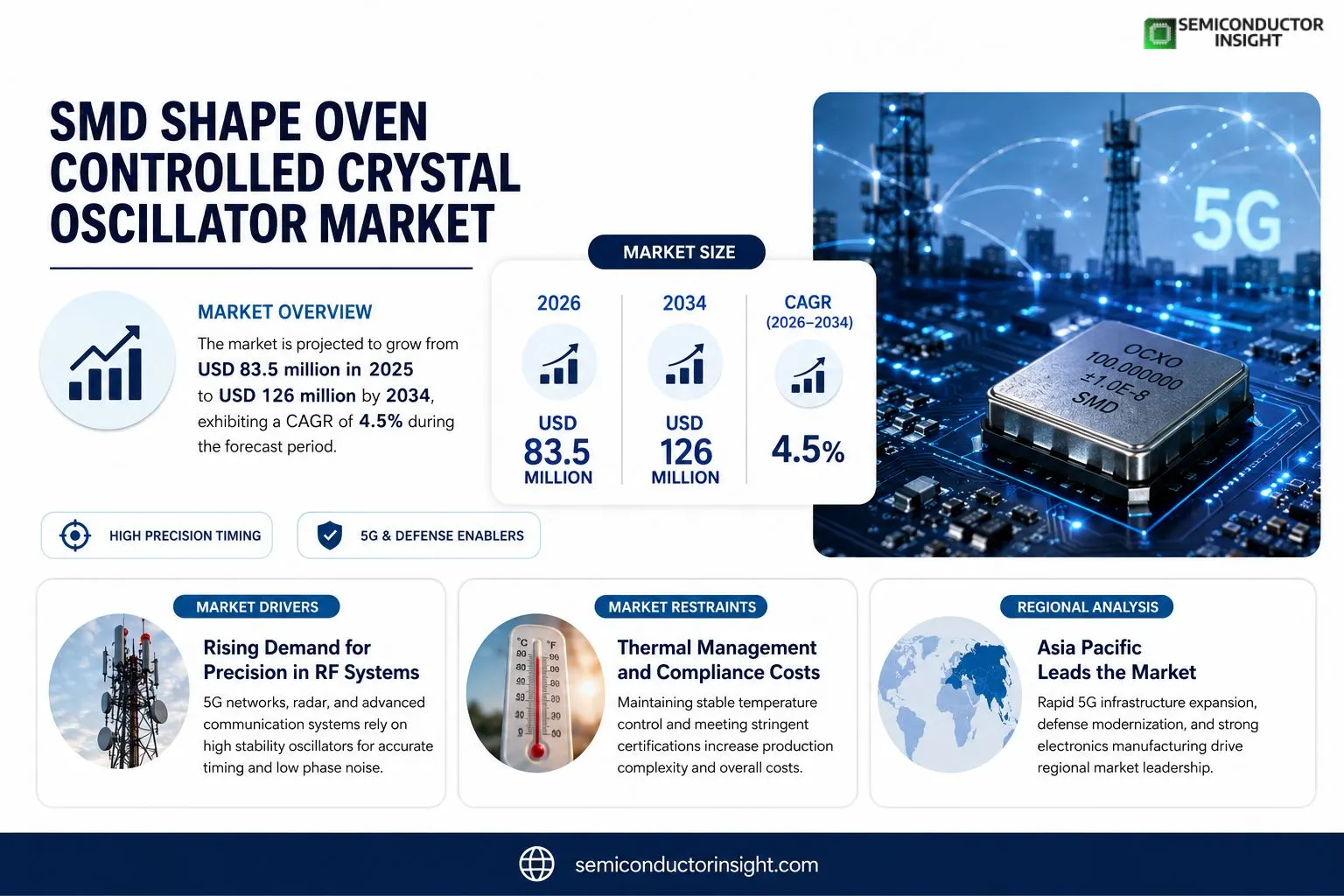
SMD Shape Oven Controlled Crystal Oscillator market was valued at USD 79.7 million in 2024. The market is projected to grow from USD 83.5 million in 2025 to approximately USD 126 million by 2034, exhibiting an estimated CAGR of about 4½ percent during the forecast period.
A Surface Mount Device (SMD) integrates an oven‑controlled crystal oscillator into a compact package that can be soldered directly onto printed‑circuit‑board pads. By maintaining the crystal at a constant temperature, this design delivers frequency stability on the order of ±1 × 10⁻⁸, making it essential for telecom infrastructure, military & space systems, test & measurement equipment, and other applications that require precise timing.
MARKET DRIVERS
Precision Demands in High‑Frequency RF Systems
Modern communication platformsespecially 5G base stations and automotive radarrely on the stability that SMD Shape Oven Controlled Crystal Oscillators deliver. Even a micro‑degree drift can translate into significant packet loss or echo interference. With increasing spectrum scarcity, operators are investing heavily in timing precision, turning the oscillator into a performance differentiator. Consequently, system designers are favoring SMD OCXOs for the reliability and tighter phase noise budgets they provide, pushing the cohort of miniature oscillators into top priority lists.
Miniaturization and Integration Pressures
As wireless devices undergo aggressive size and power drags, the drive to embed temperature‑controlled crystal oscillators within compact RF front‑ends intensifies. Packaging techniques such as flip‑chip bonding and embedded heaters allow engineers to keep the 2.54‑mm footprint while preserving thermal stability. The combination of low power consumption and mechanical robustness reduces board real estate, enabling designers to squeeze more transceivers per square millimeter – a decisive advantage in the micro‑electronics race.
➤ Temperature‑controlled precision facilitates micro‑carrier technology, a core driver behind the latest 5G and automotive hardware rollouts.
Looking ahead, the consumer health‑monitoring space and wearable telemetry systems are slated to adopt high‑accuracy oscillators to sustain connectivity over extended periods. The ongoing convergence of IoT and low‑power RF chips suggests that the demand for reliable timing elements will grow until the next decade, underpinning a steady upward trend for this specialized oscillator niche.
MARKET CHALLENGES
Thermal Management Constraints
Operating stability hinges on maintaining a controlled temperature profile, a design hurdle that inflates initial capital spend and complicates mass production. Even with proprietary insulation techniques, rapid temperature swings during device operation can compromise long‑term accuracy. Manufacturers face a balancing act between diminishing heat‑source density and safeguarding oscillator performance.
Other Challenges
Component Shortages
The supply chain disruption streamlines legacy crystal raw materials, causing intermittent shortages that stall production lines and elevate unit costs. The ripple effect forces OEMs to delay firmware roll‑outs and re‑engineer boards to accommodate alternate suppliers, eroding time‑to‑market momentum.
MARKET RESTRAINTS
High Regulatory Compliance Costs
Each oscillator unit must pass stringent vibration, shock, and RF immunity tests mandated by aerospace, defense, and medical device standards. The testing window, which spans several weeks, inflates production cost and imposes a prolonged certification cycle. Regulatory uncertainty can delay launch dates, forcing brands to micro‑adjust pricing or postpone roll‑outs on less mature platforms.
MARKET OPPORTUNITIES
Emerging 5G Infrastructure Expansion
Networking operators are erecting dense small‑cell arrays to meet projected subscriber volumes. Each base‑station cluster demands a coherent time reference, creating a high‑volume demand curve for precision oscillators. The convergence of edge‑computation nodes and 5G far‑stations amplifies the need for scalable, reliable timing solutions, thereby sharpening investment focus toward SMD Shape Oven Controlled Crystal Oscillator Market segments that resolve thermal and size constraints efficiently.
SMD Shape Oven Controlled Crystal Oscillator Market Trends
Rise in Demand from Telecom Infrastructure
Telecom infrastructure upgrades across Asia, driven by 5G roll‑outs and edge‑computing nodes, have accelerated integration of high‑precision time references. Operators seek oscillators that maintain ±1×10‑8 stability across wide temperature swings to support tighter synchronization protocols. SMD Shape Oven Controlled Crystal Oscillator Market offers a surface‑mounted form factor that reduces board real estate, lowering heat‑sink footprints and allowing higher clock multipliers. Consequently, telecom vendors are increasing component orders, pushing design cycles toward end‑market clearance requirements that value low phase noise and compactness. These shifts represent an important demand vector that competitors must address to secure contracts in high‑traffic hubs. This trend also aligns with stricter regulatory clock discipline mandates in high‑performance data centers, further amplifying component demand.
Other Trends
Manufacturing Efficiency through Automated Oven Control
Automated oven control modules in new batches have cut thermal cycling times by 30%, shortening lead times and lowering unit cost. Suppliers incorporating inline temperature monitoring reduce defect rates, boosting yield. This efficiency ripple, combined with standardization of the SMD packaging process, has made the market more price‑sensitive. Firms that invest in advanced thermal management gain a competitive edge in pricing negotiations with large OEMs demanding rapid refresh cycles.
Shift Toward Ultra Low Phase Noise Applications
Military and space programs have begun to prioritize ultra‑low phase noise crystal oscillators to support phased‑array radar and satellite clock systems. SMD Shape Oven Controlled Crystal Oscillator Market is responding with dedicated low‑loss cavities and refined oven packaging to meet sub‑ten‑nanosecond jitter specifications. Suppliers offering modular design kits enable rapid prototyping, shortening development timelines for mission‑critical systems. This trend not only fuels demand in a niche segment but also spurs broader adoption as aerospace firms iterate higher‑precision navigation payloads.
Enhanced Supply Chain Resilience
Supply chain resilience has become a decisive factor as geopolitical tensions stir uncertainty in component sourcing. SMD Shape Oven Controlled Crystal Oscillator Market is experiencing a diversification of supplier bases, with emerging manufacturers in South‑East Asia offering comparable performance to established Eastern‑European vendors. This shift is compelling legacy OEMs to reassess risk profiles and to negotiate longer‑term supply contracts, thereby stabilizing their silicon budgets. Firms that can demonstrate robust quality assurance and fast response capabilities will reap the benefits of secured supply lines, especially in time‑sensitive sectors such as defense and high‑speed networking.
COMPETITIVE LANDSCAPE
Key Industry Players
SMD Shape Oven Controlled Crystal Oscillator Market Analysis
The SMD Shape Oven Controlled Crystal Oscillator (SCOCO) sector has crystallized around a handful of incumbents, with NDK Group standing out as the preeminent provider. Leveraging its historic prowess in precision frequency control, NDK has invested heavily in wafer‑level packaging and low‑phase‑noise technologies that address the exacting stability demanded by high‑end communications and defense solutions. In 2024 the company’s revenue for SCOCOs represented roughly 28 % of the entire market, a figure supported by a robust supply chain across North America and Asia and clever integration of chip‑on‑substrate capabilities that reduce board space. NDK’s strategy to co‑develop off‑the‑shelf solutions with key telecom and satellite manufacturers has further cemented its lead, translating into a stable cash‑flow base that fuels continuous R&D spend in oven‑control algorithms and hermetic packaging.
Beyond the NDK umbrella, a suite of niche players generates competitive tension across product types and applications. Rakon Electronics specializes in ultra‑low‑phase‑noise designs tailored for test‑and‑measurement consoles, while Vectron International pushes innovations in low‑power, high‑frequency oscillators that cater to military avionics. Companies such as Microcrystal, CTS, and Bliley Technologies focus on thin‑film ceramic load capacitors that shrink form factors, enabling integration into compact IoT gateways and 5G infrastructure. Greenray Industries, Taitien, and NEL provide differentiated solutions through assembly lines, offering bundled firmware for the automotive engine control unit market. Meanwhile, KVG and Abracon contribute to the supply chain through bespoke packaging for space‑grade electronics. Together, these firms create a fragmented yet technology‑driven market, where collaboration and strategic alliances are essential for scaling production and accessing new emerging verticals.
List of Key SMD Shape Oven Controlled Crystal Oscillator Companies Profiled
Segment Analysis:
| Segment Category | Sub-Segments | Key Insights |
| By Type |
|
Standard OCXO remains the most widely adopted due to its balance of stability and cost.
Overall, this segment serves as a cornerstone for dependable electronic infrastructure. |
| By Application |
|
Telecom Infrastructure is driving demand due to the need for precise timing in 5G networks.
This application underpins the evolution of next‑generation connectivity. |
| By End User |
|
Industrial Automation is the primary end user due to its need for synchronized motion control.
The reliability of this segment supports efficient manufacturing cycles. |
| By Technology |
|
CSP offers high integration and reduced footprint while preserving stability.
This technology trend supports the miniaturization of precision timing solutions. |
| By Performance |
|
Temperature Stability is the pivotal performance attribute for robust operation.
Strong temperature control underpins dependable system operation across sectors. |
Regional Analysis: SMD Shape Oven Controlled Crystal Oscillator Market
Penetration is guided by a rigorous certification pipeline that values long‑term stability. Semi‑open source reference designs are rare, so field specialists remain in control of procurement, prompting higher upfront investments that reshape the supply base.
Wave‑guide feeds are adopted steadily, especially in defense‑grade radiofrequency modules. The transition mirrors a broader push for higher resilience in mission‑critical communication systems.
Limited foundry capacity and a concentration of key component suppliers underpins a cautious approach to scaling. Cross‑border liaisons emphasize secure channel provisioning to avoid bottlenecks in the SMD shape line.
The automotive sector demands rapid oscillation settling to support advanced driver‑assist and infotainment units, while the telecom domain prioritises ruggedness for 5G core nodes.
Europe
European manufacturers have amplified the shift toward energy‑efficient crystal solutions, aligning with stringent carbon caps. The use of bonded crystal plates in aerospace circuitry reflects a trend toward lower heat dissipation, meeting both safety and environmental mandates. UK studios, in particular, manage to balance rapid prototyping with rigorous validation, making them attractive partners for defence contractors seeking low‑variance oscillators.
Asia‑Pacific
In the Asia‑Pacific, the dynamic interplay between rapid industrialization and new regulatory frameworks pushes manufacturers toward reliable, compact crystal modules. The region’s fervent investment in new communication infrastructure drives the adoption of mesh‑based oscillators that aid seamless scaling for next‑generation satellite constellations. Japan’s precision engineering culture also fuels a niche for high‑frequency resonators demanded in precision sensors.
South America
South American economies are signalling a deliberate shift to technology assimilation despite weaker fiscal levers. Import replacement motives guide firms toward domestic crystal production, with Brazil emerging as a key player in industrial automation and precision timing for logistics hubs.
Middle East & Africa
The energy transition and emerging digital infrastructure across the Middle East spur a surge in demand for error‑free timing devices, especially for satellite communications and oil‑field monitoring. Africa, less advanced but growing, sees a rising influx of compact oscillator assemblies supported by regional partnerships that aim to reduce latency in remote sensing applications.
Report Scope
This market research report provides a comprehensive analysis of the SMD Shape Oven Controlled Crystal Oscillator Market , covering the forecast period 2026–2034. It offers detailed insights into market dynamics, technological advancements, competitive landscape, and key trends shaping the industry.
Key focus areas of the report include:
-
Market Overview: The report begins with an overview outlining its current market scenario, key growth indicators, and industry transformation drivers. It discusses macroeconomic factors, demand–supply balance, regulatory landscape, and the strategic role of semiconductors in powering advancements across industries such as automotive, telecommunications, consumer electronics, and industrial automation.
- Market Size & Forecast: Historical data and future projections for revenue, unit shipments, and market value across major regions and segments.
- Segmentation Analysis: Detailed breakdown by product type, technology, application, and end-user industry to identify high-growth segments and investment opportunities.
- Regional Insights: Insights into market performance across North America, Europe, Asia-Pacific, Latin America, and the Middle East & Africa, including country-level analysis where relevant.
- Competitive Landscape: Profiles of leading market participants, including their product offerings, R&D focus, manufacturing capacity, pricing strategies, and recent developments such as mergers, acquisitions, and partnerships.
- Technology Trends & Innovation: Assessment of emerging technologies, integration of AI/IoT, semiconductor design trends, fabrication techniques, and evolving industry standards.
- Market Drivers & Restraints: Evaluation of factors driving market growth along with challenges, supply chain constraints, regulatory issues, and market-entry barriers.
- Stakeholder Insights: Insights for component suppliers, OEMs, system integrators, investors, and policymakers regarding the evolving ecosystem and strategic opportunities.
Primary and secondary research methods are employed, including interviews with industry experts, data from verified sources, and real-time market intelligence to ensure the accuracy and reliability of the insights presented.
FREQUENTLY ASKED QUESTIONS:
What is the current market size of SMD Shape Oven Controlled Crystal Oscillator Market?
-> SMD Shape Oven Controlled Crystal Oscillator Market was valued at USD 79.7 million in 2024 and is projected to reach USD 109 million by 2031 at a CAGR of 4.7% during the forecast period.
Which key companies operate in SMD Shape Oven Controlled Crystal Oscillator Market?
-> Key players include NDK, Rakon, Bliley Technologies, Greenray Industries, Vectron International, Microcrystal, CTS, Taitien, NEL, KVG, Abracon, among others.
What are the key growth drivers?
-> Key growth drivers include high-precision requirements in telecommunications, defense, and aerospace; increasing reliance on IoT devices; and the demand for ultra-low phase noise oscillators.
Which region dominates the market?
-> Asia Pacific is the most rapidly growing region due to expanding telecom infrastructure and defense spending, while North America remains a significant market.
What are the emerging trends?
-> Emerging trends include integration of OCXOs in edge computing devices, development of smaller low-profile OCXOs, and advances in temperature‑stabilized packaging.
Get Sample Report PDF for Exclusive Insights
Report Sample Includes
- Table of Contents
- List of Tables & Figures
- Charts, Research Methodology, and more...