SMD Outsourced Manufacturing Market Insights
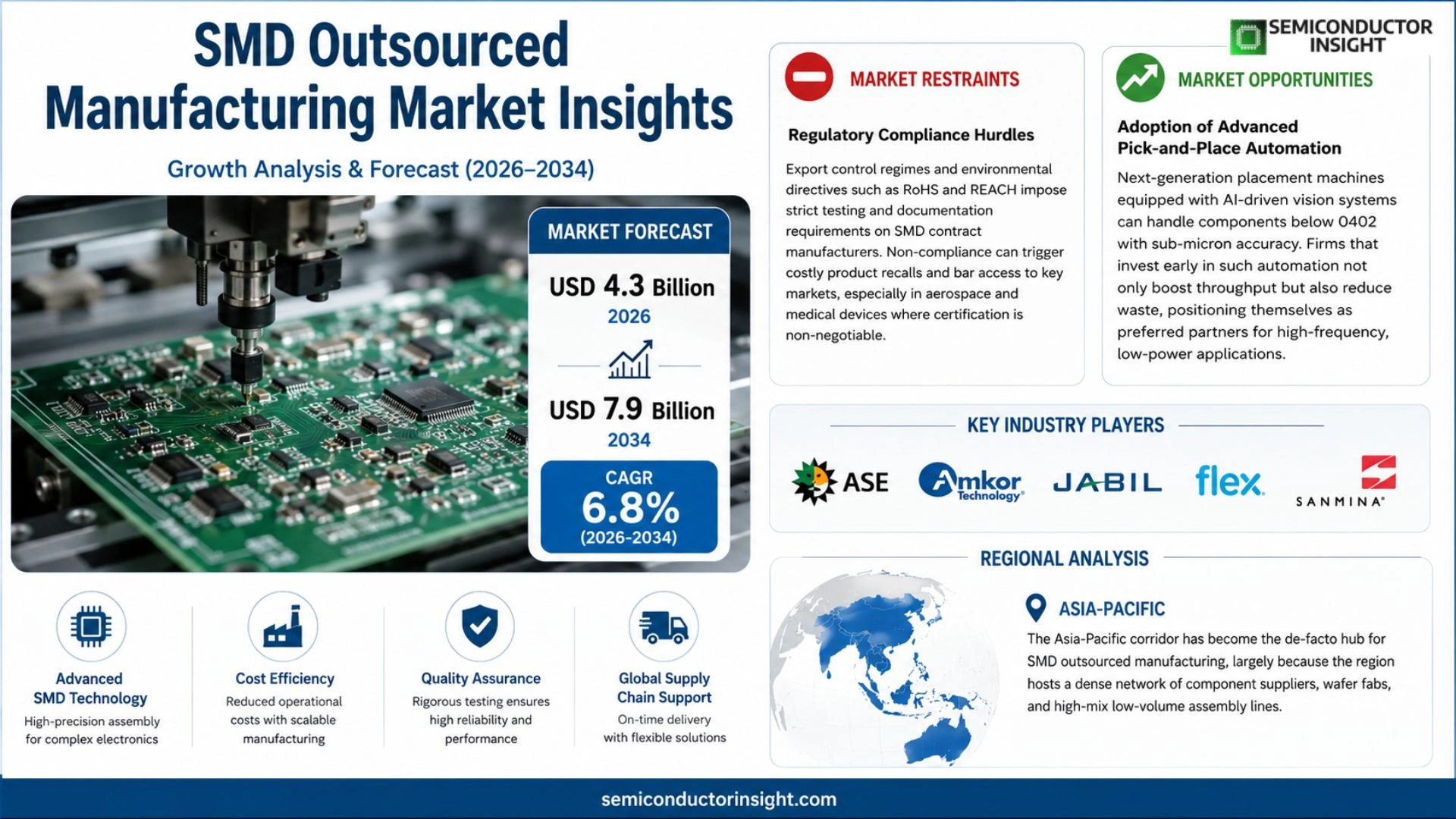
SMD Outsourced Manufacturing market size was valued at USD 4.2 billion in 2025. The forecast indicates growth from USD 4.3 billion in 2026 to USD 7.9 billion by 2034, reflecting an annual compound rate of approximately 6.8 % over the period.
SMD Outsourced Manufacturing refers to the contract‑based production of surface‑mount device assemblies, where specialized foundries handle component placement, soldering, inspection and testing on behalf of original equipment manufacturers. This service enables designers to accelerate time‑to‑market while leveraging economies of scale.
The expansion is fueled by rising demand for compact electronics in automotive and IoT applications, alongside tighter component shortages that push OEMs toward external partners for reliable capacity and cost efficiency.
MARKET DRIVERS
Rising Demand for Compact Electronics
The proliferation of wearables, IoT nodes, and automotive telematics is compelling OEMs to shrink board footprints, which in turn fuels the need for high‑density surface‑mount devices. Manufacturers that can provide reliable SMD outsourcing find themselves at the front of a value chain where board space is premium. This pressure accelerates the migration from through‑hole to SMD assemblies, creating a steady stream of contracts for contract manufacturers.
Cost Advantages of Outsourcing
When production volumes exceed a few thousand units, the economics of scale tilt sharply in favor of third‑party fabs. Lower labor rates, amortized capital equipment, and bulk component sourcing allow customers to achieve margins that internal lines cannot match. The resulting cost differential has become a decisive factor for midsize and large enterprises seeking to protect profitability amid price‑sensitive end markets.
➤ “Outsourcing SMD assembly is no longer a cost‑saving exercise; it is an enabler of technology road‑maps that demand speed and precision.”
Consequently, the SMD Outsourced Manufacturing Market is consolidating around a core group of providers that can combine high‑mix, low‑volume flexibility with the efficiencies of high‑volume production, a blend that is increasingly rare in the industry.
MARKET CHALLENGES
Supply Chain Volatility
Geopolitical tensions and pandemic‑era disruptions have revealed how dependent SMD assemblers are on a narrow set of component suppliers. Fluctuating lead times for passive and semiconductor parts translate into schedule slips for contract manufacturers, eroding the very advantage they promise to their clients.
Other Challenges
Talent Shortage
The precision required for fine‑pitch placement demands a workforce skilled in advanced equipment operation. As senior technicians retire, the pipeline for qualified engineers and machine operators is insufficient, forcing firms to raise wages and invest heavily in training programs.
MARKET RESTRAINTS
Regulatory Compliance Hurdles
Export control regimes and environmental directives such as RoHS and REACH impose strict testing and documentation requirements on SMD contract manufacturers. Non‑compliance can trigger costly product recalls and bar access to key markets, especially in aerospace and medical devices where certification is non‑negotiable.
MARKET OPPORTUNITIES
Adoption of Advanced Pick‑and‑Place Automation
Next‑generation placement machines equipped with AI‑driven vision systems can handle components below 0402 with sub‑micron accuracy. Firms that invest early in such automation not only boost throughput but also reduce waste, positioning themselves as preferred partners for high‑frequency, low‑power applications that dominate the emerging market segment.
SMD Outsourced Manufacturing Market Trends
Increasing Reliance on Integrated Test Services
Customers are gravitating toward providers that combine assembly and testing under a single roof. By eliminating hand‑offs between separate vendors, manufacturers reduce cycle time, lower defect exposure, and obtain tighter data correlation across process steps. This operational alignment is especially valuable for high‑mix, low‑volume products where each iteration carries significant engineering cost. As design cycles compress, the ability to receive a fully qualified module in one shipment becomes a differentiator that can shave weeks from time‑to‑market.
Other Trends
Regional Capacity Realignment
Asia continues to dominate capacity, yet a noticeable shift is occurring as firms expand footprint in North America and Europe. The move is driven by concerns over supply‑chain resilience and the desire to serve automotive and industrial customers that require localized production for regulatory compliance. Companies that establish clean‑room facilities close to end‑users gain leverage in negotiating contracts that stipulate on‑site or near‑site delivery, thereby mitigating lead‑time risk associated with trans‑pacific logistics.
Consolidation Among Tier‑One Providers
The competitive arena is tightening as larger players acquire niche specialists, especially those with proprietary test methodologies or advanced packaging capabilities. This consolidation creates a tiered supplier ecosystem: a handful of vertically integrated firms dominate volume contracts, while a vibrant layer of boutique outfits focuses on highly customized or emerging technology nodes. Clients must therefore evaluate not only price but also the strategic fit of a partner’s long‑term roadmap, as the ability to co‑develop next‑generation solutions increasingly influences procurement decisions.
COMPETITIVE LANDSCAPE
Key Industry Players
SMD Outsourced Manufacturing Market – Competitive Overview
ASE Group dominates the outsourced assembly and test arena, leveraging its vertically integrated model that couples advanced wafer‑level packaging with high‑volume surface‑mount technology (SMT) lines. Its revenue footprint, which accounts for roughly thirty percent of global SMD manufacturing income, reflects a strategy that blends deep client relationships in semiconductor design houses with a broad geographic footprint spanning North America, East Asia and Europe. By aligning its service portfolio with the accelerating demand for automotive electronics and 5G communications modules, ASE has created pricing leverage and entry barriers for smaller firms. The firm’s recent expansion of test‑service capacity in Taiwan and Singapore illustrates a deliberate move to capture value‑added segments, reinforcing its position as a reference point for market structure and competitive pricing dynamics. This scale also enables ASE to negotiate bulk component rates, further compressing cost structures for its OEM customers.
Trailing the market leader, Amkor, JECT, SPIL and Powertech Technology each command distinctive niches,Amkor excels in advanced test solutions for high‑performance compute chips, while JECT focuses on compact assembly for wearable and IoT devices. SPIL’s strength lies in mixed‑signal packaging for automotive safety modules, and Powertech’s Korea‑based fabs specialize through high‑density interconnects for telecommunications. Mid‑tier players such as TSHT, TFME and UTAC provide cost‑competitive assembly services that attract emerging‑stage semiconductor start‑ups, especially in Southeast Asia. Chipbond and ChipMOS, both headquartered in Taiwan, differentiate through rapid prototype turn‑around, supporting design‑win cycles for consumer electronics. Regional specialists including KYEC, Unisem and Walton Advanced Engineering deepen the competitive fabric in China’s industrial parks, while Signetics, Hana Micron and NEPES round out the landscape with focused capabilities in niche test equipment and specialty substrates. This layered ecosystem creates both collaboration opportunities and pricing pressure that mid‑size manufacturers must navigate to sustain margins. Consequently, these firms frequently pursue strategic alliances or acquire niche service providers to broaden their value‑chain reach.
List of Key SMD Outsourced Manufacturing Companies Profiled
- ASE Group
- Amkor Technology
- JECT
- SPIL
- Powertech Technology Inc
- TSHT
- TFME
- UTAC
- Chipbond
- ChipMOS Technologies
- KYEC
- Unisem
- Walton Advanced Engineering
- Signetics
- Hana Micron
- NEPES
Segment Analysis:
| Segment Category | Sub-Segments | Key Insights |
| By Type |
|
Test Service
|
| By Application |
|
Automotive
|
| By End User |
|
OEMs
|
| By Technology |
|
Advanced Packaging
|
| By Service Model |
|
Turnkey Manufacturing
|
Regional Analysis: SMD Outsourced Manufacturing Market
Asia‑Pacific
The proximity of silicon wafer plants, assembly houses, and test facilities creates a vertically integrated supply chain that shortens component hand‑off cycles. OEMs benefit from reduced freight costs and enhanced visibility, enabling tighter control over production schedules without sacrificing cost efficiency.
While each country maintains its own standards, regional trade agreements have harmonised key safety and environmental requirements. This regulatory cohesion lowers compliance overhead for multinational firms, allowing them to scale outsourced operations across borders with relative ease.
A steady pipeline of engineering graduates, coupled with on‑the‑job apprenticeship programs, sustains a workforce adept at fine‑pitch placement and automated optical inspection. This depth of expertise elevates quality outcomes for complex SMD assemblies.
Demand from mobile, automotive, and IoT sectors fuels the need for agile production capacity. Contract manufacturers that embed Industry 4.0 sensors and AI‑driven yield analytics are positioned to attract higher‑value contracts.
North America
North America retains a strong design and R&D base, yet many original equipment manufacturers delegate high‑volume SMD assembly to offshore partners to preserve capital. The strategic imperative is to balance cost savings with supply‑chain resilience, prompting firms to retain critical test and qualification steps domestically while leveraging Asian capacity for volume runs. Recent shifts toward near‑shoring for defense‑related electronics illustrate a nuanced approach: risk‑averse segments keep core assets stateside, whereas consumer electronics continue to rely on outsourced manufacturing that offers scale and flexibility.
Europe
European players emphasize compliance, sustainability, and precision engineering. While the continent hosts niche contract manufacturers specializing in high‑reliability SMD production for aerospace and medical devices, broader volume needs are still outsourced to regions with lower labor costs. The regulatory environment,particularly REACH and RoHS,pressures firms to adopt green soldering practices, which in turn influences supplier selection criteria across the SMD outsourced manufacturing market. Companies that can certify environmentally responsible processes gain preferential access to premium European contracts.
South America
South America’s market remains modest but is gaining traction as regional electronics assemblers seek cost‑effective capacity. Countries such as Brazil and Mexico are developing localized SMD assembly hubs to serve domestic automotive and telecommunications growth. However, infrastructure gaps and fluctuating currency conditions compel firms to adopt a hybrid model, utilizing local facilities for final testing while routing bulk production to established overseas partners. This dual‑sourcing strategy mitigates exposure to logistical disruptions while meeting regional demand.
Middle East & Africa
The Middle East & Africa region is at an early stage of embracing outsourced SMD manufacturing. Strategic investments in free‑zone industrial parks and incentives for high‑tech manufacturing aim to attract foreign contract manufacturers. Emerging automotive and renewable‑energy projects in the Gulf create a nascent demand for reliable surface‑mount components, encouraging multinational OEMs to pilot pilot projects with local partners. Success will depend on the ability to deliver consistent quality amid a developing supplier base.
Report Scope
This market research report provides a comprehensive analysis of the SMD Outsourced Manufacturing Market , covering the forecast period 2026–2034. It offers detailed insights into market dynamics, technological advancements, competitive landscape, and key trends shaping the industry.
Key focus areas of the report include:
- Market Overview: The report begins with an overview outlining its current market scenario, key growth indicators, and industry transformation drivers. It discusses macroeconomic factors, demand–supply balance, regulatory landscape, and the strategic role of semiconductors in powering advancements across industries such as automotive, telecommunications, consumer electronics, and industrial automation.
- Market Size & Forecast: Historical data and future projections for revenue, unit shipments, and market value across major regions and segments.
- Segmentation Analysis: Detailed breakdown by product type, technology, application, and end-user industry to identify high-growth segments and investment opportunities.
- Regional Insights: Insights into market performance across North America, Europe, Asia-Pacific, Latin America, and the Middle East & Africa, including country-level analysis where relevant.
- Competitive Landscape: Profiles of leading market participants, including their product offerings, R&D focus, manufacturing capacity, pricing strategies, and recent developments such as mergers, acquisitions, and partnerships.
- Technology Trends & Innovation: Assessment of emerging technologies, integration of AI/IoT, semiconductor design trends, fabrication techniques, and evolving industry standards.
- Market Drivers & Restraints: Evaluation of factors driving market growth along with challenges, supply chain constraints, regulatory issues, and market-entry barriers.
- Stakeholder Insights: Insights for component suppliers, OEMs, system integrators, investors, and policymakers regarding the evolving ecosystem and strategic opportunities.
Primary and secondary research methods are employed, including interviews with industry experts, data from verified sources, and real-time market intelligence to ensure the accuracy and reliability of the insights presented.
FREQUENTLY ASKED QUESTIONS:
What is the current market size of SMD Outsourced Manufacturing Market?
-> SMD Outsourced Manufacturing market forecast indicates growth from USD 4.3 billion in 2026 to USD 7.9 billion by 2034
Which key companies operate in SMD Outsourced Manufacturing Market?
-> Key players include ASE Group, Amkor, JECT, SPIL, Powertech Technology Inc, TSHT, TFME, UTAC, Chipbond, ChipMOS, KYEC, Unisem, Walton Advanced Engineering, Signetics, Hana Micron, NEPES.
What are the key growth drivers?
-> Key growth drivers include rising demand for outsourced SMD services, rapid product innovation, expanding applications across communications, automotive, computing, consumer and other segments, and increasing investment in test and assembly capabilities.
Which region dominates the market?
-> Asia dominates the market, driven by strong growth in China, while the United States and Europe also hold significant shares.
What are the emerging trends?
-> Emerging trends include accelerated growth of the Test Service segment, integration of advanced testing technologies, and the evolution of Assembly Service offerings to support higher‑density SMD solutions.

Get Sample Report PDF for Exclusive Insights
Report Sample Includes
- Table of Contents
- List of Tables & Figures
- Charts, Research Methodology, and more...