Smart Sensor (IO-Link) with Embedded MCU Market Insights
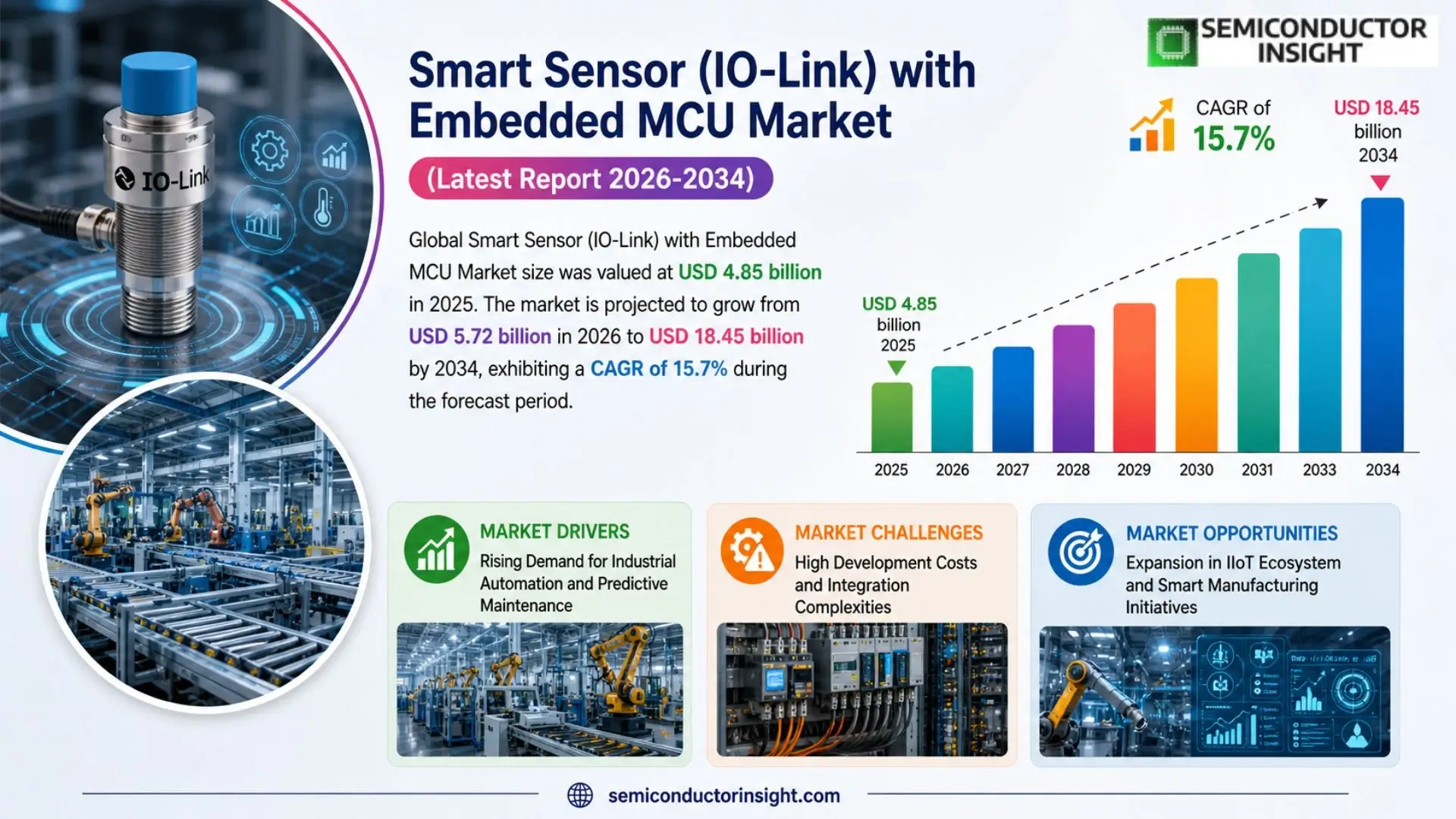
Smart Sensor (IO-Link) with Embedded MCU Market size was valued at USD 4.85 billion in 2025. The market is projected to grow from USD 5.72 billion in 2026 to USD 18.45 billion by 2034, exhibiting a CAGR of 15.7% during the forecast period.
Smart Sensor (IO-Link) with Embedded MCU refers to advanced industrial sensors that integrate IO-Link communication protocol directly with a microcontroller unit (MCU) embedded within the sensor housing. These devices enable real-time, bidirectional digital communication between sensors and automation systems, allowing for detailed parameter exchange, diagnostics, and configuration without additional hardware. The embedded MCU handles local data processing, edge intelligence, and protocol management, transforming traditional analog or simple digital sensors into smart, networked components essential for Industry 4.0 applications.
The market is experiencing rapid growth due to several factors, including the accelerating adoption of industrial automation, the push toward smart factories, and the rising need for predictive maintenance across manufacturing sectors. Furthermore, increasing demand for flexible production lines and enhanced operational efficiency drives manufacturers to deploy these intelligent sensors. While legacy systems often rely on point-to-point wiring with limited data capabilities, IO-Link enabled smart sensors with embedded MCUs provide rich diagnostic information and process data directly from the field level. However, integration complexities with existing infrastructure can present initial challenges in brownfield deployments.
Additionally, advancements in low-power MCU architectures and IO-Link transceivers have made it feasible to embed sophisticated processing capabilities even in compact, cost-sensitive sensor designs. This evolution supports applications ranging from discrete manufacturing to process industries, where precise monitoring of parameters such as temperature, pressure, position, and vibration is critical. Key players continue to innovate by developing highly integrated solutions that combine sensing elements, signal conditioning, MCU, and IO-Link communication in a single package, thereby reducing system complexity and installation costs. The overall ecosystem benefits from standardized communication that enhances interoperability and scalability in modern automation environments.
MARKET DRIVERS
Industry 4.0 and Industrial IoT Adoption
The integration of Smart Sensor (IO-Link) with Embedded MCU solutions is accelerating due to the rapid shift toward smart manufacturing and Industry 4.0 initiatives. These intelligent sensors combine precise sensing capabilities with IO-Link communication and on-board microcontrollers, enabling real-time data processing, diagnostics, and bidirectional communication directly at the field level. This architecture supports decentralized decision-making and reduces dependency on central controllers, driving efficiency gains across discrete and process industries.
Advancements in Embedded Intelligence and Predictive Maintenance
Embedded MCUs in IO-Link smart sensors allow local edge processing of sensor data, including parameter configuration, condition monitoring, and basic analytics. Manufacturers are increasingly deploying these devices to enable predictive maintenance strategies that minimize unplanned downtime. The ability to transmit rich diagnostic information alongside process values positions Smart Sensor (IO-Link) with Embedded MCU technology as a core enabler for higher overall equipment effectiveness in automotive, machine tool, and intralogistics applications.
➤ The proliferation of IO-Link nodes, supported by standardized IEC 61131-9 communication, continues to expand the ecosystem of compatible smart sensors with integrated microcontrollers.
Additionally, declining costs of microcontrollers and the demand for flexible automation solutions further propel market expansion, as these sensors simplify installation, support remote parameterization, and facilitate seamless integration into existing fieldbus networks.
MARKET CHALLENGES
Integration Complexity with Legacy Systems
Deploying Smart Sensor (IO-Link) with Embedded MCU solutions often requires careful planning to interface with older automation infrastructure that may rely on traditional analog or proprietary interfaces. While IO-Link offers standardization, retrofitting existing machinery can involve additional engineering efforts to ensure compatibility and full utilization of advanced features such as event-driven diagnostics.
Other Challenges
Initial Deployment Costs
Although long-term benefits are significant, the upfront investment in IO-Link masters, smart sensors with embedded MCUs, and associated software tools can be higher compared to basic discrete sensors, potentially slowing adoption among small and medium-sized enterprises.
Skill Gaps in Workforce
Effective implementation demands specialized knowledge in digital communication protocols, edge computing, and sensor parameterization, creating a shortage of trained personnel capable of maximizing the value of these intelligent systems.
MARKET RESTRAINTS
Cybersecurity and Data Integrity Concerns
As Smart Sensor (IO-Link) with Embedded MCU devices become more connected within industrial networks, they introduce additional potential entry points for cyber threats. Ensuring robust security measures for bidirectional communication and protecting embedded firmware from unauthorized access remains a critical restraint, particularly in highly regulated sectors where data integrity and system availability are paramount.
Supply Chain and Component Availability
Fluctuations in semiconductor availability directly impact the production of embedded MCUs and IO-Link transceivers used in smart sensors. Global supply chain disruptions can delay manufacturing and increase costs, constraining the ability of sensor vendors to meet surging demand from automation projects.
MARKET OPPORTUNITIES
Expansion in Wireless IO-Link and Edge AI Integration
The emergence of IO-Link Wireless variants combined with embedded MCUs opens new avenues for Smart Sensor (IO-Link) with Embedded MCU applications in mobile machinery, robotics, and areas where cabling is challenging. Integration of lightweight AI algorithms at the sensor level for local anomaly detection presents substantial growth potential, enhancing real-time responsiveness while lowering cloud dependency.
Emerging Applications in Sustainability and Process Optimization
Growing emphasis on energy efficiency and sustainable manufacturing creates opportunities for smart sensors that monitor consumption parameters with high precision. Smart Sensor (IO-Link) with Embedded MCU solutions can support detailed condition-based monitoring across food & beverage, pharmaceutical, and packaging industries, enabling optimized resource usage and compliance with environmental standards.
Smart Sensor (IO-Link) with Embedded MCU Market Trends
Adoption of Industry 4.0 Driving Integration of Smart Sensors
The integration of IO-Link communication protocol with embedded microcontroller units (MCU) within smart sensors is gaining significant momentum as manufacturers accelerate their transition toward Industry 4.0 frameworks. These devices facilitate real-time bidirectional digital communication, enabling detailed parameter exchange, advanced diagnostics, and remote configuration directly from the sensor level. The embedded MCU provides local data processing and edge intelligence, reducing reliance on centralized control systems and supporting more responsive automation environments.
This evolution allows traditional sensors to deliver rich process data and diagnostic information without additional hardware, transforming field-level components into intelligent networked elements. Sectors such as discrete manufacturing and process industries are increasingly deploying these solutions for precise monitoring of parameters including temperature, pressure, position, and vibration.
Other Trends
Advancements in Low-Power Architectures and Edge Processing
Progress in low-power MCU designs and IO-Link transceivers has enabled the embedding of sophisticated processing capabilities into compact sensor packages. This supports cost-effective implementations while maintaining high performance for edge intelligence applications. Manufacturers are focusing on highly integrated solutions that combine sensing elements, signal conditioning, MCU, and communication protocol in a single unit, thereby lowering system complexity and installation expenses.
Enhanced Predictive Maintenance Capabilities
Smart Sensor (IO-Link) with Embedded MCU solutions are playing a central role in predictive maintenance strategies across industrial facilities. By delivering comprehensive diagnostic data and real-time condition monitoring, these sensors help operators identify potential issues before they lead to downtime, improving overall equipment effectiveness and operational reliability in smart factory settings.
Interoperability and Scalability in Automation Ecosystems
Standardized IO-Link communication enhances interoperability between sensors, actuators, and higher-level automation systems, including connections to Ethernet-based networks and cloud platforms. This standardization simplifies device replacement and configuration, offering plug-and-play functionality that supports flexible production lines and scalable deployments. As industries prioritize enhanced operational efficiency and data-driven decision making, the combination of IO-Link protocol with embedded MCU technology continues to address legacy infrastructure challenges while enabling seamless brownfield and greenfield automation upgrades.
The market reflects broader shifts toward decentralized intelligence and connected industrial environments, where smart sensors contribute to optimized processes and reduced total cost of ownership through improved diagnostics and maintenance practices.
COMPETITIVE LANDSCAPEKey Industry Players
Established Automation Leaders Driving Innovation in Smart IO-Link Sensors with Embedded MCUs
Smart Sensor (IO-Link) with Embedded MCU Market is characterized by strong competition among global automation specialists, with European manufacturers particularly dominant due to their expertise in industrial sensing and protocol integration. Siemens AG leads the landscape through its comprehensive portfolio of IO-Link enabled smart sensors that incorporate advanced embedded MCUs for edge processing, diagnostics, and seamless integration into digital factory ecosystems. The market structure features a mix of large multinational corporations offering end-to-end automation solutions and specialized sensor manufacturers focusing on high-performance, compact designs that combine sensing elements, signal conditioning, and microcontroller capabilities in single packages.
Other significant players include sensor-focused firms that excel in niche applications such as predictive maintenance and flexible manufacturing lines. Companies like Balluff GmbH, ifm electronic GmbH, and Pepperl+Fuchs continue to push boundaries with highly integrated IO-Link devices featuring low-power MCUs, enhancing interoperability and reducing installation complexity in Industry 4.0 environments. This competitive dynamic fosters rapid technological advancement in bidirectional communication, local data processing, and scalable automation solutions across discrete and process industries.
List of Key Smart Sensor (IO-Link) with Embedded MCU Companies Profiled
- Siemens AG
- Rockwell Automation, Inc.
- OMRON Corporation
- Balluff GmbH
- ifm electronic GmbH
- Pepperl+Fuchs
- SICK AG
- Hans Turck GmbH & Co. KG
- Banner Engineering Corporation
- Festo SE & Co. KG
- SMC Corporation
- Baumer Group
- Emerson Electric Co.
- Leuze electronic GmbH + Co. KG
Segment Analysis:
| Segment Category | Sub-Segments | Key Insights |
| By Type |
|
Position Sensors stand out as the leading segment due to their critical role in enabling precise motion control and object detection in automated assembly lines. These sensors with embedded MCUs deliver real-time position data along with diagnostic information directly to controllers, facilitating immediate adjustments and reducing downtime. The integration of IO-Link allows seamless parameter configuration and condition monitoring, making them indispensable for flexible manufacturing environments where quick changeovers are essential. Their ability to support edge intelligence helps in local decision-making, enhancing overall system responsiveness and reliability in dynamic production settings. |
| By Application |
|
Predictive Maintenance emerges as the dominant application area for smart IO-Link sensors with embedded MCUs. By providing continuous diagnostic data and early warning indicators directly from the sensor level, these devices empower maintenance teams to anticipate failures before they occur. The embedded processing capability enables local analysis of vibration patterns, temperature trends, and operational anomalies, supporting condition-based strategies that minimize unplanned interruptions. This application enhances asset longevity and operational continuity across industrial facilities by transforming raw sensor data into actionable intelligence without overburdening central systems. |
| By End User |
|
Automotive Manufacturing represents the leading end-user segment owing to its stringent requirements for precision, traceability, and high-speed production. Smart sensors with IO-Link and embedded MCUs enable detailed monitoring of robotic operations, welding processes, and assembly quality while supporting rapid reconfiguration of production lines for different vehicle models. The bidirectional communication and local intelligence help maintain tight tolerances and ensure compliance with quality standards. This segment benefits significantly from reduced wiring complexity and enhanced interoperability between diverse automation components in modern smart factories. |
| By Communication Interface |
|
IO-Link Master Integrated leads this segment by offering seamless connectivity and centralized data aggregation directly at the field level. These configurations simplify network architecture by embedding advanced protocol handling within the sensor-MCU ecosystem, allowing for faster commissioning and reduced installation time. The integrated approach supports richer data exchange including event notifications and parameter updates, promoting greater system transparency and easier troubleshooting. This design proves particularly valuable in complex automation setups where minimizing points of failure and enhancing scalability are priorities. |
| By Intelligence Level |
|
Advanced Analytics Enabled sensors with embedded MCUs are gaining prominence as they bridge the gap between raw data collection and meaningful insights. These devices perform local signal processing, trend analysis, and anomaly detection, reducing latency in decision-making processes. The embedded intelligence allows for more sophisticated condition monitoring and adaptive control responses directly at the sensor, supporting the transition toward autonomous industrial operations. This level of capability enhances overall equipment effectiveness by enabling proactive interventions and optimizing process parameters in real time across various manufacturing scenarios. |
Regional Analysis: Smart Sensor (IO-Link) with Embedded MCU Market
Europe
Europe stands as the leading region Smart Sensor (IO-Link) with Embedded MCU Market, driven by its mature industrial base and strong commitment to Industry 4.0 principles. The region benefits from advanced manufacturing ecosystems, particularly in automotive, machinery, and process industries, where IO-Link enabled smart sensors integrated with embedded MCUs deliver real-time diagnostics, simplified wiring, and enhanced interoperability. Countries like Germany, with its precision engineering heritage, lead adoption through widespread deployment in flexible production lines and predictive maintenance applications.The integration of embedded MCUs allows these smart sensors to perform edge-level data processing, reducing latency and enabling smarter decision-making at the field level. European manufacturers prioritize standardization and sustainability, making IO-Link technology ideal for optimizing energy consumption and minimizing downtime across smart factories. Regulatory frameworks supporting digital transformation further accelerate the shift from traditional analog sensors to intelligent, bidirectional communication solutions.
Collaborative ecosystems involving sensor specialists, automation giants, and research institutions foster continuous innovation in compact, power-efficient designs. As industries pursue greater flexibility and resilience in supply chains, the demand for IO-Link smart sensors with embedded processing capabilities continues to strengthen Europe’s dominant position in this evolving market.
Europe excels in developing sophisticated IO-Link smart sensors incorporating advanced embedded MCUs for on-device intelligence. This enables seamless integration into existing automation architectures while supporting advanced features like condition monitoring and parameter configuration. The region’s focus on high-quality engineering ensures reliable performance in demanding industrial environments.
Strong emphasis on smart manufacturing drives the uptake of IO-Link technology across discrete and process industries. Embedded MCUs enhance sensor capabilities for real-time data exchange, supporting agile production systems and digital twins. This technological synergy positions European facilities at the forefront of connected automation.
IO-Link smart sensors with embedded MCUs contribute to energy efficiency and resource optimization goals. By enabling precise monitoring and control, these solutions help manufacturers reduce waste and comply with stringent environmental standards prevalent across the continent.
Close partnerships between technology providers, end-users, and standardization bodies accelerate innovation and market penetration. The presence of leading automation companies fosters rapid deployment of next-generation smart sensor solutions tailored to regional industrial needs.
North America
North America demonstrates robust growth Smart Sensor (IO-Link) with Embedded MCU Market, fueled by significant investments in industrial automation and IoT infrastructure. The United States leads through extensive adoption in automotive assembly, aerospace, and food processing sectors, where embedded MCUs enable intelligent sensors to deliver actionable insights directly at the machine level. This reduces reliance on central control systems and improves overall operational agility. Canadian industries also contribute through focus on resource efficiency in mining and energy applications. The region’s innovation-driven culture encourages integration of advanced diagnostics and wireless capabilities, making IO-Link solutions increasingly attractive for retrofitting legacy equipment and building future-ready smart factories. Emphasis on cybersecurity and data integrity further supports deployment of these intelligent sensor networks.
Asia-Pacific
Asia-Pacific emerges as a dynamic and rapidly expanding region for Smart Sensor (IO-Link) with Embedded MCU Market. Rapid industrialization in China, Japan, and South Korea drives demand for smart sensors that enhance manufacturing precision and flexibility. Embedded MCUs play a critical role in enabling local data processing for high-speed production lines and robotics applications. Government initiatives promoting smart factories and digital transformation accelerate adoption across electronics, automotive, and heavy machinery sectors. India and Southeast Asian nations are increasingly incorporating IO-Link technology to upgrade their manufacturing capabilities and attract global supply chain investments. The region’s cost-competitive electronics ecosystem supports scalable production of advanced sensor solutions while addressing the need for reliable, real-time monitoring in diverse industrial settings.
South America
South America shows steady interest Smart Sensor (IO-Link) with Embedded MCU Market, particularly in resource-intensive industries such as mining, oil and gas, and agriculture. Countries like Brazil and Argentina are gradually modernizing their industrial infrastructure, deploying IO-Link enabled sensors to improve process control and equipment reliability. Embedded MCUs facilitate edge intelligence that helps operators manage remote assets more effectively in challenging environments. While adoption rates remain moderate compared to more mature markets, growing awareness of predictive maintenance benefits and efficiency gains is encouraging selective implementation. Local partnerships with global automation providers are helping tailor solutions to regional operational requirements, laying the foundation for broader future expansion.
Middle East & Africa
The Middle East and Africa region presents emerging opportunities Smart Sensor (IO-Link) with Embedded MCU Market, driven by investments in oil and gas, petrochemicals, and infrastructure development. Nations in the Gulf are integrating smart sensors to enhance safety, optimize extraction processes, and support smart city initiatives. Embedded MCUs provide the necessary local processing power for reliable operation in harsh conditions where real-time decision making is essential. South Africa and other key economies are exploring applications in mining and manufacturing to boost productivity. Although the market is still developing, increasing focus on digitalization and technology transfer from international players is fostering gradual adoption of IO-Link solutions for improved asset management and operational excellence.
Report Scope
This market research report provides a comprehensive analysis of the Smart Sensor (IO-Link) with Embedded MCU Market , covering the forecast period 2026–2034. It offers detailed insights into market dynamics, technological advancements, competitive landscape, and key trends shaping the industry.
Key focus areas of the report include:
- Market Overview: The report begins with an overview outlining its current market scenario, key growth indicators, and industry transformation drivers. It discusses macroeconomic factors, demand–supply balance, regulatory landscape, and the strategic role of semiconductors in powering advancements across industries such as automotive, telecommunications, consumer electronics, and industrial automation.
- Market Size & Forecast: Historical data and future projections for revenue, unit shipments, and market value across major regions and segments.
- Segmentation Analysis: Detailed breakdown by product type, technology, application, and end-user industry to identify high-growth segments and investment opportunities.
- Regional Insights: Insights into market performance across North America, Europe, Asia-Pacific, Latin America, and the Middle East & Africa, including country-level analysis where relevant.
- Competitive Landscape: Profiles of leading market participants, including their product offerings, R&D focus, manufacturing capacity, pricing strategies, and recent developments such as mergers, acquisitions, and partnerships.
- Technology Trends & Innovation: Assessment of emerging technologies, integration of AI/IoT, semiconductor design trends, fabrication techniques, and evolving industry standards.
- Market Drivers & Restraints: Evaluation of factors driving market growth along with challenges, supply chain constraints, regulatory issues, and market-entry barriers.
- Stakeholder Insights: Insights for component suppliers, OEMs, system integrators, investors, and policymakers regarding the evolving ecosystem and strategic opportunities.
Primary and secondary research methods are employed, including interviews with industry experts, data from verified sources, and real-time market intelligence to ensure the accuracy and reliability of the insights presented.
FREQUENTLY ASKED QUESTIONS:
What is the current market size of Smart Sensor (IO-Link) with Embedded MCU Market?
-> Smart Sensor (IO-Link) with Embedded MCU Market was valued at USD 4.85 billion in 2025 and is expected to reach USD 18.45 billion by 2034, growing at a CAGR of 15.7%.
Which key companies operate Smart Sensor (IO-Link) with Embedded MCU Market?
-> Key players include leading developers of IO-Link enabled smart sensors and embedded MCU solutions, as referenced in the industry landscape.
What are the key growth drivers?
-> Key growth drivers include accelerating industrial automation, rising demand for smart factories, predictive maintenance needs, and advancements in low-power MCU and IO-Link technologies.
Which region dominates the market?
-> Asia-Pacific is the fastest-growing region due to rapid industrialization, while Europe remains a major hub for automation technology adoption.
What are the emerging trends?
-> Emerging trends include integration of edge intelligence, highly integrated sensor-MCU-IO-Link packages, standardized communication ecosystems, and enhanced interoperability for Industry 4.0 environments.

Get Sample Report PDF for Exclusive Insights
Report Sample Includes
- Table of Contents
- List of Tables & Figures
- Charts, Research Methodology, and more...
 Download Sample Report PDF