
Smart Device DDIC Market Insights
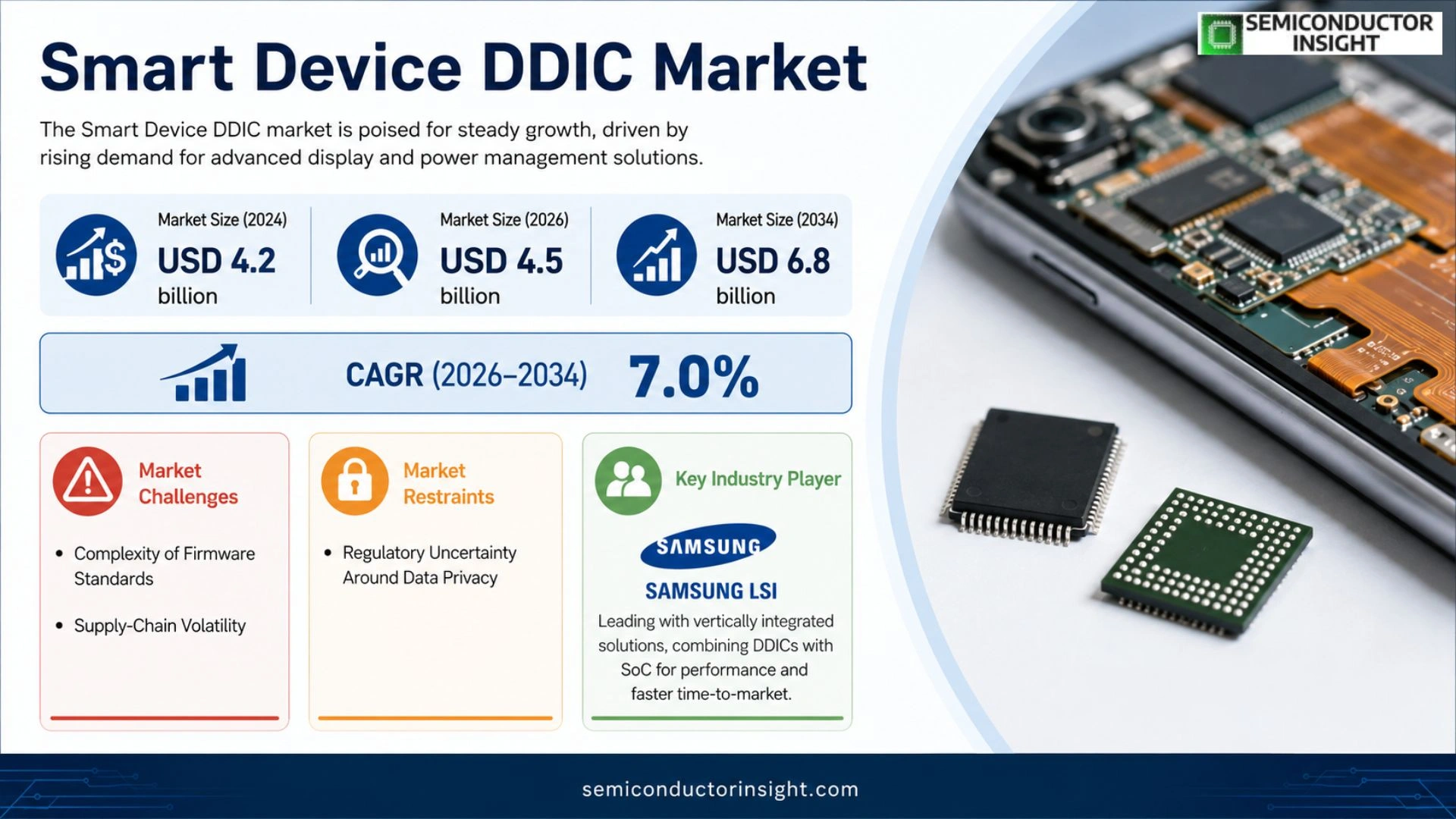
Smart Device DDIC market size was valued at USD 4.2 billion in 2024. The market is projected to grow from USD 4.5 billion in 2026 to USD 6.8 billion by 2034, exhibiting a CAGR of 7.0% during the forecast period.
Smart Device Display Driver Integrated Circuits (DDIC) are semiconductor components that translate digital video signals into analog voltages required by LCD, OLED and emerging micro‑LED panels. By managing timing, voltage scaling and power sequencing, DDICs enable high‑resolution graphics, low power consumption and advanced features such as variable refresh‑rate and touch integration across smartphones, wearables, televisions and automotive displays.
The market is experiencing rapid growth due to several factors, including rising adoption of high‑end smartphones with foldable displays, expanding demand for smart wearables that require ultra‑low‑power drivers, and increased investment in AI‑enhanced image processing within TV panels. Moreover, advancements in manufacturing processes,such as Samsung LSI’s transition to 7‑nm FD‑SOI for OLED drivers announced in late 2023,and strategic partnerships,e.g., Novatek’s collaboration with a leading Chinese OEM on AI‑driven LCD drivers in early 2024,are further accelerating expansion. Key players operating in this space include Samsung LSI, Novatek, Synaptics, LX Semicon, Himax, Raydium Semiconductor, Fitipower, Sitronix, ILITEK and Magnachip.
MARKET DRIVERS
Increasing Integration of AI at the Edge
Smart Device DDIC market is gaining traction as manufacturers embed inference engines directly into device‑level data control units. This shift shortens the latency loop between sensor capture and decision making, which is essential for applications such as predictive maintenance and autonomous navigation. Companies that adopt edge AI can differentiate their product portfolios and command premium pricing.
Demand for Real‑Time Data Processing
Enterprises across logistics, retail, and industrial automation are prioritizing architectures that process streams of information without reliance on distant cloud resources. The rise of 5G connectivity amplifies this need, as bandwidth becomes abundant yet latency remains a critical performance metric. Vendors that offer tightly coupled DDIC solutions are positioned to capture a larger share of ecosystem contracts.
➤ “Embedding decision intelligence within the device is no longer a novelty; it is becoming a baseline expectation for next‑generation products.”
These dynamics collectively pressure OEMs to re‑engineer product roadmaps, allocating R&D spend toward modular DDIC designs that can be customized per vertical market. The strategic implication is a faster product‑to‑market cycle and heightened competition on feature depth rather than merely on price.
MARKET CHALLENGES
Complexity of Firmware Standards
Developers confront a fragmented standards environment where legacy interfaces coexist with emerging open‑source frameworks. Aligning firmware across heterogeneous hardware generations demands extensive validation, which inflates time‑to‑release and strains engineering resources. This environment discourages smaller players from entering the arena, consolidating market power among established firms.
Other Challenges
Supply‑Chain Volatility
Component shortages, particularly for high‑performance microcontrollers, have forced manufacturers to adopt dual‑sourcing strategies. The unpredictability of lead times translates into higher inventory costs and occasional production pauses, eroding margin expectations for many participants in Smart Device DDIC market.
MARKET RESTRAINTS
Regulatory Uncertainty Around Data Privacy
Legislative bodies worldwide are tightening rules on on‑device data handling, imposing rigorous consent and anonymization requirements. Companies that have not yet embedded privacy‑by‑design mechanisms risk costly retrofits or market penalties, which dampens aggressive product expansion.
The ambiguous timeline for forthcoming regulations creates hesitation among investors, who prefer projects with clearly defined compliance pathways. This caution slows capital allocation toward innovative DDIC architectures that could otherwise accelerate market growth.
Moreover, cross‑border data residency mandates constrain the deployment of centralized update services, compelling vendors to design localized firmware ecosystems,an undertaking that adds complexity and operational overhead.
MARKET OPPORTUNITIES
Emerging Use Cases in Automotive and Healthcare
Automakers are integrating DDICs to manage sensor fusion for advanced driver‑assistance systems, while healthcare device makers leverage them for continuous patient monitoring. Both sectors require ultra‑reliable, low‑latency computation, opening a niche for premium DDIC solutions that meet stringent safety certifications.
Start‑ups focusing on specialty algorithms,such as anomaly detection in wearable ECG monitors,are partnering with DDIC vendors to embed proprietary models directly onto the device. This collaboration shortens data transmission cycles, reduces battery consumption, and offers a compelling value proposition to end‑users.
Investors recognize that these verticals exhibit higher willingness to pay for secure, on‑device intelligence, suggesting that targeted product launches could yield disproportionate returns compared with generic consumer deployments.
Smart Device DDIC Market Trends
Convergence of Display Technology and Power Management
The latest wave of high‑refresh‑rate panels and ultra‑high‑resolution screens is forcing DDIC suppliers to embed more sophisticated timing and voltage regulation functions within a single silicon footprint. Manufacturers that can pair precise backlight control with on‑chip power sequencing are seeing stronger order books from premium smartphone assemblers, who view these capabilities as differentiators for user experience. This convergence reduces board‑level component count, lowers OEM BOM pressure, and shortens time‑to‑market for next‑generation devices, prompting a realignment of R&D budgets toward mixed‑signal architectures.
Other Trends
Shift Toward OLED Driver ICs
OLED panels demand driver circuits that can handle wide current swings while maintaining colour accuracy, prompting a gradual migration away from traditional LCD‑centric designs. Suppliers that have already introduced flexible driver topologies are capturing a larger slice of the wearable and flagship‑phone segments, where the visual impact of OLED is a selling point. This movement also encourages the adoption of advanced packaging techniques, such as fan‑out wafer‑level, to meet the size constraints of slim form factors.
Geographic Realignment and Supplier Consolidation
North American and Asian OEMs are increasingly favoring a narrower pool of DDIC partners that can guarantee consistent yield across multiple process nodes. The resulting pressure has accelerated merger activity among mid‑tier providers seeking scale, while the top tier,Samsung LSI, Novatek, and Synaptics,tighten their design‑win agreements with leading handset brands. For downstream distributors, this translates into a more predictable supply chain but also a higher barrier to entry for new entrants lacking the required technical depth.
COMPETITIVE LANDSCAPE
Key Industry Players
Smart Device DDIC Competitive Overview
Samsung LSI continues to shape the high‑performance segment of Smart Device DDIC market, leveraging its vertically integrated design‑to‑fab capabilities. By bundling display driver ICs with system‑on‑chip (SoC) components, Samsung offers OEMs a single‑source solution that reduces bill‑of‑materials and accelerates time‑to‑market. This approach has entrenched the firm as the preferred supplier for flagship smartphones and premium televisions, where tight power budgets and advanced interface requirements demand tightly coordinated silicon. The company’s strong relationships with major display manufacturers also grant it preferential access to cutting‑edge substrate technologies, reinforcing its position at the top of the revenue hierarchy. As a result, Samsung’s market share remains disproportionately large compared with its peers, compelling rivals to either specialize in niche driver architectures or pursue strategic partnerships to broaden their addressable base.
Beyond the market leader, a constellation of specialized firms fuels competition across distinct application verticals. Novatek and Synaptics focus on cost‑effective driver solutions for mid‑range smartphones and wearables, capitalizing on mature process nodes to keep unit costs low while maintaining acceptable performance. Himax and Raydium Semiconductor embed advanced tuning algorithms in their LCD and OLED drivers, targeting premium display panels that require high refresh rates and dynamic backlight control. Fitipower, Sitronix and ILITEK differentiate themselves through compact form‑factors suited for IoT and automotive heads‑up displays, where space constraints dominate design choices. Magnachip and FocalTech have invested heavily in mixed‑signal integration, enabling simultaneous touch‑sensor and driver functionality that appeals to device makers seeking to shrink PCB real‑estate. Anapass, Viewtrix, GalaxyCore, SinoWealth, Chipone, Eswin and Jadard Technology round out the landscape, each carving out niches in emerging markets such as AR/VR headsets, portable health monitors, and low‑power e‑readers. Their collective activity keeps the ecosystem vibrant and forces the larger players to innovate continuously.
List of Key Smart Device DDIC Companies Profiled
- Samsung LSI
- Novatek
- Synaptics
- LX Semicon
- Himax
- Raydium Semiconductor
- Fitipower
- Sitronix
- ILITEK
- Magnachip
- FocalTech
- Anapass
- Viewtrix
- GalaxyCore
- SinoWealth
Segment Analysis:
| Segment Category | Sub-Segments | Key Insights |
| By Type |
|
LCD Driver IC continues to dominate due to its mature ecosystem and cost‑effective integration with a wide range of display panels.
|
| By Application |
|
Smartphone remains the principal driver of DDIC adoption, shaping product roadmaps across manufacturers.
|
| By End User |
|
Consumer Electronics drives the bulk of DDIC demand, reflecting rapid adoption of visually rich interfaces.
|
| By Technology Trend |
|
Low‑Power Design is emerging as a decisive factor for next‑generation devices.
|
| By Market Driver |
|
Demand for High Refresh‑Rate Displays accelerates DDIC innovation across form factors.
|
Regional Analysis: Smart Device DDIC Market
North America
OEMs in the United States are embedding DDIC modules to streamline sensor data aggregation for advanced driver assistance. The approach reduces wiring complexity and improves latency, which is critical for safety‑critical functions.
Premium smartphone manufacturers leverage DDIC designs to enable seamless camera‑to‑display pipelines, delivering richer visual experiences without sacrificing battery life.
Factories adopting edge analytics rely on DDIC solutions to fuse data from vision systems and predictive sensors, enhancing real‑time decision making on the production floor.
Emerging diagnostic equipment incorporates DDIC chips to manage high‑resolution imaging streams, allowing clinicians to access clearer visuals directly at the point of care.
Europe
European manufacturers are emphasizing sustainability in device design, prompting a shift toward DDIC architectures that minimize material usage while preserving performance. Collaborative standards bodies across the EU are aligning on interoperable data formats, which eases integration across borders. The region’s strong emphasis on privacy also drives solutions that process data locally, reinforcing the appeal of on‑chip data handling. As a consequence, European firms are carving out niche markets in automotive safety and industrial monitoring where compliance and efficiency intersect.
Asia‑Pacific
In Asia‑Pacific, rapid urbanization fuels demand for smart city infrastructure, creating fertile ground for DDIC‑enabled surveillance and traffic management systems. Local chip producers are scaling production capacities, targeting cost‑sensitive segments without compromising core functionality. Partnerships between hardware OEMs and software developers accelerate the rollout of intelligent edge devices, especially in emerging economies where infrastructure upgrades are a priority.
South America
South American markets, while smaller in absolute terms, are witnessing strategic investments in agricultural technology that rely on DDIC to process data from drones and ground sensors. The ability to combine high‑resolution imagery with real‑time analytics on a single chip reduces latency in precision farming applications, yielding tangible productivity gains for growers. Government incentives for technology adoption further encourage local companies to explore these solutions.
Middle East & Africa
In the Middle East & Africa, energy‑intensive sectors such as oil‑gas and renewable power are adopting DDIC platforms to monitor equipment health and optimize resource allocation. The focus on rugged, low‑power designs addresses the harsh environmental conditions typical of the region. Additionally, burgeoning telecom expansions are creating demand for smarter base stations that can handle diverse data streams with minimal footprint.
Report Scope
This market research report provides a comprehensive analysis of the Smart Device DDIC Market , covering the forecast period 2026–2034. It offers detailed insights into market dynamics, technological advancements, competitive landscape, and key trends shaping the industry.
Key focus areas of the report include:
- Market Overview: The report begins with an overview outlining its current market scenario, key growth indicators, and industry transformation drivers. It discusses macroeconomic factors, demand–supply balance, regulatory landscape, and the strategic role of semiconductors in powering advancements across industries such as automotive, telecommunications, consumer electronics, and industrial automation.
- Market Size & Forecast: Historical data and future projections for revenue, unit shipments, and market value across major regions and segments.
- Segmentation Analysis: Detailed breakdown by product type, technology, application, and end-user industry to identify high-growth segments and investment opportunities.
- Regional Insights: Insights into market performance across North America, Europe, Asia-Pacific, Latin America, and the Middle East & Africa, including country-level analysis where relevant.
- Competitive Landscape: Profiles of leading market participants, including their product offerings, R&D focus, manufacturing capacity, pricing strategies, and recent developments such as mergers, acquisitions, and partnerships.
- Technology Trends & Innovation: Assessment of emerging technologies, integration of AI/IoT, semiconductor design trends, fabrication techniques, and evolving industry standards.
- Market Drivers & Restraints: Evaluation of factors driving market growth along with challenges, supply chain constraints, regulatory issues, and market-entry barriers.
- Stakeholder Insights: Insights for component suppliers, OEMs, system integrators, investors, and policymakers regarding the evolving ecosystem and strategic opportunities.
Primary and secondary research methods are employed, including interviews with industry experts, data from verified sources, and real-time market intelligence to ensure the accuracy and reliability of the insights presented.
FREQUENTLY ASKED QUESTIONS:
What is the current market size and forecast for Smart Device DDIC?
-> Global Smart Device DDIC market size is projected to grow from USD 4.5 billion in 2026 to USD 6.8 billion by 2034, exhibiting a CAGR of 7.0%
Which key manufacturers are present in Smart Device DDIC market?
-> Key players include Samsung LSI, Novatek, Synaptics, LX Semicon, Himax, Raydium Semiconductor, Fitipower, Sitronix, ILITEK, Magnachip, etc.
What is the expected CAGR for Smart Device DDIC market?
-> The market is expected to grow at a CAGR of % from 2024 to 2031.
What is the outlook for the LCD Driver IC segment?
-> LCD Driver IC segment will reach USD million by 2036, with a % CAGR over the next ten years.
What share do the top five players hold in 2025?
-> In 2025, the global top five players had a share of approximately % in terms of revenue.
Get Sample Report PDF for Exclusive Insights
Report Sample Includes
- Table of Contents
- List of Tables & Figures
- Charts, Research Methodology, and more...
 Download Sample Report PDF


