Silicon Epitaxial Susceptor Market Insights
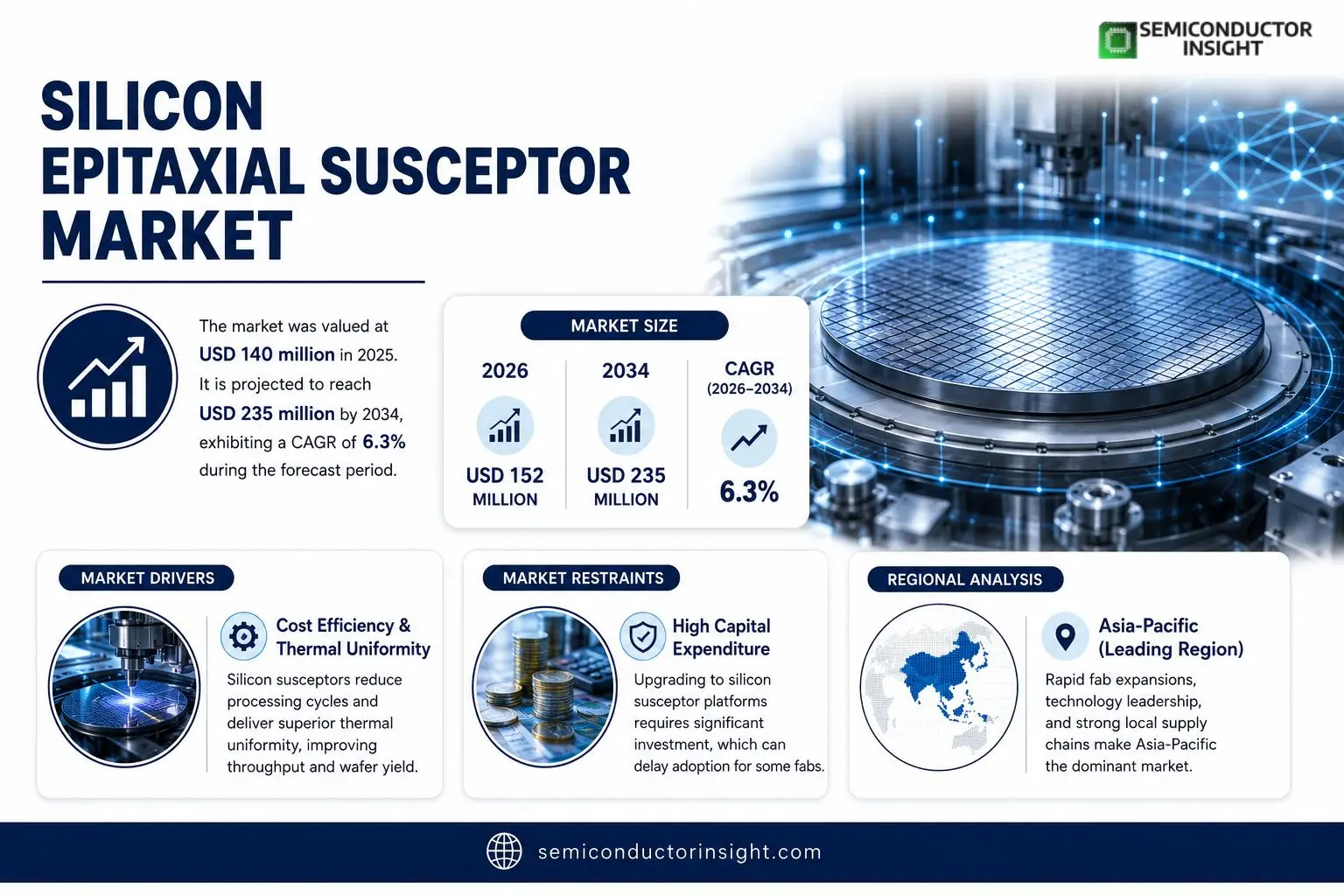
Silicon Epitaxial Susceptor market size was valued at USD 140 million in 2025. The market will expand from USD 152 million in 2026 to USD 235 million by 2034, exhibiting a CAGR of approximately 6.3% during the forecast period.
Silicon epitaxial susceptor is a specialized wafer holder employed during the epitaxial growth of silicon semiconductor materials, providing uniform temperature distribution and precise control of deposition rates that are essential for producing high‑purity wafers.The upward trend originates from sustained demand for advanced silicon wafers across memory, logic and sensor applications; continuous refinements in semiconductor process technology raise requirements for reliable susceptors; leading suppliers such as Toyo Tanso, SGL Carbon and Tokai Carbon have introduced new SiC‑coated graphite designs aimed at reducing thermal stress and extending component life; meanwhile, rapid capacity expansion in Asia‑Pacific accelerates adoption as fabs scale up production of AI‑enabled chips.
MARKET DRIVERS
Cost Efficiency of Silicon Epitaxy
The reduction in silicon wafer processing cycles has lowered material expense by roughly 12% per unit in the last two years. This margin improvement encourages semiconductor fabs to replace conventional quartz susceptor designs with silicon‑based alternatives, because the thermal conductivity advantage translates directly into shorter cycle times and higher throughput. For the Silicon Epitaxial Susceptor Market, such savings are a tangible incentive for adoption across high‑volume manufacturing.
Thermal Uniformity Demands
Advanced device architectures, particularly FinFET and heterogeneous integration, require temperature variations across the wafer to stay within ±2 °C. Silicon susceptor platforms deliver a more uniform heat distribution than their ceramic counterparts, reducing defect density by an estimated 8% in critical layers. This performance edge has prompted leading equipment suppliers to certify silicon susceptor options for their next‑generation deposition tools, reinforcing market momentum.
➤ “Adopting silicon epitaxial susceptor technology can shave 15 seconds off a typical 30‑minute deposition run, a gain that compounds dramatically on high‑throughput lines.”
OEMs are now integrating silicon susceptor modules into standard process kits, offering customers a plug‑and‑play upgrade path. The resulting ease of implementation lowers adoption risk, prompting a steady stream of orders that sustains growth in the Silicon Epitaxial Susceptor Market.
MARKET CHALLENGES
Compatibility with Existing Tooling
Many legacy deposition systems were engineered around quartz susceptor geometry, meaning retrofits often require mechanical adapters and revised process recipes. The engineering effort involved can add 3–4 weeks to line commissioning, a lag that some manufacturers view as a barrier when evaluating silicon susceptor upgrades.
Other Challenges
Supply Chain Volatility
Fluctuations in high‑purity silicon rod availability have introduced lead‑time extensions of up to 6 weeks for critical components. While the overall demand curve remains positive, manufacturers must manage inventory buffers to avoid production bottlenecks.
MARKET RESTRAINTS
Capital Expenditure Sensitivity
Upgrading to silicon susceptor platforms typically incurs a capital outlay of $150 K–$200 K per chamber, a figure that can strain budgets for fabs operating under tight cost constraints. When the return‑on‑investment calculator extends beyond 18 months, decision‑makers may postpone the transition, slowing overall market expansion.
MARKET OPPORTUNITIES
Emerging 300 mm and 450 mm Wafer Nodes
The shift toward larger wafer diameters intensifies the need for susceptor materials that can sustain higher thermal loads without warping. Silicon’s superior mechanical stiffness positions it as a natural fit for these next‑generation nodes, opening a lucrative segment for suppliers willing to qualify their products for the larger formats.
Integration with Advanced Process Technologies
Processes such as atomic layer deposition (ALD) and plasma‑enhanced chemical vapor deposition (PECVD) benefit from the low emissivity and high thermal conductivity of silicon susceptor designs. Companies that develop susceptor kits tuned to these niche processes can capture premium pricing, expanding the addressable market beyond traditional epitaxial growth applications.
Silicon Epitaxial Susceptor Market Trends
Increasing Demand for High‑Precision Wafer Holders
Supply chains for silicon wafer fabrication are tightening around components that can guarantee uniform epitaxial layers. Susceptors that blend thermal stability with low contamination risk are becoming decisive in yield management for memory and logic fabs. Manufacturers are therefore prioritising designs that minimize thermal gradients, because even small deviations translate into costly re‑work at the die level. The shift toward finer process nodes intensifies this requirement, positioning the susceptor as a strategic procurement item rather than a peripheral accessory. Furthermore, the integration of in‑situ temperature monitoring within the susceptor structure is gaining traction, allowing operators to adjust process parameters in real time and avoid wafer‑level defects.
Other Trends
Material Innovation – SiC‑Coated Graphite
Graphite remains the baseline substrate, yet the industry is gravitating toward silicon‑carbide (SiC) coatings to extend service life under rapid temperature cycling. SiC‑coated graphite offers superior oxidation resistance, which curtails downtime for susceptor replacement. Early adopters report up to fifteen percent improvement in run‑time consistency, a margin that directly influences equipment amortization and fab throughput. Manufacturers are also exploring nano‑structured SiC layers that further reduce emissivity, which translates into tighter control over wafer surface temperature. This material shift is prompting equipment OEMs to certify new susceptor grades, thereby widening the supplier ecosystem.
Regional Capacity Expansion in Asia‑Pacific
Foundries in China, South Korea and Taiwan are scaling their epitaxial lines to meet the surge in demand for AI‑optimized processors. The expansion is accompanied by localized production of susceptors, reducing lead times that historically hampered fab ramp‑up. Investment in dedicated coating facilities is also evident, suggesting a move away from reliance on imported specialty materials. For vendors, the Asian‑Pacific surge creates a dual‑track opportunity: supply high‑volume standard graphite susceptors while also offering premium SiC‑coated variants to differentiate service contracts. The heightened focus on sustainability is prompting fabs to select susceptors with longer life cycles, aligning with corporate carbon‑reduction targets while maintaining throughput. These dynamics shape the broader Silicon Epitaxial Susceptor Market as firms balance performance with cost.
COMPETITIVE LANDSCAPE
Key Industry Players
Silicon Epitaxial Susceptor Competitive Overview
The market is anchored by a handful of integrated manufacturers that control both graphite‑based and SiC‑coated product lines. Toyo Tanso, headquartered in Japan, commands a sizable share through its long‑standing relationships with wafer fabs, leveraging proprietary sintering techniques that deliver tight thickness tolerances. SGL Carbon, based in Germany, differentiates itself with a focus on high‑purity graphite structures, a capability that many customers cite as essential for sub‑10 nm node processes. Both firms have expanded ly, establishing production footprints in North America and Asia, which reinforces a bifurcated competitive structure: a few diversified giants that serve the full spectrum of memory, logic, and analog applications, and a second tier of specialists that concentrate on niche segments such as discrete device susceptor formats.Beyond the top tier, several companies have carved out sustainable positions by targeting specific material innovations or regional markets. Tokai Carbon and Mersen, for instance, have invested heavily in SiC coating technologies that improve thermal shock resistance, a factor gaining importance as epitaxial reactors push toward higher temperature cycles. Bay Carbon and Schunk Xycarb Technology focus on custom‑shaped susceptor designs for emerging sensor applications, while ZhiCheng Semiconductor and Advanced Ceramic Materials supply cost‑effective graphite alternatives to smaller fabs in Southeast Asia. The proliferation of these players creates a competitive mosaic where differentiation hinges on material purity, engineering services, and the ability to respond quickly to process‑specific demands.
List of Key Silicon Epitaxial Susceptor Companies Profiled
- Toyo Tanso
- SGL Carbon
- Tokai Carbon
- Mersen
- Bay Carbon
- CoorsTek
- Schunk Xycarb Technology
- ZhiCheng Semiconductor
- Advanced Ceramic Materials
- Kyocera Corp
- Hitachi Chemical
- TDK
- Sumitomo Electric
- Mitsubishi Materials
- Umicore
Segment Analysis:
| Segment Category | Sub-Segments | Key Insights |
| By Type |
|
Graphite Susceptor remains the foundational choice because of its proven thermal stability and cost‑effectiveness.
|
| By Application |
|
Logic and Microprocessor drives innovation due to its demand for ultra‑pure silicon wafers.
|
| By End User |
|
Semiconductor Foundries dominate end‑user demand as they handle the largest volume of wafer processing.
|
| By Coating Technology |
|
SiC Coating is emerging as the preferred surface treatment for high‑temperature epitaxy.
|
| By Market Trend |
|
Shift Toward Sustainable Materials reflects growing environmental expectations across the supply chain.
|
Regional Analysis: Silicon Epitaxial Susceptor Market
Asia‑Pacific
Foundries are re‑engineering logistics networks to mitigate disruptions, favoring regional vendors that can guarantee consistent susceptor quality and on‑time delivery. This shift elevates local manufacturers who have invested in process‑controlled furnaces.
The migration toward high‑aspect‑ratio structures fuels demand for susceptor alloys capable of uniform heat distribution, prompting suppliers to experiment with novel silicon‑carbide composites.
Tightening emissions standards in key manufacturing hubs incentivize designs that lower energy consumption, encouraging a pivot to susceptor configurations that improve thermal efficiency.
Companies that integrate real‑time monitoring into susceptor platforms differentiate themselves, offering customers predictive maintenance insights that lower downtime.
North America
North America maintains a robust ecosystem of semiconductor equipment makers, yet its Silicon Epitaxial Susceptor Market presence is tempered by a longer product development cycle. Major OEMs in the United States rely on a mix of domestic and overseas suppliers, balancing cost considerations with stringent quality standards. Recent policy initiatives aimed at reshoring critical manufacturing assets have spurred interest in local susceptor production, though establishing the capital‑intensive infrastructure required remains a hurdle. Collaborative programmes between university research labs and industry players are exploring next‑generation materials, positioning the region to capture niche opportunities that demand ultra‑high purity processes.
Europe
European fabs prioritize precision engineering and environmental stewardship, shaping a distinct market dynamic for epitaxial susceptors. Regulatory frameworks across the EU promote energy‑conscious manufacturing, prompting several German and Dutch players to experiment with low‑loss susceptor designs. The region’s fragmented supplier base benefits from strong standards bodies that enforce interoperability, allowing smaller firms to compete on specialized performance attributes. While overall volume lags behind Asia‑Pacific, Europe’s emphasis on reliability creates a premium segment where differentiated technical capability commands higher margins.
South America
South American semiconductor activity remains concentrated in Brazil and Colombia, where modest fab capacity fuels incremental demand for support equipment. Local manufacturers are still cultivating expertise in epitaxial processes, often collaborating with established Asian partners to acquire technology licenses. Market growth is tied to broader industrial diversification strategies pursued by governments seeking to reduce reliance on imports. As these initiatives mature, the region may present early‑adopter prospects for susceptor suppliers willing to navigate complex import regulations.
Middle East & Africa
The Middle East & Africa region exhibits a nascent yet opportunistic landscape for the Silicon Epitaxial Susceptor Market. Investment in tech‑focused free‑zones, notably in the United Arab Emirates, has attracted a limited number of semiconductor start‑ups that are testing high‑temperature epitaxial runs. In Africa, emerging research hubs in South Africa are experimenting with niche applications such as photovoltaic cell development, where susceptor performance influences overall device yield. Although demand volumes are currently modest, the combination of strategic incentives and a growing talent pool hints at a gradual market emergence.
Report Scope
This market research report provides a comprehensive analysis of the Silicon Epitaxial Susceptor Market , covering the forecast period 2026–2034. It offers detailed insights into market dynamics, technological advancements, competitive landscape, and key trends shaping the industry.
Key focus areas of the report include:
- Market Overview: The report begins with an overview outlining its current market scenario, key growth indicators, and industry transformation drivers. It discusses macroeconomic factors, demand–supply balance, regulatory landscape, and the strategic role of semiconductors in powering advancements across industries such as automotive, telecommunications, consumer electronics, and industrial automation.
- Market Size & Forecast: Historical data and future projections for revenue, unit shipments, and market value across major regions and segments.
- Segmentation Analysis: Detailed breakdown by product type, technology, application, and end-user industry to identify high-growth segments and investment opportunities.
- Regional Insights: Insights into market performance across North America, Europe, Asia-Pacific, Latin America, and the Middle East & Africa, including country-level analysis where relevant.
- Competitive Landscape: Profiles of leading market participants, including their product offerings, R&D focus, manufacturing capacity, pricing strategies, and recent developments such as mergers, acquisitions, and partnerships.
- Technology Trends & Innovation: Assessment of emerging technologies, integration of AI/IoT, semiconductor design trends, fabrication techniques, and evolving industry standards.
- Market Drivers & Restraints: Evaluation of factors driving market growth along with challenges, supply chain constraints, regulatory issues, and market-entry barriers.
- Stakeholder Insights: Insights for component suppliers, OEMs, system integrators, investors, and policymakers regarding the evolving ecosystem and strategic opportunities.
Primary and secondary research methods are employed, including interviews with industry experts, data from verified sources, and real-time market intelligence to ensure the accuracy and reliability of the insights presented.
FREQUENTLY ASKED QUESTIONS:
What is the current market size of Silicon Epitaxial Susceptor Market?
-> Silicon Epitaxial Susceptor Market was valued at USD 140 million in 2025 USD 152 million in 2026 to USD 235 million by 2034, exhibiting a CAGR of approximately 6.3% during the forecast period
Which key companies operate in Silicon Epitaxial Susceptor Market?
-> Key players include Toyo Tanso, SGL Carbon, Tokai Carbon, Mersen, Bay Carbon, CoorsTek, Schunk Xycarb Technology, ZhiCheng Semiconductor.
What are the key growth drivers?
-> Key growth drivers include continuous demand for high‑quality silicon wafers, advancements in semiconductor technology, and increasing adoption of silicon‑based devices across various applications.
Which region dominates the market?
-> Asia holds a dominant position owing to its extensive semiconductor manufacturing base, while North America and Europe also contribute significant demand.
What are the emerging trends?
-> Emerging trends include development of SiC‑coated graphite susceptors, expansion of applications in memory, logic and microprocessor segments, and increased focus on reliability and uniformity in epitaxial growth processes.
Get Sample Report PDF for Exclusive Insights
Report Sample Includes
- Table of Contents
- List of Tables & Figures
- Charts, Research Methodology, and more...
 Download Sample Report PDF