Silicon Carbide Heating Rod Market Insights
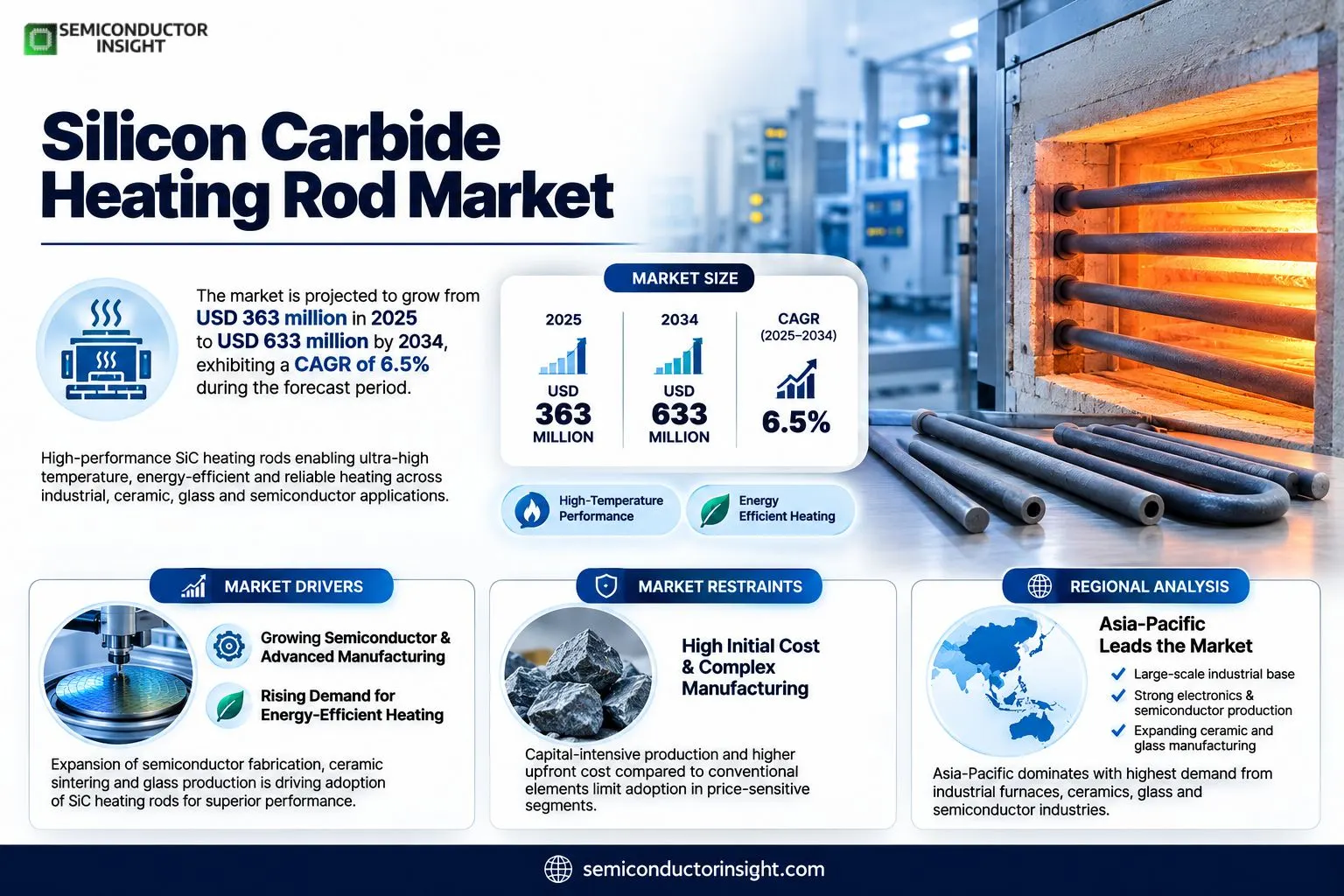
Silicon Carbide Heating Rod market was valued at USD 363 million in 2025 and is forecasted to rise to roughly USD 633 million by 2034, reflecting an implied CAGR of about 6.5 % over the period.
Silicon carbide heating rodsalso called SiC rodsare resistance heating elements produced from high‑purity silicon carbide through high‑temperature sintering. They tolerate temperatures up to 1600 °C, resist oxidation, deliver high thermal efficiency and enjoy long service life, making them indispensable for laboratory muffle furnaces, ceramic sintering kilns, glass‑melting furnaces, metallurgical heat‑treatment units and semiconductor material preparation.The sector benefits from several strengths: extreme temperature capability enables demanding furnace processes; durability reduces maintenance compared with conventional elements; superior thermal conductivity cuts energy consumption; chemical inertness protects against harsh environments; and minimal thermal expansion supports precise temperature control. Nevertheless, higher upfront costs and sensitivity to mechanical shock pose challenges that manufacturers must address through robust handling procedures and clear value communication.
MARKET DRIVERS
Rising Demand for High‑Efficiency Thermal Solutions
Silicon Carbide Heating Rod Market benefits from manufacturers seeking to slash energy consumption in furnaces and kilns. Silicon carbide’s ability to reach temperatures above 1600 °C while maintaining low resistive losses makes it a preferred material for processes that cannot tolerate thermal drift. This efficiency translates into lower operating costs, prompting OEMs to specify silicon‑carbide rods in new equipment designs.
Expansion of Semiconductor and Power‑Electronics Fabrication
Fabrication facilities for wide‑bandgap semiconductors such as GaN and SiC are proliferating across Asia‑Pacific and North America. These plants require precise, contamination‑free heating elements that can endure rapid thermal cycling. Silicon carbide heating rods meet those criteria, driving procurement budgets toward higher‑specification components. As production volumes climb, supplier contracts become larger and longer‑term.
➤ Industry pilots have shown up to a 12 % reduction in furnace cycle time when silicon carbide rods replace traditional nichrome elements, directly boosting throughput.
Beyond pure performance, regulatory pressure on carbon emissions forces plant managers to adopt materials that support greener operations. Silicon carbide’s superior thermal stability reduces the need for frequent part replacements, cutting waste and aligning with sustainability targets. This confluence of cost, reliability, and compliance fuels the market’s upward trajectory.
MARKET CHALLENGES
Manufacturing Complexity and Cost Sensitivity
Producing silicon carbide heating rods demands tightly controlled sintering processes and high‑purity raw material sourcing. The capital intensity of such facilities translates into higher unit prices compared with conventional heating elements. End‑users operating on thin margins may hesitate to adopt the technology unless clear ROI can be demonstrated within a short payback window.
Other Challenges
Supply‑Chain Volatility
Fluctuations in the availability of high‑grade silicon carbide powdersoften tied to mining output and geopolitical factorsintroduce lead‑time uncertainty. Projects that depend on just‑in‑time delivery risk schedule slips, prompting some customers to retain legacy inventory despite efficiency drawbacks.
MARKET RESTRAINTS
Limited Awareness in Low‑Temperature Segments
While high‑temperature industrial sectors have embraced silicon carbide rods, many low‑temperature applicationssuch as small‑scale drying or domestic heatingremain dominated by cheaper alloys. The perceived over‑engineering of silicon carbide in these segments suppresses demand, creating a ceiling on market expansion unless educational outreach reshapes buyer perceptions.
MARKET OPPORTUNITIES
Integration with Smart Furnace Controls
Advances in IoT‑enabled furnace management allow real‑time monitoring of rod temperature, resistance, and wear. Embedding sensors within silicon carbide heating rods can generate predictive maintenance alerts, extending service life and unlocking new revenue models based on data services. Companies that pair robust rod design with digital analytics are positioned to capture premium contracts in both automotive and aerospace supply chains.
Silicon Carbide Heating Rod Market Trends
High‑Temperature Capability Fuels Adoption in Advanced Manufacturing
The ability of silicon carbide elements to sustain temperatures above 1,600 °C distinguishes them from conventional resistive heaters. This performance envelope aligns tightly with the thermal demands of ceramic sintering kilns, glass melt furnaces, and metal‑heat‑treatment lines, where temperature overshoot translates directly into product defects. Manufacturers that transition to SiC rods report a reduction in cycle time of 12‑15 % because the material’s superior thermal conductivity delivers heat more uniformly, enabling tighter process windows. The operational benefit is amplified in semiconductor wafer production, where even marginal temperature variations can impact dopant diffusion. Consequently, Silicon Carbide Heating Rod Market is witnessing a migration of capital equipment budgets from legacy nickel‑based elements toward SiC solutions, especially among firms prioritizing yield improvement and energy‑cost containment.
Other Trends
Cost Structure and Profitability Shifts
Raw material expenseprimarily high‑purity silicon carbide powderaccounts for roughly 45 % of the bill of materials for a standard rod. Process yield, which hinges on precise sintering parameters, adds another variable cost layer. Companies that have invested in automated sintering furnaces and statistical process control consistently achieve yields above 92 %, lifting gross margins into the upper‑30 % band. In contrast, smaller workshops that rely on batch‑by‑batch manual handling often see margins compressed to the mid‑20 % range. The price differential between off‑the‑shelf U‑shaped rods ($50‑$300) and bespoke high‑density models (> $600) reflects this margin disparity, prompting mid‑size producers to specialize in value‑added, application‑specific designs rather than competing on volume alone.
Supply Chain Consolidation Enhances Margins
Fragmentation in the upstream supply of silicon carbide powder has begun to recede as a handful of producers secure long‑term contracts with raw‑material miners. This consolidation reduces price volatility and shortens lead times for downstream rod manufacturers. The effect ripples through the distribution network: industrial consumable distributors now favour partners who can guarantee consistent batch quality, while e‑commerce platforms experience higher repeat‑order rates for standardized rod configurations. For end users, the net outcome is a more predictable procurement landscape, allowing engineering teams to lock in heating specifications earlier in the product development cycle. The strategic implication for market participants is clearinvesting in upstream alliances or vertical integration can lock in cost advantages that translate into stronger competitive positioning within Silicon Carbide Heating Rod Market.
COMPETITIVE LANDSCAPEKey Industry Players
Competitive Overview of Silicon Carbide Heating Rod Producers
Kanthal dominates the high‑temperature segment thanks to its vertically integrated supply chain that secures premium SiC powder and sintering capacity. Its focus on U‑shaped rods for metallurgical furnaces delivers economies of scale, translating into gross margins in the upper‑range of the 25‑40 % industry band. Tokai Konetsu Kogyo, leveraging a Japanese heritage of precision ceramic processing, captures a sizeable share of laboratory‑grade elements where tight tolerance and repeatability command premium pricing. Both firms benefit from long‑term contracts with major furnace OEMs, reinforcing a market structure where a handful of vertically strong players dictate pricing, while smaller workshops operate on niche, customized orders.Beyond the leaders, a group of agile specialists expands the competitive set. American Elements and CoorsTek provide a broad catalog of straight‑stick and low‑resistance rods tailored to the semiconductor and photovoltaics arenas, where rapid thermal cycles are critical. Regional manufacturers such as Zhengzhou Songshan Heating Elements, Risesun, and Insulcon compete on cost advantage in emerging Asian markets, often serving e‑commerce distributors. European niche players like SIM Srl and SicTech focus on high‑density, atmosphere‑controlled elements for advanced ceramic sintering, differentiating themselves through proprietary binder technologies. This layered ecosystem of scale‑driven giants and innovative mid‑size firms creates a market where differentiation hinges on process control, application‑specific design, and geographic reach.
List of Key Silicon Carbide Heating Rod Companies Profiled
- Kanthal
- Kanthal
- Tokai Konetsu Kogyo
- Tokai Konetsu Kogyo
- American Elements
- American Elements
- CoorsTek Corporation
- CoorsTek Corporation
- I Squared R Element Co., Inc.
- Noritake
- Risesun
- Zhengzhou Shibo Nonferrous Metal Products Co., Ltd.
- Insulcon
- SIM Srl
- Volton
- Zhengzhou Songshan Heating Elements Co.,Ltd.
- SicTech
Segment Analysis:
| Segment Category | Sub-Segments | Key Insights |
| By Type |
|
U‑shape and W‑shape
|
| By Application |
|
Industrial Furnace Heating Rod
|
| By End User |
|
Ceramics
|
| By Temperature Range |
|
1200°C – 1600°C
|
| By Design Flexibility |
|
Customized geometry
|
Regional Analysis: Silicon Carbide Heating Rod Market
North America
Heavy‑industry players in the United States are substituting traditional heating elements with silicon‑carbide rods to meet tighter thermal‑management specifications. The shift is driven by a desire to extend equipment uptime and reduce unplanned outages, especially in high‑temperature furnaces used for alloy processing.
University‑industry collaborations in the Great Lakes corridor focus on tailoring crystal orientation to enhance heat flux uniformity. These projects aim to produce rods that can operate at marginally higher temperatures without compromising structural integrity.
The domestic supply chain benefits from vertically integrated silicon‑carbide wafer producers, minimizing lead times. However, fluctuations in high‑purity silicon feedstock can create bottlenecks that manufacturers mitigate through strategic inventory buffers.
Recent environmental guidelines in Canada encourage the adoption of energy‑efficient heating solutions, indirectly boosting demand for high‑performance ceramic rods that lower overall power consumption.
Europe
European demand for silicon‑carbide heating rods is shaped by rigorous emissions standards and a strong push toward electrification of industrial processes. Countries such as Germany and France are investing in next‑generation power‑electronics factories, where temperature stability is critical for wafer‑level testing. Local suppliers differentiate themselves through compliance certifications that meet EU safety directives, allowing OEMs to source components without additional regulatory hurdles. The focus on circular‑economy principles also drives interest in recyclable ceramic solutions, positioning the region as a testing ground for sustainable material practices.
Asia‑Pacific
Asia‑Pacific’s trajectory is propelled by rapid capacity expansion in semiconductor fabs across China, South Korea and Taiwan. These facilities require heating elements that can sustain continuous operation at temperatures exceeding 1200 °C, a niche well‑served by silicon‑carbide rods. Regional manufacturers benefit from lower labor costs and proximity to raw material sources, enabling competitive pricing. Yet, the market faces pressure from intellectual‑property concerns, prompting joint ventures that blend local production efficiencies with Western design expertise.
South America
In South America, Brazil’s emerging renewable‑energy equipment sector is the primary driver for advanced heating components. Projects involving high‑temperature thermochemical storage systems view silicon‑carbide rods as a means to achieve higher thermal‑efficiency cycles. Limited domestic production means most purchases are imported, creating an opportunity for distributors that can navigate customs complexities and provide localized technical support.
Middle East & Africa
The Middle East & Africa region is witnessing modest uptake of silicon‑carbide heating rods within oil‑field processing and emerging green‑hydrogen initiatives. Operators value the material’s resistance to corrosive environments, which aligns with the harsh chemical exposures typical of refinery upgrades. While market size remains small relative to other regions, strategic partnerships with European technology firms are introducing best‑practice designs, laying the groundwork for incremental growth as regional energy transition projects mature.
Report Scope
This market research report provides a comprehensive analysis of the Silicon Carbide Heating Rod Market , covering the forecast period 2026–2034. It offers detailed insights into market dynamics, technological advancements, competitive landscape, and key trends shaping the industry.
Key focus areas of the report include:
- Market Overview: The report begins with an overview outlining its current market scenario, key growth indicators, and industry transformation drivers. It discusses macroeconomic factors, demand–supply balance, regulatory landscape, and the strategic role of semiconductors in powering advancements across industries such as automotive, telecommunications, consumer electronics, and industrial automation.
- Market Size & Forecast: Historical data and future projections for revenue, unit shipments, and market value across major regions and segments.
- Segmentation Analysis: Detailed breakdown by product type, technology, application, and end-user industry to identify high-growth segments and investment opportunities.
- Regional Insights: Insights into market performance across North America, Europe, Asia-Pacific, Latin America, and the Middle East & Africa, including country-level analysis where relevant.
- Competitive Landscape: Profiles of leading market participants, including their product offerings, R&D focus, manufacturing capacity, pricing strategies, and recent developments such as mergers, acquisitions, and partnerships.
- Technology Trends & Innovation: Assessment of emerging technologies, integration of AI/IoT, semiconductor design trends, fabrication techniques, and evolving industry standards.
- Market Drivers & Restraints: Evaluation of factors driving market growth along with challenges, supply chain constraints, regulatory issues, and market-entry barriers.
- Stakeholder Insights: Insights for component suppliers, OEMs, system integrators, investors, and policymakers regarding the evolving ecosystem and strategic opportunities.
Primary and secondary research methods are employed, including interviews with industry experts, data from verified sources, and real-time market intelligence to ensure the accuracy and reliability of the insights presented.
FREQUENTLY ASKED QUESTIONS:
What is the current market size of Silicon Carbide Heating Rod Market?
-> Silicon Carbide Heating Rod Market was valued at USD 363 million in 2025 and is expected to reach USD 558 million by 2032, at a CAGR of 6.5% during the forecast period.
Which key companies operate in Silicon Carbide Heating Rod Market?
-> Key players include Tokai Konetsu Kogyo, Kanthal, American Elements, CoorsTek Corporation, I Squared R Element Co., Inc., Noritake, Risesun, Zhengzhou Shibo Nonferrous Metal Products Co., Ltd., Insulcon, SIM Srl, Volton, Zhengzhou Songshan Heating Elements Co.,Ltd., SicTech.
What are the key growth drivers?
-> Key growth drivers include superior high‑temperature capability (up to 1600°C), long lifespan and durability, high energy efficiency, chemical resistance, and precise temperature control.
Which region dominates the market?
-> Asia holds the largest market share, driven by extensive industrial furnace, ceramic sintering, and semiconductor manufacturing activities.
What are the emerging trends?
-> Emerging trends include development of high‑density and customized SiC rods for specialized atmospheres, increasing adoption in photovoltaic and advanced semiconductor processes, and focus on reducing initial cost through process optimization.

Get Sample Report PDF for Exclusive Insights
Report Sample Includes
- Table of Contents
- List of Tables & Figures
- Charts, Research Methodology, and more...