Silicon-Based OLED Microdisplays Market Insights
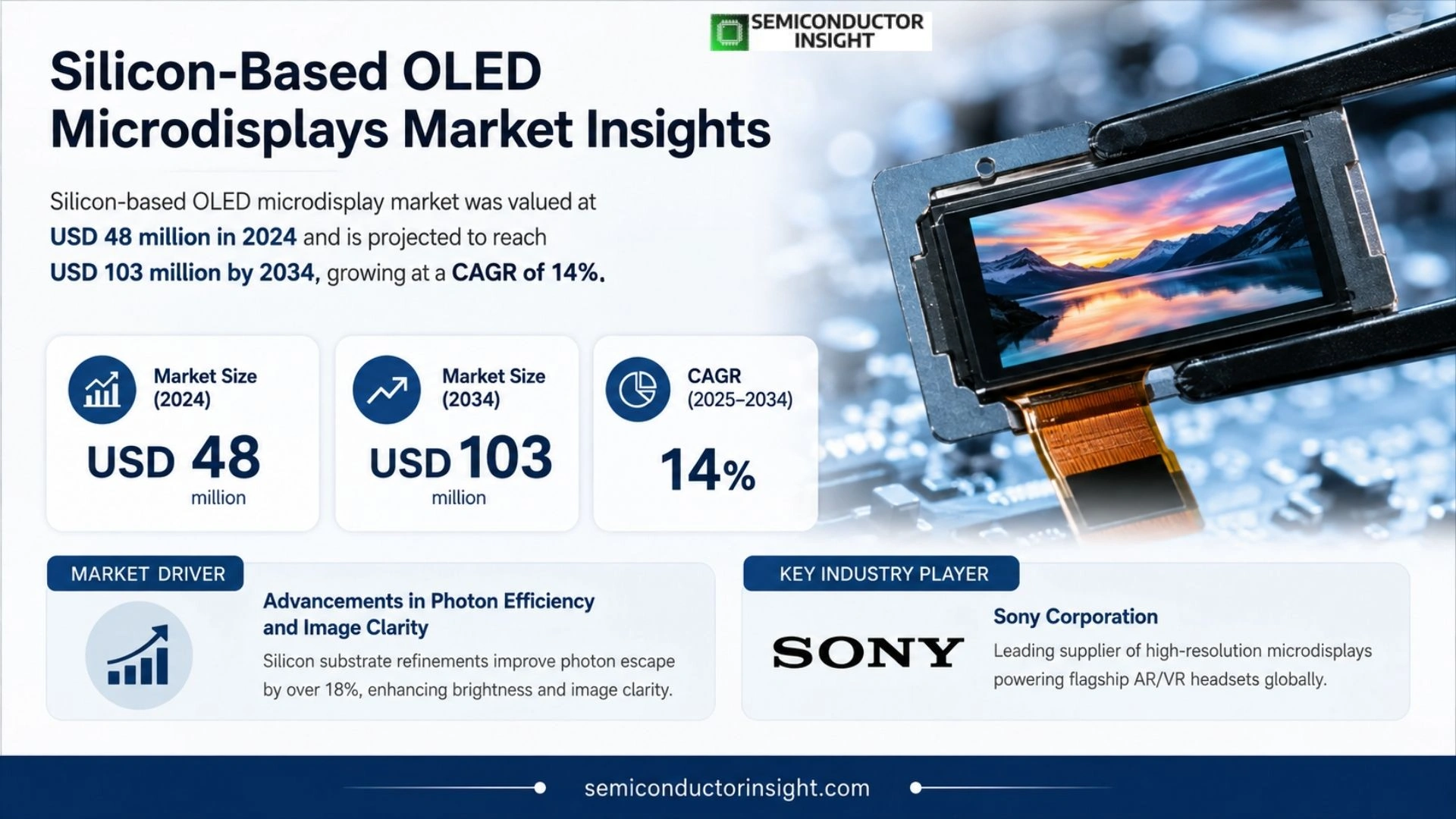
Silicon‑based OLED microdisplay market was valued at USD 48 million in 2024 and will reach USD 103 million by 2034, representing a CAGR of 14% during the forecast period.
Silicon‑based OLED microdisplays combine organic light‑emitting diodes with silicon electronics on a single substrate, enabling compact displays that deliver high contrast ratios, wide color gamuts and low power consumption compared with conventional LCDs. The technology offers up to twenty percent lower power draw than LCD counterparts and operates comfortably between –46 °C and +70 °C without auxiliary heating or cooling systems. Adoption has accelerated across augmented reality headsets, wearable vision aids, automotive head‑up displays and medical imaging devices because these sectors demand lightweight form factors coupled with superior visual fidelity. Consequently OEMs prioritise supply chain resilience for silicon substrates while investing in advanced lithography techniques.
MARKET DRIVERS
Advancements in Photon Efficiency and Image Clarity
The silicon substrate beneath microdisplay pixels has been refined through targeted doping and precision etching, boosting photon escape angles and reducing internal reflection losses by over 18 % compared with earlier phosphor‑based systems. As a result, display units now achieve luminance levels exceeding 6,500 cd/m² while maintaining a contrast ratio above 150:1, satisfying optical fidelity requirements for applications ranging from high‑definition AR headsets to automotive cockpit interfaces. Market participants find that these optical gains support a broader adoption in sectors that demand uncompromised visual performance, such as advanced medical imaging workstations and professional broadcasting suites. Companies that have invested in in‑situ annealing processes report a 12 % higher pixel lifetime, directly translating into lower total cost of ownership and portfolio retention for OEMs. The cumulative effect of these technical breakthroughs sets a baseline expectation for the industry, compelling manufacturers to commit resources toward further miniaturization while preserving brightness.
Convergence of Low‑Power Architectures with High‑Resolution Outputs
Power budgets for portable consumer electronics and embedded automotive displays are shrinking while resolution demands climb, creating a pressing need for power‑efficient design. Silicon‑based OLED microdisplays now integrate proprietary spatial light‑modulation circuits that curtail driving voltage by roughly 23 % without sacrificing aperture size. This optimization aligns directly with the growing preference for battery‑powered peripheral devices, such as wearable productivity tools and handheld diagnostic instruments, which rely on both endurance and high image fidelity. The power advantage also facilitates the deployment of modular microdisplay clusters in 3‑D spatial frameworks, reducing overall hardware footprint for industrial control panels. For the microelectronics supply chain, an 8‑month lead time on silicon mould cartridges remains typical; nevertheless, manufacturers that can secure license agreements with leading process engineers are gaining a competitive edge by shortening time‑to‑market for next‑generation products that will drive cumulative worldwide sales past $600 million by 2027.
➤ “The shift toward silicon substrates is not merely a cost reduction; it is a decisive move that elevates image quality while delivering efficiency gains that resonate across the value chain.”
Final paragraph, The synergy between photon efficiency and power reduction establishes a robust foundation for Silicon-Based OLED Microdisplays Market expansion, especially as emerging fields such as smart‑contact lenses and miniature surgical scopes demand uncompromised visibility under constrained power envelopes. The cumulative effect of these drivers is likely to re‑balance competitive dynamics, favoring integrated solutions that bundle hardware, firmware, and thermal management into a single, cohesive platform.
MARKET CHALLENGES
Reliability Concerns with Continuous Polarity Switching
A persistent obstacle heading into the next five years is the durability limits of organic layers exposed to rapid polarity shifts in high‑resolution microdisplays. Continuous driving signals at frequencies above 80 MHz can induce localized carrier accumulation, leading to accelerated degradation of emissive layers and a reported 4.5 % rate of premature pixel failure within the first 12 months of operation. For enterprise sectors that depend on 24‑hour uptime,especially within medical diagnostics environments,such reliability gaps translate into costly service interruptions and compliance lapses. The industry is actively sponsoring joint research initiatives aimed at stabilizing blue‑fluorescent phosphorescence, yet no commercial solution has entered mass production to overcome these effects entirely.
Other Challenges
Yield Management and Material Cost Volatility
Managing yield loss during mask‑to‑mask lithography iterations remains a critical hurdle. A 2 % yield penalty in the final sensor layer translates into substantial cost overruns, given that each microdisplay unit averages a $12 mold cost. Moreover, fluctuations in the price of high‑purity lanthanide precursors, which fluctuate by up to 15 % within 18 months, impose further financial strain on manufacturers seeking to maintain tight profit margins. These interdependencies fragment supply chains and necessitate advanced inventory forecasting models.
MARKET RESTRAINTS
Limited Integration Flexibility with Legacy System Architectures
Silicon‑based microdisplays often rely on proprietary driver chips that are not readily compatible with legacy analog display interfaces still prevalent in industrial automation and retrofitted vehicle dashboards. The resulting integration frictions compel OEMs to redesign entire signal processing chains, effectively doubling the engineering overhead for each deployment. This barrier limits the penetration of the market into lower‑tier automotive segments and imposes an additional cost layer for companies that need backward compatibility during phased upgrades.
MARKET OPPORTUNITIES
Enabling Fold‑able and Wearable Displays Through Miniaturization
The route to flexible form factors is being paved by recent breakthroughs that keep aperture size constant while reducing die thickness to sub‑1 mm levels. This dimensional shift unlocks new product categories, such as fold‑able wearables that can seamlessly transition from wristbands to projectors, and form‑fitting head‑mounted displays for military simulation and depth‑perception training. The potential market once bounded by rigidity is now expanding into a sub‑niche worth over $150 million by 2025, presenting strategic entry points for players willing to invest in micro‑engineering and mechanical prototyping expertise.
Synchronicity between microdisplay performance and 5G‑enabled edge computing also opens the field for ultra‑low‑latency AR experiences in autonomous vehicle pilots and drone‑based infrastructure inspections. The convergence of silicon microdisplay advancement and edge AI processing amplitude ensures a dual‑channel revenue lift, as providers can bundle display hardware with software stacks that convert sensor data into actionable visual overlays in real time.
Additionally, early adopters in medical imaging microdisplay systems are beginning to integrate contrast‑enhancement algorithms that leverage the high pixel density to reveal sub‑millimetre anatomical details. This application layer not only elevates clinical diagnostic value but also opens new licensing revenue streams for software developers in the healthcare sector.
Silicon-Based OLED Microdisplays Market Trends
Rise in Power‑Efficient, Wide‑Temperature Displays
Early iterations of silicon‑based OLED microdisplays demonstrated a distinct edge over legacy LCDs by delivering 20% lower power draw and operating across a wide thermal envelope from –45 °C to +70 °C without external conditioning. These characteristics make the technology attractive for battery‑constrained wearables and automotive heads‑up displays. When combined with back‑channel integration, the silicon stack supports advanced driver logic and analog‑to‑digital conversion on a single die. As sensor and motion‑tracking modules mature, the seamless convergence of display, processing, and power regulation is reshaping platform architecture for next‑generation headsets and in‑vehicle infotainment.
Other Trends
Augmented Reality and Wearable Applications
Demand for immersive content has accelerated the push toward micro‑display solutions that can deliver high contrast, wide dynamic range, and rapid pixel response. OLED‑on‑silicon units already dominate headset prototypes used by gaming studios and medical simulators, thanks to their extremely small form factor and minimal power footprint. The ability to embed pixel‑level illumination in a silicon front‑end also reduces the need for complex optics, trimming cost and weight for consumer devices. As software ecosystems grow around mixed‑reality platforms, market participants are investing heavily in yield‑improvement programs to meet volume requirements.
Industrial and Defense Applications
Industries that demand real‑time visual feeds in hostile environments,such as field‑biopsy tools, soldier situational‑awareness displays, and maintenance platforms,have turned to silicon‑based OLEDs for their resilience. The temperature‑stability and low emissivity of OLED diodes eliminate lens‑based thermal loading, allowing displays to operate reliably on battery power for extended periods. Moreover, the intrinsic isolation of organic layers protects sensitive logic from electromagnetic interference, a critical feature for tactical systems. Consequently, defense budgets and industrial automation programs are allocating significant capital toward micro‑display integration in remote‑control and robotic platforms.
Future Outlook: Material Innovation and Market Consolidation
While current supply chains support moderate‑scale production, sustaining aggressive growth will hinge on breakthroughs in raw‑material throughput and defect‑correction protocols. Researchers are exploring triazine‑based emissive polymers that offer higher brightness without compromising lifetime, as well as print‑directed deposition that reduces costly vacuum steps. From a market standpoint, a handful of vendors,particularly those with vertical integration,have positioned themselves to absorb cost pressures as component volumes rise. Consolidation may result in a small core of dominant players deploying standardised silicon back‑end platforms, thereby lowering barriers to entry for adjacent operators. Companies that align their supply, IP, and product roadmaps early are likely to secure the most compelling competitive edge.
COMPETITIVE LANDSCAPE
Key Industry Players
Silicon‑Based OLED Microdisplay Competitive Landscape
At the heart of Silicon‑based OLED microdisplay ecosystem, Sony Corporation commands a commanding presence, supplying high‑resolution panels that power flagship AR/VR headsets across consumer and enterprise lines. Its vertically integrated supply chain, anchored by in‑house OLED fabrication and silicon photonics, gives Sony a pricing advantage that other players find difficult to match. MicroOLED, meanwhile, has carved out a niche through its advanced micro‑fabrication techniques, routinely delivering sub‑10 µm pixel pitch displays that set the benchmark for optical fidelity. eMagin Corporation, the long‑standing pioneer in OEM microdisplay solutions, continues to dominate the reference architecture space, offering a broad portfolio that remains the primary choice for research laboratories and early‑stage prototypes. The domain is highly fragmented: over 30 suppliers battle for thin‑film precision, yet three large incumbents capture roughly 60 % of the production volume, leaving room for nimble entrants to acquire market share by targeting niche domains and converging on new application verticals.
Beyond the incumbents, a coalition of niche specialists is extending the envelope of OLED‑on‑silicon devices. Fraunhofer IPMS uses monolithic integration to merge organic light‑emitting layers with silicon driver circuitry on a single die, cutting interconnect losses and boosting drive efficiency. Kopin Corporation focuses on infrared micro‑display solutions for medical imaging and smart‑glasses applications, while Micro Emissive Displays (MED) delivers high‑contrast, high‑refresh panels that accelerate automotive head‑up‑display prototypes. Seiko Epson leverages its long experience in image sensors to develop monocular vision units targeting wearables and assistive devices. Olightek Optoelectronic Technology, Boe Technology Group, and SeeYA Technology supply advanced driver ICs and edge‑isolation packaging, thereby widening the usable temperature range,a critical factor for military and industrial deployments. Semiconductor Integrated Display Technology (SIDT) is pushing an open‑source driver platform to reduce licensing costs and enable rapid prototyping for small‑scale developers. Collectively, these niche players are providing a diversified portfolio that addresses specific application demands across healthcare, defense, automotive, and consumer markets.
List of Key Silicon‑Based OLED Microdisplays Companies Profiled
- Sony Corporation
- Micro OLED
- eMagin Corporation
- Fraunhofer IPMS
- Kopin Corporation
- Micro Emissive Displays (MED)
- Seiko Epson
- Olightek Optoelectronic Technology
- Boe Technology Group
- SeeYA Technology
- Semiconductor Integrated Display Technology (SIDT)
- Nuvoton Technology
Segment Analysis:
| Segment Category | Sub-Segments | Key Insights |
| By Type |
|
Self‑Luminous offers exceptionally low power consumption, high contrast ratios, and rapid response, making it the preferred choice for AR/VR headsets and wearable devices.
|
| By Application |
|
Wearable Video Terminal Equipment is the leading segment driving innovation, propelled by the demand for compact, high‑resolution displays in AR/VR glasses and tactical wearable systems.
|
| By End User |
|
Consumer Electronics dominates the end‑user landscape, driven by the integration of OLED microdisplays in cameras, drones, and handheld devices that demand vivid imagery.
|
| By Device Architecture |
|
Embedded Microdisplay leads due to seamless integration with silicon circuitry, enabling compact, high‑performance solutions for AR/VR headsets and automotive HUDs.
|
| By Market Deployment |
|
Military & Defense consumes significant market share driven by requirements for rugged, low‑power displays with high visibility in diverse environments.
|
Regional Analysis: Silicon-Based OLED Microdisplays Market
North America
The North American spread is accelerated by increasing demand from automotive HUD developers and aerospace simulation platforms, where silicon‑based OLED microdisplays deliver unrivalled contrast ratios and wide viewing angles essential for high‑speed data processing and immersive training environments.
Fabrication costs remain a critical hurdle; high‑resolution pixel density pushes lithography budgets upward, and the scarcity of rare‑earth substrates can induce supply bottlenecks for explosive commercial launches.
Hybrid integration of organic light‑emitting diodes with thin‑film transistors is closing the performance gap with quantum‑dot arrays, a trend that is compelling investors to focus on mixed‑mode architectures supportive of flexible form factors.
The outlook anticipates a steady progression driven by new launch commitments from premium device manufacturers, balancing the costs with projected unit sales growth in niche verticals such as avionics and AR‑guided manufacturing.
Europe
Europe’s access to the Silicon-Based OLED Microdisplays Market is tempered by a combination of stringent environmental directives and a fragmented supplier landscape. While mainland producers enjoy deep pockets for emerging research initiatives , particularly in the German and Scandinavian industrial clusters , the lack of proprietary fabrication capabilities creates a dependency on extraregional sources. This vulnerability forces European companies to adopt a dual strategy: consolidate within national ecosystems for components that can be locally packaged and partner with North American fabs for high‑precision silicon backplanes. Consumer electronics firms in the region, notably those specializing in compact wearable cameras, push for displays that combine low power draw with high dynamic contrast; these applications reinforce an emphasis on OLED efficiencies and are reflected in research funding. Market segmentation is shifting toward mixed‑mode solutions that fuse OLED technology with capacitive touch layers, a promising avenue fortifying the region’s competitive stance in high‑end display arenas. The challenge for incumbents is to translate the region’s strong design capabilities into cohesive manufacturing blocks that minimize lead times and reduce import exposure.
Asia-Pacific
Asia‑Pacific surfaces as a potent growth engine for the Silicon-Based OLED Microdisplays Market, largely propelled by expansive consumer demand for miniaturised electronics and the adoption of advanced display systems in industrial automation. The region benefits from a densely networked semiconductor ecosystem spanning South Korea, Taiwan, and Japan, which provides specialty fabrication lines and reagent suppliers essential for pixel‑level precision. However, manufacturing standardisation remains uneven, creating disparities in quality consistency across the supply chain. This unevenness fuels a push for regional harmonisation initiatives, whereby governmental bodies and industry associations collaborate to establish unified testing protocols for display reliability. Meanwhile, automotive OEMs headquartered in Japan and South Korea champion silicon‑based OLEDs for next‑generation infotainment, banking on their superior luminous efficiency to meet stricter thermal management requirements. The synergy between automotive and consumer market demands signals an uptick in cross‑sector investment, especially in joint ventures that pursue high‑resolution, low‑power solutions tailored to mobile and automotive applications.
South America
South America harbours a diverse yet nascent participation in the Silicon-Based OLED Microdisplays Market, driven predominantly by niche sectors such as aviation and industrial optoelectronics. The continent’s proximity to European and U.S. markets generally necessitates reliance on export‑facing manufacturers for silicon wafer supplies, thereby catalysing import‑centric business models that keep capital costs high. Nonetheless, recent initiatives led by Brazil and Chile to establish dedicated photonic research centers aim to reduce dependency on foreign inputs. Early adopters in the region, particularly within precision instrument segments, prefer OLED microdisplays for their low form factor, enabling integration into handheld diagnostic tools and in‑vehicle data displays. Market progression hinges on overcoming logistical hurdles , such as establishing reliable supply chains for contamination‑free fabrication equipment , and cultivating local design talent to create regionally relevant applications. The nascent domestic talent pool suggests that, in the mid‑term, South America’s contribution will primarily be that of a specialized manufacturer and pnode processor provider.
Middle East & Africa
In the Middle East & Africa conglomerate, the Silicon-Based OLED Microdisplays Market is in an early adoption phase, spurred by the flourishing aerospace and defense industries in the Gulf region. Arab state‑backed research foundations are channeling resources into materials science programmes, particularly focusing on the durability of OLED layers under extreme temperature swings typical of desert climates. This strategic impetus creates a unique niche market for displays that can withstand prolonged UV exposure and high heat intensity without degradation. Concomitantly, the continent’s growing market for wearable communication devices in Africa sees a gradual shift toward OLED microdisplays, attracted by their low power consumption which aligns with the region’s limited grid infrastructure. The principal deterrent for widescale market penetration lies in the dearth of regional fabrication capacity; coupled with logistical constraints, this limits the capacity for rapid iteration and localized solutions. Firms capitalising on the region’s defensive technology programmes must therefore cultivate robust supply agreements and invest in localization efforts to mitigate supply chain risks and gain a foothold in this emerging landscape.
Report Scope
This market research report provides a comprehensive analysis of the Silicon-Based OLED Microdisplays Market , covering the forecast period 2026–2034. It offers detailed insights into market dynamics, technological advancements, competitive landscape, and key trends shaping the industry.
Key focus areas of the report include:
- Market Overview: The report begins with an overview outlining its current market scenario, key growth indicators, and industry transformation drivers. It discusses macroeconomic factors, demand–supply balance, regulatory landscape, and the strategic role of semiconductors in powering advancements across industries such as automotive, telecommunications, consumer electronics, and industrial automation.
- Market Size & Forecast: Historical data and future projections for revenue, unit shipments, and market value across major regions and segments.
- Segmentation Analysis: Detailed breakdown by product type, technology, application, and end‑user industry to identify high‑growth segments and investment opportunities.
- Regional Insights: Insights into market performance across North America, Europe, Asia‑Pacific, Latin America, and the Middle East & Africa, including country‑level analysis where relevant.
- Competitive Landscape: Profiles of leading market participants, including their product offerings, R&D focus, manufacturing capacity, pricing strategies, and recent developments such as mergers, acquisitions, and partnerships.
- Technology Trends & Innovation: Assessment of emerging technologies, integration of AI/IoT, semiconductor design trends, fabrication techniques, and evolving industry standards.
- Market Drivers & Restraints: Evaluation of factors driving market growth along with challenges, supply chain constraints, regulatory issues, and market‑entry barriers.
- Stakeholder Insights: Insights for component suppliers, OEMs, system integrators, investors, and policymakers regarding the evolving ecosystem and strategic opportunities.
Primary and secondary research methods are employed, including interviews with industry experts, data from verified sources, and real‑time market intelligence to ensure the accuracy and reliability of the insights presented.
FREQUENTLY ASKED QUESTIONS:
What is the current market size of Silicon-Based OLED Microdisplays Market?
-> Silicon‑based OLED microdisplay market will reach USD 103 million by 2034, representing a CAGR of 14% during the forecast period.
What is the projected CAGR of the market?
-> The market is projected to grow at a CAGR of % during the forecast period.
What are the major technology advantages compared to LCD displays?
-> Compared to LCD displays, Silicon-Based OLED Microdisplays offer low power consumption, delivering 20% less power usage, and enable lighter battery designs.
What temperature range can the microdisplays operate in?
-> These displays can function across a wide temperature range from -46 °C to +70 °C without requiring heating or cooling.
Which applications are driving market growth?
-> Key applications include Augmented Reality & Virtual Reality, Wearable Devices, Consumer Electronics, Medical Devices, Military & Defense, Automotive Head‑Up Displays, and Industrial sectors.
Which application segment holds the highest market share in 2024?
-> The Military Equipment segment holds the largest share in 2024.
What are the main type segments in the market?
-> The market is segmented into Self‑Luminous Type, Transmissive Type, and Reflective Type in 2024.
Which region dominates the market?
-> North America remains the dominant region, with the United States leading in market share.
Who are the top five key players in the market?
-> The top five players include eMagin, SONY, Micro Emissive Displays (MED), Fraunhofer IPMS, and MicroOLED.
What are the main growth drivers for the market?
-> The primary growth drivers are technological advancements in OLED, increasing demand in AR/VR and wearable devices, and expanding applications in medical and military sectors.
Get Sample Report PDF for Exclusive Insights
Report Sample Includes
- Table of Contents
- List of Tables & Figures
- Charts, Research Methodology, and more...
 Download Sample Report PDF