Server Cooling Fans Market Insights
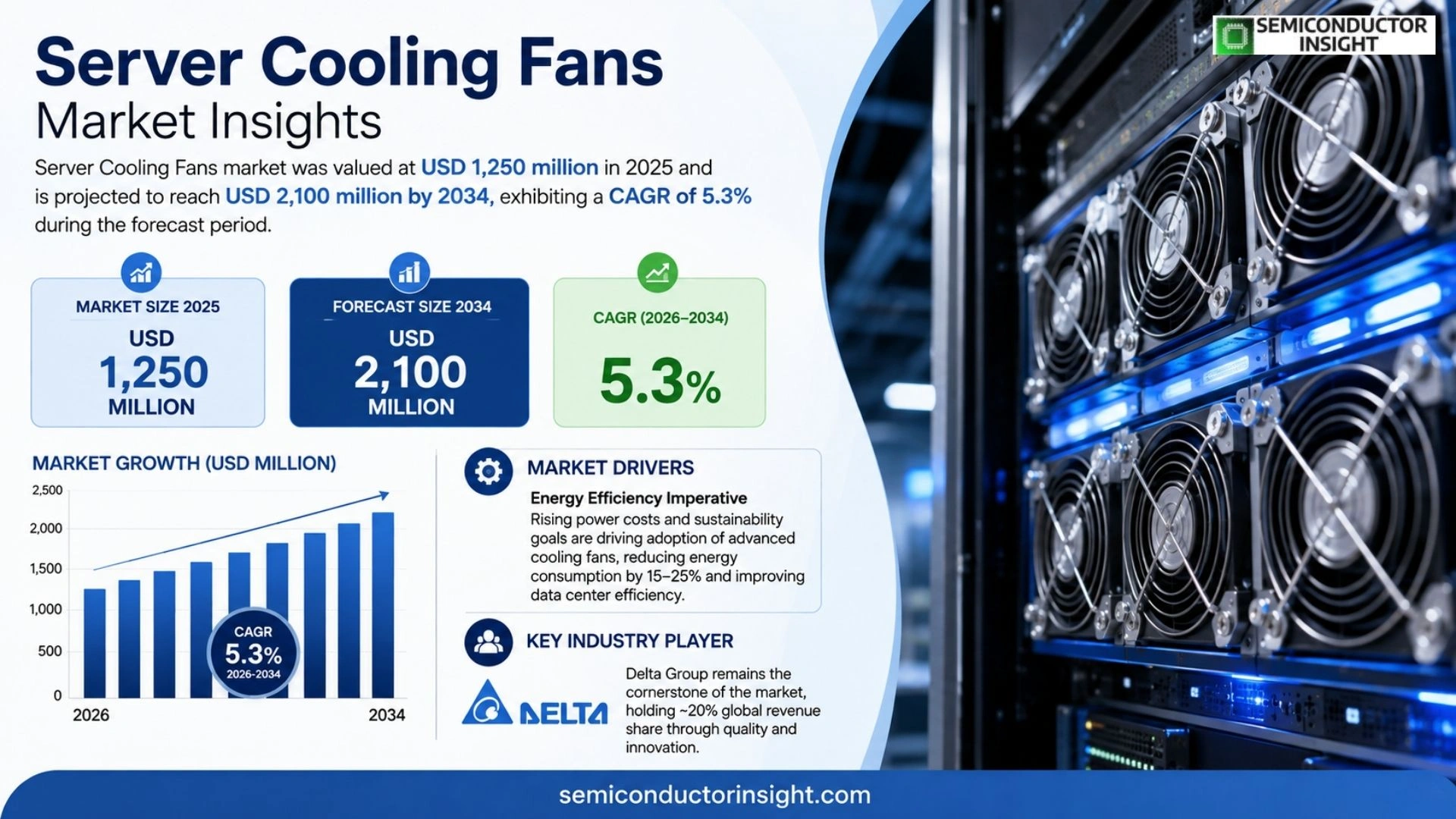
Server Cooling Fans market was valued at USD 1,250 million in 2025 and is projected to reach USD 2,100 million by 2034, exhibiting a CAGR of 5.3% during the forecast period.
Server cooling fans are high‑performance axial or centrifugal devices engineered to expel heat generated by servers within data centres, maintaining optimal operating temperatures and enhancing system reliability.
The sector gains momentum from increasing deployment of high‑density computing infrastructures, tightening energy‑efficiency standards such as EU Energy Labeling directives, and the rapid expansion of edge computing nodes that demand robust thermal management solutions.
MARKET DRIVERS
Energy Efficiency Imperative
The escalating cost of power and rising electricity tariffs have forced enterprises to prioritize thermal management in their data center operations. Server cooling fans have become a point of focus because they are one of the most cost‑effective means of reducing overall energy consumption. When measured in kWh per watt of computational capacity, optimized fan configurations can cut cooling overhead by 15–25 %. This not only improves the return on investment for existing infrastructure but also aligns with corporate sustainability mandates that increasingly demand measurable carbon footprints. The adoption of high‑frequency, variable‑speed fans allows data center operators to balance airflow against computational load, increasing fan efficiency by up to 30 % during low‑usage periods. Such operational gains translate directly into thinner margins and profit‑boosting opportunitites for manufacturers that can deliver fans with high static pressure and low power draw.
Data Center Thermal Constraints
Modern server racks, especially those employing dense blade configurations, present an intricate network of hot spots that standard cooling solutions struggle to address. The rise of artificial intelligence, high‑performance computing, and 5G edge nodes has pushed thermal densities beyond 2 kW per rack in certain facilities, surpassing the capabilities of conventional axial fans. As a result, server cooling fans have been redesigned to provide higher static pressure and improved airflow patterns while maintaining a compact form factor. Vendors which integrate active thermal sensors and PWM control into the fan architecture provide real‑time adjustment capabilities that correlate directly with workload fluctuations, thereby reducing heat transfer losses and hot‑spot formation. These advances address an immediate operational challenge that, if left unmanaged, could lead to premature hardware failure and increased mean‑time‑to‑repair metrics.
➤ Server cooling fan investments directly influence a data center’s power usage effectiveness (PUE), driving improvements that can shift operational expenditures from 12 % to 7 % of total IT costs under optimal fan configurations.
On the supply side, the impetus for deploying advanced fans is amplified by tight equipment budgets and the need for rapid rollout of cooling solutions. Manufacturers that provide modular fan units compatible with legacy chassis designs can tap into a market segment that prefers incremental upgrades over complete platform replacement. Additionally, the proliferation of smart fan technologies that can integrate with building management systems opens new revenue streams into facility‑wide IoT ecosystems, thus expanding the market beyond pure fan sales. In sum, the confluence of cost pressure, operational demands, and regulatory expectations converges to form a clear and actionable incentive for data center operators to modernize their cooling fan portfolio.
MARKET CHALLENGES
Supply Chain Volatility
Global silicon shortages and the consolidation of semiconductor foundries have introduced variable lead times and price spikes for fan motors. This has complicated procurement cycles for manufacturers and delayed deployment schedules for data center purchasers. The dependence on a limited pool of component suppliers also constrains the ability to rapidly incorporate new materials or designs into production lines, slowing innovation turnover. For end users, the abrupt cost fluctuations can jeopardize budget adherence, forcing the postponement of cooling upgrades that potentially expose systems to thermal risk.
Other Challenges
Noise Footprint
While fans are becoming quieter, the regulatory pressure on acoustic performance in corporate and community environments persists. Achieving ultra‑low noise levels requires premium materials or active noise cancellation, which marginally inflates unit cost and complexifies the design envelope.
Compliance Barriers
A spectrum of regional standards,ranging from ISO 9001 certification for quality management to UL and CE for electrical safety,requires each fan iteration to undergo extensive testing. The certification cycle can take 6–12 months, stalling market entry and eroding competitive advantage for smaller players who lack in‑house testing facilities.
MARKET RESTRAINTS
Capital Expense Hurdles
Initial capital outlays for deploying high‑performance server cooling fans in large‑scale data centers remain substantially high. In many regions, the upfront cost of integrating high‑pressure fans together with necessary ducting, ventilation, and control systems can exceed 30 % of the total infrastructure budget. Financing structures often favor long‑term energy savings rather than short‑term CAPEX, making it challenging for some operators to justify large initial investments when competing demands vie for limited funding. Moreover, the lack of standardized metrics to assess long‑term fan reliability has historically weakened the perceived return on investment, cementing a reservation among risk‑averse organizations that prefer proven, albeit less efficient, legacy solutions.
MARKET OPPORTUNITIES
Integration with Predictive Maintenance Platforms
Data center operators are increasingly adopting AI‑driven predictive maintenance frameworks that flag component degradation before failure occurs. Server cooling fans equipped with built‑in vibration sensors, temperature probes, and firmware that can transmit operational metrics to central analytics platforms present an attractive value proposition. Manufacturers that embed these capabilities can command premium pricing while offering a service layer that extends beyond the physical product. The convergence of fan technology with software analytics also provides an avenue to create subscription‑based firmware update services, turning a traditionally one‑off hardware purchase into a recurring revenue stream.
Another promising avenue lies in the expanding domain of edge computing. Constrained spaces and limited power budgets in edge sites demand ultra‑compact, high‑static‑pressure fans that can operate at low velocities while maintaining thermal performance. This niche diverges from the bulk of the data center segment, allowing manufacturers to differentiate through specialized design patents. The proliferation of 5G infrastructure projects worldwide, coupled with the expected rise in decentralized data processing, positions edge servers as a high‑growth frontier for fan manufacturers who cultivate lightweight, low‑noise solutions.
Server Cooling Fans Market Trends
Rise in Energy‑Efficient Fan Adoption
Data center operators are confronting escalating power costs and tightening carbon‑emission mandates, which are reshaping the lens through which cooling equipment is evaluated. Server Cooling Fans Market is now judged largely on a fan’s ability to deliver high airflow at the lowest possible electrical input. As a result, manufacturers are prioritising high‑efficiency brushless DC designs, ultra‑low‑noise motors and tighter aerodynamic tolerances, all of which translate into a reduction of per‑server cooling power consumption by up to 30 % relative to legacy units. This shift is further reinforced by utility incentives tied to cooling performance metrics, encouraging procurement decisions that favour the most efficient fan solutions available.
Other Trends
Shift Toward Axial and Hybrid Fan Designs
Analysing fan geometry, axial configurations have overtaken centrifugal options in many tier‑3 and tier‑4 data centers. The lightweight profile of axial units reduces rack depth penetration, providing operators with more flexible placement options while maintaining comparable pressure head performance. Manufacturers are now also embracing hybrid designs that merge axial airflow delivery with centrifugal pressure stages, striking a balance between volumetric flow and static pressure. This evolution serves a dual purpose: it permits scaling of fan throughput without compromising on airflow density, and it mitigates the need for ancillary pressure‑boosting components that often dominate cost structures in traditional centrifugal systems.
Integration of Predictive Analytics and Sensor Controls
Concurrent developments in sensor‑based control and predictive analytics are enabling dynamic modulation of fan speed in real time, thereby tightening the thermal envelope of server racks. This trend further amplifies the benefits of energy‑efficient fans, as instantaneous demand‑driven throttling eliminates wasteful idling. The result is a sharper return on investment for facilities that invest early in fan technologies that can seamlessly integrate with management software, a factor that heavily influences procurement cycles in Server Cooling Fans Market.
For fan manufacturers, the convergence of greener mandates and smarter infrastructure demands an accelerated product roadmap that incorporates tighter noise budgets, lower current draw and greener materials. Companies that adopt modular platforms can re‑configure fan assemblies for different rack configurations without redesigning the core motor, shortening time‑to‑market. Investment in closed‑loop monitoring systems also offers a competitive edge; by feeding real‑time energy consumption data back to orchestration tools, operators can validate the promised efficiency gains. Consequently, firms that combine aerodynamic innovation with software‑enabled velocity control will find themselves at the forefront of Server Cooling Fans Market, commanding premium pricing and securing long‑term contracts in high‑performance data acquisition facilities.
COMPETITIVE LANDSCAPE
Key Industry Players
Server Cooling Fans Market Competitive Landscape
Delta Group remains the cornerstone of Server Cooling fans sector, commanding roughly a twentieth of global revenue through superior product quality and sustained R&D investment. Its focus on developing ultra‑quiet axial fans with low power consumption has aligned intimately with the tightening thermal budgets of modern high‑density data centres. By bundling proprietary fan controls and predictive maintenance software, Delta has secured long‑term contracts with key Tier‑1 cloud operators, effectively locking in significant market share as cooling demands grow.
Beyond Delta, a cohort of niche manufacturers has carved out distinct market niches. NMB and SUNON excel in high‑airflow centrifugal solutions, capturing demand in enterprise rack and blade server environments where airflow rates exceed 10 CFM per unit. Nidec and Sanyo Denki target specialized industrial data halls, offering fans with built‑in airflow monitoring that reduce operator intervention. ADDA and AVC specialize in extreme‑temperature deployments, producing fans rated for operating ranges of –40 °C to +85 °C, a segment that is expanding with edge‑computing hubs situated in harsh climates. Parallelly, Delta Electronics, Arima, and Shiying provide cost‑effective fan arrays suited to small‑to‑medium‑sized providers, while Jidong and ZhuaFan focus on low‑noise solutions for open‑frame server quiet zones. Together, this fragmented landscape creates competitive pressure for continuous innovation and pricing discipline.
List of Key Server Cooling Fans Companies Profiled
- Delta Group
- Delta Group
- SUNON
- Nidec Corporation
- Sanyo Denki
- ADDA
- AVC
- Delta Electronics
- Arima
- Shiying
- Jidong
- ZhuaFan
- Deltagroup.com (link)
Segment Analysis:
| Segment Category | Sub-Segments | Key Insights |
| By Type |
|
Axial Fans provide high static pressure suitable for dense rack installations and are favored for their low noise. – Often integrated into modular blade servers to maintain uniform airflow. – Require less maintenance due to fewer moving parts. – Emerging designs focus on energy efficiency and compact form factors. |
| By Application |
|
Rack Server dominates the data-center landscape due to its scalability and ease of maintenance. – Requires high airflow capacity to manage thermal loads of consolidated workloads. – Cooling solutions aim to balance performance with cost of operation. – Newer fan technologies focus on minimal vibration and enhanced reliability. |
| By End User |
|
Cloud Service Providers prioritize energy efficiency and system uptime. – Select fans with certified low acoustic signatures to meet regulatory standards. – Incorporate predictive maintenance tools in fan selection. – Favor supply chains that guarantee timely component availability. |
| By Installation Configuration |
|
Modular Fan Array offers flexible expansion and targeted cooling paths. – Enables precise temperature control across server racks. – Supports hot-swapping for zero‑downtime maintenance. – Reduces overall AC power consumption through efficient airflow distribution. |
| By Service Model |
|
Managed Cooling Solutions combine fan hardware with monitoring software for predictive cooling management. – Provide clients with visibility into temperature trends and failure risks. – Reduce operational costs through optimized fan speed control. – Enhance system reliability by integrating redundancy strategies. |
Regional Analysis: Server Cooling Fans Market
North America
The proliferation of hyperscale data centers escalates demand for high‑capacity fans that maintain optimal airflow while mitigating noise. Competition among cloud providers turns modest efficiency gains into sizable cost reductions. Accordingly, planners prioritize fan configurations that lower power usage effectiveness by 5‑10%, making performance gains financially attractive.
Fiber‑reinforced composite fans offer superior vibration damping and low‑vibration noise. Programmable speed governors tie fan output to real‑time temperature gradients, preserving lifespan while ensuring thermal stability. Larger airflow volumes become viable, allowing operators to scale capacity without expanding physical footprint.
Key domestic players such as Delta Electronics and Pearson Power secure alliances with major server OEMs, embedding fan modules into reference designs. Their modular approach enables retrofitting of legacy racks, extending capital utilisation and reducing time‑to‑value.
U.S. federal energy conservation mandates, combined with state noise‑level regulations, drive vendors to devise fans that comply with spectral emission limits. NEMA and UL 1741 certifications give purchasers confidence and allow suppliers to differentiate compliant offerings.
Europe
The European server cooling fans market is driven by stringent environmental directives and a demanding focus on circularity. Regulators are mandating lower power consumption and extended product lifecycles, which pushes data centres toward fans that integrate ventilation and heat recovery. The EU’s net‑zero by 2050 agenda fuels investment in renewable‑powered cooling, encouraging low‑vibration, high‑efficiency solutions. Green credit schemes and ESG‑compliant funds push enterprises toward suppliers offering robust thermal monitoring. With the rapid deployment of 5G infrastructure, the need for heat management at base‐station sites is accelerating, opening a new niche for fan manufacturers to capture energy‑efficient deployments across the continent.
Asia‑Pacific
The Asia‑Pacific region presents a mixed landscape where emerging markets spur growth while Japan and South Korea invest heavily in energy‑efficient data centre infrastructure. Aging data‑centre stock prompts operators to retrofit older racks with fans that deliver higher airflow and lower acoustic signatures. Governments tighten carbon disclosure requirements, compelling firms to adopt solutions that reduce facility PUE. The region’s surge in cloud capacity, especially in electrical‑power‑dense nations, amplifies demand for fans that manage thermal loads in high‑humidity environments. Local manufacturers leverage low‑cost production to supply custom fan kits, enabling rapid deployment in mega‑city data centres. Collaborative R&D between municipalities and tech firms explores AI‑driven optimisation, positioning the region as an early adopter of next‑generation cooling algorithms.
South America
South America’s server cooling fans market is in an upgrade phase, driven by expanding cloud services and a surge in cloud‑managed hosting. Brazil and Argentina,key digital hubs,prioritize fan technologies that mitigate heat in HVAC‑limited environments. Emerging energy‑efficiency standards motivate a shift from conventional axial fans to hybrid solutions featuring variable speed control and acoustic dampening. High electricity tariffs in the region incentivise operators to use fans with lower per‑cfm power draw, trimming long‑term operating costs. Supply chain volatility and limited domestic manufacturing keep many firms dependent on imports, affecting price stability. Nevertheless, growing awareness of sustainable operations spurs early adoption of fans meeting rigorous environmental benchmarks.
Middle East & Africa
The Middle East and Africa market confronts extreme ambient temperatures and limited cooling infrastructure. To comply with international reliability standards, firms deploy fan assemblies with high‑displacement technology and robust bearing designs that endure heat spikes. Power instability promotes financial models that favour lower upfront capital, making modular, energy‑efficient fans appealing. Government digital‑transformation initiatives for smart cities inject capital into state‑owned data centres, demanding fan solutions combining low acoustic output with high airflow rates. In Africa, unreliable grid power drives operators toward fans that support staggered load profiles and integrate with backup generators. These utilitarian priorities could anchor long‑term demand for fan solutions that deliver proven thermal resilience without compromising cost‑effectiveness.
Report Scope
This market research report provides a comprehensive analysis of the Server Cooling Fans Market , covering the forecast period 2026–2034. It offers detailed insights into market dynamics, technological advancements, competitive landscape, and key trends shaping the industry.
Key focus areas of the report include:
- Market Overview: The report begins with an overview outlining its current market scenario, key growth indicators, and industry transformation drivers. It discusses macroeconomic factors, demand–supply balance, regulatory landscape, and the strategic role of semiconductors in powering advancements across industries such as automotive, telecommunications, consumer electronics, and industrial automation.
- Market Size & Forecast: Historical data and future projections for revenue, unit shipments, and market value across major regions and segments.
- Segmentation Analysis: Detailed breakdown by product type, technology, application, and end-user industry to identify high-growth segments and investment opportunities.
- Regional Insights: Insights into market performance across North America, Europe, Asia-Pacific, Latin America, and the Middle East & Africa, including country-level analysis where relevant.
- Competitive Landscape: Profiles of leading market participants, including their product offerings, R&D focus, manufacturing capacity, pricing strategies, and recent developments such as mergers, acquisitions, and partnerships.
- Technology Trends & Innovation: Assessment of emerging technologies, integration of AI/IoT, semiconductor design trends, fabrication techniques, and evolving industry standards.
- Market Drivers & Restraints: Evaluation of factors driving market growth along with challenges, supply chain constraints, regulatory issues, and market-entry barriers.
- Stakeholder Insights: Insights for component suppliers, OEMs, system integrators, investors, and policymakers regarding the evolving ecosystem and strategic opportunities.
Primary and secondary research methods are employed, including interviews with industry experts, data from verified sources, and real-time market intelligence to ensure the accuracy and reliability of the insights presented.
FREQUENTLY ASKED QUESTIONS:
What is the current market size of Server Cooling Fans Market?
-> Server Cooling Fans market is projected to reach USD 2,100 million by 2034, exhibiting a CAGR of 5.3% during the forecast period.
Which key companies operate in Server Cooling Fans Market?
-> Key players include Delta Group, NMB, SUNON, Nidec Corporation, Sanyo Denki, ADDA, AVC, and other leading manufacturers.
What are the key growth drivers?
-> Key growth drivers include expanding data center demand, high‑throughput computing needs, increased focus on energy efficiency, and the rise of edge computing ecosystems.
Which region dominates the market?
-> North America remains the dominant region, driven by large data center deployments and strong investment in cooling technologies, with China also representing a rapidly growing market.
What are the emerging trends?
-> Emerging trends include high‑efficiency axial fan design, variable‑speed operation, integration of IoT sensor monitoring, and adoption of IoT‑enabled predictive maintenance solutions in server environments.
Get Sample Report PDF for Exclusive Insights
Report Sample Includes
- Table of Contents
- List of Tables & Figures
- Charts, Research Methodology, and more...
 Download Sample Report PDF