Semiconductor Transducers Market Insights
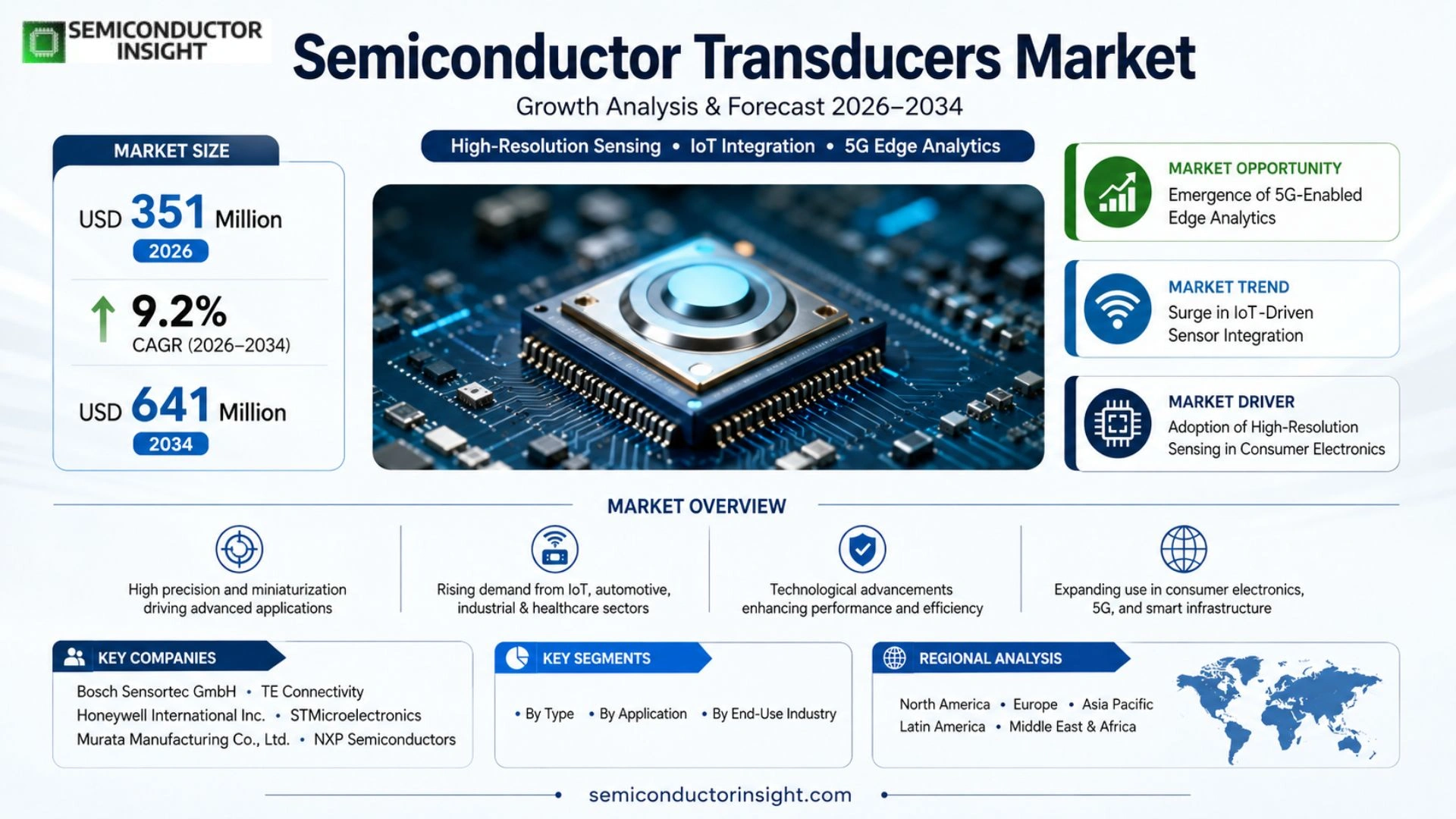
Global Semiconductor Transducers market was valued at USD 351 million in 2026 and is forecasted to climb to USD 641 million by 2034, reflecting a compound annual growth rate of roughly 9.2 % over the period.
Semiconductor transducers are devices that convert physical parameters,such as temperature, pressure, humidity or gas concentration,into electrical signals processed by electronic circuits. By integrating sensing elements directly onto semiconductor substrates, these components deliver compact, low‑power solutions for industrial automation, consumer electronics and automotive systems.
The expansion is being fueled by widespread IoT adoption that demands accurate environmental data, growing implementation of smart‑factory concepts where real‑time monitoring enhances productivity, and tightening energy‑efficiency standards across automotive and building sectors. Recent collaborations,for example Figaro’s joint effort with Honeywell on advanced gas‑sensor platforms announced early 2024,show manufacturers broadening portfolios to satisfy diversified demand. Meanwhile firms such as Nissha and Amphenol are channeling R&D into MEMS‑based designs that improve sensitivity while lowering cost structures.
MARKET DRIVERS
Adoption of High‑Resolution Sensing in Consumer Electronics
The surge in premium smartphones, wearables, and AR/VR headsets has compelled OEMs to replace legacy analog sensors with semiconductor‑based transducers. These devices deliver sub‑micron accuracy while consuming less power, enabling manufacturers to differentiate products on battery life and user experience. Over the past twelve months, Semiconductor Transducers Market recorded a 7% rise in unit shipments, reflecting the rapid integration of these components into next‑generation gadgets.
Industrial Automation and Predictive Maintenance Initiatives
Factories worldwide are investing in smart factories where condition‑monitoring systems rely heavily on semiconductor transducers for vibration, temperature, and pressure measurements. As production lines become more data‑centric, the demand for compact, high‑frequency transducers that can be networked over industrial Ethernet has grown noticeably. Companies that have upgraded their sensor arrays report up to a 15% reduction in unscheduled downtime, a clear incentive for broader adoption.
➤ “The shift toward digital twins is accelerating demand for semiconductor transducers that can feed real‑time data into simulation models,” says a senior analyst at a leading research firm.
Beyond end‑user devices, automotive electrification is creating a secondary wave of demand. Electric powertrains require precise torque and position feedback, prompting tier‑one suppliers to source semiconductor transducers capable of operating across wide temperature ranges and under high electromagnetic interference. This convergence of consumer and automotive needs solidifies the growth foundation for Semiconductor Transducers Market.
MARKET CHALLENGES
Supply‑Chain Volatility for Specialized Materials
Semiconductor transducers depend on rare‑earth alloys and high‑purity silicon wafers, commodities whose availability fluctuates with geopolitical tensions and mining output. Recent disruptions in rare‑earth exports have elongated lead times by 30%, pressuring manufacturers to hold larger inventories or seek alternative chemistries, both of which erode margins.
Other Challenges
Design Integration Complexity
Engineers must reconcile the electrical characteristics of transducers with existing PCB layouts, power budgets, and thermal management schemes. The steep learning curve often necessitates collaboration with niche design houses, extending development cycles and increasing non‑recurring engineering costs.
MARKET RESTRAINTS
Cost Sensitivity in High‑Volume Segments
While premium applications readily absorb higher component prices, mass‑market segments such as low‑cost IoT sensors remain price‑driven. The per‑unit cost of advanced semiconductor transducers,often 40% above that of traditional piezo‑electric counterparts,restricts their penetration in price‑elastic markets, prompting some manufacturers to delay upgrades.
Regulatory compliance adds another layer of restraint. Standards related to electromagnetic compatibility and environmental safety require extensive testing, which can delay product launches and inflate upfront expenditures, especially for smaller players lacking in‑house certification capabilities.
MARKET OPPORTUNITIES
Emergence of 5G‑Enabled Edge Analytics
The rollout of 5G networks is unlocking real‑time analytics at the edge, where semiconductor transducers can feed ultra‑low‑latency data streams for applications ranging from smart grids to autonomous drones. Companies that align their product roadmaps with edge‑computing platforms stand to capture a growing slice of Semiconductor Transducers Market, as end‑users prioritize instantaneous insights over centralized processing.
Additionally, the rise of modular robotics in logistics offers a fertile niche. Modular robots require interchangeable sensing units that can be hot‑swapped without recalibration. Semiconductor transducers, with their compact form factor and digital interfaces, are ideally suited for such plug‑and‑play architectures, presenting a clear avenue for market entrants to differentiate their offerings.
Semiconductor Transducers Market Trends
Surge in IoT‑Driven Sensor Integration
The adoption of interconnected devices across manufacturing floors, smart homes, and vehicle platforms is prompting OEMs to embed more semiconductor‑based transducers directly into product architectures. This shift reduces bill‑of‑materials costs while delivering higher signal fidelity and faster response times. As a result, vendors are redesigning modules to accommodate temperature, pressure and gas sensors on the same silicon die, which shortens time‑to‑market for new IoT solutions. For suppliers, the trend translates into larger volume orders but also demands tighter coordination with firmware teams to ensure calibration algorithms keep pace with hardware evolution.
Other Trends
Emergence of Miniaturized Multi‑Parameter Sensors
Manufacturers are consolidating several measurement functions,such as humidity, pressure and gas detection,into sub‑millimetre packages. This miniaturization is fueled by advances in MEMS processing and by the need to fit sensors into cramped automotive cabins and wearables. The multi‑parameter approach not only simplifies system design but also creates cross‑selling opportunities, allowing players to bundle data streams for predictive maintenance services. Companies that master wafer‑level packaging stand to capture premium pricing tiers.
Regional Realignment Toward Asian Production Hubs
While North America continues to dominate high‑value applications in medical and aerospace, the bulk of volume manufacturing is migrating to China, South Korea and Vietnam. The relocation is driven by lower labor costs, government incentives for semiconductor fabs, and a growing local supplier ecosystem for sensor substrates. This geographic shift pressures legacy suppliers to reevaluate logistics and to invest in regional design centres to stay close to end‑users. For Semiconductor Transducers Market, the realignment accentuates the importance of supply‑chain resilience and may reshape pricing dynamics as Asian fabs achieve economies of scale.
COMPETITIVE LANDSCAPE
Key Industry Players
Semiconductor Transducers Market: Competitive Overview
The landscape is dominated by a handful of large integrated‑device firms that have leveraged deep analog and sensor engineering capabilities to secure the majority of high‑volume contracts in automotive and industrial automation. These incumbents benefit from vertically integrated fabs, extensive IP portfolios, and long‑standing relationships with tier‑1 OEMs, which translates into pricing power and accelerated time‑to‑market for new temperature, pressure and gas sensing modules. At the same time, a wave of midsize specialists is carving out niche positions by offering customized form factors, ultra‑low power consumption, or specialty materials such as MEMS‑based diaphragms. Their agility allows them to respond quickly to emerging IoT applications in environmental monitoring and medical devices, forcing the majors to consider strategic partnerships or acquisitions to plug capability gaps.
Geographically, Asian manufacturers are expanding their footprint through aggressive capacity upgrades in China, South Korea and Taiwan, capitalising on lower wafer costs and proximity to key end‑users. European players, while smaller in scale, differentiate with stringent automotive safety certifications and robust supply‑chain traceability, which resonates with regulators in the EU and North America. The competitive tension has sparked a modest wave of M&A activity,primarily aimed at acquiring niche sensor IP or securing regional distribution networks,signalling that market share will increasingly be defined by the ability to integrate heterogeneous transducer technologies into unified sensor platforms.
List of Key Semiconductor Transducers Companies Profiled
- Figaro
- Honeywell
- Nissha
- Amphenol
- New Cosmos Electric
- Alphasense
- Sensorix
- MGK Sensor
- Shanghai AICI
- China Wafer Level CSP
- Zhengzhou Winsen
- STMicroelectronics
- Infineon Technologies
- Bosch Sensortec
- TDK
Segment Analysis:
| Segment Category | Sub-Segments | Key Insights |
| By Type |
|
Temperature Sensor is emerging as the most widely adopted type because of its critical role in thermal management across electronics, automotive powertrains, and industrial machinery.
|
| By Application |
|
Industrial Automation drives the majority of demand due to the sector’s reliance on precise measurement for process control and safety systems.
|
| By End User |
|
Automotive remains the leading end‑user segment as vehicle electrification and advanced driver‑assistance systems (ADAS) demand higher sensor fidelity.
|
| By Integration Platform |
|
Embedded Modules are gaining traction because system‑on‑chip (SoC) architectures allow seamless integration with microcontrollers and ASICs.
|
| By Market Trend |
|
IoT‑Enabled Sensors are reshaping the transducer landscape as connectivity becomes a baseline requirement.
|
Regional Analysis: Semiconductor Transducers Market
Asia-Pacific
Recent disruptions have prompted manufacturers to diversify wafer sources across multiple foundries, reducing reliance on single‑point suppliers. This diversification is complemented by strategic inventory buffers that align with just‑in‑time production models, enhancing overall system robustness.
Growth in electric‑vehicle powertrain control and wearable health monitors is stretching device specifications, prompting designers to prioritize miniaturization and low‑power operation in new transducer architectures.
Government subsidies for advanced semiconductor fabs and dedicated R&D tax credits are lowering entry barriers for niche players, while regional trade accords smooth cross‑border component flow.
Universities in Singapore and Japan are launching joint programs with industry, feeding a steady stream of engineers versed in MEMS and sensor integration, which firms are quickly absorbing into product development cycles.
North America
In North America, Semiconductor Transducers Market is shaped by a strong emphasis on precision engineering and high‑value applications, such as aerospace instrumentation and industrial automation. End‑users demand stringent reliability, prompting suppliers to invest heavily in validation processes and to adopt advanced packaging techniques that improve signal integrity. The presence of leading research institutions drives incremental improvements in sensitivity and temperature compensation, allowing American firms to command premium pricing for niche solutions. However, escalating labor costs and tighter environmental regulations compel manufacturers to streamline production footprints, leading to strategic consolidations and partnerships with Asian fab operators to retain cost competitiveness.
Europe
European stakeholders approach the transducer sector with a focus on sustainability and regulatory compliance, especially within automotive safety systems and medical diagnostics. The region’s rigorous certification regimes force OEMs to prioritize long‑term reliability over short‑term cost advantages, encouraging the development of highly robust designs. Collaborative consortia, often sponsored by the EU, align standards across borders, facilitating market entry for smaller players that otherwise would face fragmented regulatory landscapes. While the overall market size lags behind Asia‑Pacific, Europe’s appetite for high‑precision, low‑noise devices sustains a profitable niche that attracts specialized firms.
South America
South American adoption of semiconductor transducers remains anchored in telecom infrastructure upgrades and emerging smart‑city projects. Local manufacturers are gradually shifting from legacy silicon technologies to more integrated solutions that support IoT connectivity. Limited domestic fabrication capacity drives reliance on imported components, which in turn raises the importance of robust after‑sales support networks. Economic volatility creates a cautious investment climate, yet public‑sector initiatives aimed at improving transportation safety are opening incremental demand for reliable sensing modules.
Middle East & Africa
In the Middle East and Africa, the market is propelled by oil‑field instrumentation, renewable‑energy monitoring, and defense‑related sensing applications. Nations such as the United Arab Emirates are channeling sovereign‑wealth funds into high‑technology parks that host transducer design startups, fostering an ecosystem that blends local expertise with foreign manufacturing know‑how. Infrastructure projects demand rugged devices capable of operating in extreme temperature ranges, prompting suppliers to tailor packaging solutions. While overall spend is modest, the strategic importance of reliable measurement in resource extraction ensures a steady, if niche, revenue stream for specialized vendors.
Report Scope
This market research report provides a comprehensive analysis of the Semiconductor Transducers Market , covering the forecast period 2026–2034. It offers detailed insights into market dynamics, technological advancements, competitive landscape, and key trends shaping the industry.
Key focus areas of the report include:
- Market Overview: The report begins with an overview outlining its current market scenario, key growth indicators, and industry transformation drivers. It discusses macroeconomic factors, demand–supply balance, regulatory landscape, and the strategic role of semiconductors in powering advancements across industries such as automotive, telecommunications, consumer electronics, and industrial automation.
- Market Size & Forecast: Historical data and future projections for revenue, unit shipments, and market value across major regions and segments.
- Segmentation Analysis: Detailed breakdown by product type, technology, application, and end-user industry to identify high-growth segments and investment opportunities.
- Regional Insights: Insights into market performance across North America, Europe, Asia-Pacific, Latin America, and the Middle East & Africa, including country-level analysis where relevant.
- Competitive Landscape: Profiles of leading market participants, including their product offerings, R&D focus, manufacturing capacity, pricing strategies, and recent developments such as mergers, acquisitions, and partnerships.
- Technology Trends & Innovation: Assessment of emerging technologies, integration of AI/IoT, semiconductor design trends, fabrication techniques, and evolving industry standards.
- Market Drivers & Restraints: Evaluation of factors driving market growth along with challenges, supply chain constraints, regulatory issues, and market-entry barriers.
- Stakeholder Insights: Insights for component suppliers, OEMs, system integrators, investors, and policymakers regarding the evolving ecosystem and strategic opportunities.
Primary and secondary research methods are employed, including interviews with industry experts, data from verified sources, and real-time market intelligence to ensure the accuracy and reliability of the insights presented.
FREQUENTLY ASKED QUESTIONS:
What is the current market size of Semiconductor Transducers Market?
-> Semiconductor Transducers Market is expected to reach USD 641 million by 2034, growing at a CAGR of 9.2% during the forecast period.
Which key companies operate in Semiconductor Transducers Market?
-> Key players include Figaro, Honeywell, Nissha, Amphenol, New Cosmos Electric, Alphasense, Sensorix, MGK Sensor, Shanghai AICI, China Wafer Level CSP, and Zhengzhou Winsen.
What are the key growth drivers?
-> Key growth drivers include the rapid expansion of IoT‑based electronics, increasing demand for high‑performance sensors in automotive and industrial automation, and advancing analog IC applications such as signal conversion, power management, and automotive‑specific functions.
Which region dominates the market?
-> The reference does not specify a single dominant region for Semiconductor Transducers Market.
What are the emerging trends?
-> Emerging trends include integration of hybrid MPUs/MCUs for real‑time processing, growth of analog integrated circuits for signal conversion and power management, and heightened interest in automotive‑specific analog solutions driven by IoT adoption.
Get Sample Report PDF for Exclusive Insights
Report Sample Includes
- Table of Contents
- List of Tables & Figures
- Charts, Research Methodology, and more...
 Download Sample Report PDF