Semiconductor Sensors Market Insights
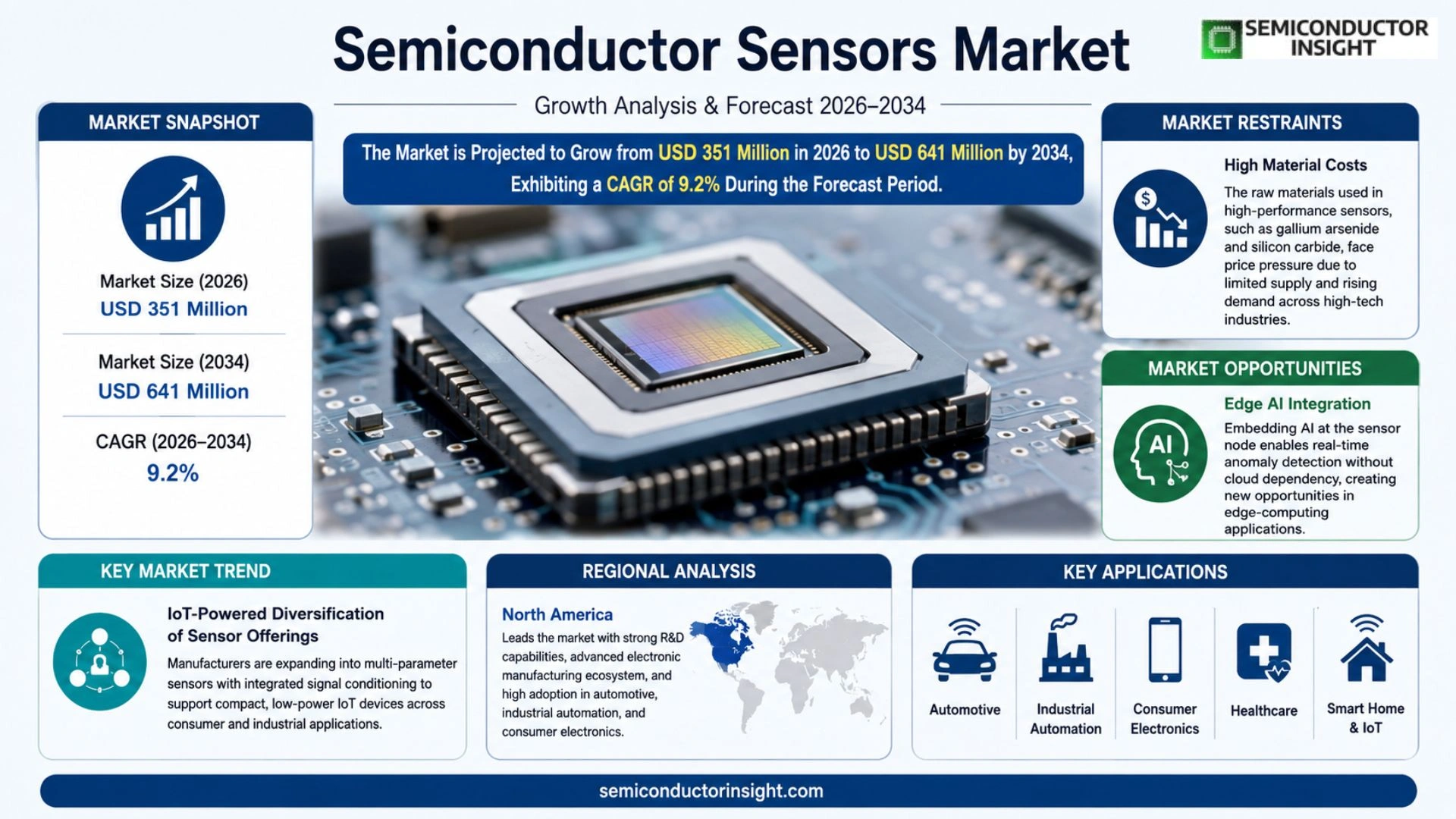
Global Semiconductor Sensors market is projected to grow from USD 351 million in 2026 to USD 641 million by 2034, exhibiting a CAGR of 9.2% during the forecast period.
Semiconductor Sensors comprise temperature sensors, pressure sensors, humidity sensors and gas sensors that convert physical phenomena into electrical signals for use in industrial automation, household appliances, environmental monitoring, medical equipment and automotive systems.
The expansion reflects increasing adoption of IoT‑enabled devices, heightened need for accurate analog conversion and growing investment in automotive electronics. Leading firms such as Figaro, Honeywell, Nissha and Amphenol are broadening their offerings through new product introductions and strategic collaborations aimed at meeting evolving customer requirements.
MARKET DRIVERS
Rising Demand for Smart Manufacturing
The adoption of Industry 4.0 principles has pushed equipment manufacturers to embed sensor intelligence directly into production lines. Semiconductor Sensors provide the granular data required for predictive maintenance, reducing unplanned downtime and boosting overall equipment effectiveness. As factories shift from batch processing to continuous, data‑rich operations, the need for high‑precision sensing escalates.
Growth of Automotive Electrification
Electrified powertrains and advanced driver‑assistance systems rely heavily on temperature, pressure and proximity detection. The migration from internal‑combustion to electric vehicles creates a steady stream of integration projects where Semiconductor Sensors are indispensable for battery management and safety functions. OEMs are therefore re‑engineering vehicle architectures to accommodate larger sensor arrays.
➤ Semiconductor Sensors are the silent enablers of device intelligence, turning raw data into actionable insight.
Beyond these two pillars, the proliferation of IoT endpoints in consumer electronics reinforces the market’s momentum. Every new connected appliance,whether a wearable or a home appliance,adds to the cumulative sensor count, reinforcing a virtuous cycle of demand and innovation.
MARKET CHALLENGES
Supply Chain Volatility
Recent geopolitical shifts and pandemic‑era disruptions have exposed the fragility of semiconductor fabrication networks. Manufacturers of Semiconductor Sensors face elongated lead times for silicon wafers, which in turn compresses product launch windows for downstream industries. Companies that cannot secure reliable tier‑one sources risk losing market share to better‑positioned rivals.
Other Challenges
Regulatory Hurdles
Stringent safety certifications for automotive and medical applications add layers of testing and documentation. The time and expense required to achieve compliance can deter smaller players from entering niche segments, limiting overall market diversification.
MARKET RESTRAINTS
High Material Costs
The raw materials that underpin sensor performance,such as gallium arsenide and silicon carbide,have experienced price pressure due to limited mining capacity and increasing demand across multiple high‑tech sectors. Elevated input costs compress margins for sensor manufacturers, especially those operating on thin volume‑based pricing models.
MARKET OPPORTUNITIES
Edge AI Integration
Embedding lightweight AI algorithms at the sensor node allows real‑time anomaly detection without routing data to central servers. This trend opens a lucrative niche for Semiconductor Sensors that combine sensing capability with on‑chip inference. Companies that develop standardized AI‑enabled sensor modules stand to capture a growing share of the emerging edge‑computing market.
Semiconductor Sensors Market Trends
IoT‑Powered Diversification of Sensor Offerings
The rise of interconnected devices is reshaping the demand profile for semiconductor sensors. Manufacturers are expanding portfolios beyond traditional temperature and pressure units to incorporate humidity, gas, and multi‑parameter chips that can be embedded directly into edge nodes. This shift matters because it lowers bill‑of‑materials for OEMs while delivering richer data streams, a combination that accelerates product cycles in consumer electronics and industrial control. Suppliers that can integrate signal‑conditioning functions on the same die gain a competitive edge, as system‑integrators seek to reduce board space and power consumption.
Other Trends
Automotive Integration and Safety Enhancements
Vehicle electrification and autonomous driving functions are prompting automakers to embed semiconductor sensors throughout power‑train and chassis systems. Pressure sensors now monitor battery cooling loops, while gas sensors detect cabin air quality to meet emerging regulatory expectations. The strategic relevance lies in the ability of these sensors to provide real‑time feedback that supports fault‑diagnosis algorithms, thereby improving vehicle reliability and after‑sales service margins. Companies that align sensor design with automotive qualification standards are positioned to capture a growing slice of the mobility supply chain.
Regional Supply‑Chain Realignment
Geopolitical shifts and recent semiconductor shortages have motivated semiconductor sensor producers to diversify manufacturing footprints. Asian hubs continue to dominate volume production, yet North American and European fabs are receiving renewed investment to serve high‑value applications such as medical diagnostics and precision industrial automation. This redistribution influences lead‑time reliability and cost structures, prompting end users to reassess sourcing strategies. Vendors that can guarantee consistent quality across multiple sites are likely to become preferred partners for customers seeking resilience against future disruptions.
COMPETITIVE LANDSCAPE
Key Industry Players
Semiconductor Sensors Market: Competitive Overview
The sensor segment is dominated by a handful of multinational corporations that have leveraged extensive R&D budgets and broad distribution networks to secure footholds across automotive, industrial automation, and consumer IoT applications. Honeywell, with its integrated sensing portfolio, has capitalized on strategic acquisitions in the MEMS space, allowing it to offer temperature, pressure, and gas solutions from a single platform. This has forced rivals to either specialize or pursue joint ventures to meet the breadth of customer demand. Texas Instruments and STMicroelectronics, traditionally analog power players, have repurposed their mixed‑signal expertise toward high‑precision temperature and humidity sensors, delivering products that meet stringent automotive reliability standards. The resulting market structure resembles a tiered hierarchy: a core of vertically integrated giants controlling a majority of revenue, and a peripheral layer of agile specialists that compete on niche performance metrics and rapid time‑to‑market.
Beyond the tier‑1 group, a constellation of niche innovators injects diversity into the ecosystem. Figaro Engineering remains a reference point for gas‑detecting modules, especially in environmental monitoring, thanks to its long‑standing calibration expertise. Alphasense distinguishes itself through ultra‑low‑power designs tailored for wearable health devices, while Amphenol Advanced Sensors focuses on ruggedized pressure transducers for harsh industrial settings. Companies such as New Cosmos Electric and Zhengzhou Winsen have expanded their presence in Asian OEM chains by offering cost‑competitive humidity and temperature units, often partnering with OEMs to co‑develop bespoke solutions. This fragmentation creates a dynamic competitive pressure that encourages continuous product differentiation and incremental performance gains.
List of Key Semiconductor Sensors Companies Profiled
- Honeywell
- Texas Instruments
- Bosch Sensortec
- Infineon Technologies
- STMicroelectronics
- NXP Semiconductors
- AMS AG
- Sensirion
- Figaro Engineering
- Alphasense
- Amphenol Advanced Sensors
- New Cosmos Electric
- Zhengzhou Winsen
- Shanghai AICI
- Murata Manufacturing
Segment Analysis:
| Segment Category | Sub-Segments | Key Insights |
| By Type |
|
Temperature Sensors are gaining prominence because of their fundamental role in thermal management across multiple domains.
|
| By Application |
|
Industrial Automation represents a core driver for sensor adoption, especially in smart factories.
|
| By End User |
|
Automotive OEMs are integrating semiconductor sensors extensively to meet safety and efficiency standards.
|
| By Form Factor |
|
Chip‑Scale solutions are gaining traction due to their ability to be co‑integrated with ASICs and MCUs.
|
| By Connectivity |
|
Wireless connectivity is becoming a cornerstone for distributed sensing networks.
|
Regional Analysis: Semiconductor Sensors Market
North America
The region’s automotive firms prioritize sensor fusion for advanced driver‑assistance systems, prompting OEMs to source high‑resolution LiDAR and radar chips from local suppliers. Collaborative validation programs shorten time‑to‑market for safety‑critical modules.
Wearable device manufacturers exploit the proximity of design studios to sensor fabricators, enabling rapid iteration of ultra‑compact motion and health sensors that meet stringent battery life expectations.
Factories adopting predictive maintenance rely on temperature and vibration sensors embedded in legacy equipment, fostering a market for retrofit‑compatible semiconductor solutions.
Federal initiatives that earmark funding for semiconductor research reinforce the region’s leadership, while export‑control adjustments shape supplier‑customer dynamics across the border.
Europe
European manufacturers draw strength from rigorous standards that drive sensor accuracy and reliability. Automotive clusters in Germany and France demand components that comply with stringent safety certifications, prompting local designers to adopt robust packaging technologies. Meanwhile, the Nordic region advances environmental sensing, leveraging sensor data to meet aggressive climate targets. Companies that align product roadmaps with EU sustainability directives find a receptive market in both industrial and consumer segments.
Asia‑Pacific
Asia‑Pacific’s rapid industrialization fuels a surge in demand for cost‑effective sensor arrays. China’s expansive electronics assembly base creates pressure for high‑volume, low‑margin devices, while Japan and South Korea focus on high‑precision applications such as medical imaging and aerospace. The region’s talent pool in semiconductor design sustains a pipeline of innovative sensor architectures, yet supply chain fragmentation poses challenges for end‑to‑end integration.
South America
In South America, growth is anchored by investments in smart agriculture and renewable energy monitoring. Brazil’s agribusiness sector increasingly adopts soil moisture and ambient condition sensors to optimize yields, while Chile’s solar farms rely on temperature and irradiance sensors to maximize output. The market remains fragmented, but partnerships with North American firms are opening channels for higher‑grade sensor technologies.
Middle East & Africa
The Middle East & Africa region experiences modest but steady adoption of semiconductor sensors, driven by oil‑and‑gas monitoring and emerging smart‑city projects. United Arab Emirates initiatives to embed sensors in water‑management infrastructure exemplify a shift toward data‑driven resource stewardship. African nations are beginning to explore sensor‑enabled health diagnostics, indicating a nascent but potentially transformative market segment.
Report Scope
This market research report provides a comprehensive analysis of the Semiconductor Sensors Market , covering the forecast period 2026–2034. It offers detailed insights into market dynamics, technological advancements, competitive landscape, and key trends shaping the industry.
Key focus areas of the report include:
- Market Overview: The report begins with an overview outlining its current market scenario, key growth indicators, and industry transformation drivers. It discusses macroeconomic factors, demand–supply balance, regulatory landscape, and the strategic role of semiconductors in powering advancements across industries such as automotive, telecommunications, consumer electronics, and industrial automation.
- Market Size & Forecast: Historical data and future projections for revenue, unit shipments, and market value across major regions and segments.
- Segmentation Analysis: Detailed breakdown by product type, technology, application, and end-user industry to identify high-growth segments and investment opportunities.
- Regional Insights: Insights into market performance across North America, Europe, Asia-Pacific, Latin America, and the Middle East & Africa, including country-level analysis where relevant.
- Competitive Landscape: Profiles of leading market participants, including their product offerings, R&D focus, manufacturing capacity, pricing strategies, and recent developments such as mergers, acquisitions, and partnerships.
- Technology Trends & Innovation: Assessment of emerging technologies, integration of AI/IoT, semiconductor design trends, fabrication techniques, and evolving industry standards.
- Market Drivers & Restraints: Evaluation of factors driving market growth along with challenges, supply chain constraints, regulatory issues, and market-entry barriers.
- Stakeholder Insights: Insights for component suppliers, OEMs, system integrators, investors, and policymakers regarding the evolving ecosystem and strategic opportunities.
Primary and secondary research methods are employed, including interviews with industry experts, data from verified sources, and real-time market intelligence to ensure the accuracy and reliability of the insights presented.
FREQUENTLY ASKED QUESTIONS:
What is the current market size of Semiconductor Sensors Market?
-> Semiconductor Sensors market is projected to grow from USD 351 million in 2026 to USD 641 million by 2034, exhibiting a CAGR of 9.2%.
Which key companies operate in Semiconductor Sensors Market?
-> Key players include Figaro, Honeywell, Nissha, Amphenol, New Cosmos Electric, Alphasense, Sensorix, MGK Sensor, Shanghai AICI, China Wafer Level CSP, Zhengzhou Winsen.
What are the key growth drivers?
-> Key growth drivers include the rising popularity of IoT‑based electronics, increasing demand for powerful processors and controllers, and expanding analog IC applications such as signal conversion, automotive‑specific solutions, and power management.
Which region dominates the market?
-> Asia holds a significant share of Semiconductor Sensors market, driven by strong semiconductor manufacturing ecosystems and growing demand for sensor‑enabled devices.
What are the emerging trends?
-> Emerging trends include the integration of temperature, pressure, humidity, and gas sensors into IoT platforms, development of smart sensor networks, and advancements in analog IC technologies supporting power‑efficient sensor solutions.
Get Sample Report PDF for Exclusive Insights
Report Sample Includes
- Table of Contents
- List of Tables & Figures
- Charts, Research Methodology, and more...
 Download Sample Report PDF