Semiconductor Pressure Sensors and Transducers Market Insights
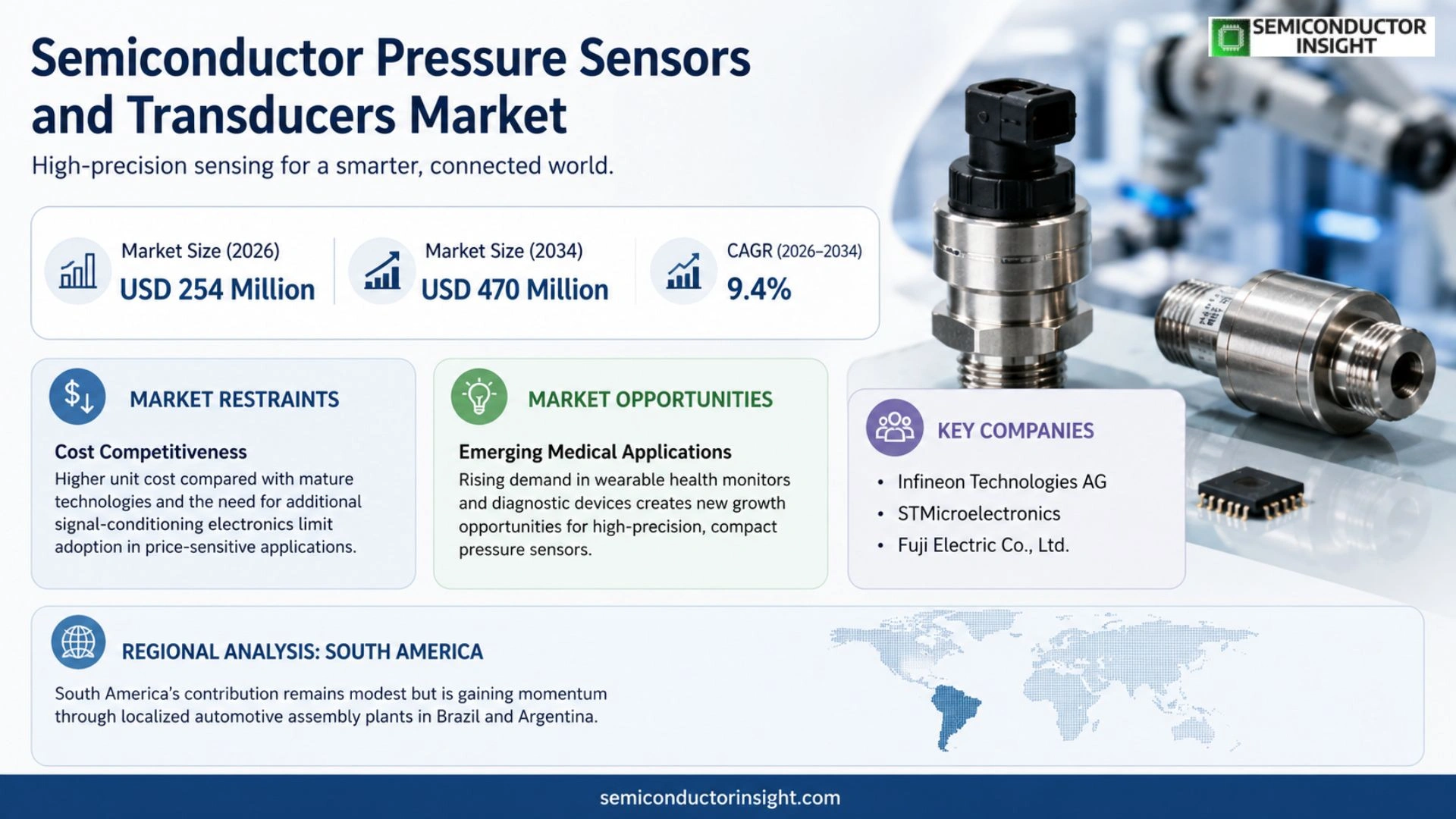
Global Semiconductor Pressure Sensors and Transducers market was valued at USD 254 million in 2026 and is expected to reach USD 470 million by 2034, exhibiting a CAGR of 9.4% during the forecast period.
Semiconductor pressure sensors are precision transducers used throughout wafer‑fabrication steps,including chemical‑mechanical polishing (CMP), wafer cleaning, detecting and bonding,to provide real‑time pressure measurements that ensure process stability and high yield.
The upward trend is driven by expanding semiconductor fab capacity worldwide, growing IoT‑enabled equipment that demands tighter process control, and ongoing innovations such as micromachined silicon (MMS) and solid‑state sensor designs. Recent collaborations among leading manufacturers focus on embedding these sensors directly into production tools, further accelerating demand across North America, Asia‑Pacific and Europe.
MARKET DRIVERS
Integration with Advanced Automotive Systems
The rise of electric‑drive and autonomous platforms has compelled vehicle manufacturers to replace traditional electromechanical pressure devices with semiconductor‑based pressure sensors. These solid‑state components deliver higher accuracy, faster response times, and reduced part counts, which directly aligns with OEM goals of lower weight and improved reliability. Manufacturers that adopt these sensors can achieve tighter control over engine combustion, battery management, and braking systems, thereby differentiating their offerings in a crowded market.
Adoption in Industrial Internet of Things (IIoT)
Industrial operators are retrofitting legacy equipment with network‑enabled monitoring solutions. Semiconductor pressure transducers, with their inherent digital interfaces and low power draw, fit seamlessly into edge‑computing architectures. The ability to stream real‑time pressure data to cloud analytics platforms enables predictive maintenance, which translates into measurable reductions in unplanned downtime. Enterprises that leverage this capability can justify higher upfront sensor costs through long‑term operational savings.
➤ “The convergence of electrified mobility and IIoT is reshaping procurement priorities, pushing semiconductor pressure devices to the top of the technology stack.”
Overall, the confluence of stricter emissions regulations, demand for higher efficiency, and the digital transformation of manufacturing plants creates a fertile environment for Semiconductor Pressure Sensors and Transducers Market. Companies that invest in scalable silicon‑based designs are positioned to capture a substantial share of this expanding demand.
MARKET CHALLENGES
Regulatory Hurdles
Compliance with automotive functional safety standards such as ISO 26262 and industrial certifications like IEC 61508 imposes rigorous validation cycles. Sensor manufacturers must allocate considerable engineering resources to prove reliability under extreme temperature and vibration conditions. This prolongs time‑to‑market and raises development expenditures, especially for smaller players lacking dedicated test facilities.
Other Challenges
Supply Chain Volatility
The semiconductor ecosystem continues to experience periodic capacity constraints, driven by fluctuations in wafer fab availability and raw material pricing. When demand for memory and logic chips spikes, foundry slots for pressure sensor production become scarcer, leading to longer lead times. Companies that do not diversify their manufacturing footprint risk inventory shortages and missed contract opportunities.
MARKET RESTRAINTS
Cost Competitiveness
Although semiconductor pressure sensors offer performance advantages, their unit cost remains higher than that of mature piezoresistive counterparts. Price‑sensitive segments, such as low‑cost consumer appliances, often opt for legacy technologies to preserve profit margins. Without a clear pathway to reduce fabrication expenses, broader adoption across these segments may remain limited.
Furthermore, the necessity for ancillary signal‑conditioning electronics can add to the overall system cost, deterring OEMs that prioritize ultra‑low‑cost designs. Until economies of scale are achieved through larger production volumes, cost restraints will temper the pace of market penetration.
MARKET OPPORTUNITIES
Emerging Medical Applications
Wearable health monitors and point‑of‑care diagnostic devices increasingly rely on precise pressure detection for blood‑flow analysis and respiratory tracking. Semiconductor transducers, with their compact size and hermetic sealing, satisfy stringent medical standards while enabling seamless integration with Bluetooth‑low‑energy modules. This opens a new revenue stream for sensor makers willing to navigate FDA approval pathways.
In parallel, the push toward minimally invasive surgical tools creates demand for miniature pressure sensors that can operate reliably within the human body. Companies that co‑develop sensor modules with medical equipment manufacturers can capture value from a market that is both high‑margin and less exposed to commodity‑price pressures.
Semiconductor Pressure Sensors and Transducers Market Trends
Real‑time Pressure Monitoring Fuels Fab‑Level Efficiency
Manufacturing lines for advanced semiconductors rely on precise atmospheric and vacuum control. The introduction of semiconductor‑grade pressure sensors that can deliver sub‑millibar accuracy has become a decisive factor for yield optimization. Plant engineers now embed these transducers directly into deposition chambers, enabling closed‑loop feedback that trims cycle time while reducing defectivity. Because the cost of a missed wafer can exceed thousands of dollars, operators are willing to invest in sensor platforms that integrate with existing process control software, thereby converting raw pressure data into actionable set‑point adjustments. This shift from periodic to continuous measurement is reshaping procurement criteria across the foundry ecosystem.
Other Trends
Broadening Product Portfolio by Sensor Architecture
Vendors are expanding beyond traditional variable‑capacitance designs to include micromachined silicon and solid‑state options. Micromachined devices offer superior temperature stability, which aligns with the tighter thermal budgets of 3‑nm lithography tools. Meanwhile, solid‑state transducers provide robustness in chemically aggressive environments such as plasma etching. The diversification allows manufacturers to target niche applications,ranging from chemical‑vapor‑deposition monitoring to wafer‑bonding pressure verification,without forcing a one‑size‑fits‑all solution. As customers demand more specialized sensor signatures, the market sees a gradual erosion of homogeneous product lines and a rise in application‑specific variants.
Application Reach Extends into Advanced Wafer Processing Steps
Beyond the classic use cases of chemical‑mechanical polishing and wafer cleaning, pressure transducers are now integral to emerging steps such as atomic‑layer deposition and selective epitaxy. In these processes, pressure fluctuations directly influence film uniformity and interface quality. By placing calibrated sensors at critical choke points, equipment manufacturers can offer predictive maintenance alerts that anticipate pump wear before a pressure drop translates into a process upset. The ripple effect is a more reliable production schedule and a clearer pathway for fabs to adopt next‑generation node technologies without overhauling their existing pressure‑control infrastructure.
COMPETITIVE LANDSCAPE
Key Industry Players
Semiconductor Pressure Sensors and Transducers – Competitive Overview
Infineon and STMicroelectronics dominate the upper tier of the market, collectively accounting for a sizable proportion of global shipments. Both firms have leveraged deep semiconductor know‑how to integrate pressure‑sensing capability directly into wafer‑fab equipment, reducing line‑time latency and improving process yield. Their portfolios span micromachined silicon devices, solid‑state transducers, and variable‑capacitance modules that meet the stringent temperature and contamination tolerances of clean‑room environments. Robust engineering pipelines and long‑term contracts with leading fabs give these manufacturers a defensible foothold, while their scale enables cost‑effective volume production that smaller rivals struggle to match. The overall structure remains moderately consolidated, with the top five firms contributing roughly 40 % of revenue, leaving ample room for specialized entrants to capture niche segments.
Beyond the marquee names, a cadre of focused players enriches the ecosystem. Fuji Electric concentrates on chemical‑vapor‑deposition (CVD) pressure monitoring, offering thin‑film solutions tuned for high‑temperature processes. Alps Alpine supplies automotive‑grade analog pressure interfaces that are being repurposed for rugged fab instrumentation. Brooks Instrument and Setra have carved out reputations for ultra‑precise transducers used in chemical‑mechanical polishing stations. Nidec and NXP target low‑power, embedded sensor modules suited to IoT‑enabled fabs, while Azbil emphasizes networking‑ready devices for smart‑factory integration. Honeywell, Mitsubishi Electric, and Panasonic bring cross‑industry supply chain depth, facilitating regional expansion in Europe and Asia. Emerging Chinese firms such as Guangzhou Aosong Electronic, Wuxi Huagan, and Boyi Pneumatics are rapidly scaling production capacities, positioning themselves as cost‑competitive alternatives for domestic fabs.
List of Key Semiconductor Pressure Sensors and Transducers Companies Profiled
- Infineon Technologies AG
- STMicroelectronics
- Fuji Electric Co., Ltd.
- Alps Alpine Co., Ltd.
- Brooks Instrument
- Setra Systems
- Nidec Corporation
- NXP Semiconductors
- Honeywell International Inc.
- Azbil Corporation
- Mitsubishi Electric
- Panasonic Corporation
- WIKA Alexander Wilhelm GmbH
- Boyi Pneumatics
- Guangzhou Aosong Electronic
- Wuxi Huagan
Segment Analysis:
| Segment Category | Sub-Segments | Key Insights |
| By Type |
|
Micromachined Silicon (MMS)
|
| By Application |
|
Wafer Bonding
|
| By End User |
|
Fab Equipment Manufacturers
|
| By Process Integration |
|
Front‑End Process Integration
|
| By Market Trend |
|
IoT‑Enabled Manufacturing
|
Regional Analysis: Semiconductor Pressure Sensors and Transducers Market
North America
Automotive manufacturers in the U.S. and Canada are re‑engineering engine control units to embed semiconductor pressure sensors that monitor intake manifold and brake‑by‑wire systems. The shift towards electric and hybrid platforms amplifies the need for compact, high‑resolution transducers, prompting tier‑one suppliers to expand their silicon‑based portfolios.
Medical device makers are replacing conventional pressure transducers in ventilators and infusion pumps with semiconductor variants that deliver superior linearity and lower power consumption. Regulatory incentives for portable diagnostics accelerate adoption, and the convergence of pressure sensing with wireless telemetry opens new avenues for remote patient monitoring.
Defense contracts require pressure sensors that survive high‑g launch environments and wide thermal swings, a niche well‑served by silicon‑on‑glass MEMS technologies. Aerospace integrators are leveraging these transducers for cabin pressurization monitoring and fuel‑system management, where weight savings translate directly into performance gains.
Smartphone and wearable manufacturers are embedding miniature pressure sensors to enable altitude detection, weather‑aware applications, and gesture control. The push for ultra‑low‑power operation drives innovations in CMOS‑compatible designs, allowing sensor integration directly onto application‑specific integrated circuits.
Europe
Europe’s semiconductor pressure sensor landscape is defined by strong collaboration between original equipment manufacturers and research institutions across Germany, France, and the United Kingdom. Automotive fleets transitioning to Euro 7 emissions standards necessitate precise manifold pressure monitoring, prompting original design manufacturers to embed advanced transducers within engine control units. At the same time, the medical device sector benefits from EU directives encouraging energy‑efficient equipment, fostering the uptake of silicon‑based pressure modules in portable imaging devices. While regulatory scrutiny can extend certification timelines, Europe’s dense network of testing labs and standards bodies assists manufacturers in navigating compliance, reinforcing the region’s reputation for high‑quality, reliable sensor solutions.
Asia‑Pacific
Asia‑Pacific emerges as a high‑growth arena for semiconductor pressure sensors, driven primarily by rapid industrialization in China, South Korea, and Japan. Manufacturing hubs are upgrading assembly lines with sensor‑enabled automation, where real‑time pressure feedback improves yield and reduces waste. The automotive market, bolstered by expanding electric‑vehicle production, demands miniaturized, cost‑effective transducers that can be mass‑produced on existing wafer fabs. Additionally, rising demand for smart home appliances and wearables in India and Southeast Asia creates a broad base for low‑power pressure sensors integrated into IoT edge devices. Supply‑chain synergies between fabless designers and foundries accelerate product cycles, positioning the region as a pivotal production engine.
South America
South America’s contribution to the semiconductor pressure sensor ecosystem remains modest but is gaining momentum through localized automotive assembly plants in Brazil and Argentina. These facilities seek to replace legacy electromechanical transducers with silicon alternatives to meet stricter fuel‑efficiency targets imposed by regional policies. In the agricultural equipment sector, pressure sensors are being incorporated into irrigation and harvest machines to enable variable‑rate control, aligning with sustainability initiatives. Although limited domestic fab capacity compels reliance on imports, growing awareness of the performance and energy benefits of semiconductor devices is encouraging regional distributors to stock a broader range of pressure transducer families.
Middle East & Africa
The Middle East & Africa region presents a niche but strategic market for pressure sensors, anchored by extensive oil‑and‑gas operations and emerging renewable‑energy projects. In upstream extraction, semiconductor transducers provide the accuracy required for downhole pressure monitoring, enhancing safety and optimizing production rates. Meanwhile, large‑scale solar farms in the United Arab Emirates are integrating pressure‑based flow sensors to manage coolant systems, reflecting a diversification of demand beyond traditional hydrocarbon applications. Limited local semiconductor manufacturing infrastructure creates dependence on imports, yet strategic partnerships with global vendors are facilitating technology transfer and the establishment of regional testing facilities.
Report Scope
This market research report provides a comprehensive analysis of the Semiconductor Pressure Sensors and Transducers Market , covering the forecast period 2026–2034. It offers detailed insights into market dynamics, technological advancements, competitive landscape, and key trends shaping the industry.
Key focus areas of the report include:
- Market Overview: The report begins with an overview outlining its current market scenario, key growth indicators, and industry transformation drivers. It discusses macroeconomic factors, demand–supply balance, regulatory landscape, and the strategic role of semiconductors in powering advancements across industries such as automotive, telecommunications, consumer electronics, and industrial automation.
- Market Size & Forecast: Historical data and future projections for revenue, unit shipments, and market value across major regions and segments.
- Segmentation Analysis: Detailed breakdown by product type, technology, application, and end-user industry to identify high-growth segments and investment opportunities.
- Regional Insights: Insights into market performance across North America, Europe, Asia-Pacific, Latin America, and the Middle East & Africa, including country-level analysis where relevant.
- Competitive Landscape: Profiles of leading market participants, including their product offerings, R&D focus, manufacturing capacity, pricing strategies, and recent developments such as mergers, acquisitions, and partnerships.
- Technology Trends & Innovation: Assessment of emerging technologies, integration of AI/IoT, semiconductor design trends, fabrication techniques, and evolving industry standards.
- Market Drivers & Restraints: Evaluation of factors driving market growth along with challenges, supply chain constraints, regulatory issues, and market-entry barriers.
- Stakeholder Insights: Insights for component suppliers, OEMs, system integrators, investors, and policymakers regarding the evolving ecosystem and strategic opportunities.
Primary and secondary research methods are employed, including interviews with industry experts, data from verified sources, and real-time market intelligence to ensure the accuracy and reliability of the insights presented.
FREQUENTLY ASKED QUESTIONS:
What is the current market size of Semiconductor Pressure Sensors and Transducers Market?
-> Semiconductor Pressure Sensors and Transducers Market was valued at USD 470 million by 2034, at a CAGR of 9.4% during the forecast period.
Which key companies operate in Semiconductor Pressure Sensors and Transducers Market?
-> Key players include Infineon, Fuji Electric, STMicroelectronics, Alps Alpine, Brooks Instrument, Setra, Nidec, NXP, Azbil, Honeywell, Mitsubishi, Panasonic, WIKA, Boyi Pneumatics, Guangzhou Aosong Electronic, Wuxi Huagan.
What are the key growth drivers?
-> Key growth drivers include real-time pressure monitoring in semiconductor manufacturing, increasing adoption of IoT‑enabled devices, and rising demand for analog ICs and power management solutions.
Which region dominates the market?
-> Asia-Pacific leads the market owing to the concentration of semiconductor fabs and high demand for advanced pressure sensing solutions.
What are the emerging trends?
-> Emerging trends include integration of pressure sensors with AI/IoT platforms, development of solid‑state and micromachined silicon technologies, and enhanced signal conversion capabilities.

Get Sample Report PDF for Exclusive Insights
Report Sample Includes
- Table of Contents
- List of Tables & Figures
- Charts, Research Methodology, and more...
 Download Sample Report PDF