Market Insights
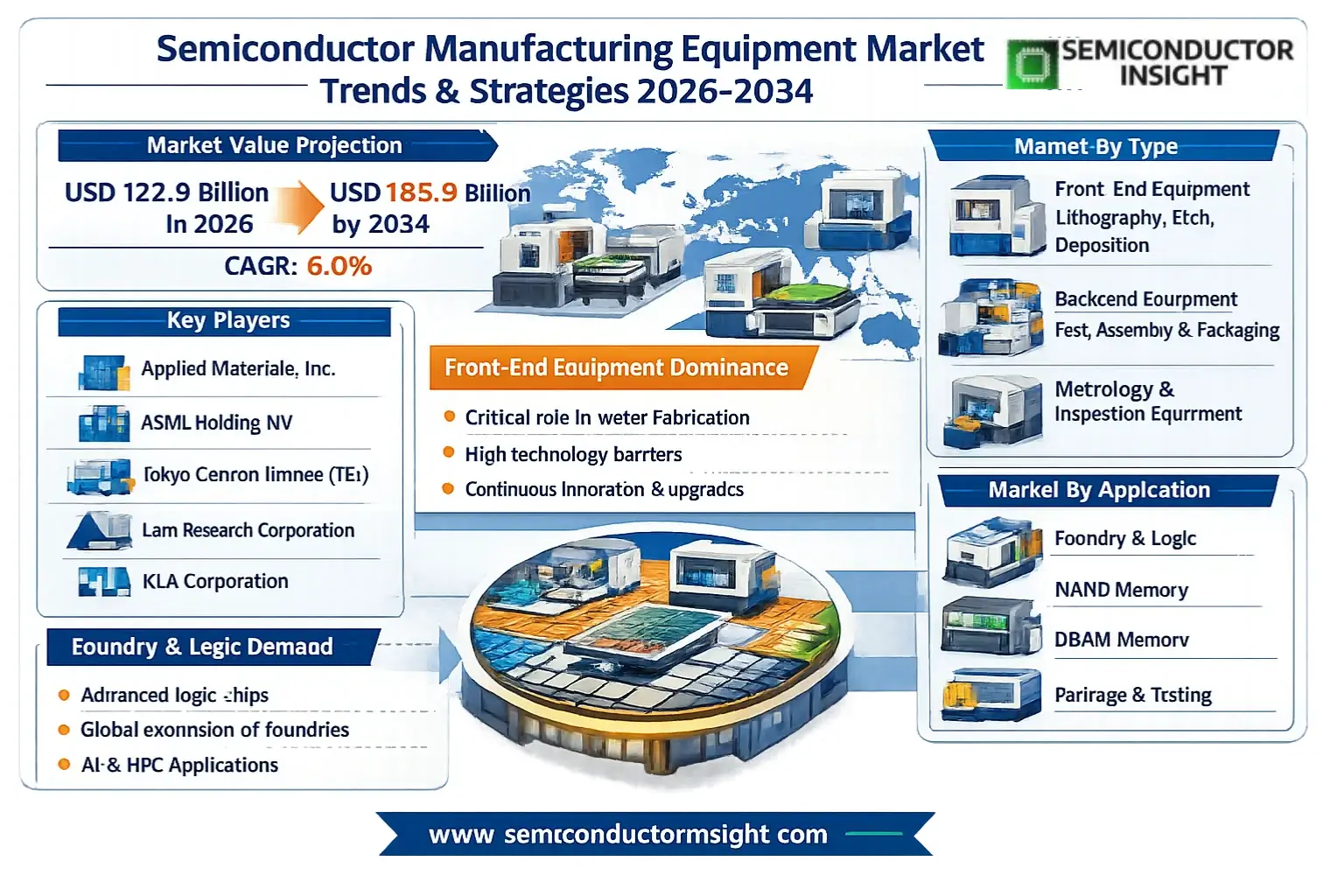
Global Semiconductor Manufacturing Equipment Market was valued at USD 122.9 billion in 2026 and is projected to reach USD 185.9 billion by 2034, exhibiting a CAGR of 6.0% during the forecast period.
Semiconductor Manufacturing Equipment Market encompasses a wide range of tools used in the production of integrated circuits and microchips. These include front-end wafer fabrication equipment such as lithography systems, etching machines, deposition tools, and inspection systems, as well as back-end assembly and testing equipment. The industry is highly specialized, with precision engineering playing a critical role in enabling advanced semiconductor manufacturing processes.
The market growth is driven by increasing demand for semiconductors across various applications including consumer electronics, automotive, and industrial sectors. Furthermore, advancements in technologies such as artificial intelligence (AI), 5G networks, and the Internet of Things (IoT) are fueling the need for more sophisticated semiconductor components. Key players like ASML, Applied Materials, and Tokyo Electron continue to dominate the market through continuous innovation in extreme ultraviolet (EUV) lithography and other cutting-edge technologies.
MARKET DRIVERS
Growing Demand for Advanced Semiconductor Chips
Semiconductor Manufacturing Equipment Market is experiencing significant growth due to rising demand for advanced semiconductor chips in applications like 5G, AI, and IoT. Global semiconductor sales reached over USD 500 billion in 2023, driving investments in new fabrication facilities.
Government Incentives and Semiconductor Self-Sufficiency
Countries worldwide are investing heavily in domestic semiconductor production capabilities. The CHIPS Act in the U.S. and similar initiatives in Europe and Asia are allocating billions to strengthen local semiconductor manufacturing equipment supply chains.
Leading foundries are accelerating capacity expansions, with over 20 new advanced fabs scheduled for construction by 2026, significantly boosting equipment procurement.
MARKET CHALLENGES
High Capital Intensity and Technical Complexity
Semiconductor Manufacturing Equipment Market requires substantial capital investment, with a single EUV lithography machine costing over USD 150 million. The technical complexity also creates barriers to entry for new market players.
Other Challenges
Supply Chain Vulnerabilities
Trade restrictions and geopolitical tensions have exposed vulnerabilities in the semiconductor manufacturing equipment supply chain, particularly for critical components like precision optics and specialized materials.
Skilled Labor Shortage
The industry faces an acute shortage of engineers and technicians capable of operating and maintaining advanced semiconductor fabrication equipment.
MARKET RESTRAINTS
Long Equipment Development Cycles
Semiconductor Manufacturing Equipment Market is constrained by the extended development timelines for next-generation technologies, with R&D cycles often spanning 3-5 years before commercialization.
Environmental Regulations
Strict environmental regulations on chemical usage and energy consumption in semiconductor fabrication are increasing compliance costs for equipment manufacturers.
MARKET OPPORTUNITIES
Transition to Advanced Packaging Technologies
The shift towards chiplet architectures and 3D packaging is creating new opportunities for semiconductor manufacturing equipment providers specializing in hybrid bonding and wafer-level packaging solutions.
Emerging Memory Technologies
Development of next-generation memory solutions like MRAM and ReRAM requires specialized semiconductor manufacturing equipment, opening new revenue streams for equipment vendors with expertise in these areas.
Semiconductor Manufacturing Equipment Market Trends
Accelerated Growth in Front-End Equipment Dominance
Global Semiconductor Manufacturing Equipment Market, valued at USD 122.9 billion in 2026, is projected to grow at a 6.0% CAGR through 2034. Front-end equipment dominates with 87.6% market share, driven by complex wafer fabrication processes requiring advanced lithography, etching, and deposition systems. This segment’s growth is fueled by rising demand for cutting-edge chips in AI, 5G, and IoT applications.
Other Trends
Regional Manufacturing Expansion
Production hubs continue expanding beyond traditional bases in US, Japan, and South Korea to include China and Europe. China’s semiconductor self-sufficiency initiatives have spurred equipment investments, with local manufacturers like NAURA and AMEC gaining ground in deposition and etching segments.
Technology Consolidation Among Equipment Leaders
Market leadership remains concentrated with top 5 companies holding over 60% share. ASML dominates lithography, Applied Materials leads in deposition/CMP, while Lam Research and TEL control etching. Recent mergers like KLA’s acquisition of Orbotech strengthen integrated process control solutions, reflecting industry’s move toward consolidated technology stacks.
300mm Wafer Equipment Transition
300mm wafer tools now represent 75% of equipment sales as fabs prioritize larger wafer sizes for cost efficiency. However, growing demand for specialized chips maintains healthy 200mm equipment market, particularly for automotive and industrial applications.
Back-End Equipment Modernization
Test and packaging equipment (11.4% combined share) is undergoing rapid innovation to support advanced packaging architectures like chiplets and 3D ICs. Key players like Teradyne and Advantest are developing higher throughput test systems to meet rising demand from foundries and OSAT providers.
COMPETITIVE LANDSCAPE
Key Industry Players
Oligopolistic Market Structure with Technological Dominance
Semiconductor Manufacturing Equipment Market is dominated by a handful of global players controlling critical technology segments. Applied Materials leads the deposition equipment segment with 30% market share, while ASML holds over 80% of the lithography equipment market. The etching equipment segment is controlled by Lam Research, TEL, and Applied Materials with combined 75% market share. These players maintain dominance through continuous R&D investment averaging 15-20% of revenues and strategic acquisitions of emerging technology firms.
Niche segments feature specialized competitors: KLA Corporation dominates inspection equipment (52% share), while SCREEN Semiconductor leads cleaning equipment. Emerging Chinese players like NAURA and AMEC are gaining traction in domestic markets through government-supported initiatives, capturing 12% of China’s equipment market. Japanese firms maintain strong presence in coater/developer and testing equipment segments, with Advantest and Teradyne leading test equipment.
List of Key Semiconductor Manufacturing Equipment Companies Profiled
- Applied Materials, Inc.
- ASML Holding NV
- Tokyo Electron Limited (TEL)
- Lam Research Corporation
- KLA Corporation
- SCREEN Semiconductor Solutions
- ASM International
- Carl Zeiss SMT
- Hitachi High-Tech Corporation
- Advantest Corporation
- Teradyne Inc.
- NAURA Technology Group
- Axcelis Technologies
- Onto Innovation
- EBEAM Corporation
Segment Analysis:
| Segment Category | Sub-Segments | Key Insights |
| By Type |
|
Front-end Equipment dominates the market due to:
|
| By Application |
|
Foundry and Logic segment shows strongest demand because:
|
| By End User |
|
Foundries represent the most dynamic end-user segment due to:
|
| By Equipment Technology |
|
EUV Lithography technology shows the highest growth potential because:
|
| By Wafer Size |
|
300mm Equipment remains the industry standard due to:
|
Regional Analysis: Semiconductor Manufacturing Equipment Market
Asia-Pacific
Taiwan maintains its position as the global foundry hub through TSMC’s technological leadership and massive capacity expansions. The island’s concentrated semiconductor ecosystem drives consistent demand for advanced manufacturing equipment.
South Korean giants Samsung and SK Hynix dominate memory production, requiring specialized equipment for DRAM and NAND flash. The country invests heavily in next-generation memory technologies and packaging solutions.
China’s semiconductor equipment market grows rapidly as domestic fabs expand despite export controls. Local equipment makers gain ground in mature nodes while international suppliers navigate complex trade restrictions.
Japan retains strength in semiconductor materials and niche equipment segments. Japanese suppliers benefit from proximity to Asian customers and strong positioning in key process technologies.
North America
North America remains a strategic market led by Intel’s major fab expansion plans and growing foundry investments. The U.S. CHIPS Act stimulates domestic semiconductor manufacturing capacity, benefiting equipment suppliers. The region maintains leadership in semiconductor equipment design and manufacturing, with key suppliers headquartered in California. Arizona emerges as a semiconductor cluster with TSMC and Intel building advanced fabs, driving local equipment demand. Research institutions collaborate with equipment makers to develop next-generation semiconductor manufacturing technologies.
Europe
Europe focuses on strengthening its semiconductor equipment and materials ecosystem through initiatives like the European Chips Act. The region specializes in niche equipment segments for power semiconductors and MEMS. Germany remains the center of Europe’s semiconductor equipment industry with strong clusters around Dresden and Munich. ASML’s extreme ultraviolet lithography monopoly gives Europe critical importance in advanced node manufacturing. European fabs increasingly adopt smart manufacturing and Industry 4.0 solutions in their equipment strategies.
Middle East & Africa
The Middle East sees growing semiconductor manufacturing ambitions, particularly in Israel’s specialized fab operations and emerging Gulf state initiatives. Israel continues to be an innovation hub for semiconductor technologies, driving equipment demand for specialized applications. Some Gulf countries explore semiconductor manufacturing as part of economic diversification plans, though the market remains small compared to other regions. Africa shows early signs of semiconductor assembly development, primarily serving local consumer electronics markets.
South America
South America’s semiconductor equipment market remains limited but shows potential growth in Brazil and Mexico. The region primarily serves assembly and test operations rather than front-end manufacturing. Some countries implement policies to attract semiconductor packaging investments, creating localized equipment demand. The market focuses on older-generation equipment suitable for less advanced manufacturing processes in the region.
Report Scope
This market research report provides a comprehensive analysis of the Semiconductor Manufacturing Equipment Market , covering the forecast period 2026–2034. It offers detailed insights into market dynamics, technological advancements, competitive landscape, and key trends shaping the industry.
Key focus areas of the report include:
- Market Overview: The report begins with an overview outlining its current market scenario, key growth indicators, and industry transformation drivers. It discusses macroeconomic factors, demand–supply balance, regulatory landscape, and the strategic role of semiconductors in powering advancements across industries such as automotive, telecommunications, consumer electronics, and industrial automation.
- Market Size & Forecast: Historical data and future projections for revenue, unit shipments, and market value across major regions and segments.
- Segmentation Analysis: Detailed breakdown by product type, technology, application, and end-user industry to identify high-growth segments and investment opportunities.
- Regional Insights: Insights into market performance across North America, Europe, Asia-Pacific, Latin America, and the Middle East & Africa, including country-level analysis where relevant.
- Competitive Landscape: Profiles of leading market participants, including their product offerings, R&D focus, manufacturing capacity, pricing strategies, and recent developments such as mergers, acquisitions, and partnerships.
- Technology Trends & Innovation: Assessment of emerging technologies, integration of AI/IoT, semiconductor design trends, fabrication techniques, and evolving industry standards.
- Market Drivers & Restraints: Evaluation of factors driving market growth along with challenges, supply chain constraints, regulatory issues, and market-entry barriers.
- Stakeholder Insights: Insights for component suppliers, OEMs, system integrators, investors, and policymakers regarding the evolving ecosystem and strategic opportunities.
Primary and secondary research methods are employed, including interviews with industry experts, data from verified sources, and real-time market intelligence to ensure the accuracy and reliability of the insights presented.
FREQUENTLY ASKED QUESTIONS:
What is the current market size of Semiconductor Manufacturing Equipment Market?
-> Semiconductor Manufacturing Equipment Market was valued at USD 122.9 billion in 2026 and is projected to reach USD 185.9 billion by 2034, exhibiting a CAGR of 6.0% during the forecast period.
Which key companies operate in Semiconductor Manufacturing Equipment Market?
-> Key players include Applied Materials, ASML, TEL, Lam Research, KLA Corporation, SCREEN, NAURA, Advantest, ASM International, Hitachi High-Tech Corporation, among others.
What are the key growth drivers?
-> Key growth drivers include increasing demand for semiconductors across automotive, telecommunications, and consumer electronics sectors, technological advancements in fabrication techniques, and rising investments in semiconductor manufacturing infrastructure.
Which region dominates the market?
-> Asia dominates the market, with significant production and consumption in China, Japan, and South Korea. North America and Europe also hold substantial market shares.
What are the emerging trends?
-> Emerging trends include advancements in lithography technology, integration of AI in semiconductor manufacturing, and development of advanced metrology and inspection systems.
Get Sample Report PDF for Exclusive Insights
Report Sample Includes
- Table of Contents
- List of Tables & Figures
- Charts, Research Methodology, and more...
 Download Sample Report PDF