3D NAND (String Stack) Bonding Market Insights
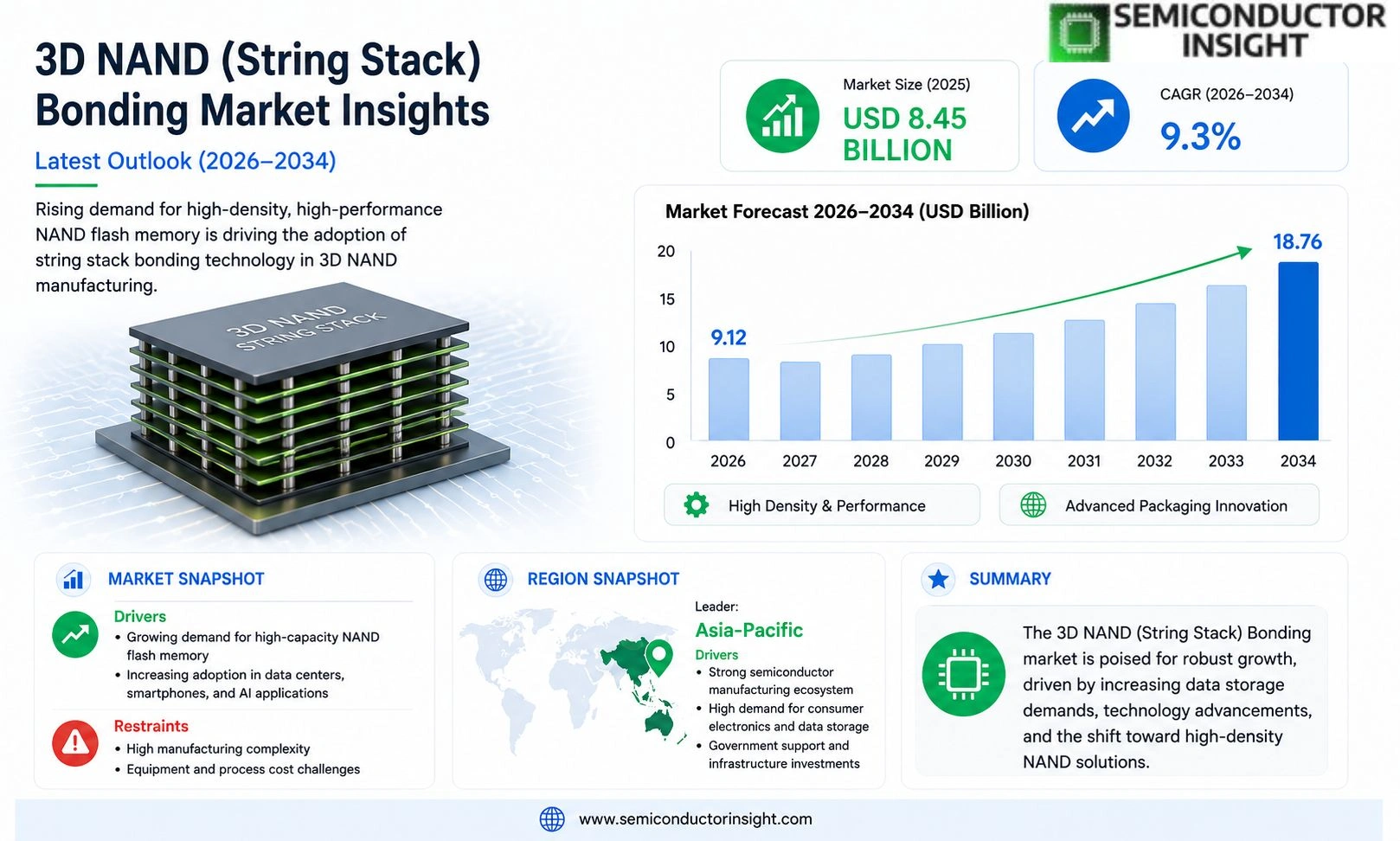
Global 3D NAND (String Stack) Bonding market size was valued at USD 8.45 billion in 2025. The market is projected to grow from USD 9.12 billion in 2026 to USD 18.76 billion by 2034, exhibiting a CAGR of 9.3% during the forecast period.
3D NAND (String Stack) Bonding refers to an advanced semiconductor manufacturing technique used to vertically stack memory cells, significantly increasing storage density while reducing power consumption and cost per bit. This technology involves bonding multiple layers of NAND flash memory strings using precision alignment and thermal compression processes, enabling higher capacity storage solutions essential for data centers, consumer electronics, and enterprise applications. The process leverages hybrid bonding or copper-to-copper thermocompression bonding to ensure reliable electrical connections between stacked layers, enhancing performance and scalability beyond traditional planar NAND architectures.
The rapid expansion of 3D NAND (String Stack) Bonding Market is driven by surging demand for high-capacity storage in cloud computing, AI-driven workloads, and next-generation mobile devices. Leading semiconductor manufacturers are aggressively scaling production capacities; for instance, Samsung Electronics announced plans in early 2024 to ramp up its 8th-generation V-NAND production using string-stacking techniques to achieve over 1,000-layer stacking. Similarly, SK Hynix and Micron Technology are advancing their respective roadmaps toward 500+ layer counts, further propelling market growth through technological innovation and strategic capital investments.
MARKET DRIVERS
Surging Data Consumption
The exponential growth of data-intensive applications such as artificial intelligence and cloud computing significantly drives 3D NAND (String Stack) Bonding Market. As enterprises require higher storage densities, manufacturers are compelled to adopt advanced stacking technologies to maximize die capacity per wafer. This trend ensures a consistent demand for high-precision bonding solutions capable of supporting the intricate layer structures required in modern memory chips.
Technological Advancements
Market analysts predict a continued shift toward nanometer-scale bonding processes to reduce parasitic capacitance and power consumption. By refining 3D NAND (String Stack) Bonding Market protocols, manufacturers can achieve greater device reliability and thermal efficiency, which is essential for mobile and high-performance computing sectors.
➤ Enhanced production yields from automated bonding systems
The integration of intelligent bonding equipment allows for real-time monitoring, drastically reducing the defect rate in the production of high-density memory arrays. This technological leap is critical in meeting the stringent quality standards of the global 3D NAND (String Stack) Bonding Market.
MARKET CHALLENGES
Thermal Management Issues
The high temperatures required for specific bonding techniques, such as flux removal or copper electroplating, pose a significant challenge to the longevity of 3D NAND structures. Excessive heat can degrade the dielectric layers, potentially leading to device failure and reduced yield rates in the competitive 3D NAND (String Stack) Bonding Market.
Other Challenges
Defect Sensitivity
The complexity of string stack architectures makes every singulation step critical. Even microscopic defects in the bonding interface can lead to catastrophic failure in high-end applications.
MARKET RESTRAINTS
Infrastructure Costs
The capital intensity associated with establishing advanced back-end-of-line (BEOL) manufacturing facilities represents a major restraint for the market. Establishing a robust supply chain for 3D NAND (String Stack) Bonding Market requires billions in investment for precision machinery and ultra-cleanroom environments, creating a high barrier to entry for new competitors.
MARKET OPPORTUNITIES
Heterogeneous Integration
The convergence of memory processing units (MPUs) and high-bandwidth memory presents a major opportunity for 3D NAND (String Stack) Bonding Market. As system designers seek to optimize data flow between compute and storage, advanced bonding techniques that facilitate 3D stacking of different chip types will see increased adoption.
Trends
Primary Trend Heading Here
The global 3D NAND (String Stack) Bonding market is experiencing substantial growth, fueled by the increasing demand for high-capacity data storage. This advanced technology allows for the vertical stacking of memory cells, leading to significant increases in storage density while simultaneously improving power efficiency and reducing the cost per bit. 3D NAND (String Stack) Bonding is crucial for meeting the escalating storage requirements of data centers, consumer electronics, and enterprise sectors.
Other Trends
Technological Advancements in Stacking Density
Leading semiconductor companies are continuously pushing the boundaries of stacking technology. Samsung Electronics, for instance, has announced plans to enhance its 8th-generation V-NAND production through string-stacking, aiming for over 1,000 layers. SK Hynix and Micron Technology are also actively developing roadmaps to achieve 500+ layer counts, driving innovation and expanding the capabilities of 3D NAND (String Stack) Bonding.
Increasing Adoption in Data Centers
The data center market represents a significant driver for 3D NAND (String Stack) Bonding. The ever-growing volume of data necessitates higher storage capacities and improved performance. String-stacking technology provides the scalability and density required to support the demands of cloud computing, artificial intelligence, and other data-intensive applications. This trend is expected to sustain strong demand for 3D NAND (String Stack) Bonding solutions.
Focus on Power Efficiency
As data centers and mobile devices continue to grow, power efficiency is paramount. 3D NAND (String Stack) Bonding contributes to lower power consumption compared to traditional planar NAND architectures. This makes it an attractive technology for applications where energy conservation is critical, further boosting its adoption in various sectors reliant on high-performance, low-power memory solutions.
The continued advancements in 3D NAND (String Stack) Bonding technology are poised to play a vital role in shaping the future of data storage, enabling higher capacity, improved performance, and enhanced energy efficiency for a wide range of applications.
COMPETITIVE LANDSCAPE
Key Industry Players
Key Industry Players in 3D NAND (String Stack) Bonding
3D NAND (String Stack) Bonding Market is characterized by a mix of established memory manufacturers and specialized bonding equipment suppliers. Key players are actively investing in R&D and expanding production capacities to meet the growing demand for high-density storage solutions. The competitive landscape is intense, with companies focusing on technological advancements such as string-stacking and improved bonding techniques to achieve higher layer counts and enhanced performance.
The market has witnessed significant consolidation and strategic partnerships as companies seek to strengthen their positions in the value chain. Vertical integration strategies, where manufacturers control both NAND flash production and bonding capabilities, are becoming increasingly prevalent. Moreover, collaborations between equipment providers and memory manufacturers are accelerating the adoption of advanced bonding technologies. This dynamic environment fosters innovation and drives efficiency in the 3D NAND (String Stack) Bonding sector.
List of Key 3D NAND (String Stack) Bonding Companies Profiled
- Samsung Electronics
- SK Hynix
- Micron Technology
- GlobalFoundries
- Amkor Technology
- STATS ChipPac
- Dens Technologies
- JCET Group
- AmMag
- Nanoco Inc.
- Jako Advanced Technology Co., Ltd.
- Epac Technology Co., Ltd.
- Polycon Technology
- Lattice Semiconductor
- Winbond Electronics Corporation
Segment Analysis:
| Segment Category | Sub-Segments | Key Insights |
| By Type |
|
String Stack Bonding is a dominant technology facilitating higher storage densities through vertical stacking of memory cells. It offers advantages in terms of reduced footprint and improved performance compared to planar NAND. Hybrid Bonding is gaining traction as a versatile technology enabling the integration of diverse materials and functionalities within the stacked layers. It allows for greater flexibility in design and manufacturing processes. Copper-to-Copper Thermocompression Bonding is recognized for its reliability and efficiency in creating robust electrical connections between the stacked layers, contributing to enhanced data integrity and system stability. |
| By Application |
|
Data Centers are a major driver due to the increasing demand for high-capacity, energy-efficient storage for cloud services and virtualized environments. Consumer Electronics benefit from the miniaturization and enhanced performance enabled by 3D NAND, leading to thinner and more powerful devices. Enterprise Storage Systems utilize 3D NAND to provide reliable and scalable storage solutions for businesses managing large datasets and critical applications. |
| By End User |
|
Cloud Service Providers are key consumers, driving demand for large-scale 3D NAND deployments in their data centers. Mobile Device Manufacturers integrate 3D NAND into smartphones and other mobile devices to increase storage capacity and improve performance. Data Storage Vendors are incorporating 3D NAND into their storage solutions, offering a wide range of products for various applications. |
| By Layer Count |
|
Up to 128 Layers represent the earlier stage of 3D NAND adoption, still utilized in some cost-sensitive applications. 129-256 Layers are becoming increasingly prevalent, offering a balance between cost and storage density for a wide range of applications. 257+ Layers are driving the next wave of storage capacity, essential for demanding workloads in data centers and high-performance computing. |
| By Node Size |
|
20nm nodes are gradually being phased out as manufacturers transition to smaller process technologies. 19nm and 14nm nodes are currently in use, offering a good compromise between performance, power consumption, and cost. The shift towards smaller nodes (e.g., 10nm and beyond) aims to further increase storage density and improve energy efficiency. |
Regional Analysis:
North America
The escalating data demands of cloud computing and artificial intelligence are fueling the need for high-performance, high-capacity memory in data centers. 3D NAND (String Stack) Bonding plays a crucial role in meeting these requirements by offering superior storage density and reliability.
The continuous evolution of smartphones, tablets, and other consumer electronics drives the demand for smaller, faster, and more energy-efficient storage solutions. 3D NAND (String Stack) Bonding facilitates the miniaturization of memory chips, enabling the development of next-generation mobile devices and consumer electronics.
The automotive sector is increasingly adopting advanced electronic systems requiring substantial data storage capabilities. 3D NAND (String Stack) Bonding provides the high reliability and performance needed for automotive applications, including infotainment systems, autonomous driving technologies, and vehicle diagnostics.
The proliferation of Internet of Things (IoT) devices in industrial settings generates massive amounts of data that require efficient and reliable storage. 3D NAND (String Stack) Bonding enables the development of robust memory solutions for industrial IoT applications, supporting data analytics and predictive maintenance.
Europe
Europe represents a significant market for 3D NAND (String Stack) Bonding, with a strong focus on automotive, industrial, and enterprise sectors. The region’s commitment to technological innovation and data privacy regulations is shaping the demand for advanced memory technologies. European manufacturers are increasingly adopting 3D NAND (String Stack) Bonding to enhance the performance and capacity of their products while adhering to stringent data security standards. The region’s robust automotive industry is a key driver of demand for high-performance storage solutions.
Asia-Pacific
Asia-Pacific is anticipated to be the fastest-growing market for 3D NAND (String Stack) Bonding, fueled by the rapid expansion of the electronics manufacturing sector in countries like China, South Korea, and Taiwan. The region’s large-scale data center deployments and increasing consumer spending on mobile devices are driving the demand for high-capacity, high-performance storage solutions. The strong presence of memory manufacturers in this region further contributes to the market’s growth.
United States
The United States remains a key market for 3D NAND (String Stack) Bonding, characterized by a strong emphasis on innovation and high-performance computing. The region’s advanced semiconductor industry and growing data center infrastructure are driving the demand for cutting-edge memory technologies. Investment in research and development is a key factor supporting the growth of 3D NAND (String Stack) Bonding Market in the US.
South America
South America is emerging as a regional market for 3D NAND (String Stack) Bonding, driven by the growth of the telecommunications and consumer electronics sectors. Increasing internet penetration and the rising demand for mobile devices are contributing to the expansion of the market. The region is expected to witness steady growth in the coming years as data storage needs continue to increase.
Middle East & Africa
The Middle East and Africa represent a developing market for 3D NAND (String Stack) Bonding, with growing investments in infrastructure and digital transformation initiatives. The expansion of the telecommunications sector and the increasing adoption of cloud services are driving the demand for advanced memory solutions. The region’s focus on technological advancement is expected to fuel market growth in the future.
Report Scope
This market research report provides a comprehensive analysis of the 3D NAND (String Stack) Bonding Market , covering the forecast period 2026–2034. It offers detailed insights into market dynamics, technological advancements, competitive landscape, and key trends shaping the industry.
Key focus areas of the report include:
- Market Overview: The report begins with an overview outlining its current market scenario, key growth indicators, and industry transformation drivers. It discusses macroeconomic factors, demand–supply balance, regulatory landscape, and the strategic role of semiconductors in powering advancements across industries such as automotive, telecommunications, consumer electronics, and industrial automation.
- Market Size & Forecast: Historical data and future projections for revenue, unit shipments, and market value across major regions and segments.
- Segmentation Analysis: Detailed breakdown by product type, technology, application, and end-user industry to identify high-growth segments and investment opportunities.
- Regional Insights: Insights into market performance across North America, Europe, Asia-Pacific, Latin America, and the Middle East & Africa, including country-level analysis where relevant.
- Competitive Landscape: Profiles of leading market participants, including their product offerings, R&D focus, manufacturing capacity, pricing strategies, and recent developments such as mergers, acquisitions, and partnerships.
- Technology Trends & Innovation: Assessment of emerging technologies, integration of AI/IoT, semiconductor design trends, fabrication techniques, and evolving industry standards.
- Market Drivers & Restraints: Evaluation of factors driving market growth along with challenges, supply chain constraints, regulatory issues, and market-entry barriers.
- Stakeholder Insights: Insights for component suppliers, OEMs, system integrators, investors, and policymakers regarding the evolving ecosystem and strategic opportunities.
Primary and secondary research methods are employed, including interviews with industry experts, data from verified sources, and real-time market intelligence to ensure the accuracy and reliability of the insights presented.
FREQUENTLY ASKED QUESTIONS:
What is the current market size of 3D NAND (String Stack) Bonding Market?
-> 3D NAND (String Stack) Bonding market size was valued at USD 8.45 billion in 2025. The market is projected to grow from USD 9.12 billion in 2026 to USD 18.76 billion by 2034, exhibiting a CAGR of 9.3% during the forecast period.
Which key companies operate in 3D NAND (String Stack) Bonding Market?
-> Key players include Samsung Electronics, SK Hynix, and Micron Technology, among others.
What are the key growth drivers?
-> Key growth drivers include rising demand for high‑capacity storage in cloud computing, AI‑driven workloads, next‑generation mobile devices, and advancements in ultra‑high layer stacking technologies.
Which region dominates the market?
-> Asia‑Pacific dominates the market, driven by major manufacturers and rapid adoption of advanced NAND stacking solutions.
What are the emerging trends?
-> Emerging trends include 1,000‑layer and beyond stacking, hybrid bonding, copper‑to‑copper thermocompression bonding, and AI‑optimized memory architectures.

Get Sample Report PDF for Exclusive Insights
Report Sample Includes
- Table of Contents
- List of Tables & Figures
- Charts, Research Methodology, and more...
 Download Sample Report PDF