Semiconductor Humidity Sensors Market Insights
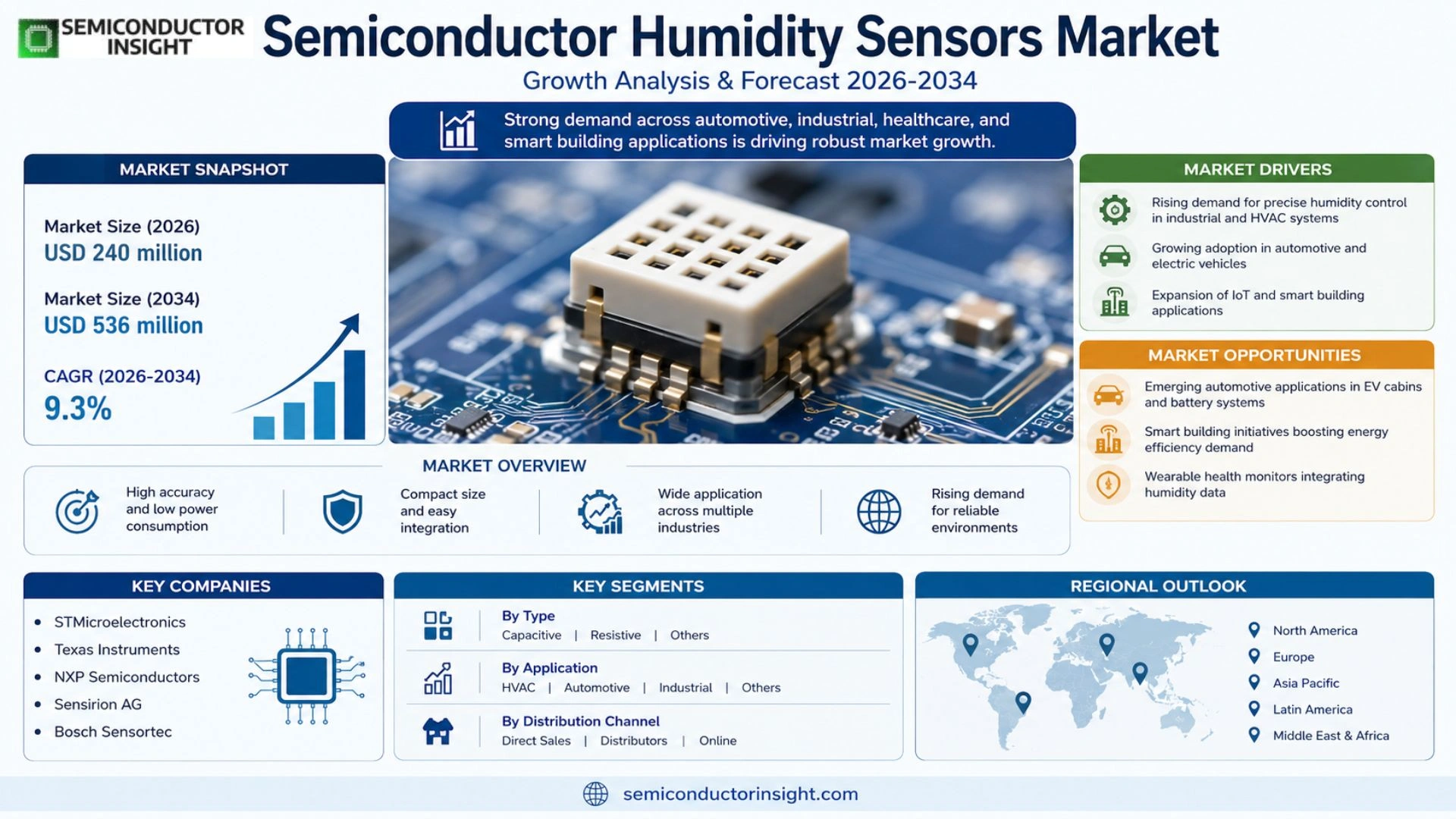
Global Semiconductor Humidity Sensors market size was valued at USD 240 million in 2026 and is projected to reach USD 536 million by 2034, exhibiting a CAGR of 9.3 % during the forecast period.
Semiconductor Humidity Sensors are solid‑state devices that convert moisture levels into electrical signals with high precision, low power consumption, and long‑term stability, making them suitable for industrial automation, HVAC control, automotive climate systems, and weather‑station networks.
The market expands because IoT‑enabled equipment demands reliable environmental monitoring, while automotive electrification pushes manufacturers toward compact, low‑energy sensors. Recent product launches from STMicroelectronics and Texas Instruments emphasize capacitive designs that improve accuracy under harsh conditions, reinforcing adoption across North America and Asia‑Pacific.
MARKET DRIVERS
Industrial Automation Demand
The surge in automated manufacturing lines has elevated the need for precise moisture monitoring. Semiconductor Humidity Sensors provide the rapid response and miniaturized footprint required to keep process yields stable, especially in high‑volume environments where a few percent deviation in humidity can translate into costly rework.
IoT Integration
Connected devices now embed humidity sensing as a standard telemetry point. Edge analytics platforms leverage the low‑power operation of semiconductor‑based sensors to trigger real‑time adjustments, creating a feedback loop that improves energy efficiency in climate‑controlled facilities.
➤ “When humidity data is streamed directly to control systems, manufacturers can shift from batch‑wise correction to continuous optimization.”
These dynamics collectively reinforce the growth trajectory of Semiconductor Humidity Sensors Market, as OEMs prioritize components that align with both precision engineering and digital interoperability.
MARKET CHALLENGES
Production Cost Sensitivity
Despite performance advantages, semiconductor‑based humidity sensors remain priced higher than traditional polymer or ceramic alternatives. Small‑to‑mid‑size producers often cite budget constraints that limit the adoption of these premium devices, especially when the cost differential does not immediately translate into measurable ROI.
Other Challenges
Supply Chain Complexity
The reliance on high‑purity silicon wafers and specialized deposition equipment introduces a fragile supply chain. Any disruption,from raw material shortages to equipment downtime,can cascade into longer lead times, eroding confidence among downstream manufacturers.
MARKET RESTRAINTS
Regulatory Hurdles
Stringent certification processes in sectors such as food processing and medical devices prolong time‑to‑market for new sensor designs. Compliance testing adds both financial and temporal burdens, discouraging smaller innovators from entering the field.
Material compatibility restrictions further limit deployment in aggressive environments. Certain alloy housings react adversely to corrosive vapors, forcing engineers to select more expensive enclosures that offset the sensor’s cost advantage.
Calibration stability over extended lifespans remains a technical restraint. Frequent recalibration requirements increase maintenance overhead, reducing the attractiveness of semiconductor hygrometers for remote installations where service visits are costly.
MARKET OPPORTUNITIES
Emerging Automotive Applications
Electric vehicle cabins and battery management systems demand tight humidity control to prevent condensation that could impair electronics. The compact size and low drift of semiconductor humidity sensors match the automotive sector’s push toward integrated, space‑efficient components.
The rise of smart building initiatives offers another avenue. HVAC systems equipped with networked humidity sensors can dynamically balance comfort and energy consumption, creating a value proposition that resonates with sustainability‑focused property owners.
Wearable health monitors are beginning to incorporate ambient humidity data to refine skin‑temperature algorithms. As consumer demand for more holistic wellness metrics grows, sensor manufacturers that can certify medical‑grade reliability will capture a niche yet lucrative segment.
Semiconductor Humidity Sensors Market Trends
Industrial Adoption Accelerates Accuracy Demands
Semiconductor Humidity Sensors market posted a valuation of roughly US$ 220 million in 2024 and is on track to exceed US$ 405 million by 2031. The upward trajectory stems from manufacturers prioritising precision and power efficiency in environments where humidity control directly influences product quality,particularly in HVAC installations, automotive climate modules, and high‑volume industrial processing lines. Sensors that combine high accuracy with low standby draw enable longer service intervals and reduce maintenance budgets, a factor that resonates strongly with OEMs aiming to tighten total cost of ownership.
Other Trends
Shift Toward Capacitive Designs
Capacitive humidity sensors have begun to eclipse their resistive counterparts in new equipment specifications. Their superior linearity across a wide relative humidity range and reduced susceptibility to contamination align with the stricter reliability standards imposed by smart‑factory initiatives. Suppliers that can integrate capacitive elements onto existing analog‑front‑end platforms are seeing faster design wins, especially in regions where compliance with energy‑efficiency codes is becoming mandatory.
Regional Divergence Fuels Competitive Landscape
North America continues to dominate premium‑price segments, driven by automotive manufacturers embedding humidity monitoring into electric‑vehicle battery management systems. Meanwhile, Asian producers are leveraging cost‑effective fabrication techniques to supply mass‑market HVAC components, resulting in a pronounced price‑performance gradient between the two territories. European firms, responding to stricter environmental regulations, are allocating R&D spend toward sensors that can operate reliably under extreme temperature‑humidity cycles, positioning themselves for niche applications in aerospace and renewable‑energy infrastructure. This geographic split compels global players to adopt hybrid strategies,maintaining high‑margin offerings for the West while scaling volume‑driven lines for the East.
COMPETITIVE LANDSCAPE
Key Industry Players
Semiconductor Humidity Sensors – Competitive Overview
STMicroelectronics commands the largest share of the global semiconductor humidity sensor arena, leveraging a broad portfolio that spans capacitive and resistive technologies. Its integration of low‑power analog front ends and proven silicon‑on‑silicon processes has secured multi‑year contracts with HVAC manufacturers and automotive OEMs, reinforcing a market structure that favours scale‑driven pricing and rapid product iteration. Texas Instruments follows closely, differentiating through precision reference architectures that appeal to industrial automation customers requiring stringent stability across temperature extremes. NXP’s focus on automotive‑grade sensors, combined with a robust IP portfolio, positions it as a strategic partner for vehicle electrification programs, while Bosch Sensortec and Sensirion capture niche segments in consumer electronics and wearables through ultra‑compact form factors and high‑resolution humidity readouts. This concentration of capabilities among a handful of large‑scale players creates a competitive baseline where entry barriers are high, yet opportunities persist for differentiated performance or cost leadership.
Beyond the tier‑one cohort, a diverse set of specialist firms enriches the ecosystem. Guangzhou Aosong Electronic and Shanghai Aisense dominate regional supply chains in China, emphasizing cost‑efficient resistive designs for building‑automation installations. Analog Devices has entered the space with precision signal‑conditioning ASICs that enable sensor fusion in smart‑grid applications. Infineon Technologies offers robust automotive‑qualified packages, while Melexis supplies automotive interior climate control modules with integrated humidity sensing. TE Connectivity and Amphenol Advanced Sensors focus on ruggedized modules for aerospace and defense, capitalising on their extensive connector expertise. Companies such as TDK, Omron, and Honeywell provide complementary MEMS‑based humidity sensors that integrate seamlessly with broader IoT platforms, thereby widening the addressable market for low‑volume, high‑value applications.
List of Key Semiconductor Humidity Sensors Companies Profiled
- STMicroelectronics
- Texas Instruments
- NXP Semiconductors
- Sensirion AG
- Bosch Sensortec
- Guangzhou Aosong Electronic
- Shanghai Aisense
- Analog Devices
- Infineon Technologies
- Melexis
- TE Connectivity
- Amphenol Advanced Sensors
- TDK
- Omron
- Honeywell International
Segment Analysis:
| Segment Category | Sub-Segments | Key Insights |
| By Type |
|
Capacitive sensors dominate discussions because of their superior stability over temperature variations; they are praised for low power consumption which aligns with battery‑operated IoT deployments; designers appreciate the linear response that simplifies calibration across diverse environments. |
| By Application |
|
Industrial environments value the sensors for their ruggedness and ability to maintain accuracy under harsh conditions; they enable predictive maintenance by delivering reliable humidity data to control systems; integration with existing PLC architectures is seamless, fostering wider adoption in process industries. |
| By End User |
|
OEM manufacturers prioritize sensors that can be easily embedded within compact modules; they favour designs that require minimal external components, reducing bill‑of‑materials; the reliability narrative is crucial as OEMs aim to assure long product lifecycles for customers. |
| By Integration Mode |
|
Embedded ASIC solutions are highlighted for delivering tight form‑factor integration and reducing signal latency; hybrid platforms gain attention for enabling on‑chip processing that supports advanced algorithms in smart devices; the market perceives standalone modules as flexible options for rapid prototyping and low‑volume applications. |
| By Market Trend |
|
IoT enablement drives demand for sensors that can seamlessly feed data into cloud platforms; energy‑efficient designs are prized for extending battery life in remote deployments; miniaturization trends encourage innovative packaging that fits into ever‑smaller consumer and wearable devices. |
Regional Analysis: Semiconductor Humidity Sensors Market
Asia‑Pacific
Foundries in Taiwan and Singapore dominate wafer production, offering process nodes optimized for sensor miniaturization. Their capacity to integrate humidity‑sensing dies with mixed‑signal circuits reduces assembly steps, driving cost efficiencies that attract tier‑1 device makers seeking volume scale.
Automotive electrification, climate‑controlled HVAC systems, and agricultural IoT solutions consume the bulk of the region’s sensor output. Each segment values the ability to maintain moisture equilibrium under diverse environmental stressors, prompting customized calibration packages.
National standards in Japan and South Korea now mandate integrated humidity monitoring for safety‑critical equipment, spurring OEMs to embed sensors at design time rather than as after‑market add‑ons.
Emerging approaches such as graphene‑based sensing layers and AI‑enhanced drift compensation are receiving venture backing, positioning the region to shape the next wave of high‑resolution humidity detection.
North America
North America remains a pivotal market for Semiconductor Humidity Sensors sector, chiefly because of its mature automotive and aerospace industries that demand rigorous moisture management. Design houses in the United States leverage extensive software‑tool ecosystems to fuse sensor data into predictive maintenance platforms, turning raw humidity readings into actionable insights. Meanwhile, Canadian research institutions contribute to material science breakthroughs, particularly in low‑power sensor architectures suitable for edge computing. The region’s emphasis on standards compliance and cybersecurity forces manufacturers to embed robust encryption within sensor firmware, creating a niche for vendors that can certify end‑to‑end data integrity. As a result, partnerships between silicon designers and system integrators are intensifying, fostering an environment where platform‑level innovation supersedes isolated component sales.
Europe
European demand for semiconductor humidity sensors is driven by stringent building‑automation directives and a steady rollout of smart‑grid infrastructure. Countries such as Germany and France prioritize energy‑saving climate control, prompting OEMs to embed high‑precision humidity monitoring within HVAC and renewable‑energy equipment. The continent’s strong intellectual‑property framework encourages local firms to protect novel sensor fabrication techniques, especially those targeting low‑temperature operation in historic building retrofits. Additionally, sustainability certifications increasingly require real‑time moisture data to prevent mold growth, expanding the addressable market for sensors that can operate reliably over long service intervals. Collaborative consortia linking universities, industry, and policy makers are shaping a regulatory landscape that rewards data‑driven environmental control.
South America
In South America, Semiconductor Humidity Sensors market is gaining traction as agricultural producers adopt precision‑farming platforms that rely on accurate moisture sensing for irrigation scheduling. Nations such as Brazil and Argentina are investing in digital‑agriculture pilots that integrate sensor networks with satellite imagery, creating demand for rugged, low‑cost humidity modules capable of withstanding harsh field conditions. Urbanization trends also drive interest in building‑automation solutions that mitigate humidity‑related material degradation in humid coastal cities. While local manufacturing capacity remains limited, the region is seeing increased imports from Asia‑Pacific suppliers, coupled with joint‑development agreements that tailor sensor characteristics to tropical climates.
Middle East & Africa
The Middle East & Africa region presents a unique set of opportunities for humidity sensor providers, chiefly due to extreme desert environments where precise moisture control is essential for both data‑center cooling and indoor‑air‑quality management. Gulf Cooperation Council (GCC) nations are constructing smart‑city projects that embed sensor arrays within building envelopes to optimize HVAC loads and reduce water usage. In Africa, burgeoning telecom infrastructure demands robust environmental monitoring to protect equipment from condensation in coastal hubs. Although the market is still nascent, the combination of high‑value smart‑city contracts and the need for resilient sensor designs in harsh climates is prompting multinational firms to establish regional hubs and localized support services.
Report Scope
This market research report provides a comprehensive analysis of the Semiconductor Humidity Sensors Market , covering the forecast period 2026–2034. It offers detailed insights into market dynamics, technological advancements, competitive landscape, and key trends shaping the industry.
Key focus areas of the report include:
- Market Overview: The report begins with an overview outlining its current market scenario, key growth indicators, and industry transformation drivers. It discusses macroeconomic factors, demand–supply balance, regulatory landscape, and the strategic role of semiconductors in powering advancements across industries such as automotive, telecommunications, consumer electronics, and industrial automation.
- Market Size & Forecast: Historical data and future projections for revenue, unit shipments, and market value across major regions and segments.
- Segmentation Analysis: Detailed breakdown by product type, technology, application, and end-user industry to identify high-growth segments and investment opportunities.
- Regional Insights: Insights into market performance across North America, Europe, Asia-Pacific, Latin America, and the Middle East & Africa, including country-level analysis where relevant.
- Competitive Landscape: Profiles of leading market participants, including their product offerings, R&D focus, manufacturing capacity, pricing strategies, and recent developments such as mergers, acquisitions, and partnerships.
- Technology Trends & Innovation: Assessment of emerging technologies, integration of AI/IoT, semiconductor design trends, fabrication techniques, and evolving industry standards.
- Market Drivers & Restraints: Evaluation of factors driving market growth along with challenges, supply chain constraints, regulatory issues, and market-entry barriers.
- Stakeholder Insights: Insights for component suppliers, OEMs, system integrators, investors, and policymakers regarding the evolving ecosystem and strategic opportunities.
Primary and secondary research methods are employed, including interviews with industry experts, data from verified sources, and real-time market intelligence to ensure the accuracy and reliability of the insights presented.
FREQUENTLY ASKED QUESTIONS:
What is the current market size of Semiconductor Humidity Sensors Market?
-> Semiconductor Humidity Sensors market size was valued at USD 240 million in 2026 and is projected to reach USD 536 million by 2034, exhibiting a CAGR of 9.3 %
Which key companies operate in Semiconductor Humidity Sensors Market?
-> Key players include STMicroelectronics, Texas Instruments (TI), NXP Semiconductors, Guangzhou Aosong Electronic, Shanghai Aisense, among others.
What are the key growth drivers?
-> Key growth drivers include enhanced reliability, high accuracy, and low power consumption of semiconductor humidity sensors, enabling more efficient and long‑lasting systems in industrial automation, HVAC, and automotive applications.
Which region dominates the market?
-> Asia‑Pacific shows the strongest demand due to rapid industrialization, expanding HVAC infrastructure, and growing automotive production, making it the dominant region for semiconductor humidity sensors.
What are the emerging trends?
-> Emerging trends include integration of humidity sensors into IoT‑enabled smart HVAC systems, automotive safety modules, and low‑power edge devices that leverage the sensors’ accuracy and reliability.

Get Sample Report PDF for Exclusive Insights
Report Sample Includes
- Table of Contents
- List of Tables & Figures
- Charts, Research Methodology, and more...
 Download Sample Report PDF