Ruthenium (Ru) Interconnect Market Insights
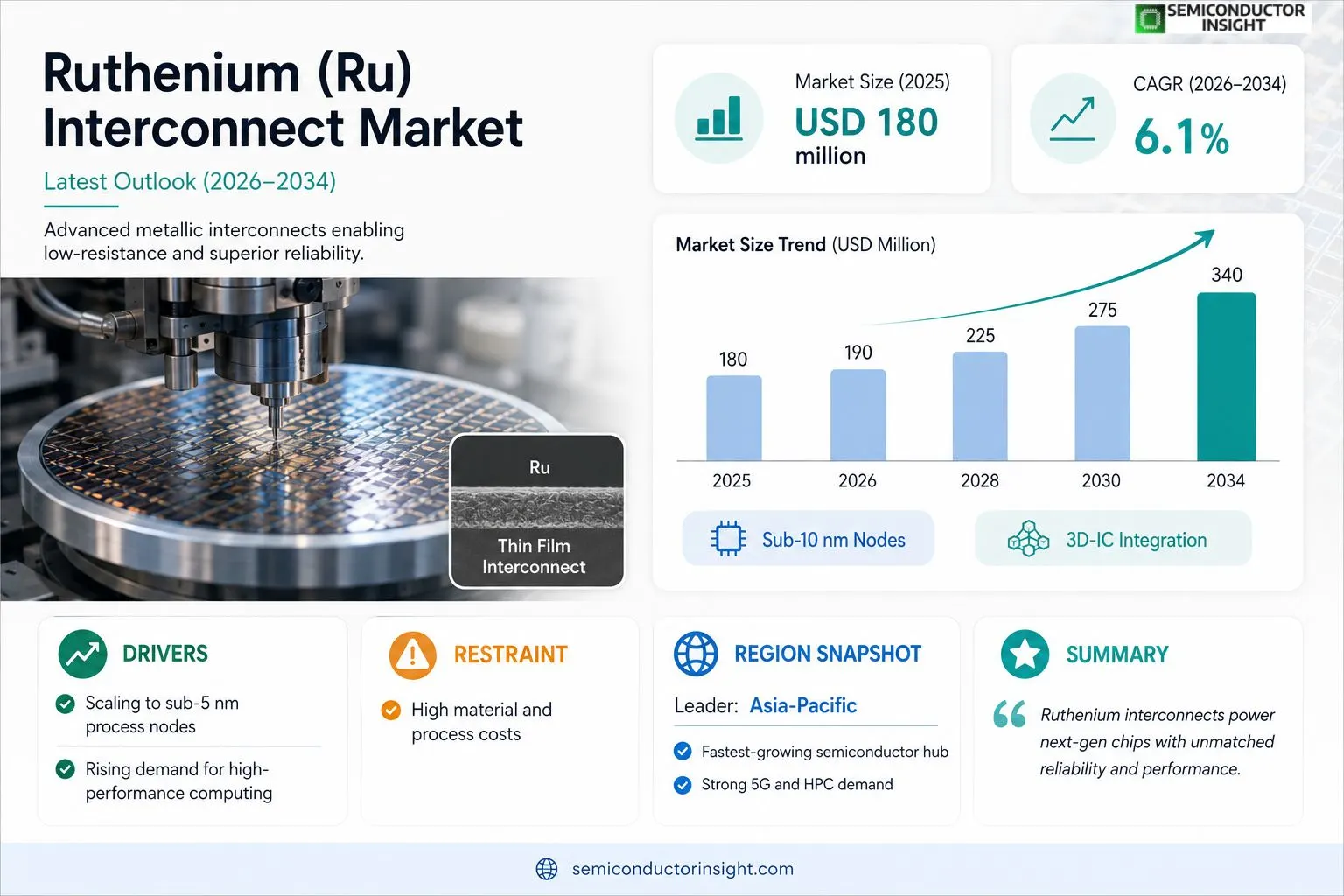
Global Ruthenium (Ru) Interconnect Market size was valued at USD 180 million in 2025. The market is projected to grow from USD 190 million in 2026 to USD 340 million by 2034, exhibiting a CAGR of 6.1% during the forecast period.
Ruthenium interconnects are thin‑film metallic conductors employed in advanced semiconductor devices to replace copper at sub‑10 nm nodes because of their superior electromigration resistance and lower resistivity at nanoscale dimensions. They enable tighter line widths and improved signal integrity in logic and memory chips.The market is experiencing rapid growth due to several factors, including heightened demand for high‑performance computing, increasing rollout of 5G infrastructure, and rising investment in next‑generation chip manufacturing. Furthermore, recent collaborations between leading foundries and material suppliers have accelerated technology transfer, while cost‑reduction initiatives are making Ru‑based processes more economically viable.
MARKET DRIVERS
Technology Advancement in Semiconductor Nodes
The ongoing shift to sub‑5 nm process nodes is prompting chip manufacturers to adopt Ruthenium (Ru) Interconnect Market solutions because of Ru’s low resistivity and excellent reliability under high‑temperature annealing. This technical advantage drives capital investment in Ru‑based metallization platforms.
Demand for High‑Performance Computing
Data‑center expansion and AI workloads require interconnects with minimal signal loss, positioning Ru as a preferred material over copper in critical back‑end‑of‑line stages. The performance edge directly fuels market uptake.
➤ Industry forecasts indicate that the integration of Ru interconnects will become a standard practice for leading‑edge nodes within the next five years.
Furthermore, government initiatives supporting advanced semiconductor fabs in key regions are accelerating adoption of Ru‑based processes, reinforcing the growth trajectory of Ruthenium (Ru) Interconnect Market.
MARKET CHALLENGES
High Material and Process Costs
Despite its performance benefits, ruthenium remains more expensive than conventional copper, and the specialized deposition equipment adds to the overall fab expenditure, limiting rapid scale‑up.
Other Challenges
Integration Complexity
The transition from copper to Ru demands re‑qualification of process steps, stringent contamination controls, and workforce training, which can slow adoption timelines.
MARKET RESTRAINTS
Supply Chain Vulnerabilities
Ruthenium is a rare by‑product of platinum and palladium mining, and its supply is concentrated in a few geographic locations. Any disruption can constrain Ruthenium (Ru) Interconnect Market pipeline.Additionally, the limited number of certified ruthenium sputtering providers creates bottlenecks, especially for high‑volume production runs.The lack of standardized testing protocols for Ru interconnect reliability further restrains confidence among tier‑1 semiconductor manufacturers.
MARKET OPPORTUNITIES
Emerging Applications in 3D‑IC and Chip‑let Integration
Three‑dimensional integrated circuits and heterogeneous chip‑let architectures require ultra‑low resistance vertical interconnects, a niche where ruthenium’s superior electromigration resistance offers a clear advantage.Strategic partnerships between equipment vendors and material suppliers are creating new process windows that lower the cost impact of Ru, making it more accessible for mid‑range fabs.Finally, the growing emphasis on energy‑efficient computing drives demand for interconnect solutions that reduce power loss, positioning Ruthenium (Ru) Interconnect Market for accelerated adoption in next‑generation devices.
Ruthenium (Ru) Interconnect Market Trends
Shift to Sub‑10 nm Nodes Drives Ru Adoption
The push toward sub‑10 nm semiconductor nodes has placed unprecedented stress on traditional copper interconnects, whose electromigration resistance and resistivity degrade sharply at these dimensions. Ruthenium (Ru) interconnects, with markedly lower resistivity at the nanoscale and superior resistance to atom migration, now enable designers to achieve tighter line widths while preserving signal integrity. Leading foundries are integrating Ru thin‑film processes into logic and memory production lines to meet the performance targets of next‑generation CPUs and GPUs. This transition is reinforced by the material’s compatibility with existing damascene workflows, allowing a relatively smooth technology transfer without major equipment overhaul. Consequently, Ruthenium (Ru) Interconnect Market is experiencing a clear upward trajectory as manufacturers prioritize reliability and power efficiency in ultra‑scaled devices.
Other Trends
5G Infrastructure Expansion
The global rollout of 5G networks is accelerating the demand for high‑throughput data processing, which in turn fuels the need for faster and more reliable semiconductor components. Data‑center processors and edge‑computing chips designed for 5G back‑haul require interconnect solutions that can sustain high current densities without failure. Ruthenium’s robustness under intense electrical stress makes it an attractive choice for these applications, allowing manufacturers to produce chips that support the low‑latency, high‑bandwidth requirements of next‑generation wireless services. As telecom operators continue to densify network topology, the ripple effect on chip design amplifies the relevance of Ru‑based interconnects across the supply chain.
Cost‑Reduction and Supply‑Chain Collaboration
Recent collaborations between leading foundries and specialty material suppliers have focused on scaling Ru production while driving down unit costs. Joint R&D initiatives streamline deposition techniques, improve yield, and reduce the number of process steps required for Ru integration. These efficiency gains are complemented by strategic sourcing agreements that stabilize raw‑material availability, mitigating the volatility historically associated with precious‑metal markets. In addition, environmentally conscious manufacturing practices are emerging, as Ru recycling and waste‑minimization programs become standard within advanced node fabs. The convergence of cost‑effective supply chains and greener processes positions Ruthenium (Ru) Interconnect Market for sustained growth, with broader industry adoption expected as the technology matures.
COMPETITIVE LANDSCAPEKey Industry Players
Ruthenium Interconnect Market Competitive Overview
The Ruthenium (Ru) interconnect segment is dominated by large semiconductor‑equipment manufacturers that have integrated Ru deposition capabilities into their existing product lines. Applied Materials leads the market by offering a full suite of atomic‑layer‑deposition (ALD) and physical‑vapor‑deposition (PVD) tools optimized for sub‑10 nm nodes, leveraging its extensive customer base among leading foundries. ASM International follows closely, providing high‑throughput ALD systems that achieve uniform Ru films with superior electromigration resistance. These incumbents benefit from deep R&D pipelines, strategic collaborations with chipmakers, and the ability to bundle Ru solutions with complementary process technologies, creating a consolidated market structure where a few tier‑one suppliers capture the majority of equipment spend.Beyond the tier‑one tier, a cohort of niche specialists contributes critical materials and equipment expertise. Companies such as Veeco Instruments and Picosun focus on specialized sputtering and ALD platforms that address high‑volume, low‑cost production. Materials firms including Umicore, Heraeus, and Sumitomo Metal Mining supply high‑purity Ru precursors and target materials, enabling cost‑effective scaling. Regional players like Tokyo Electron, Lam Research, and Hitachi High‑Technologies reinforce the competitive landscape by tailoring equipment to specific customer requirements, while emerging entrants from Korea and Taiwan are advancing alternative Ru‑based processes to capture market share in the fast‑growing high‑performance computing and 5G segments.
List of Key Ruthenium Interconnect Companies Profiled
- Applied Materials, Inc.
- ASM International N.V.
- Lam Research Corporation
- Tokyo Electron Ltd.
- Hitachi High‑Technologies Corporation
- Veeco Instruments Inc.
- Picosun Oy
- Sumitomo Metal Mining Co., Ltd.
- Umicore
- Heraeus Holding GmbH
- POSCO Advanced Materials
- JX Nippon Mining & Metals Corporation
- Materion Corporation
- Advanced Semiconductor Materials International (ASMI)
- Savannah Materials Ltd.
Segment Analysis:
| Segment Category | Sub-Segments | Key Insights |
| By Type |
|
Thin‑film ruthenium
|
| By Application |
|
Logic chips
|
| By End User |
|
Semiconductor manufacturers
|
| By Integration Stage |
|
Back‑end interconnect
|
| By Performance Driver |
|
Electromigration resistance
|
Regional Analysis: North America
United States
The strategic importance of the US in technological innovation positions it as a key driver for Ruthenium (Ru) Interconnect Market. Government funding for defense and aerospace programs creates consistent demand for high-reliability materials. The concentration of leading electronics manufacturers and research institutions further fuels market growth. Challenges include the volatility of raw material prices and increasing competition from alternative materials. However, the strong technological foundation and continuous innovation ensure sustained demand for Ruthenium in critical interconnect applications. The US is also a major importer and exporter of Ruthenium-based components, contributing significantly to the global supply chain for the Ruthenium Interconnect Market.
The aerospace and defense sectors represent a major application segment for Ruthenium interconnects, where high reliability and resistance to harsh operating conditions are paramount. Ruthenium’s ability to withstand extreme temperatures and corrosive environments makes it ideal for these demanding applications.
The burgeoning high-performance computing (HPC) industry is increasingly relying on Ruthenium interconnects to facilitate faster data transfer speeds and improved processing capabilities. Ruthenium’s electrical conductivity and thermal stability are crucial for these advanced computing systems.
Ruthenium finds application in medical devices and implants due to its biocompatibility and unique electrical properties, contributing to advancements in diagnostic and therapeutic technologies.
Ruthenium interconnects are utilized in various industrial electronic applications where high reliability and resistance to wear and tear are essential.
Europe
Europe exhibits a steady growth in Ruthenium (Ru) Interconnect Market, propelled by advancements in automotive electronics, telecommunications infrastructure, and industrial automation. The region’s strong emphasis on sustainable technologies and efficient resource utilization is fostering demand for high-performance materials like Ruthenium. Several key players in the European electronics industry are actively exploring the use of Ruthenium in their products, driving market expansion. The automotive sector’s shift towards electric vehicles and advanced driver-assistance systems (ADAS) is creating new opportunities for Ruthenium interconnects. However, stringent environmental regulations and fluctuating economic conditions pose certain challenges to market growth within Europe. The focus on circular economy principles is also influencing material selection and recycling practices in the region.
Asia-Pacific
The Asia-Pacific region is emerging as a significant and rapidly growing market for Ruthenium (Ru) Interconnects. Driven by the expansion of electronics manufacturing in countries like China, Taiwan, and South Korea, the demand for Ruthenium is steadily increasing. The region’s substantial investments in 5G infrastructure, artificial intelligence (AI), and the Internet of Things (IoT) are fueling the need for high-performance interconnect solutions. The presence of major electronics manufacturers and a large consumer base contributes to the robust growth of the Ruthenium Interconnect Market in Asia-Pacific. Despite the strong growth potential, competition from lower-cost alternatives and geopolitical uncertainties represent challenges for market players in the region. There’s a growing emphasis on domestic production and supply chain security within the Asia-Pacific region, which could influence market dynamics.
South America
South America represents a relatively smaller but expanding market for Ruthenium (Ru) Interconnects. The growth is primarily linked to the development of the electronics industry in countries like Brazil and Argentina, as well as investments in telecommunications infrastructure. The increasing adoption of smartphones, smart devices, and industrial automation systems is contributing to the demand for high-performance interconnect solutions. The region’s economic stability and supportive government policies are favorable for market growth. However, limited domestic production capabilities and reliance on imports pose challenges for the Ruthenium interconnect market in South America, along with complex regulatory environments.
Middle East & Africa
The Middle East and Africa represent a nascent market for Ruthenium (Ru) Interconnects, with growth potential driven by increasing investments in infrastructure projects, particularly in telecommunications and energy sectors. The expansion of smart cities and the growing demand for advanced electronics are further supporting market expansion. The region’s economic diversification initiatives and government focus on technological advancement are creating new opportunities for Ruthenium interconnect applications. However, limited industrial base and geopolitical instability are hindering the overall growth of the Ruthenium Interconnect Market in the region. Significant investments in renewable energy projects are also expected to influence the demand for specialized interconnect materials.
Report Scope
This market research report provides a comprehensive analysis of the Ruthenium (Ru) Interconnect Market , covering the forecast period 2026–2034. It offers detailed insights into market dynamics, technological advancements, competitive landscape, and key trends shaping the industry.
Key focus areas of the report include:
- Market Overview: The report begins with an overview outlining its current market scenario, key growth indicators, and industry transformation drivers. It discusses macroeconomic factors, demand–supply balance, regulatory landscape, and the strategic role of semiconductors in powering advancements across industries such as automotive, telecommunications, consumer electronics, and industrial automation.
- Market Size & Forecast: Historical data and future projections for revenue, unit shipments, and market value across major regions and segments.
- Segmentation Analysis: Detailed breakdown by product type, technology, application, and end-user industry to identify high-growth segments and investment opportunities.
- Regional Insights: Insights into market performance across North America, Europe, Asia-Pacific, Latin America, and the Middle East & Africa, including country-level analysis where relevant.
- Competitive Landscape: Profiles of leading market participants, including their product offerings, R&D focus, manufacturing capacity, pricing strategies, and recent developments such as mergers, acquisitions, and partnerships.
- Technology Trends & Innovation: Assessment of emerging technologies, integration of AI/IoT, semiconductor design trends, fabrication techniques, and evolving industry standards.
- Market Drivers & Restraints: Evaluation of factors driving market growth along with challenges, supply chain constraints, regulatory issues, and market-entry barriers.
- Stakeholder Insights: Insights for component suppliers, OEMs, system integrators, investors, and policymakers regarding the evolving ecosystem and strategic opportunities.
Primary and secondary research methods are employed, including interviews with industry experts, data from verified sources, and real-time market intelligence to ensure the accuracy and reliability of the insights presented.
FREQUENTLY ASKED QUESTIONS:
What is the current market size of Ruthenium (Ru) Interconnect Market?
-> Ruthenium (Ru) Interconnect Market was valued at USD 180 million in 2025 and is expected to reach USD 340 million by 2034.
Which key companies operate in Ruthenium (Ru) Interconnect Market?
-> Key players include leading semiconductor manufacturers and material suppliers such as Intel, TSMC, Samsung, Heraeus, and Umicore.
What are the key growth drivers?
-> Key growth drivers include high‑performance computing demand, 5G infrastructure rollout, and investment in next‑generation chip manufacturing.
Which region dominates the market?
-> Asia-Pacific is the fastest‑growing region, while Europe remains a significant market.
What are the emerging trends?
-> Emerging trends include integration of Ru interconnects in sub‑10 nm nodes, collaborative technology transfer programs, and cost‑reduction initiatives for Ru‑based processes.

Get Sample Report PDF for Exclusive Insights
Report Sample Includes
- Table of Contents
- List of Tables & Figures
- Charts, Research Methodology, and more...
 Download Sample Report PDF