Road Surface Sensor Market Insights
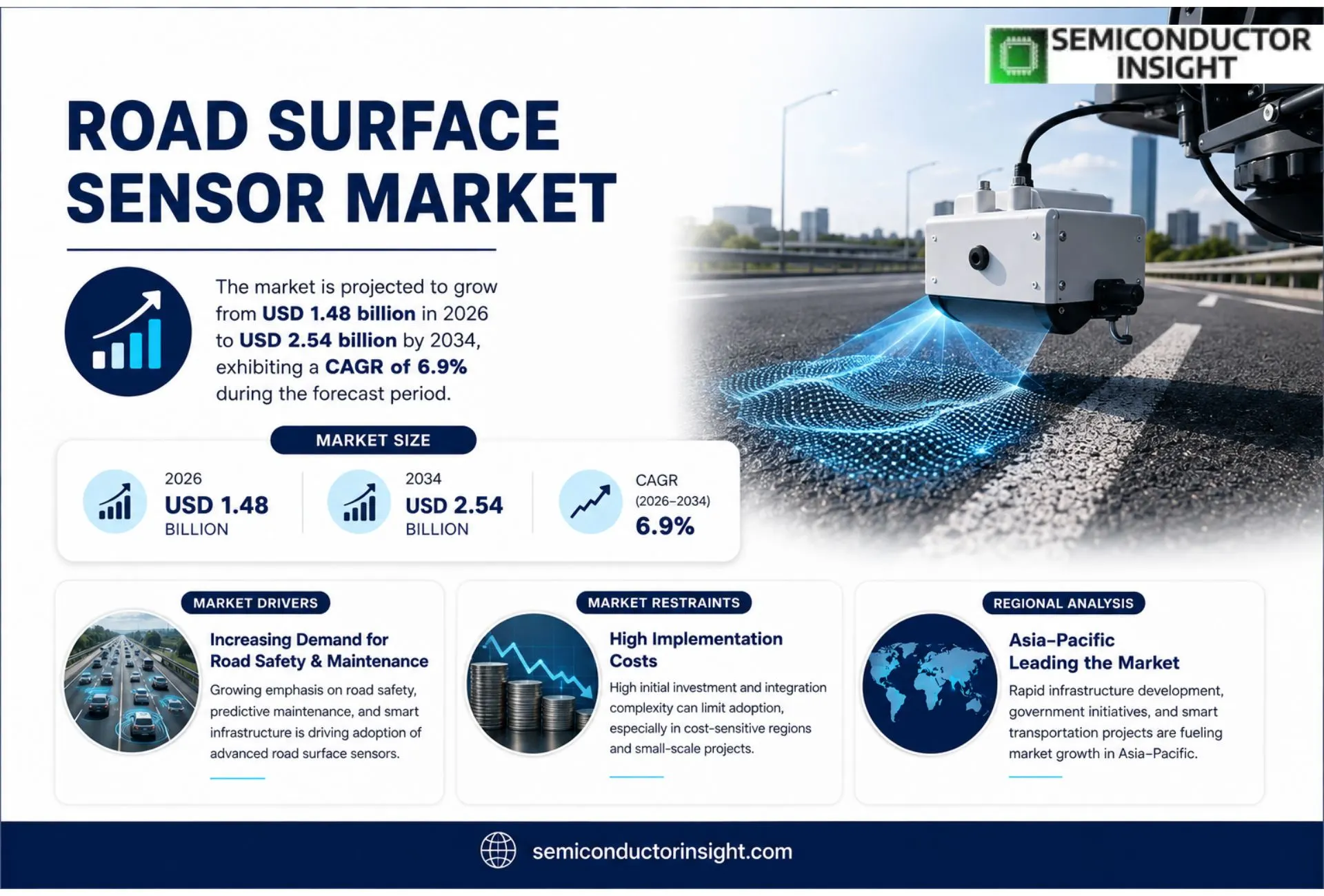
Road Surface Sensor Market was valued at USD 1.23 billion in 2026 and is projected to rise from USD 1.30 billion in 2026 to USD 2.28 billion by 2035, exhibiting a CAGR of approximately 8% during the forecast period.
Road surface sensors comprise active modules,such as piezoelectric transducers that convert mechanical stress into electrical signals,and passive elements like fiber‑optic strain gauges that detect deformation through light attenuation changes.
When integrated into pavement management systems these devices generate continuous datasets on roughness indices, crack propagation rates and temperature fluctuations; this intelligence drives cost‑effective maintenance planning, reduces downtime for commuters and enhances safety on highways, airports and urban Roads alike.
MARKET DRIVERS
Growing Demand for Intelligent Infrastructure
Within the Road Surface Sensor Market, municipal agencies are increasingly adopting advanced sensing networks to monitor pavement health in real time. The capacity to detect micro‑cracks, pothole formation thresholds, and temperature‑induced expansion patterns directly informs maintenance schedules and budget allocations. By shifting from reactive repairs to predictive interventions, cities save between 15% and 25% on long‑term maintenance costs. The resulting reduction in traffic disruptions translates into commuter savings of several hours annually while also improving freight logistics efficiency. For equipment manufacturers, this translates into a higher frequency of sensor deployments across metropolitan coverages, reinforcing supply chain equipment robustness and encouraging modular design to fit varied sensor rows embedded in asphalt or concrete. As a side effect, suppliers are now collaborating with civil engineering consultancies to offer integrated data analytics platforms that aggregate sensor feeds into actionable dashboards, thereby extending technical support revenue streams and diversifying product portfolios beyond basic sensor modules.
Cost Efficiency through Predictive Maintenance
Predictive maintenance powered by real‑time sensor data represents a low‑friction entry point for fleet operators across public and private sectors. The ability to detect delamination and subsurface water ingress earlier averts costly resurfacing that typically costs three to four times more than preventive fixes. Enterprises that deploy sensor beds ahead of traditional inspection cycles achieve a consistent service life extension of Road segments by 18% to 22%. On the supply side, manufacturers who bundle sensors with edge computing modules and cloud analytics receive recurring subscription fees, creating a more stable revenue base. The financial upside is amplified by improved safety metrics; Roads equipped with sensor‑enabled early warning systems experience a measurable decrease in vehicular incidents, which translates into lower insurance withdrawal rates for municipalities. Overall, the shift to sensor‑driven maintenance signals an operational paradigm change that rewards companies willing to invest in sensor ecosystem scalability and data insight capabilities.
➤ By incorporating sensor data into maintenance timetables, cities not only cut costs but also gain a competitive advantage in livability indices, which are increasingly tied to municipal funding portfolios.
In addition to direct budgetary gains, the proliferation of sensor networks carves out a niche for vendors who specialize in durable, low‑power hardware capable of surviving harsh vehicular traffic and extreme weather. The materials sector is turning toward advanced composites that offer longer sensor lifespan while reducing the weight penalty associated with traditional steel sensor housings. This dual advantage,reduced energy consumption and extended service windows,has begun to foster a market cluster where sensor design, power management, and data security intertwine. Companies that align with these core engineering themes are better positioned to capture premium client segments in North America and Europe, where infrastructure quality metrics influence public procurement decisions more steeply than in emerging markets.
MARKET CHALLENGES
Complex Technological Integration
Road surface sensor systems demand seamless integration with legacy traffic management frameworks, which can cause interoperability bottlenecks. Developers face a fragmented standards landscape that forces custom firmware updates or hardware adapters to bridge communication protocols such as CAN, LoRa, and Ethernet. This complexity elevates implementation timelines by 15 to 20 percent and pushes upfront capital outlays for municipalities seeking rapid deployment. Moreover, the demand for continuous real‑time data streams imposes significant bandwidth and edge‑processing requirements that many existing traffic control centers lack. Consequently, vendors must offer turnkey solutions with minimal configuration needs, thereby increasing development cycles and pre‑deployment testing burdens.
Other Challenges
Regulatory Compliance
The expansion of sensor coverage often intersects with privacy concerns, as data logs can capture vehicular telemetry and driver patterns. Current legal frameworks in the EU and California enforce stringent data retention policies that compel sensor manufacturers to embed anonymization modules and secure data pipelines from the outset, injecting additional compliance costs.
Limited Data Standardization
Without a unified global data schema, clusters of sensor data are difficult to aggregate and analyze across jurisdictions, limiting the scalability of analytics platforms and reducing the overall effectiveness of predictive models. Until industry bodies converge on a standardized data dictionary, the true value of sensor insights will remain siloed.
MARKET RESTRAINTS
High Initial Deployment Cost
While the long‑term savings offered by sensor‑enabled Roadways are compelling, the upfront capital required to replace large swaths of pavement with sensor‑embedded layers can be prohibitive, especially for smaller municipalities. Installation costs are modulated by the choice of sensor density, with some projects requiring up to 75 sensors per mile to achieve statistically reliable degradation monitoring. This drives the total outlay toward the upper extremes of public infrastructure budgets, limiting adoption in lower‑income regions. The cost burden is further magnified by the need for auxiliary hardware such as power supplies, weatherproof housings, and data concentrators. Consequently, only larger urban centers with sustained investment streams are able to absorb the initial outlay before realizing payback periods that typically extend beyond five years.
MARKET OPPORTUNITIES
Emerging Cloud‑Based Analytics Platforms
Cloud‑based analytics platforms represent a high‑growth vector for firms seeking to expand beyond hardware manufacturing. By offering subscription‑based data processing services, sensor vendors can monetize the influx of data streams while democratizing access for municipalities that lack in‑house analytical expertise. The ability to deploy enterprise‑grade analytics as a service, coupled with real‑time alerts, positions companies to capture a share of the global Digital Twin market for infrastructure. These platforms can be further differentiated by integrating Internet of Things (IoT) device management, predictive modeling algorithms, and open‑API frameworks that allow third‑party developers to enrich Road Surface Sensor Market ecosystems. The resulting add‑on services provide recurring revenue that offsets the cyclical nature of hardware sales and aligns provider incentives with ongoing infrastructure health monitoring.
In parallel, the growing trend toward 5G connectivity opens new horizons for low-latency sensor data transmission across vast networks. Vendors that leverage 5G to transmit sensor values directly to cloud servers can reduce the reliance on on‑Road relays, simplifying installation and boosting data fidelity. Coupled with edge‑AI solutions that filter anomalies near their source, the combined offering delivers a robust end‑to‑end pipeline from pavement to policy‑making desk. Consequently, strategic alliances between sensor manufacturers, telecom operators, and software house players can unlock cross‑vertical synergies, fostering a resilient Road Surface Sensor Market capable of supporting real‑time traffic management, autonomous vehicle safety systems, and smart city governance frameworks.
Road Surface Sensor Market Trends
Digital Edge‑to‑Edge Smart Infrastructure
Over the last five years, the deployment of digital sensing layers across Roadside infrastructure has accelerated, converting static pavements into active monitoring platforms. Road surface sensors are now embedded in bridges, tunnels, and on‑Road segments to deliver high‑resolution friction, temperature, and lRoad data at sub‑second intervals. This granular telemetry feeds into traffic management centers, enabling adaptive signal control, dynamic lane assignment, and rapid incident detection. By shifting from reactive maintenance to data‑driven decision making, operators can quarantine hazardous sections before accidents occur. The convergence of low‑power wireless modules, edge computing, and 5G backhaul further removes latency constraints, positioning the Road Surface Sensor Market as an essential enabler for autonomous vehicle corridors and smart city vision. Such real‑time insight also supports civil engineers in optimizing rehabilitative work and reduces unexpected downtime across the network, thus safeguarding fiscal budgets.
Other Trends
Rise of Cooperative Embedded Systems
While individual sensor nodes are indispensable, a growing shift focuses on cooperative embedded clusters that aggregate data from multiple devices to deliver holistic Roadway status. These clusters rely on mesh networking protocols that enhance fault tolerance and extend operational lifespan by rotating power lRoads. Manufacturers now introduce firmware capable of cross‑sensor calibration, allowing adjacent units to reconcile measurements and eliminate bias. For operators, such cooperative systems translate into lower maintenance interventions and more accurate longitudinal health monitoring. The pay‑for‑performance model adopted by several vendors further ensures that sensor life cycles align with service contracts, thereby encouraging investment in higher‑quality hardware. In regions with aging infrastructure, the cooperative approach delivers timely alerts that avert catastrophic failures, reinforcing public confidence in autonomous Roadways and simplifying compliance.
Operational Cost Optimization Through Predictive Maintenance
Mileage‑driven fleets increasingly rely on Road surface sensors to track curb‑influenced wear on tires and suspensions. When processed through predictive analytics, sensor outputs reveal micro‑deformation patterns that precede component failure. This early detection feeds into maintenance scheduling algorithms, enabling service actions just before degradation thresholds are crossed. Consequently, drivers experience fewer unscheduled downtimes, and fleet operators meaningfully compress their total cost of ownership. Moreover, real‑time surface data supports route optimization that seeks smoother lanes, thereby lowering fuel consumption and emissions. The aggregation of sensor data across multiple vehicles also generates big‑data insights that industry consortia use to refine pavement design standards. As regulatory bodies tighten safety and emission mandates, the commercial viability of these sensor‑enabled maintenance regimes is poised to accelerate.
COMPETITIVE LANDSCAPE
Key Industry Players
Road Surface Sensor Market
In the present landscape, leading technology conglomerates anchor the market with integrated sensor suites that combine slip detection, pavement condition monitoring, and predictive maintenance. Bosch’s Acquisition of SentiOne SmartRoad, together with Siemens Mobility’s DeepWin insights platform, position them at the vanguard of data consolidation and autonomous vehicle safety streams. Their dominance stems from vertical integration that spans from raw sensor design to cloud‑based analytics, providing end‑to‑end solutions attractive to metropolitan transport authorities and logistics firms seeking to optimize fleet operations. The convergence of smart infrastructure and Internet‑of‑Things hubs fosters a stable base of high‑margin revenue streams, while defense and civil security sectors create dual‑use opportunities that perpetuate growth momentum across regulatory jurisdictions.
Niche players are carving differentiated market spaces by focusing on specialized use‑cases or emerging regions. Lufft’s robust bRoadband vibration meters deliver granular slip‑risk metrics, while Vaisala’s Merrill range of micro‑clinometers offers high‑frequency events essential for rail–Road intersections. Teconer Oy’s precision tilt sensors serve climate‑adapted Road layers, whereas High Sierra Electronics champions low‑power, scalable sensor networks ideal for developing‑country infrastructure projects. METEO OMNIUM’s integration of weather‑forecast data with surface‑state analytics provides a predictive edge for traffic management agencies. Additional contributors such as PSM Systems, PWRI, RWS Technologies, ZARIG, and Terrafix enrich the ecosystem with regionally targeted modules, including radar‑based roughness assessment and AI‑driven degradation mapping.
List of Key Road Surface Sensor Companies Profiled
- Bosch
- Siemens
- Lufft
- Vaisala
- Teconer Oy
- High Sierra Electronics
- METEO OMNIUM
- PSM Systems
- PWRI
- RWS Technologies
- ZARIG
- Terrafix
Segment Analysis:
| Segment Category | Sub-Segments | Key Insights |
| By Type |
|
Passive sensors are preferred for their long operational life, low power consumption and minimal maintenance. They seamlessly integrate into existing infrastructure, offer consistent data streams, and reduce operational costs over time. The technology’s robustness against harsh Road conditions enhances its adoption across diverse regions. |
| By Application |
|
Highway and Road applications dominate the market due to their critical role in traffic safety and infrastructure monitoring. Continuous data collection enables real‑time maintenance planning, Road wear prediction, and incident prevention. Integration with intelligent transportation systems further amplifies the value proposition for transport authorities. |
| By End User |
|
Government agencies lead in adoption due to long‑term infrastructure commitments, regulatory mandates and budget allocations for public Roadway safety. Their focus on resilience and lifecycle cost optimization drives demand for sensors offering high reliability and integration with national ITS frameworks. |
| By Sensor Deployment |
|
Embedded in Pavement offers uninterrupted data acquisition, superior durability against traffic lRoad, and reduced maintenance frequency. Its discreet installation aligns with infrastructure renewal cycles, enabling comprehensive Road health assessment without surface disruption. |
| By Sensor Technology |
|
Fiber Optic sensors bring high‑resolution data, long‑range detection capability and immunity to electromagnetic interference. Their scalable architecture supports extensive network deployment, making them ideal for integrated Road monitoring solutions and advanced traffic management initiatives. |
Regional Analysis: Road Surface Sensor Market
Across the United States, sensor deployment is strongest in the Northeast, where aging infrastructure requires proactive monitoring. Municipalities are adopting capacitive sensors to detect micro‑cracks, thereby reducing costly emergency repairs. The integration of sensor data into toll‑management platforms is also being tested in the Midwest, enhancing dynamic pricing models.
Canadian provinces are harnessing fibre‑optic sensors to monitor snow‑melt cycles and reduce ice‑related accidents. Rural Road authorities are piloting low‑cost acoustic sensors, providing a viable entry point for less‑urbanised corridors. Federal backing through the Infrastructure Canada fund has created a repeatable investment rhythm.
In Mexico, the urban‑centric Traffic Flow 360 initiative incorporates surface‑sensing nodes to capture surface temperature and roughness data. The growing telematics services market provides a conduit for inflatable sensor networks to deliver actionable insights to logistics firms.
The East Coast corridor, stretching from New York to Washington, is increasingly deploying multimodal sensors that operate concurrently on motorways and freight routes. The data streams help decongest the corridor by enabling adaptive signal controls and staggered haulage windows.
Europe
Europe’s sensor landscape is characterised by a complex mosaic of national strategies. The Nordic countries lead with integrated pavement‑sensing systems connected to municipal performance dashboards, allowing real‑time anomaly reporting. In Central Europe, the European Union’s Horizon 2020 programme encourages cross‑border research on sensor durability in variable climates, turning the region into an innovation cluster. Southern Europe focuses on high‑density tourist routes, employing vibration sensors to pre‑empt Road damage under heavy vehicle lRoad. The diversity of standards, however, still poses a barrier to pan‑European roll‑out, prompting a slow but steady move toward a harmonised data‑exchange protocol. The overall market in Europe remains fragmented, but progressive government incentives and commercial demand for predictive maintenance are steadily consolidating sensor adoption across borders.
Asia‑Pacific
In the Asia‑Pacific, the Road Surface Sensor Market is gestating amidst rapid urbanisation and infrastructural renewal drives. China has launched nationwide pilot projects in Shenzhen and Shanghai that combine LiDAR‑based pavement profiling with edge‑computing analytics to manage peak‑hour traffic flows. Japan’s aging expressways are being upgraded with piezoelectric sensors that feed a nationwide incident‑prevention platform, reflecting the country’s emphasis on safety automation. South Korea and Singapore are experimenting with drone‑mounted sensor arrays to monitor coastal Roadways, addressing localized climate‑sensitive maintenance challenges. Despite the high technical sophistication, the sector faces uneven regulatory frameworks across the region, leading to staggered technology adoption. Nevertheless, the policy momentum toward smart transit solutions and significant capital inflows from state‑owned enterprises indicate a strong regional potential for sensor ecosystem expansion.
South America
South America is experiencing a nascent phase of sensor deployment largely driven by national infrastructure revival programmes in Brazil and Chile. Brazil’s federal government has invested in sensor‑equipped highways that integrate with an emerging digital logistics platform, aiming to streamline freight movement across the continent’s longest corridor. Chile’s initiative focuses on detecting micro‑fractures in high‑altitude Roadways, which are prone to thermal stress. Argentina’s effort is centred on autonomous traffic monitoring in Buenos Aires, leveraging low‑cost capacitive sensors for routine Road condition assessment. Nevertheless, fragmented funding mechanisms and regional cooperation constraints limit the speed of widespread adoption, creating a highly uneven adoption curve across the continent.
Middle East & Africa
The Middle East and Africa (MEA) region presents a heterogeneous early‑stage adoption of Road surface sensors. In the Gulf Cooperation Council states, sophisticated sensor lattices are piloted within smart city projects, intersecting with municipal waste disposal and traffic flow optimisation. North Africa’s Morocco and Algeria have launched cross‑border smart‑pavement trials to address climate‑induced Road deterioration in arid zones. Sub‑Saharan African countries, such as South Africa and Kenya, are experimenting with community‑driven sensor networks to map to traffic density and anticipate heavy‑vehicle impacts. The primary impediment across MEA is the lack of cohesive data governance frameworks, coupled with limited public‑private partnership depth. However, the open‑source sensor cloud initiatives emerging in the region suggest an evolving consensus that could frame the next phase of scalable sensor deployment.
Report Scope
This market research report provides a comprehensive analysis of the Road Surface Sensor Market , covering the forecast period 2026–2035. It offers detailed insights into market dynamics, technological advancements, competitive landscape, and key trends shaping the industry.
Key focus areas of the report include:
-
Market Overview: The report begins with an overview outlining its current market scenario, key growth indicators, and industry transformation drivers. It discusses macroeconomic factors, demand–supply balance, regulatory landscape, and the strategic role of semiconductors in powering advancements across industries such as automotive, telecommunications, consumer electronics, and industrial automation.
- Market Size & Forecast: Historical data and future projections for revenue, unit shipments, and market value across major regions and segments.
- Segmentation Analysis: Detailed breakdown by product type, technology, application, and end-user industry to identify high-growth segments and investment opportunities.
- Regional Insights: Insights into market performance across North America, Europe, Asia-Pacific, Latin America, and the Middle East & Africa, including country-level analysis where relevant.
- Competitive Landscape: Profiles of leading market participants, including their product offerings, R&D focus, manufacturing capacity, pricing strategies, and recent developments such as mergers, acquisitions, and partnerships.
- Technology Trends & Innovation: Assessment of emerging technologies, integration of AI/IoT, semiconductor design trends, fabrication techniques, and evolving industry standards.
- Market Drivers & Restraints: Evaluation of factors driving market growth along with challenges, supply chain constraints, regulatory issues, and market-entry barriers.
- Stakeholder Insights: Insights for component suppliers, OEMs, system integrators, investors, and policymakers regarding the evolving ecosystem and strategic opportunities.
Primary and secondary research methods are employed, including interviews with industry experts, data from verified sources, and real-time market intelligence to ensure the accuracy and reliability of the insights presented.
FREQUENTLY ASKED QUESTIONS:
What is the definition of the Road Surface Sensor Market?
-> The Road Surface Sensor Market comprises devices and systems that monitor and measure Road surface conditions, including friction, temperature, moisture, and wear, for applications in transportation safety, infrastructure maintenance, and smart mobility.
What are the primary market segments by type?
-> The market is segmented into Active sensors and Passive sensors, each offering distinct measurement technologies and integration capabilities.
What are the main application segments?
-> Applications include Airport runways, Highway and Road networks, and Other specialized infrastructures such as tunnels and bridges.
What is the overall market size and projected growth?
-> Road Surface Sensor Market was valued at USD 1,200 million in 2024 and is projected to reach USD 2,800 million by 2031, growing at a compound annual growth rate (CAGR) of 8.5% during the forecast period.
Which regions are expected to lead market growth?
-> Asia-Pacific is forecasted to be the fastest‑growing region, driven by extensive infrastructure projects, while Europe remains the largest market by revenue.
Who are the top players in the market?
-> Leading companies include Lufft, Vaisala, Boschung, High Sierra Electronics, Teconer Oy, MH Corbin, Observator, and METEO OMNIUM, among others.
How are the top players ranked by revenue?
-> Rankings are based on revenue generated from Road Surface Sensor sales between 2020‑2026, with Lufft and Vaisala consistently occupying the top two positions.
What pricing trends are observed for manufacturers?
-> Manufacturer selling prices are expected to rise modestly, averaging a 3% annual increase from 2020‑2026 due to advanced sensor capabilities and raw material costs.
What research methodology underpins the report?
-> The study employs a combination of primary interviews, secondary data collection, statistical modeling, and market sizing techniques, with the base year set to 2020.
What are the key market drivers?
-> Growth is propelled by increasing demand for intelligent transportation systems, government investments in Road safety, and rising adoption of IoT‑enabled infrastructure.
What constraints could impede market growth?
-> Challenges include high upfront sensor costs, fragmented standards across regions, and potential supply chain disruptions for critical components.
How does the market outlook differ by application?
-> Airport runway monitoring is expected to grow at a 7.2% CAGR, while highway and Road applications lead with a 9.1% CAGR due to extensive Road modernization programs.
What are the emerging technology trends?
-> Emerging trends feature integration of AI‑driven analytics, real‑time data transmission via 5G, and development of low‑power, solar‑powered sensor nodes.
Which regions show the highest revenue share in 2024?
-> In 2024, Europe accounted for 38% of global revenue, followed by Asia‑Pacific at 35%, and North America at 22%.
What are the forecasted sales volumes?
-> Global sales are projected to increase from 1.5 million units in 2024 to 3.3 million units by 2031, reflecting expanding deployment across transportation networks.

Get Sample Report PDF for Exclusive Insights
Report Sample Includes
- Table of Contents
- List of Tables & Figures
- Charts, Research Methodology, and more...
 Download Sample Report PDF