Key Statistics
Key Takeaways
- North America is the largest regional market, supported by wireless R&D, aerospace and defense programs, semiconductor design, satellite communications, network-equipment development and the presence of major test-and-measurement suppliers and high-value customers.
- Spectrum analyzers are the leading type because frequency-domain measurement remains fundamental across transmitter development, interference analysis, wireless validation, EMC troubleshooting and advanced modulation work.
- Telecommunication devices form the most demanding application pool as 5G-Advanced, Wi-Fi, satellite connectivity and early 6G development require wider bandwidth, higher frequencies, more antenna paths and more complex modulation.
- High-frequency RF test equipment is among the fastest-growing product areas because FR2, FR3, automotive radar, satellite links and emerging 6G research extend characterization beyond traditional sub-6 GHz workflows.
- Capital cost and rapid standard evolution restrain adoption, particularly for smaller laboratories. Instruments must support wider bandwidth, more ports and higher frequency while customers also face calibration, fixture, software and skilled-engineer costs.
- Automation and software are becoming competitive differentiators. Customers increasingly value repeatable test sequences, remote operation, data analytics, over-the-air methods and software-defined upgrades that extend instrument life as wireless standards evolve.
RF Tester Equipment Market Overview
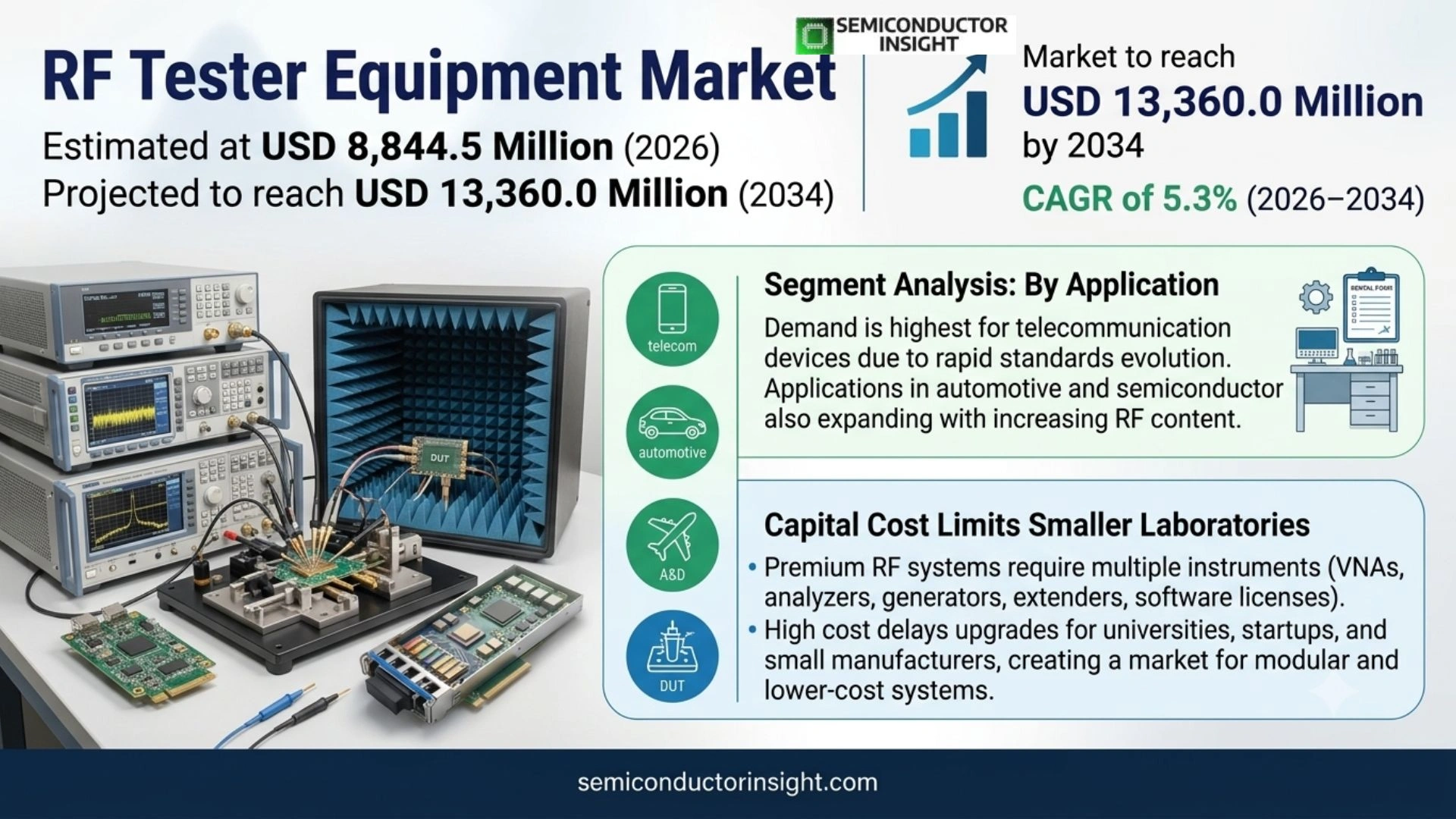
RF Tester Equipment Market was valued at USD 8,400.0 million in 2025, is estimated at USD 8,844.5 million in 2026, and is projected to reach USD 13,360.0 million by 2034, representing a CAGR of 5.3% during 2026–2034. North America is the largest regional market in 2025, while the commercial growth mechanism is increasingly shaped by 5G-Advanced device complexity, 6G FR3 and sub-THz research, non-terrestrial networks, Wi-Fi evolution, automotive radar, and increasingly automated semiconductor RF test.
RF tester equipment includes specialized instruments used to generate, measure, analyze and validate radio-frequency signals from approximately kilohertz ranges through microwave and millimeter-wave frequencies. The category includes signal generators, spectrum and signal analyzers, vector network analyzers, power meters, shielded test systems and wireless connectivity testers. These instruments are used in research, semiconductor characterization, product development, manufacturing, certification, deployment and field maintenance.
The technical burden of RF test increases whenever a communications standard adds bandwidth, antenna paths, carrier aggregation, modulation complexity or higher-frequency operation. 5G-Advanced devices require more sophisticated transmit and receive validation than earlier cellular generations; Wi-Fi continues to expand channel bandwidth and spatial streams; non-terrestrial networks introduce satellite link conditions; automotive radar pushes high-volume testing at millimeter-wave frequencies; and 6G research is extending characterization into FR3 and other new spectrum ranges.
Instrument economics are therefore moving from stand-alone hardware specifications toward reconfigurable platforms. A high-end customer evaluates frequency range and dynamic range, but also software automation, measurement applications, upgrade paths, calibration support, remote control and compatibility with existing test code. This favors suppliers that can preserve a customer’s workflow across multiple standards generations, because replacing measurement software and validation procedures can cost more than replacing the instrument itself.
Segment Analysis: By Type
By type, the market covers signal generators, shield boxes, spectrum analyzers, vector network analyzers, Wi-Fi/Bluetooth testers, and power meters. Spectrum analyzers hold the leading position because they are fundamental to frequency-domain measurement, while vector network analyzers and advanced signal generators capture high value in component characterization, FR3 research, phased-array work and wideband wireless development.
| Type | Technical role | Market position |
|---|---|---|
| Signal Generators | Create calibrated continuous-wave or modulated RF signals used to stimulate receivers, amplifiers, transceivers and complete communications systems. Advanced vector generators reproduce complex 5G, Wi-Fi, satellite and radar waveforms with precise frequency, power, modulation and timing control. | A high-value development and validation segment. Demand rises with modulation complexity and bandwidth because engineers need realistic, repeatable stimulus signals. Software-defined waveform libraries and multi-channel synchronization increase switching costs by embedding the instrument into automated test systems and long-lived validation procedures. |
| Shield Boxes | Provide controlled RF-isolated environments for wireless devices, modules and antennas during development or manufacturing test. They reduce external interference and prevent test signals from radiating into the surrounding environment, improving repeatability for conducted and radiated measurements. | A supporting but important segment in production and device validation. Growth follows wireless-device manufacturing and over-the-air test requirements. Value increases when enclosures include antenna couplers, automation, robotics or fixture integration, while basic boxes face stronger price competition and local manufacturing alternatives. |
| Spectrum Analyzers | Measure signal power as a function of frequency and increasingly combine real-time, vector-signal and demodulation functions. Engineers use them to evaluate spurious emissions, occupied bandwidth, spectral purity, interference, modulation quality and transient events across communications, radar and semiconductor applications. | The leading type because almost every RF development environment requires frequency-domain analysis. Premium positions are defended through wider instantaneous bandwidth, lower noise floor, higher frequency coverage, phase-noise performance and software applications that decode advanced wireless standards or capture short-duration signals. |
| Vector Network Analyzer | Measures complex scattering parameters to characterize the magnitude and phase behavior of RF and microwave components, interconnects, antennas and networks. VNAs are essential for filters, amplifiers, cables, packages, antenna arrays and high-frequency front ends where impedance and transmission behavior determine system performance. | A technically demanding, high-value segment. FR3, millimeter-wave radar, satellite communications and advanced packaging increase the need for more ports, higher frequencies and calibrated fixture de-embedding. Customers prioritize measurement accuracy, dynamic range, calibration ecosystems and application software over entry-level price. |
| Wi-Fi/Bluetooth Tester | Combines generation and analysis functions optimized for wireless-connectivity standards, allowing chipsets, modules and finished devices to be tested against protocol-specific RF requirements. Production-oriented systems emphasize throughput, multi-device handling and automated calibration. | Strongly tied to consumer-electronics and IoT manufacturing. New Wi-Fi generations, wider channels, multi-link operation and Bluetooth evolution create recurring software and hardware upgrade demand. Cost per test second is critical in production, so automation and parallel test capability can matter more than maximum laboratory-grade specifications. |
| Power Meter | Measures absolute and average RF power using sensor heads optimized for different frequencies, levels and modulation types. Power meters remain important for calibration, amplifier characterization, transmitter verification and traceable measurement chains where accuracy must be maintained across instruments and test fixtures. | A mature but resilient segment. Stand-alone demand is steadier than for analyzers, but advanced wideband and peak-power applications support premium sensors. Calibration traceability, sensor interchangeability and compatibility with automated systems determine long-term supplier preference in aerospace, defense and manufacturing environments. |
Why do frequency range and measurement precision increasingly determine price?
High-frequency and high-precision instruments require lower-noise front ends, more stable local oscillators, wider-bandwidth converters, advanced calibration methods and carefully controlled signal paths. Moving from sub-6 GHz measurements into FR2, FR3 or automotive-radar frequencies also makes cables, connectors, fixtures and probe interfaces part of the measurement problem. Buyers therefore pay for an integrated accuracy budget rather than simply a higher frequency label. Instruments that preserve traceability while automating de-embedding and calibration can command substantial premiums.
Segment Analysis: By Application
By application, demand spans consumer electronics, automotive, telecommunication devices, aerospace and defense, and semiconductors. Telecommunication devices form the most demanding application because standards evolve rapidly and require broad protocol support. Semiconductor and automotive applications are also expanding as RF content increases in front-end modules, connectivity ICs, radar sensors and highly integrated wireless systems.
| Application | Demand characteristics |
|---|---|
| Consumer Electronics | Smartphones, routers, wearables, PCs, smart-home devices and IoT products require high-throughput test for cellular, Wi-Fi, Bluetooth and other radios. Manufacturers focus on reducing seconds per unit without losing calibration accuracy, so integrated testers, parallel measurement, software automation and compact shielding systems are critical to production economics. |
| Automotive | Radar, vehicle connectivity, keyless access, telematics, V2X and in-cabin wireless systems create a growing RF validation burden. Automotive radar introduces millimeter-wave characterization, while long qualification cycles require stable calibration and reproducible fixtures. Suppliers must support both component-level testing and over-the-air system verification under production conditions. |
| Telecommunication Devices | Base stations, user equipment, radio units, antennas and network modules must meet complex standards for modulation quality, spectral emissions, sensitivity and multi-antenna behavior. 5G-Advanced and early 6G research add wider bandwidth, FR3 experimentation, AI-assisted receiver concepts and non-terrestrial links, sustaining demand for premium signal generators, analyzers and channel emulation. |
| Aerospace & Defense | Radar, electronic warfare, secure communications, satellite payloads and avionics require high dynamic range, low phase noise, wide frequency coverage and traceable measurement. Programs are lower volume but support high instrument values because test systems must characterize signals under mission-specific conditions and often remain in service for many years. |
| Semiconductors | RF front-end ICs, power amplifiers, transceivers, filters, connectivity chips and mixed-signal devices require wafer, package and final-test characterization. Increasing integration and higher data rates raise the number of parameters measured per device, while production economics drive parallel test, calibration automation and tighter correlation between laboratory and manufacturing equipment. |
How is 6G research changing equipment requirements before a standard is finalized?
6G development creates demand well before commercial deployment because researchers must characterize candidate frequency ranges, radio front ends, waveforms, antennas and receiver algorithms. FR3 work in roughly the upper microwave range bridges traditional cellular frequencies and millimeter-wave operation, requiring wideband signal generation and network analysis with better fixture calibration. AI-assisted receivers and integrated sensing introduce additional measurement dimensions. Suppliers that provide flexible hardware and software-defined measurement applications can participate through the research cycle without waiting for a final standard.
Regional Analysis
North America leads the RF tester equipment market through its concentration of wireless R&D, semiconductor design, aerospace and defense programs, satellite communications, hyperscale connectivity and major test-equipment customers. Asia Pacific is the largest manufacturing center for wireless devices and is a major growth market, while Europe combines leading instrument vendors with automotive, industrial and 6G research demand.
Why do RF test purchasing criteria vary so much by region?
North American demand is weighted toward high-performance R&D, defense and semiconductor characterization, which supports premium instruments and software. Asia Pacific combines advanced wireless research with enormous device and electronics manufacturing volumes, so both top-end laboratories and throughput-optimized production systems matter. Europe emphasizes automotive, industrial, telecom and metrology quality. South America is more dependent on imported equipment and network deployment cycles, while Middle East and Africa increasingly invest in advanced telecom spectrum, defense and digital infrastructure.
| Region | Position | Growth outlook | Demand profile | What decides supplier selection |
|---|---|---|---|---|
| North America | Largest | Steady to strong | R&D, semiconductor, aerospace and telecom led | Performance, software, calibration, security and lifecycle support |
| Asia Pacific | Large and fast-growing | Above market average | Manufacturing plus 5G/6G development | Throughput, local service, automation, price-performance and protocol coverage |
| Europe | Established premium market | Moderate | Automotive, industrial, telecom and research led | Metrology quality, standards support, automotive workflows and interoperability |
| South America | Smaller import-dependent market | Selective | Telecom deployment and electronics manufacturing | Landed cost, service availability, financing and calibration support |
| Middle East & Africa | Emerging project market | Selective high growth | 5G/6G, defense and infrastructure | Spectrum roadmap, local support, rugged systems and project integration |
Competitive Landscape
The market is led by global test-and-measurement companies with deep RF intellectual property, calibration networks and software portfolios, alongside specialized wireless testers and value-oriented regional manufacturers. Competitive advantage comes from protecting measurement accuracy while expanding frequency, bandwidth, channel count and automation without forcing customers to rebuild established test code.
Keysight Technologies and Rohde & Schwarz compete across premium spectrum analysis, signal generation, vector network analysis, wireless protocol test and advanced research. Their installed bases create strong recurring software and service opportunities because engineers build measurement procedures around instrument APIs and application packages. Anritsu is particularly strong in communications device test and field measurement, while Tektronix and VIAVI add important capabilities across RF, network and communications validation.
Specialists such as LitePoint focus on production-oriented wireless connectivity test where throughput and cost per device are decisive. Maury Microwave serves high-frequency component characterization, while thinkRF and other focused vendors address portable or software-defined monitoring niches. Asian manufacturers such as RIGOL, SIGLENT and regional suppliers compete aggressively on price-performance, expanding access to capable RF instruments in education, general R&D and cost-sensitive production environments.
The competitive battlefield is moving toward software-defined longevity. Standards evolve faster than capital budgets, so customers prefer instruments that can add new modulation analysis, protocol features, automation and remote workflows through software. Vendors with large application libraries and calibration ecosystems can monetize upgrades while protecting installed hardware positions, whereas hardware-only competitors risk replacement when a new radio generation exceeds frequency or bandwidth limits.
| Competitive tier | Representative companies | Commercial basis |
|---|---|---|
| Global premium platform leaders | Keysight Technologies, Rohde & Schwarz, Anritsu, Tektronix, VIAVI | Broad RF portfolios, advanced measurement science, global calibration and service, standards participation, software applications and enterprise automation ecosystems. |
| Wireless & microwave specialists | LitePoint, Maury Microwave, thinkRF, Tescom, Adivic | Focused production connectivity test, component characterization, monitoring, fixtures and specialized application expertise. |
| Value and regional equipment suppliers | RIGOL, GW Instek, SIGLENT Technologies, Zhuhai Bojay Electronics, EMCPIONEER | Price-performance, broad distribution, improving bandwidth and frequency capability, and strong appeal to general R&D, education and cost-sensitive manufacturing. |
Key Market Participants
Keysight Technologies, Rohde & Schwarz, Tektronix, Anritsu, VIAVI, LitePoint, RIGOL, GW Instek, Maury Microwave, thinkRF, Tescom, Adivic, SIGLENT Technologies, Zhuhai Bojay Electronics, EMCPIONEER.
Production Capacity Analysis
RF tester production depends on precision microwave hardware, high-speed data converters, frequency synthesizers, low-noise front ends, calibration standards, mechanical interconnects and sophisticated software. Capacity is less about assembly volume than about the availability of high-performance RF components and the engineering required to calibrate each signal path across frequency, temperature and power. Premium instruments also rely on long-lived service and metrology infrastructure after shipment.
Front-end performance is established by mixers, attenuators, amplifiers, oscillators, filters and converters that must preserve dynamic range across very wide frequency ranges. High-end instruments often use custom or tightly specified RF components, making redesign difficult when a supplier changes a process or package. Component qualification therefore affects both production continuity and the ability to support an instrument family for a decade or more.
System integration combines precision analog RF paths with FPGAs, CPUs, high-speed converters and large data-processing pipelines. A modern analyzer may capture gigahertz of instantaneous bandwidth and perform complex demodulation in real time, creating demanding thermal and digital requirements beside the microwave hardware. Calibration data must compensate for path variation so that performance remains traceable rather than merely fast.
Manufacturing continues after final assembly through calibration, verification and service. Premium instruments require reference standards, accredited calibration processes and global repair capability. Customers in defense, semiconductor and telecom labs often cannot accept long downtime, so regional calibration centers and loaner equipment become part of the commercial value proposition. This service footprint is difficult for a new entrant to replicate quickly.
| Capacity layer | Where it concentrates | Commercial constraint |
|---|---|---|
| Precision RF components | United States, Europe, Japan and advanced Asian semiconductor ecosystems | Low-noise, wideband and millimeter-wave components require tight specifications and can have limited qualified alternatives. |
| Converters, FPGA & processing hardware | Global semiconductor supply chains centered in United States and Asia | High-speed ADC/DAC availability, FPGA roadmaps and thermal constraints determine achievable instantaneous bandwidth and processing performance. |
| Instrument integration & calibration | United States, Germany, Japan, China and other major vendor manufacturing centers | Calibration complexity, automation, traceability and experienced RF engineering limit how quickly premium production can be scaled. |
| Service & metrology network | Regional calibration centers near major telecom, semiconductor and defense customers | Turnaround time, accredited calibration, spare parts and software support are essential to lifecycle economics and customer retention. |
Market Dynamics
RF test demand rises when radios become more complex, but the same complexity raises equipment cost and shortens useful technology cycles. Suppliers must therefore help customers extend platform life through software, modularity and automation. The market’s strongest growth is tied to new frequency bands, multi-antenna systems, non-terrestrial networks and semiconductor integration that create measurement problems existing instruments cannot solve efficiently.
Market Drivers
| Factor | Directional impact | Why it matters |
|---|---|---|
| 5G-Advanced and early 6G R&D | High | New bands, wider bandwidth and AI-assisted radio concepts require upgraded generators, analyzers, VNAs and channel-emulation workflows. |
| Non-terrestrial networks and satellite connectivity | Medium-High | NTN adds Doppler, delay, timing and link conditions that require specialized device and protocol validation. |
| Automotive radar and connectivity | Medium-High | More radar sensors and wireless functions increase laboratory, over-the-air and production RF test per vehicle platform. |
| RF semiconductor integration | High | Complex front ends and connectivity ICs require more characterization parameters and tighter correlation between R&D and manufacturing. |
5G-Advanced increases software content in test
Later 5G releases add higher-order modulation, advanced antenna switching, carrier aggregation and more complex radio combinations. The hardware platform may remain capable, but measurement applications must evolve to decode new waveforms and automate new conformance procedures. This creates recurring software revenue and encourages customers to stay within an instrument ecosystem where existing automation code can be preserved.
6G FR3 expands the characterization envelope
FR3 research pushes radio development into frequencies above traditional sub-6 GHz mobile bands while maintaining wide instantaneous bandwidth. Engineers must characterize active front ends, antennas and complete signal chains with accurate de-embedding and modulation analysis. Early research therefore supports VNA, signal-generator and spectrum-analyzer demand years before commercial 6G handsets are available.
NTN brings satellite conditions into device laboratories
Direct-to-device and other non-terrestrial services require user equipment to operate under large propagation delays, Doppler shifts and changing link conditions. Reproducing these effects in a controlled laboratory requires additional signal generation, fading and protocol functions. As NTN moves into standards and certification, test requirements spread from network research into chipset and device validation.
Automotive RF content multiplies qualification points
Modern vehicles include cellular, Wi-Fi, Bluetooth, GNSS, keyless access and radar. Each radio introduces antennas, RF paths and compliance requirements, while automotive programs also demand temperature and lifetime validation. Radar at millimeter-wave frequencies requires specialized fixtures and over-the-air setups, expanding the value of high-frequency measurement beyond traditional telecom laboratories.
Market Restraints
| Factor | Directional impact | Why it matters |
|---|---|---|
| High capital cost | High | Wideband millimeter-wave analyzers, VNAs and multi-channel systems require large budgets plus fixtures, probes, software and calibration. |
| Rapid standards evolution | Medium-High | New frequency and bandwidth requirements can make otherwise functional instruments inadequate before their expected financial life ends. |
| Calibration and skills burden | Medium | Accurate high-frequency measurement requires trained engineers, reference standards, fixture de-embedding and regular calibration. |
| Complex millimeter-wave setups | Medium-High | Cables, connectors, probes and over-the-air chambers add loss and uncertainty, increasing test time and error risk. |
Capital cost limits smaller laboratories
A premium RF system is rarely just one instrument. High-frequency development may require generators, analyzers, VNAs, oscilloscopes, probes, frequency extenders, chambers and calibration kits. Software licenses and annual calibration add recurring expense. Universities, startups and smaller manufacturers therefore delay upgrades or rent equipment, creating a strong market for modular systems and lower-cost competitors.
Standards can outrun depreciation schedules
A laboratory may plan to use an instrument for seven to ten years, yet a new wireless generation can introduce bandwidth or frequency requirements the hardware cannot support. Vendors reduce this risk through upgradeable architectures, but some limits are physical. Customers therefore evaluate roadmap credibility and modularity alongside current specifications when making major capital purchases.
Measurement uncertainty rises with frequency
At millimeter-wave and FR3 frequencies, cable loss, connector repeatability, fixture behavior and probe placement become major parts of the measurement. Engineers must calibrate closer to the device under test and apply de-embedding or over-the-air methods. This requires specialized skills and longer setup time, reducing productivity even when the core instrument is sufficiently capable.
Automation integration can become a switching barrier
Manufacturing and conformance labs often contain years of custom scripts and measurement procedures. Replacing an instrument may require rewriting drivers, revalidating correlations and retraining operators. This creates customer lock-in for established vendors but also slows adoption of newer lower-cost platforms, because purchase price is only a fraction of the total migration cost.
Market Opportunities
FR3 and future 6G characterization
Research into 6–18 GHz and other candidate ranges creates demand for wideband VNAs, signal generators, analyzers and channel emulators. Suppliers that simplify calibration and automate active-device characterization can gain design-in positions during the research phase and then carry those workflows into later standards validation.
Non-terrestrial network conformance
NTN is moving satellite connectivity into mainstream cellular device roadmaps. Test vendors can expand protocol, fading, Doppler and timing capabilities for chipsets and finished devices. As certification requirements mature, NTN testing shifts from a research niche into repeatable conformance and production workflows.
Automated semiconductor RF test
RF front-end modules and connectivity chips require more measurements while manufacturers still need lower cost per tested device. Parallel test, faster calibration, machine-learning-assisted limit setting and tighter correlation between laboratory and production instruments can reduce test time and create recurring software opportunities.
AI-assisted measurement workflows
RF engineers spend significant time configuring measurements, locating interference and interpreting large datasets. AI can assist instrument setup, anomaly detection and automated root-cause analysis when embedded within a traceable measurement workflow. The opportunity is not to replace metrology with AI, but to reduce operator time while preserving deterministic measurement results.
Supply Chain Analysis
RF Components & Semiconductors. The instrument supply chain begins with specialized analog and microwave components whose noise, linearity and bandwidth set the ultimate measurement floor. High-speed converters and FPGAs then determine instantaneous bandwidth and digital processing capacity. Qualified component changes can require extensive redesign because calibration algorithms are tuned to the behavior of the complete signal path.
Instrument Hardware. Mechanical shielding, connectors, power control and thermal design must preserve the performance of precision RF circuitry. High-end instruments combine several frequency-conversion stages with digital processing and internal calibration paths. Manufacturing therefore depends on skilled assembly and automated characterization rather than simple electronics volume, which helps established vendors maintain barriers to entry.
Software & Calibration. Software creates protocol awareness, demodulation, automation and remote operation while calibration establishes traceability. These functions generate recurring revenue and extend hardware life as standards change. Customers often select a vendor based on the breadth of measurement applications and the ability to reuse existing test code across successive instrument generations.
Sales, Service & Labs. Premium RF equipment is sold with application engineering, calibration and repair support. Semiconductor, telecom and defense laboratories may lose significant productivity when an instrument is unavailable, so local service capacity materially affects supplier selection. Distributors are more important in general-purpose segments, while high-end systems are often sold directly through technical account teams.
Recent Developments in the RF Tester Equipment Market
Developments tracked to September 2026. Entries are dated to the official publication date where available.
- 17 December 2025 Conformance
Anritsu announced expanded PTCRB validation capability for 5G NR non-terrestrial-network testing, reflecting NTN’s transition from research into formal device-certification workflows. Satellite conditions add timing, Doppler and protocol requirements that increase the software and channel-simulation content required in advanced wireless test systems. Source - 3 November 2025 6G
Nokia and Rohde & Schwarz reported successful testing of an AI-powered 6G receiver using advanced signal-generation and spectrum-analysis equipment. The collaboration demonstrates that future RF testing must validate both radio hardware and adaptive receiver algorithms, expanding the role of software and data analysis in premium instruments. Source - 10 October 2025 NTN
Anritsu expanded 5G NR NTN conformance-test support, helping device developers validate satellite-connected cellular functions as standards mature. The addition illustrates how new protocol domains create recurring measurement-software demand even when the underlying test-station hardware remains in service. Source - 22 July 2025 5G-Advanced
Anritsu launched MT8000A software options for advanced 5G device RF testing, including 1024QAM downlink and enhanced transmit switching defined in 3GPP Release 17. Higher modulation complexity increases the need for accurate error-vector-magnitude, transmitter and receiver measurements in both development and validation laboratories. Source - 3 March 2025 6G FR3
Keysight and Analog Devices demonstrated characterization of a 6–18 GHz FR3 radio-frequency front end using Keysight’s PNA-X network analyzer. The work highlights an emerging equipment opportunity in candidate 6G bands where engineers need wideband active-device characterization, accurate calibration and automation before standards are finalized. Source
Report Scope & Segmentation
| Attribute | Coverage |
|---|---|
| Report title | RF Tester Equipment Market, Trends, Business Strategies 2026-2034 |
| Base / estimate / forecast | 2025 base year; 2026 estimated year; 2034 forecast end year; CAGR measured for 2026–2034. |
| By Type | Signal Generators; Shield Boxes; Spectrum Analyzers; Vector Network Analyzer; Wi-Fi/Bluetooth Tester; Power Meter |
| By Application | Consumer Electronics; Automotive; Telecommunication Devices; Aerospace & Defense; Semiconductors |
| By Frequency Range | Low-Frequency RF Tester Equipment; Medium-Frequency RF Tester Equipment; High-Frequency RF Tester Equipment |
| By Measurement Precision | Basic-Precision RF Tester Equipment; Mid-Precision RF Tester Equipment; High-Precision RF Tester Equipment |
| By End User | Manufacturers; Research Institutions; Service Providers; Military & Government |
| Regions | North America, Europe, Asia-Pacific, South America, and Middle East & Africa, with country-level analysis across the principal national markets. |
| Companies | Keysight Technologies, Rohde & Schwarz, Tektronix, Anritsu, VIAVI, LitePoint, RIGOL, GW Instek, Maury Microwave, thinkRF, Tescom, Adivic, SIGLENT Technologies, Zhuhai Bojay Electronics, EMCPIONEER |
| Customization Scope | Free report customization (equivalent to up to 4 analyst working days) with purchase. Addition or alteration to country, regional and segment scope. |
Frequently Asked Questions
What is the size of the RF tester equipment market?
The global RF tester equipment market is valued at USD 8,400.0 million in 2025, is estimated at approximately USD 8,844.5 million in 2026, and is projected to reach USD 13,360.0 million by 2034. This represents a 5.3% CAGR during 2026–2034, supported by 5G-Advanced, 6G research, NTN, automotive radar and increasingly complex RF semiconductor testing.
What is RF tester equipment?
RF tester equipment consists of instruments used to generate, measure, analyze and validate radio-frequency signals and devices. The category includes spectrum analyzers, signal generators, vector network analyzers, power meters, connectivity testers and shielded systems. These tools support product development, semiconductor characterization, manufacturing, certification and field service across communications, automotive, aerospace, defense and consumer electronics.
Which region leads the RF tester equipment market?
North America leads the market because it combines wireless R&D, semiconductor design, aerospace and defense programs, satellite communications, telecom development and major high-value instrument customers. Asia Pacific is also strategically important because it contains the largest concentration of wireless-device and electronics manufacturing, creating substantial demand for production-oriented RF test alongside advanced 5G and 6G research laboratories.
Which type of RF tester equipment leads the market?
Spectrum analyzers hold the leading position because frequency-domain measurement is fundamental to transmitter development, interference analysis, spectral emissions, modulation quality and troubleshooting. Premium analyzers increasingly combine wide instantaneous bandwidth, real-time capture and vector-signal analysis. Vector network analyzers and advanced signal generators also command high value where engineers characterize FR3, millimeter-wave, satellite and radar components.
Which application creates the strongest RF tester demand?
Telecommunication devices create the most demanding application because standards evolve continuously and require validation of modulation, spectral emissions, sensitivity, carrier aggregation and multi-antenna behavior. Semiconductor testing is another major demand pool because RF front-end modules and connectivity ICs require laboratory characterization and high-throughput production measurements that correlate closely across wafer, package and system levels.
Why does 6G create test-equipment demand before 2030?
Wireless research begins years before commercial network deployment. Engineers must characterize candidate frequency bands, antennas, front ends, waveforms, channel models and receiver algorithms while standards are still developing. FR3 and AI-assisted radio research therefore require wider-bandwidth generators, network analyzers and spectrum analyzers today. Flexible software-defined instruments can participate throughout the research cycle and later transition into conformance testing.
How do high-frequency RF testers differ from lower-frequency equipment?
High-frequency systems must control cable loss, connector repeatability, fixture behavior, phase stability and calibration much more tightly. Millimeter-wave and FR3 measurements may require frequency extenders, wafer probes or over-the-air chambers. The instrument itself also needs lower-noise front ends and wider-bandwidth converters. These requirements raise both equipment price and the engineering skill needed to obtain traceable results.
What are the main restraints on RF test equipment adoption?
The principal restraints are high capital cost, rapid standards evolution, calibration requirements and measurement complexity at high frequencies. A complete laboratory may need several instruments, software licenses, probes, fixtures and regular calibration. Customers also risk buying hardware that lacks the bandwidth or frequency range required by a future standard, so modularity and upgrade paths strongly influence purchasing decisions.
Who are the major RF tester equipment companies?
Major companies include Keysight Technologies, Rohde & Schwarz, Tektronix, Anritsu, VIAVI, LitePoint, RIGOL, GW Instek, Maury Microwave, thinkRF, Tescom, Adivic, SIGLENT Technologies, Zhuhai Bojay Electronics and EMCPIONEER. Global leaders compete on premium measurement performance and software, while specialists focus on production connectivity, microwave components or monitoring, and value suppliers broaden access to capable instruments.
Where are the strongest future opportunities in RF testing?
The strongest opportunities are in 6G FR3 characterization, non-terrestrial-network conformance, automotive radar, automated RF semiconductor production test and AI-assisted measurement workflows. These areas add new frequency, bandwidth, timing or automation requirements that existing instruments may not address efficiently. Vendors that extend platform life through software and modular upgrades can capture recurring revenue while reducing customer replacement risk.
Research Sources & Evidence Base
Get Sample Report PDF for Exclusive Insights
Report Sample Includes
- Table of Contents
- List of Tables & Figures
- Charts, Research Methodology, and more...
 Download Sample Report PDF