Antenna Tuner (Aperture & Impedance) IC Market Insights
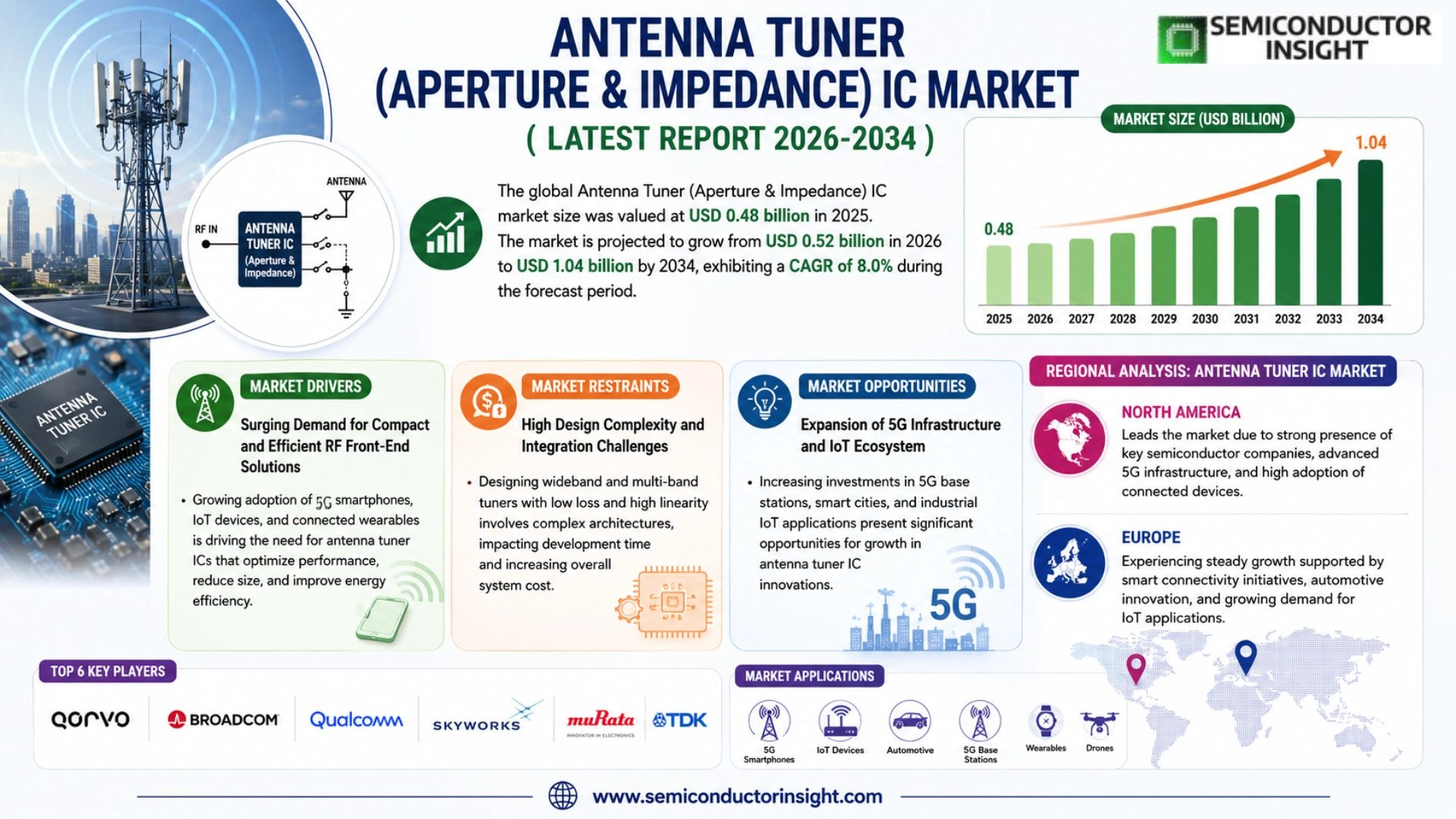
Antenna Tuner (Aperture & Impedance) IC Market size was valued at USD 0.48 billion in 2025. The market is projected to grow from USD 0.52 billion in 2026 to USD 1.04 billion by 2034, exhibiting a CAGR of 8.0% during the forecast period.
Antenna tuner ICs , encompassing both aperture tuning and impedance tuning solutions , are specialized semiconductor components designed to optimize antenna performance across multiple frequency bands. These integrated circuits dynamically adjust the electrical characteristics of an antenna system, ensuring maximum signal transmission and reception efficiency. Key product types include aperture tuners, which physically adjust the antenna’s resonant frequency, and impedance tuners, which match the antenna’s impedance to the transceiver front-end, minimizing signal loss and improving overall RF system performance.
The market is experiencing robust growth driven by the rapid global rollout of 5G networks, the proliferation of multi-band smartphones, and the increasing complexity of modern wireless communication standards. Furthermore, the expanding adoption of IoT devices and connected automotive platforms is generating sustained demand for advanced antenna management solutions. Key players operating Antenna Tuner (Aperture & Impedance) IC Market include Qorvo, Inc., Skyworks Solutions, Inc., and Murata Manufacturing Co., Ltd., all of which maintain broad product portfolios catering to consumer electronics, automotive, and industrial wireless applications.
MARKET DRIVERS
Surging Demand for Advanced Wireless Connectivity Fueling Antenna Tuner IC Adoption
Global Antenna Tuner (Aperture & Impedance) IC Market is experiencing robust growth, driven primarily by the accelerating rollout of 5G networks worldwide. As mobile network operators invest heavily in sub-6 GHz and mmWave infrastructure, the need for precision impedance matching and aperture tuning solutions has intensified. Modern smartphones and connected devices now operate across an increasingly wide range of frequency bands, making dynamic antenna tuning ICs essential for maintaining signal integrity, minimizing return loss, and maximizing radiated power efficiency. This multi-band operational requirement has made antenna tuner ICs a non-negotiable component in next-generation device design.
Proliferation of IoT and Connected Devices Expanding the Addressable Market
The rapid expansion of the Internet of Things (IoT) ecosystem represents a significant structural driver for Antenna Tuner (Aperture & Impedance) IC Market. Industrial IoT sensors, smart home devices, wearable electronics, and asset tracking modules all require compact, power-efficient antenna tuning solutions to reliably operate across heterogeneous wireless standards including Wi-Fi, Bluetooth, LTE-M, and NB-IoT. The growing complexity of RF front-end architectures in these devices, combined with the physical constraints of miniaturized form factors, places increasing design pressure on semiconductor manufacturers to deliver highly integrated impedance tuner ICs that consume minimal board space while delivering superior antenna performance.
➤ The transition toward multi-band, carrier aggregation-enabled devices is compelling OEMs to adopt adaptive antenna tuning IC solutions that dynamically optimize impedance matching in real time, directly enhancing network throughput and user experience.
Additionally, the automotive sector is emerging as a consequential demand driver for Antenna Tuner (Aperture & Impedance) IC Market. The proliferation of connected vehicles, V2X communication systems, and telematics platforms has created sustained demand for robust RF front-end components capable of operating reliably in challenging electromagnetic environments. Automotive-grade antenna tuner ICs that meet stringent AEC-Q100 qualification standards are witnessing growing design-win activity as tier-1 automotive suppliers integrate advanced wireless connectivity into next-generation vehicle platforms.
MARKET CHALLENGES
Technical Complexity of Multi-Band RF Front-End Integration Posing Design Challenges
One of the foremost challenges confronting stakeholders Antenna Tuner (Aperture & Impedance) IC Market is the escalating technical complexity associated with designing antenna tuner ICs that can seamlessly support an ever-expanding portfolio of wireless frequency bands. As 5G standards continue to evolve and devices are required to support legacy 2G/3G/4G bands concurrently with new 5G NR bands, achieving consistent impedance matching and aperture control across such a broad spectral range without degrading linearity or introducing harmonics demands sophisticated semiconductor process expertise and advanced tuning algorithms. The co-existence of multiple radios within a single device further compounds interference management challenges for antenna tuner IC designers.
Other Challenges
Supply Chain and Component Sourcing Constraints
The global semiconductor supply chain continues to present operational challenges for Antenna Tuner (Aperture & Impedance) IC Market. Specialized RF semiconductor processes, including silicon-on-insulator (SOI) and bulk CMOS technologies used in antenna tuner IC fabrication, are produced at a limited number of foundries worldwide. Capacity constraints at these specialized nodes, combined with geopolitical uncertainties affecting critical material sourcing, can introduce lead time variability and create cost pressures that impact both IC vendors and their OEM customers.
Stringent Power Consumption Requirements in Mobile Applications
Battery life remains a critical performance parameter for mobile and wearable device manufacturers, placing stringent power budget constraints on all RF front-end components, including impedance and aperture tuner ICs. Achieving the tuning range and switching speed required for dynamic multi-band operation while simultaneously meeting aggressive current consumption targets demands continuous innovation in circuit design and semiconductor process optimization, representing an ongoing engineering challenge for IC development teams operating in this market.
MARKET RESTRAINTS
High Development Costs and Extended Design Cycles Limiting Rapid Market Penetration
Antenna Tuner (Aperture & Impedance) IC Market faces a meaningful restraint in the form of substantial research and development expenditure required to bring competitive products to market. Designing antenna tuner ICs that meet the performance, reliability, and size requirements of leading smartphone OEMs and automotive Tier-1 suppliers demands significant investment in advanced semiconductor process development, RF characterization, and system-level validation. Smaller fabless semiconductor companies seeking to enter this market face considerable barriers due to the capital intensity of tape-out costs and the extended qualification timelines mandated by major OEM customers, which can stretch from initial design engagement to production ramp.
Market Consolidation Among Established RF Semiconductor Vendors Constraining New Entrants
The competitive landscape of Antenna Tuner (Aperture & Impedance) IC Market is characterized by a relatively concentrated group of established RF semiconductor companies that have invested over many years in building deep application expertise, robust patent portfolios, and entrenched customer relationships with major device OEMs. This consolidation dynamic creates a significant structural restraint for new market entrants, as the established players benefit from economies of scale in manufacturing, well-developed direct sales channels, and incumbency advantages in existing platform designs. The high switching costs associated with re-qualifying RF front-end solutions further reinforce the competitive moats of established antenna tuner IC vendors, making market share displacement a prolonged and resource-intensive endeavor for challengers.
MARKET OPPORTUNITIES
5G Expansion in Emerging Markets Creating Substantial New Demand for Antenna Tuner ICs
The ongoing geographic expansion of 5G network deployments across Asia-Pacific, Latin America, and the Middle East & Africa represents a compelling growth opportunity for Antenna Tuner (Aperture & Impedance) IC Market. As mobile subscribers in these regions upgrade from 4G to 5G-capable devices, the increased per-device content of antenna tuner ICs , driven by higher band count requirements , is expected to meaningfully expand the total addressable market. Semiconductor vendors that establish strong supply relationships with regional smartphone OEMs and white-box device manufacturers in these high-growth markets are well-positioned to capture disproportionate revenue upside as 5G penetration accelerates.
Integration of AI-Driven Adaptive Tuning Algorithms Unlocking New Value Propositions
The convergence of machine learning capabilities within RF system architectures presents a strategically important opportunity for innovators Antenna Tuner (Aperture & Impedance) IC Market. AI-driven adaptive tuning algorithms that can predict and respond to dynamic changes in the antenna operating environment , such as hand-grip effects, proximity to metallic surfaces, or rapid mobility-induced channel variations , offer the potential to deliver measurably superior antenna system performance compared to conventional static or rule-based tuning approaches. IC vendors that successfully embed or closely integrate intelligent tuning control with their aperture and impedance tuner IC solutions are expected to command premium pricing and strengthen their competitive differentiation with tier-1 OEM customers seeking leading-edge RF front-end performance.
Growth in Satellite Communication and Non-Terrestrial Network Applications
The rapid commercialization of low-earth orbit (LEO) satellite constellations and the standardization of non-terrestrial network (NTN) support within 3GPP Release 17 and beyond is creating a nascent but potentially significant opportunity segment for Antenna Tuner (Aperture & Impedance) IC Market. Consumer and enterprise devices designed to connect directly to satellite networks must support wide frequency tuning ranges and stringent impedance matching requirements to compensate for the dynamic link conditions inherent in satellite communications. This emerging application segment is expected to drive incremental demand for specialized antenna tuner ICs with enhanced tuning agility and expanded operating frequency coverage, providing IC vendors with an avenue to diversify revenue beyond traditional cellular handset markets.
Trends
5G Network Expansion Driving Demand for Advanced Antenna Tuner ICs
Antenna Tuner (Aperture & Impedance) IC Market is undergoing a significant transformation, largely propelled by the accelerating global rollout of 5G networks. As mobile operators expand 5G infrastructure across major economies, device manufacturers are under increasing pressure to integrate high-performance antenna management solutions capable of supporting broader and more complex frequency spectrums. Antenna tuner ICs , both aperture and impedance variants , have become essential components in enabling seamless multi-band connectivity, ensuring that smartphones and wireless devices maintain optimal signal quality across diverse network environments. This shift toward 5G-ready hardware is establishing antenna tuner ICs as a foundational element of next-generation wireless architecture.
Other Trends
Multi-Band Smartphone Proliferation Intensifying Component Complexity
The rapid proliferation of multi-band smartphones is a key trend reshaping Antenna Tuner (Aperture & Impedance) IC Market. Modern flagship and mid-range devices are now required to support an expanding number of frequency bands simultaneously, creating significant RF design challenges. Impedance tuner ICs address these challenges by dynamically matching antenna impedance to the transceiver front-end, minimizing signal loss and improving overall transmission efficiency. Aperture tuners, meanwhile, allow physical adjustment of the antenna’s resonant frequency, enabling compact device form factors without compromising wireless performance. Leading companies including Qorvo, Inc., Skyworks Solutions, Inc., and Murata Manufacturing Co., Ltd. are actively developing advanced tuning solutions to meet these evolving design requirements.
IoT and Connected Automotive Platforms Creating Sustained Demand
Beyond consumer electronics, the expanding adoption of Internet of Things devices and connected automotive platforms is generating sustained demand withAntenna Tuner (Aperture & Impedance) IC Market. Automotive applications, in particular, require robust antenna management solutions capable of operating reliably across varying environmental conditions and multiple wireless protocols including cellular, Wi-Fi, and V2X communication standards. Similarly, industrial IoT deployments are increasingly incorporating impedance and aperture tuning ICs to ensure consistent wireless connectivity across diverse operating environments. This diversification beyond smartphones is broadening the market’s addressable base and reducing its reliance on a single end-use segment.
Increasing Wireless Communication Complexity Elevating RF System Performance Standards
The growing complexity of modern wireless communication standards is compelling semiconductor manufacturers to innovate continuously withAntenna Tuner (Aperture & Impedance) IC Market. As devices are required to manage simultaneous connections across multiple bands and protocols, the demand for highly integrated, low-loss antenna tuning solutions is intensifying. Both aperture and impedance tuner ICs are evolving to deliver faster tuning response times, lower insertion losses, and greater integration with RF front-end modules. This trend toward higher-performance, more compact antenna management solutions is expected to remain a defining characteristic of the market as wireless technology standards continue to advance globally.
COMPETITIVE LANDSCAPE
Key Industry Players
Antenna Tuner (Aperture & Impedance) IC Market: Competitive Dynamics and Leading Innovators Shaping the Global RF Semiconductor Landscape
Global Antenna Tuner (Aperture & Impedance) IC Market is characterized by a moderately consolidated competitive structure, with a handful of established RF semiconductor leaders commanding significant market share. Qorvo, Inc., Skyworks Solutions, Inc., and Murata Manufacturing Co., Ltd. collectively represent the dominant tier of this market, leveraging expansive product portfolios, deep OEM relationships with major smartphone manufacturers, and sustained R&D investments in advanced antenna management technologies. Qorvo and Skyworks, in particular, have established themselves as primary suppliers of both aperture and impedance tuning ICs to global tier-1 mobile device manufacturers, benefiting from their vertically integrated RF front-end module capabilities and strong design-win pipelines tied to the accelerating 5G handset rollout. Murata, with its strength in passive and integrated RF components, further reinforces the competitive intensity at the premium end of the market. These leading players compete primarily on the basis of tuning speed, insertion loss performance, integration level, power consumption, and the ability to support an ever-expanding range of frequency bands demanded by multi-band 5G, LTE, and Wi-Fi co-existence architectures.
Beyond the top-tier incumbents, the Antenna Tuner IC market features a number of specialized and emerging players targeting niche segments, including automotive wireless, industrial IoT, and wearable connectivity platforms. Companies such as pSemi Corporation (a Murata subsidiary), Cavendish Kinetics (acquired by Qorvo), Broadcom Inc., NXP Semiconductors, and STMicroelectronics maintain active product lines or intellectual property positions in antenna tuning solutions. Additionally, firms including Maxscend Microelectronics, Wisol Co., Ltd., and RFMD (now part of Qorvo) contribute to the competitive ecosystem, particularly in Asia-Pacific markets where cost-competitive tuner solutions are in high demand. The competitive landscape is further shaped by ongoing consolidation through strategic acquisitions , most notably Qorvo’s absorption of Cavendish Kinetics’ MEMS-based tuner technology , as well as increasing competition from fabless Chinese semiconductor companies seeking to capture share in the rapidly growing domestic 5G device market. Innovation in tuner architecture, including the shift toward MEMS-based and BST (Barium Strontium Titanate) tuning technologies, continues to redefine competitive differentiation across the value chain.
List of Key Antenna Tuner (Aperture & Impedance) IC Companies Profiled
- Qorvo, Inc.
- Skyworks Solutions, Inc.
- Murata Manufacturing Co., Ltd.
- pSemi Corporation (A Murata Company)
- Broadcom Inc.
- NXP Semiconductors N.V.
- STMicroelectronics N.V.
- Maxscend Microelectronics Company Limited
- Wisol Co., Ltd.
- Cavendish Kinetics (Acquired by Qorvo)
- MediaTek Inc.
- Qualcomm Technologies, Inc.
- Silicon Laboratories Inc.
- Analog Devices, Inc.
- TE Connectivity Ltd.
Segment Analysis:
| Segment Category | Sub-Segments | Key Insights |
| By Type |
|
Impedance Tuner ICs currently represent the leading segment within the By Type classification, driven by their critical role in minimizing signal loss and ensuring seamless transceiver front-end matching across multiple frequency bands.
|
| By Application |
|
Smartphones & Mobile Devices dominate the application landscape, functioning as the primary consumption driver for antenna tuner ICs across both aperture and impedance tuning categories.
|
| By End User |
|
Consumer Electronics Manufacturers constitute the dominant end-user segment, underpinned by relentless volume-driven demand from global smartphone original equipment manufacturers and their supply chains.
|
| By Technology |
|
SOI (Silicon-on-Insulator) Tuner ICs represent the leading technology segment, widely preferred for their superior RF switching performance, low insertion loss characteristics, and strong linearity attributes essential for high-frequency antenna tuning applications.
|
| By Frequency Band |
|
1 GHz – 6 GHz (Mid Band) emerges as the dominant frequency band segment, reflecting the concentrated deployment of sub-6 GHz 5G networks globally and the corresponding surge in antenna tuning requirements for devices operating within this spectrum.
|
Regional Analysis: Antenna Tuner (Aperture & Impedance) IC Market
Asia-Pacific
Asia-Pacific’s accelerated 5G deployment across China, South Korea, and India is a primary catalyst for Antenna Tuner (Aperture & Impedance) IC Market in the region. As network operators expand coverage into diverse frequency bands, antenna tuner ICs that deliver efficient aperture and impedance matching become indispensable components in both handsets and base station equipment, reinforcing the region’s leading position in global demand generation.
The region hosts a dense ecosystem of IC foundries, packaging specialists, and component suppliers that provide an integrated supply chain advantage for antenna tuner IC producers. Taiwan’s TSMC, South Korea’s Samsung Foundry, and numerous Chinese semiconductor enterprises collectively reduce time-to-market and production costs, enabling faster adoption of next-generation aperture and impedance tuner IC architectures across consumer and industrial applications.
Asia-Pacific dominates global smartphone production volumes, with major OEMs continuously integrating sophisticated antenna tuner ICs to support carrier aggregation and multi-band connectivity requirements. The competitive pressure among device manufacturers to deliver superior signal quality in slim form factors directly fuels innovation in aperture-tuning and impedance-matching IC design, sustaining robust regional demand across both premium and mid-tier device segments.
Strategic government policies across China, Japan, and South Korea are channeling substantial funding into domestic semiconductor research and wireless communication technologies. These initiatives directly benefit Antenna Tuner (Aperture & Impedance) IC Market by fostering local design capabilities, reducing import dependency, and encouraging collaboration between academic institutions and industry players to develop advanced tuning IC solutions optimized for emerging 5G and beyond-5G standards.
North America
North America represents a highly mature and innovation-driven segment of Antenna Tuner (Aperture & Impedance) IC Market, characterized by the concentration of leading fabless semiconductor firms, world-class research universities, and a robust ecosystem of wireless technology developers. The United States, in particular, is home to pioneering companies advancing the design of aperture and impedance tuner ICs tailored for 5G, Wi-Fi 6/6E, and emerging satellite communication applications. Demand is further stimulated by the widespread adoption of connected devices across automotive, industrial IoT, and defense sectors, each requiring specialized antenna tuning solutions. The region benefits from close collaboration between chipmakers and major wireless carriers pursuing advanced network architectures. Regulatory support for spectrum expansion and private 5G networks continues to open new application avenues for antenna tuner IC providers operating within the North American market through 2034.
Europe
Europe occupies a significant and steadily growing position in Global Antenna Tuner (Aperture & Impedance) IC Market, underpinned by its strong automotive electronics sector, advancing industrial automation landscape, and progressive regulatory framework supporting next-generation wireless communication. Germany, Sweden, Finland, and the Netherlands serve as key hubs where antenna tuner IC technology intersects with connected vehicle platforms, Industry 4.0 deployments, and smart infrastructure initiatives. European OEMs are increasingly incorporating aperture and impedance tuning ICs into vehicle telematics systems and advanced driver assistance solutions to ensure reliable multi-band connectivity. The region’s focus on energy efficiency and miniaturization in electronic components aligns well with the performance requirements of modern antenna tuner IC designs, while EU-backed semiconductor investment programs are gradually strengthening local design and manufacturing capabilities through the forecast horizon.
South America
South America is an emerging market withAntenna Tuner (Aperture & Impedance) IC Market, with growth trajectories being shaped primarily by expanding mobile broadband penetration, progressive 4G network consolidation, and early-stage 5G rollouts in economies such as Brazil, Chile, and Colombia. While the region does not yet match the technological maturity of North America or Asia-Pacific, the rising middle-class consumer base and growing smartphone adoption rates are steadily elevating demand for devices incorporating advanced antenna tuner ICs. Local electronics assembly operations and increasing foreign direct investment in telecommunications infrastructure are creating gradual but meaningful opportunities for antenna tuner IC suppliers. Regional manufacturers are also beginning to explore partnerships with global IC vendors to access cost-effective aperture and impedance tuning solutions for locally assembled devices targeting mid-market consumers.
Middle East & Africa
The Middle East & Africa region presents a nascent yet progressively promising landscape for Antenna Tuner (Aperture & Impedance) IC Market. Gulf Cooperation Council nations, particularly the UAE and Saudi Arabia, are spearheading ambitious smart city and digital transformation programs that incorporate advanced wireless connectivity infrastructure, creating upstream demand for high-performance antenna tuner ICs. In parallel, Africa’s rapidly expanding mobile subscriber base and leapfrog adoption of mobile internet services are driving demand for affordable yet capable connected devices equipped with efficient aperture and impedance tuning components. While the region currently accounts for a smaller share of global antenna tuner IC consumption, the long-term outlook is supported by increasing telecom investment, spectrum allocation activities, and growing participation of international technology firms seeking to capture first-mover advantages in these underpenetrated but high-potential markets.
Report Scope
This market research report provides a comprehensive analysis of the Antenna Tuner (Aperture & Impedance) IC Market , covering the forecast period 2026–2034. It offers detailed insights into market dynamics, technological advancements, competitive landscape, and key trends shaping the industry.
Key focus areas of the report include:
- Market Overview: The report begins with an overview outlining its current market scenario, key growth indicators, and industry transformation drivers. It discusses macroeconomic factors, demand–supply balance, regulatory landscape, and the strategic role of semiconductors in powering advancements across industries such as automotive, telecommunications, consumer electronics, and industrial automation.
- Market Size & Forecast: Historical data and future projections for revenue, unit shipments, and market value across major regions and segments.
- Segmentation Analysis: Detailed breakdown by product type, technology, application, and end-user industry to identify high-growth segments and investment opportunities.
- Regional Insights: Insights into market performance across North America, Europe, Asia-Pacific, Latin America, and the Middle East & Africa, including country-level analysis where relevant.
- Competitive Landscape: Profiles of leading market participants, including their product offerings, R&D focus, manufacturing capacity, pricing strategies, and recent developments such as mergers, acquisitions, and partnerships.
- Technology Trends & Innovation: Assessment of emerging technologies, integration of AI/IoT, semiconductor design trends, fabrication techniques, and evolving industry standards.
- Market Drivers & Restraints: Evaluation of factors driving market growth along with challenges, supply chain constraints, regulatory issues, and market-entry barriers.
- Stakeholder Insights: Insights for component suppliers, OEMs, system integrators, investors, and policymakers regarding the evolving ecosystem and strategic opportunities.
Primary and secondary research methods are employed, including interviews with industry experts, data from verified sources, and real-time market intelligence to ensure the accuracy and reliability of the insights presented.
FREQUENTLY ASKED QUESTIONS:
What is the current market size of Antenna Tuner (Aperture & Impedance) IC Market?
-> Antenna Tuner (Aperture & Impedance) IC Market was valued at USD 0.48 billion in 2025 and is expected to reach USD 1.04 billion by 2034, growing at a CAGR of 8.0% during the forecast period from 2026 to 2034.
Which key companies operate Antenna Tuner (Aperture & Impedance) IC Market?
-> Key players include Qorvo, Inc., Skyworks Solutions, Inc., and Murata Manufacturing Co., Ltd., among others, all of which maintain broad product portfolios catering to consumer electronics, automotive, and industrial wireless applications.
What are the key growth drivers?
-> Key growth drivers include the rapid global rollout of 5G networks, the proliferation of multi-band smartphones, increasing complexity of modern wireless communication standards, expanding adoption of IoT devices, and growing demand from connected automotive platforms.
Which region dominates the market?
-> Asia-Pacific is among the fastest-growing regions, driven by high smartphone adoption and 5G infrastructure deployment, while North America remains a significant market due to advanced telecommunications infrastructure and leading semiconductor companies.
What are the emerging trends?
-> Emerging trends include aperture tuning and impedance tuning IC innovations, integration of advanced antenna management solutions in IoT and connected automotive platforms, and the development of multi-band RF semiconductor components optimized for 5G and next-generation wireless communication standards.

Get Sample Report PDF for Exclusive Insights
Report Sample Includes
- Table of Contents
- List of Tables & Figures
- Charts, Research Methodology, and more...