Market Insights
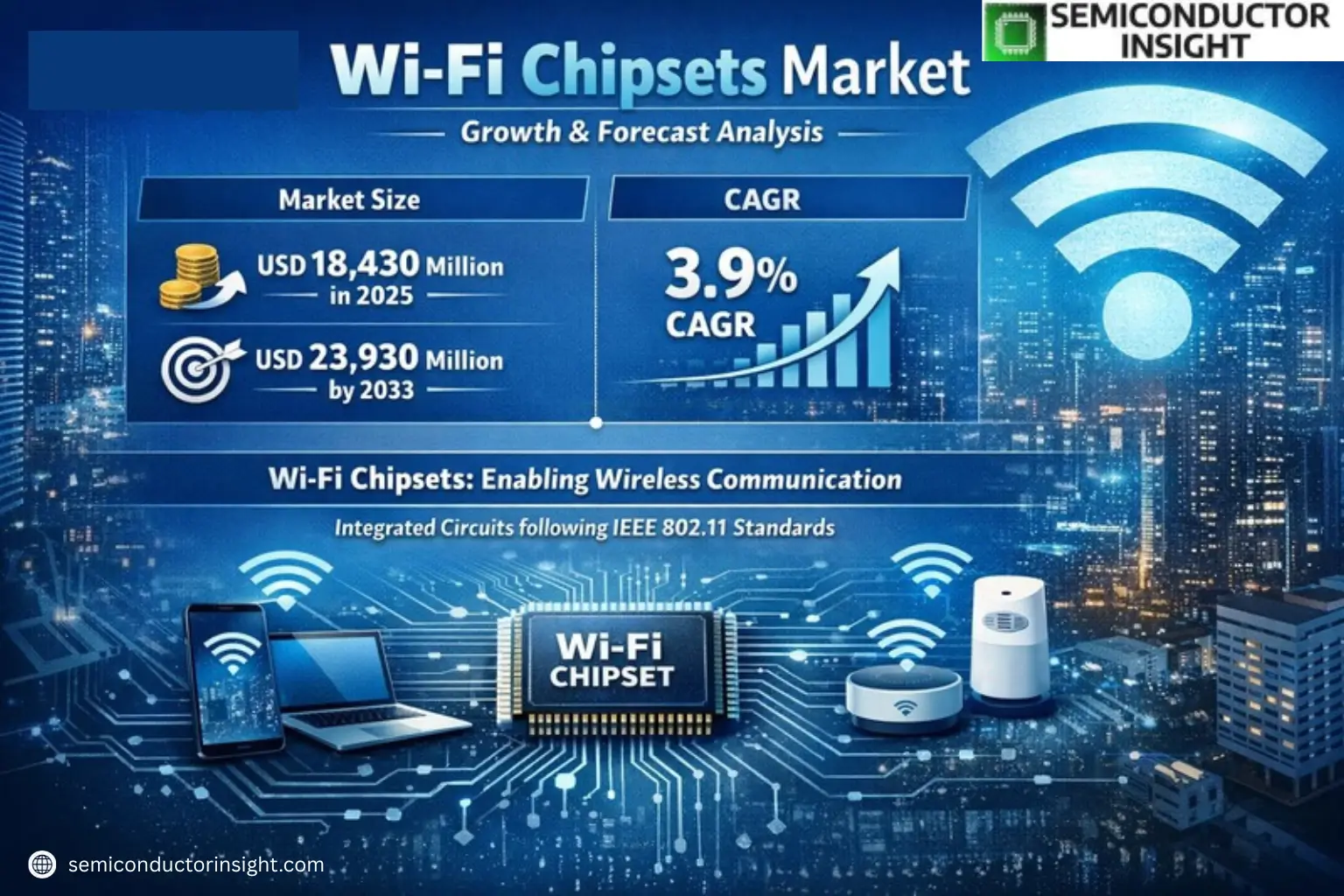
Global Wi-Fi Chipsets Market size was valued at USD 18,430 million in 2025 and is projected to reach USD 23,930 million by 2033, exhibiting a CAGR of 3.9% during the forecast period.
Wi-Fi Chipsets Market are integrated circuits that enable wireless communication between devices by adhering to IEEE 802.11 standards. These components are essential for establishing connectivity in various applications, including smartphones, laptops, smart home devices, and IoT solutions. The market is segmented into different types such as 802.11n, 802.11ac, and 802.11ad, each offering varying levels of speed and bandwidth efficiency.
The growth of the Wi-Fi Chipsets Market is driven by increasing demand for high-speed internet connectivity, proliferation of smart devices, and advancements in wireless technologies like Wi-Fi 6 (802.11ax). Leading manufacturers such as Broadcom and Qualcomm Atheros dominate the industry with significant market shares 14.40% and 7.30%, respectively as of recent data. North America remains the largest consumer region, accounting for approximately 28.06% of global consumption due to rapid technological adoption.
MARKET DRIVERS
Growing Demand for High-Speed Connectivity
Wi-Fi Chipsets Market is experiencing significant growth due to the increasing demand for high-speed, low-latency wireless connectivity. With the global adoption of Wi-Fi 6 and Wi-Fi 6E, businesses and consumers alike are upgrading their devices to support faster data transfer rates and improved network efficiency.
Expansion of IoT and Smart Devices
The proliferation of IoT devices and smart home technologies is driving demand for advanced Wi-Fi Chipsets Market. These components are essential for enabling seamless connectivity across a wide range of applications, from smart appliances to industrial automation systems.
Technological advancements in Wi-Fi standards and the rollout of 5G networks are further accelerating market growth, creating opportunities for chipset manufacturers to innovate.
MARKET CHALLENGES
High Development Costs and Complexity
The development of next-generation Wi-Fi Chipsets Market requires substantial R&D investments and sophisticated manufacturing processes. This presents a barrier for smaller players entering the Wi-Fi Chipsets Market.
Other Challenges
Regulatory and Spectrum Constraints
The allocation of radio frequencies and compliance with international standards can limit the deployment of new Wi-Fi technologies, especially in regions with strict regulations.
Supply Chain Disruptions
Global semiconductor shortages and manufacturing delays continue to impact the Wi-Fi Chipsets Market, affecting production timelines and pricing stability.
MARKET RESTRAINTS
Competition from Alternative Connectivity Solutions
Emerging wireless technologies such as 5G and Li-Fi pose competitive threats to the Wi-Fi Chipsets Market, particularly in applications requiring ultra-low latency or high-density connectivity. Market penetration may be limited in certain industrial and automotive segments where alternatives are preferred.
MARKET OPPORTUNITIES
Growth in Enterprise and Industrial Applications
The enterprise sector represents a significant growth opportunity for Wi-Fi Chipsets Market, driven by increasing adoption in smart offices, warehouses, and manufacturing facilities. Wi-Fi 6-enabled chipsets are particularly sought after for their ability to handle multiple connected devices efficiently.
Emerging Markets and Infrastructure Development
Developing economies are investing heavily in digital infrastructure, creating new opportunities for Wi-Fi Chipsets Market. The demand for affordable, high-performance connectivity solutions in these regions is expected to drive market expansion in the coming years.
Wi-Fi Chipsets Market Trends
Sustained Growth in Wi-Fi Chipsets Demand
Global Wi-Fi Chipsets Market continues its upward trajectory, valued at USD 18.43 billion in 2025 and projected to reach USD 23.93 billion by 2033. This growth, at a stable 3.9% CAGR, is fueled by increasing wireless connectivity needs across multiple sectors. The market expansion follows consistent demand patterns seen since 2020, with notable acceleration in enterprise and consumer adoption of advanced networking solutions.
Other Trends
Type-Specific Market Segmentation
802.11ac chipsets maintain dominance in 2025, accounting for approximately 42% of total market share, followed by 802.11n at 31%. Emerging Wi-Fi 6E solutions are gaining traction, though remain in early adoption phases. Segment growth varies significantly by application, with smart home devices showing the highest year-over-year growth rate at 7.2%.
Regional Market Concentration
North America leads consumption with 28.06% market share, followed by Asia-Pacific at 26.8% and Europe at 22.3%. Regional adoption patterns reveal North America’s early adoption of advanced chipsets for enterprise applications, while Asia shows stronger growth in consumer electronics integration. The U.S. alone contributes approximately 19% of global Wi-Fi Chipsets Market revenue.
Competitive Landscape Developments
Broadcom retains market leadership with 14.4% revenue share, while Qualcomm Atheros follows with 7.3%. Recent industry movements include strategic partnerships between chipset manufacturers and IoT platform providers, along with increased R&D focus on energy-efficient solutions for mobile applications. Pricing trends indicate moderate increases (1.8% YoY) for advanced chipsets, while legacy products maintain stable pricing.
Emerging Application Sectors
Beyond traditional computing devices, Wi-Fi Chipsets Market now penetrate industrial IoT (10.3% annual growth), automotive applications (8.7% growth), and healthcare equipment (6.9% growth). This diversification supports long-term market stability despite cyclical demand in consumer electronics, with enterprise-grade solutions accounting for 39% of 2025 shipments.
COMPETITIVE LANDSCAPE
Key Industry Players
Global Wi-Fi Chipsets Market Dominated by Semiconductor Giants
Wi-Fi Chipsets Market continues to be dominated by established semiconductor players, with Broadcom and Qualcomm Atheros maintaining leadership positions. These companies benefit from extensive R&D capabilities, robust patent portfolios, and partnerships with major device manufacturers across computing, networking, and mobile segments. Market consolidation has intensified as leading players expand through strategic acquisitions in adjacent wireless technologies.
Several niche players have gained traction in specialized segments, with MediaTek emerging as a strong contender in cost-sensitive consumer electronics. Startups like Quantenna (now part of ON Semiconductor) previously demonstrated innovation in high-performance Wi-Fi solutions before being acquired. The market also includes diversified semiconductor firms like Texas Instruments and NXP Semiconductors that leverage their analog expertise for integrated connectivity solutions.
List of Key Wi-Fi Chipsets Companies Profiled
- Broadcom Inc.
- Qualcomm Technologies, Inc. (Atheros)
- MediaTek Inc.
- Intel Corporation
- Marvell Technology Group
- Texas Instruments
- Realtek Semiconductor Corp.
- ON Semiconductor (Quantenna)
- Infineon Technologies (Cypress Semiconductor)
- Microchip Technology
- NXP Semiconductors
- Synaptics Incorporated
- STMicroelectronics
- Peraso Technologies
- Socionext Inc.
Segment Analysis:
| Segment Category | Sub-Segments | Key Insights |
| By Type |
|
802.11ac Wi-Fi Chipsets
|
| By Application |
|
Mobile Phone
|
| By End User |
|
Consumer Electronics
|
| By Technology Standard |
|
Dual Band
|
| By Component |
|
WLAN ICs
|
Regional Analysis: Wi-Fi Chipsets Market
Enterprises across North America are upgrading to Wi-Fi 6E chipsets to support high-density workplaces and advanced collaboration tools. The transition towards cloud-managed networks is accelerating demand for power-efficient wireless solutions.
The booming smart home market drives demand for dual-band and tri-band Wi-Fi Chipsets Market. Manufacturers are focusing on low-power consumption designs to support always-connected smart appliances and security systems.
Factory automation and Industry 4.0 initiatives create opportunities for industrial-grade Wi-Fi Chipsets Market. Ruggedized solutions with enhanced interference management are gaining traction in manufacturing environments.
Telecom operators are investing in Wi-Fi 6 mesh systems to complement 5G networks. This integration requires advanced chipsets capable of seamless handoffs between cellular and Wi-Fi networks.
Europe
Europe shows steady growth in Wi-Fi Chipsets Market with strong emphasis on data security and energy efficiency. The EU’s focus on digital transformation initiatives boosts demand for enterprise-grade networking solutions. Germany leads in industrial IoT applications, while the UK and France show high adoption in consumer electronics. Strict regulations around wireless spectrum usage influence chipset design priorities across the region. European manufacturers focus on developing eco-friendly Wi-Fi solutions with compliance to RoHS directives.
Asia-Pacific
Asia-Pacific emerges as the fastest-growing region for Wi-Fi Chipsets Market, driven by expanding smartphone penetration and smart city projects. China dominates production capabilities while Japan leads in technology innovation. India shows significant potential with its digital India initiative driving rural connectivity. Southeast Asian markets demonstrate increasing demand for cost-effective Wi-Fi solutions in consumer electronics and SME applications. The region benefits from strong semiconductor manufacturing ecosystems.
South America
South America experiences gradual adoption of advanced Wi-Fi technologies with Brazil and Argentina leading the market. Economic volatility impacts enterprise investments but consumer demand remains resilient. Mobile carriers increasingly bundle Wi-Fi solutions with broadband packages. The region shows preference for mid-range Wi-Fi Chipsets Market balancing performance and affordability. Local regulators are opening new spectrum bands to support growing connectivity needs.
Middle East & Africa
MENA shows promising growth in Wi-Fi Chipsets Market, particularly in GCC countries investing in smart infrastructure. UAE leads in deploying high-speed public Wi-Fi networks. African markets demonstrate unique requirements for long-range Wi-Fi solutions in challenging terrains. The regions growing youth population drives demand for affordable connectivity solutions. Security-conscious enterprises prefer chipsets with enhanced encryption capabilities.
Report Scope
This market research report provides a comprehensive analysis of the Wi-Fi Chipsets Market , covering the forecast period 2025–2033. It offers detailed insights into market dynamics, technological advancements, competitive landscape, and key trends shaping the industry.
Key focus areas of the report include:
- Market Overview: The report begins with an overview outlining its current market scenario, key growth indicators, and industry transformation drivers. It discusses macroeconomic factors, demand–supply balance, regulatory landscape, and the strategic role of Wi-Fi Chipsets Market in powering advancements across industries such as consumer electronics, telecommunications, smart home devices, and mobile applications.
- Market Size & Forecast: Historical data and future projections for revenue, unit shipments, and market value across major regions and segments.
- Segmentation Analysis: Detailed breakdown by product type, technology, application, and end-user industry to identify high-growth segments and investment opportunities.
- Regional Insights: Insights into market performance across North America, Europe, Asia-Pacific, Latin America, and the Middle East & Africa, including country-level analysis where relevant.
- Competitive Landscape: Profiles of leading market participants, including their product offerings, R&D focus, manufacturing capacity, pricing strategies, and recent developments such as mergers, acquisitions, and partnerships.
- Technology Trends & Innovation: Assessment of emerging technologies, integration of AI/IoT, chipset design trends, fabrication techniques, and evolving industry standards.
- Market Drivers & Restraints: Evaluation of factors driving market growth along with challenges, supply chain constraints, regulatory issues, and market-entry barriers.
- Stakeholder Insights: Insights for component suppliers, OEMs, system integrators, investors, and policymakers regarding the evolving ecosystem and strategic opportunities.
Primary and secondary research methods are employed, including interviews with industry experts, data from verified sources, and real-time market intelligence to ensure the accuracy and reliability of the insights presented.
FREQUENTLY ASKED QUESTIONS:
What is the current market size of Wi-Fi Chipsets Market?
-> Wi-Fi Chipsets Market size was valued at USD 18,430 million in 2025 and is projected to reach USD 23,930 million by 2033, exhibiting a CAGR of 3.9% during the forecast period.
Which key companies operate in Wi-Fi Chipsets Market?
-> Key players include Broadcom, Qualcomm Atheros, MediaTek, Intel, Marvell, Texas Instruments, Realtek, Quantenna Communications, Cypress Semiconductor, and Microchip.
What are the key growth drivers?
-> Key growth drivers include rising demand for wireless connectivity, increasing adoption of smart home devices, growth in mobile phone usage, and advancements in Wi-Fi technologies.
Which region dominates the market?
-> North America had the highest share of consumption in 2025, accounting for 28.06% of the global market.
What are the emerging trends?
-> Emerging trends include adoption of 802.11ac and 802.11ad standards, integration with IoT devices, and development of energy-efficient chipsets.

Get Sample Report PDF for Exclusive Insights
Report Sample Includes
- Table of Contents
- List of Tables & Figures
- Charts, Research Methodology, and more...
 Download Sample Report PDF