RF System on Chip Market Insights
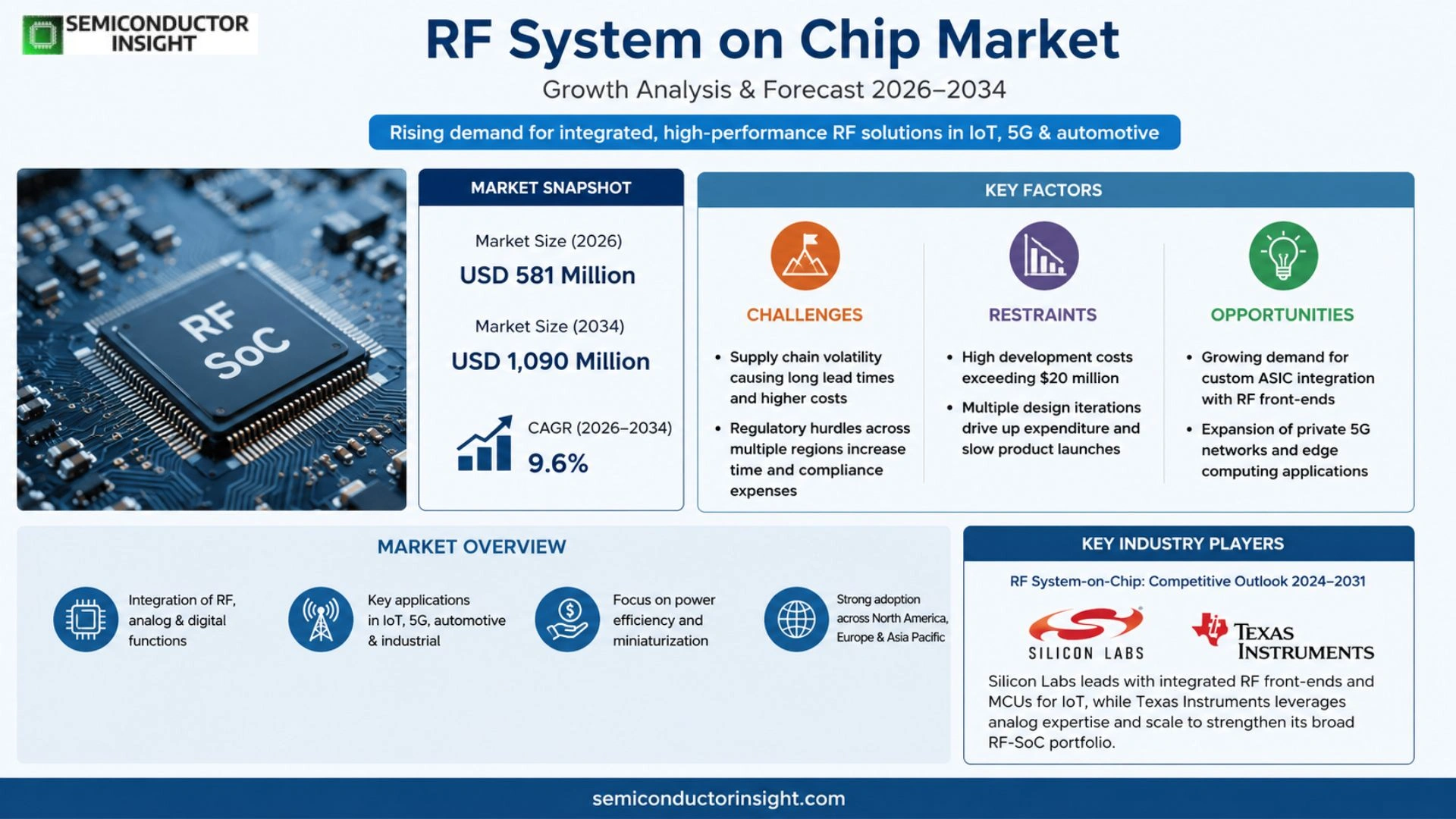
Global RF System on Chip market size was valued at USD 581 million in 2026 and will reach USD 1,090 million by 2034, reflecting a CAGR of 9.6% over the forecast horizon.
RF System on Chip integrates RF, analog and digital circuitry together with memory blocks and a microprocessor/DSP, delivering a compact single‑chip solution for wireless communication systems.
The expansion is supported by growing adoption of Bluetooth and Wi‑Fi modules in consumer electronics, increased connectivity requirements in automotive telematics, and ongoing cost‑reduction efforts from leading suppliers such as Silicon Labs, Texas Instruments and NXP.
MARKET DRIVERS
Emergence of 5G Infrastructure
The rollout of 5G networks has forced handset manufacturers to seek more compact and power‑efficient solutions. RF System on Chip designs enable carriers to meet stringent latency and bandwidth requirements while keeping device footprints minimal. This shift has accelerated adoption across both consumer and enterprise segments, pushing the overall market forward.
Integration Demands in IoT Devices
IoT deployments now span smart factories, connected cars, and wearable health monitors, all of which rely on seamless wireless connectivity. By consolidating front‑end modules, filters, and amplifiers into a single silicon die, RF System on Chip solutions cut bill‑of‑materials and simplify board design, a benefit that resonates strongly with OEMs facing massive scale‑out pressures.
➤ Industry analysts estimate that integrated RF solutions can trim BOM expenses by as much as 30 % and shorten time‑to‑market by several weeks.
Beyond cost savings, the integrated approach improves reliability by reducing inter‑connect points that are prone to failure. This reliability premium is especially valuable in mission‑critical applications such as industrial automation, where downtime directly translates to lost production.
MARKET CHALLENGES
Supply Chain Volatility
Global semiconductor shortages have exposed the fragility of sourcing high‑frequency silicon wafers. Manufacturers of RF System on Chip products often face lead times that extend beyond six months, complicating forecast accuracy for downstream customers and inflating inventory costs.
Other Challenges
Regulatory Hurdles
Compliance with regional emissions standards, such as those governing millimeter‑wave bands, demands extensive testing. The need to certify each new design across multiple jurisdictions adds both time and expense, discouraging smaller players from entering the space.
MARKET RESTRAINTS
High Development Costs
Designing a fully integrated RF System on Chip requires sophisticated EDA tools and specialist talent. Initial R&D outlays regularly surpass $20 million, a barrier that narrows the competitive field to well‑capitalized firms. This cost intensity slows the rate at which novel architectures can reach the market, tempering overall growth momentum.
Moreover, the need for multiple design iterations to meet performance targets further escalates expenditure, prompting some OEMs to continue relying on discrete component solutions despite their larger footprints.
MARKET OPPORTUNITIES
Custom ASIC Integration
Customers are increasingly requesting ASICs that embed RF front‑ends tailored to specific frequency bands. This trend opens a niche for foundries capable of offering RF System on Chip as a configurable building block, enabling faster differentiation in crowded market segments such as autonomous vehicles.
Parallel to this, the rise of private 5G networks in enterprises creates a demand for compact, high‑performance RF modules that can be integrated directly onto edge servers. Vendors that can deliver end‑to‑end solutions,covering silicon, firmware, and certification,stand to capture a sizable share of this emerging revenue stream.
Finally, advancements in silicon‑photonic packaging promise to extend operating frequencies well beyond current limits, positioning early adopters to serve next‑generation applications like real‑time holographic streaming and ultra‑low‑latency industrial control.
RF System on Chip Market Trends
Convergence of Connectivity Standards
RF System on Chip Market is seeing a pronounced move toward consolidating Bluetooth, ZigBee, WLAN and emerging proprietary protocols onto a single die. Designers cite the reduction in bill‑of‑materials and the simplification of board layout as decisive advantages. This integration also shortens time‑to‑market for new IoT devices, where product cycles are compressed. As system‑on‑chip solutions embed memory, digital signal processing and RF front‑end circuitry, OEMs can achieve higher power efficiency without compromising link reliability. The trend is especially evident in consumer wearables and smart‑home hubs, where space constraints and cost pressures force a single‑chip architecture.
Other Trends
Embedding Advanced Security Features
Security considerations are reshaping RF System on Chip Market as manufacturers embed cryptographic engines directly within the silicon. Regulatory bodies worldwide are tightening authentication requirements for wireless endpoints, prompting chip designers to incorporate tamper‑resistant storage and hardware‑based key management. These capabilities mitigate the risk of over‑the‑air attacks that have plagued legacy modular designs. Additionally, the ability to offload encryption to a dedicated block frees the host processor for higher‑level tasks, improving overall system performance. Companies that can offer a seamless blend of connectivity and security are gaining preference among enterprise‑grade IoT deployments.
Rise of Automotive Telemetry
Automotive manufacturers are turning to RF System on Chip Market to meet the stringent demands of vehicle‑to‑everything (V2X) communication and advanced driver‑assistance systems. Modern cars require radios that endure extreme temperature swings while delivering low‑latency data exchange for collision avoidance and traffic management. Integrating RF, digital baseband and microcontroller functions onto a single chip reduces latency and improves reliability, which are critical for safety‑related features. Moreover, the shift toward electric vehicles expands the need for OTA firmware updates, a task that benefits from secure, high‑throughput RF SoCs. Suppliers that align product roadmaps with automotive qualification standards are well positioned to capture this expanding segment.
COMPETITIVE LANDSCAPE
Key Industry Players
RF System‑on‑Chip: Competitive Outlook 2024‑2031
Silicon Labs commands a prominent position thanks to its tightly integrated RF front‑end and MCU portfolio, which appeals to IoT device makers seeking low‑power, high‑density solutions. Texas Instruments leverages its extensive analog expertise and scale to supply a broad spectrum of RF‑SoC products, reinforcing a tiered market where a few large firms dominate volume segments while niche players address specialized protocols. STMicroelectronics and Nordic Semiconductor occupy the mid‑range, balancing performance with cost‑effectiveness for Bluetooth and ZigBee applications, which creates a competitive pressure on pricing and time‑to‑market for emerging manufacturers. NXP’s aggressive push into automotive connectivity, coupled with a strong IP portfolio, has forced rivals to reassess their roadmap for safety‑critical RF integration. Collectively, these leaders shape a market architecture where design‑in partnerships and ecosystem support become decisive factors for customer loyalty.
Beyond the headline names, a constellation of specialized firms injects diversity into the RF‑SoC arena. Microchip’s focus on legacy industrial protocols sustains a steady demand base, while Analog Devices differentiates through high‑precision mixed‑signal capabilities that serve aerospace and defense niches. Broadcom’s acquisition strategy expands its reach into high‑frequency Wi‑Fi modules, pressuring smaller entrants to innovate on power consumption. Companies such as Infineon, Renesas, and Maxim Integrated pursue vertical integration with automotive and consumer electronics OEMs, fostering tighter supply‑chain ties. Emerging players including Espressif, Skyworks, and Quectel capitalize on rapid development cycles for wearable and smart‑home products, often partnering with chipset assemblers to accelerate market entry. This layered ecosystem generates both collaboration opportunities and competitive friction, prompting incumbents to reinforce differentiation through advanced packaging, AI‑enabled signal processing, and strategic alliances.
List of Key RF System on Chip Companies Profiled
- Silicon Labs
- Texas Instruments
- STMicroelectronics
- Nordic Semiconductor
- NXP Semiconductors
- Microchip Technology
- 4D Systems
- Analog Devices
- Broadcom
- CEL Technology
- Infineon Technologies
- Renesas Electronics
- Maxim Integrated
- Espressif Systems
- Skyworks Solutions
- Quectel Wireless Solutions
- Telink Semiconductor
Segment Analysis:
| Segment Category | Sub-Segments | Key Insights |
| By Type |
|
Bluetooth & ZigBee These low‑power wireless protocols dominate the IoT and wearable space. – Designers value the integrated RF‑SoC for reduced bill‑of‑materials and simplified antenna design. – Robust coexistence mechanisms and mature ecosystem support rapid product cycles. – Emerging mesh capabilities extend their relevance in smart‑home and industrial sensor networks. [Pointers preferred in bullets atleast 2-3]. |
| By Application |
|
Consumer Electronics Integration of RF, baseband and processing onto a single die enables sleek, battery‑efficient gadgets. – Trend toward voice‑activated assistants drives demand for always‑on connectivity. – Compact form‑factor aligns with wearables and AR/VR headsets. – Tight power budgets push manufacturers toward chips with advanced sleep modes. [Pointers preferred in bullets atleast 2-3]. |
| By End User |
|
Automotive OEMs RF‑SoC solutions are central to vehicle‑to‑everything (V2X) and in‑car infotainment. – Integrated designs meet stringent automotive reliability standards. – Multi‑protocol support simplifies architecture for connected cars. – Future electric‑vehicle platforms rely on low‑latency, high‑throughput RF links. [Pointers preferred in bullets atleast 2-3]. |
| By Frequency Band |
|
Sub‑6 GHz Remains the workhorse for most consumer and automotive applications. – Offers balanced range and penetration suitable for indoor environments. – Mature process technologies keep cost and power consumption low. – Enables seamless integration with existing cellular and Wi‑Fi ecosystems. [Pointers preferred in bullets atleast 2-3]. |
| By Integration Level |
|
Full Integration Drives product differentiation through size reduction and power efficiency. – Consolidates multiple functions, reducing board space and BOM complexity. – Enhances reliability by minimizing inter‑connect variability. – Aligns with market pressure for ultra‑compact IoT modules and edge devices. [Pointers preferred in bullets atleast 2-3]. |
Regional Analysis: RF System on Chip Market
North America
The United States exhibits a layered demand structure where flagship carriers drive high‑frequency modules for massive MIMO, while defense agencies seek ruggedized RF‑SoCs for secure communications. Vendor roadmaps highlight a pivot toward heterogeneous integration to meet divergent power‑budget constraints, prompting a surge in joint development programs between chip designers and antenna manufacturers.
Canadian firms are leveraging governmental grants to explore advanced CMOS processes that cut parasitic losses in RF paths. This research is feeding into niche automotive radar solutions, where compact size and low latency are decisive. Collaboration with U.S. silicon fabs accelerates time‑to‑market for these prototypes.
Mexico’s expanding manufacturing footprint offers a cost‑effective layer for assembly and testing of RF System on Chip components destined for North American brands. Proximity to U.S. design hubs reduces lead times, and recent trade incentives have spurred investment in high‑volume test facilities that focus on automotive and consumer wearables.
Beyond the core economies, clusters in Colorado and Texas are assembling multidisciplinary teams that blend RF engineering with AI‑enabled signal processing. Their prototypes target smart‑city sensor networks, where adaptive frequency hopping is essential for interference‑free operation.
Europe
European adoption of RF System on Chip solutions is being shaped by harmonised spectrum policies and a strong push toward autonomous vehicle standards. German automakers are integrating multi‑band transceivers to support both V2X and infotainment, while Nordic telecom operators experiment with dense small‑cell deployments that rely on highly integrated front‑ends. The region’s emphasis on sustainability translates into a preference for silicon‑on‑insulator platforms that lower power consumption, encouraging manufacturers to invest in eco‑design certifications. Collaborative research programmes across the EU accelerate the transition from discrete components to monolithic solutions, positioning Europe as a hotbed for standards‑driven innovation.
Asia‑Pacific
In the Asia‑Pacific arena, rapid consumer device turnover and aggressive 5G infrastructure upgrades fuel a distinct set of expectations for RF System on Chip Market. Chinese chipset vendors are prioritising high‑integration designs to meet domestic handset volumes, while South Korean firms focus on millimeter‑wave modules for data‑center connectivity. The Indian market, still emerging, showcases a blend of low‑cost IoT deployments and government‑backed defense projects, prompting local designers to balance performance with price sensitivity. Cross‑border supply chains across Japan, Taiwan, and Singapore create a resilient network that supports fast iteration cycles, essential for staying ahead of evolving spectrum allocations.
South America
South American demand for RF System on Chip technology is anchored in expanding mobile broadband coverage and nascent automotive electrification efforts. Brazil’s telecom operators are upgrading base stations to accommodate higher order MIMO, necessitating compact RF‑SoCs that can operate across broader bandwidths. Meanwhile, Argentine automotive startups explore radar‑based driver assistance, driving modest but steady interest in integrated solutions. Limited local fabrication capacity leads firms to depend on import‑led supply chains, prompting regional distributors to add value through system‑level integration services.
Middle East & Africa
The Middle East & Africa region displays a heterogeneous demand landscape. Gulf countries invest heavily in smart‑city initiatives, requiring RF System on Chip modules that can handle dense sensor networks and secure public‑safety communications. In contrast, sub‑Saharan markets focus on affordable connectivity, prompting manufacturers to engineer cost‑optimized chips for low‑band IoT devices. Energy‑sector projects, especially in offshore oil and gas, also demand rugged RF solutions for telemetry. The scarcity of indigenous semiconductor fabs means the region relies on strategic partnerships with Asian and European suppliers, fostering a service‑oriented market where integration expertise becomes a competitive differentiator.
Report Scope
This market research report provides a comprehensive analysis of the RF System on Chip Market , covering the forecast period 2026–2034. It offers detailed insights into market dynamics, technological advancements, competitive landscape, and key trends shaping the industry.
Key focus areas of the report include:
- Market Overview: The report begins with an overview outlining its current market scenario, key growth indicators, and industry transformation drivers. It discusses macroeconomic factors, demand–supply balance, regulatory landscape, and the strategic role of semiconductors in powering advancements across industries such as automotive, telecommunications, consumer electronics, and industrial automation.
- Market Size & Forecast: Historical data and future projections for revenue, unit shipments, and market value across major regions and segments.
- Segmentation Analysis: Detailed breakdown by product type, technology, application, and end-user industry to identify high-growth segments and investment opportunities.
- Regional Insights: Insights into market performance across North America, Europe, Asia-Pacific, Latin America, and the Middle East & Africa, including country-level analysis where relevant.
- Competitive Landscape: Profiles of leading market participants, including their product offerings, R&D focus, manufacturing capacity, pricing strategies, and recent developments such as mergers, acquisitions, and partnerships.
- Technology Trends & Innovation: Assessment of emerging technologies, integration of AI/IoT, semiconductor design trends, fabrication techniques, and evolving industry standards.
- Market Drivers & Restraints: Evaluation of factors driving market growth along with challenges, supply chain constraints, regulatory issues, and market-entry barriers.
- Stakeholder Insights: Insights for component suppliers, OEMs, system integrators, investors, and policymakers regarding the evolving ecosystem and strategic opportunities.
Primary and secondary research methods are employed, including interviews with industry experts, data from verified sources, and real-time market intelligence to ensure the accuracy and reliability of the insights presented.
FREQUENTLY ASKED QUESTIONS:
What is the current market size of RF System on Chip Market?
-> RF System on Chip market will reach USD 1,090 million by 2034, reflecting a CAGR of 9.6% over the forecast horizon.
Which key companies operate in RF System on Chip Market?
-> Key players include Silicon Labs, TI, STMicroelectronics, Nordic Semiconductor, NXP, Microchip, 4D Systems, Analog Devices, Broadcom, CEL, etc.
What are the key growth drivers?
-> Key growth drivers include integration of RF, analog and digital circuits into single‑chip solutions, rising demand for IoT and wireless connectivity, and expanding applications in consumer electronics, automotive and telecom sectors.
Which region dominates the market?
-> Asia leads the market, driven by strong adoption in China, Japan, South Korea and Southeast Asia, while Europe and North America also show significant activity.
What are the emerging trends?
-> Emerging trends include growth of Bluetooth and ZigBee segments, increased WLAN integration, AI‑enabled RF functionalities, and the development of low‑power, high‑integration RF SoC solutions.
Get Sample Report PDF for Exclusive Insights
Report Sample Includes
- Table of Contents
- List of Tables & Figures
- Charts, Research Methodology, and more...
 Download Sample Report PDF