RF GaN Semiconductor Device Market Insights
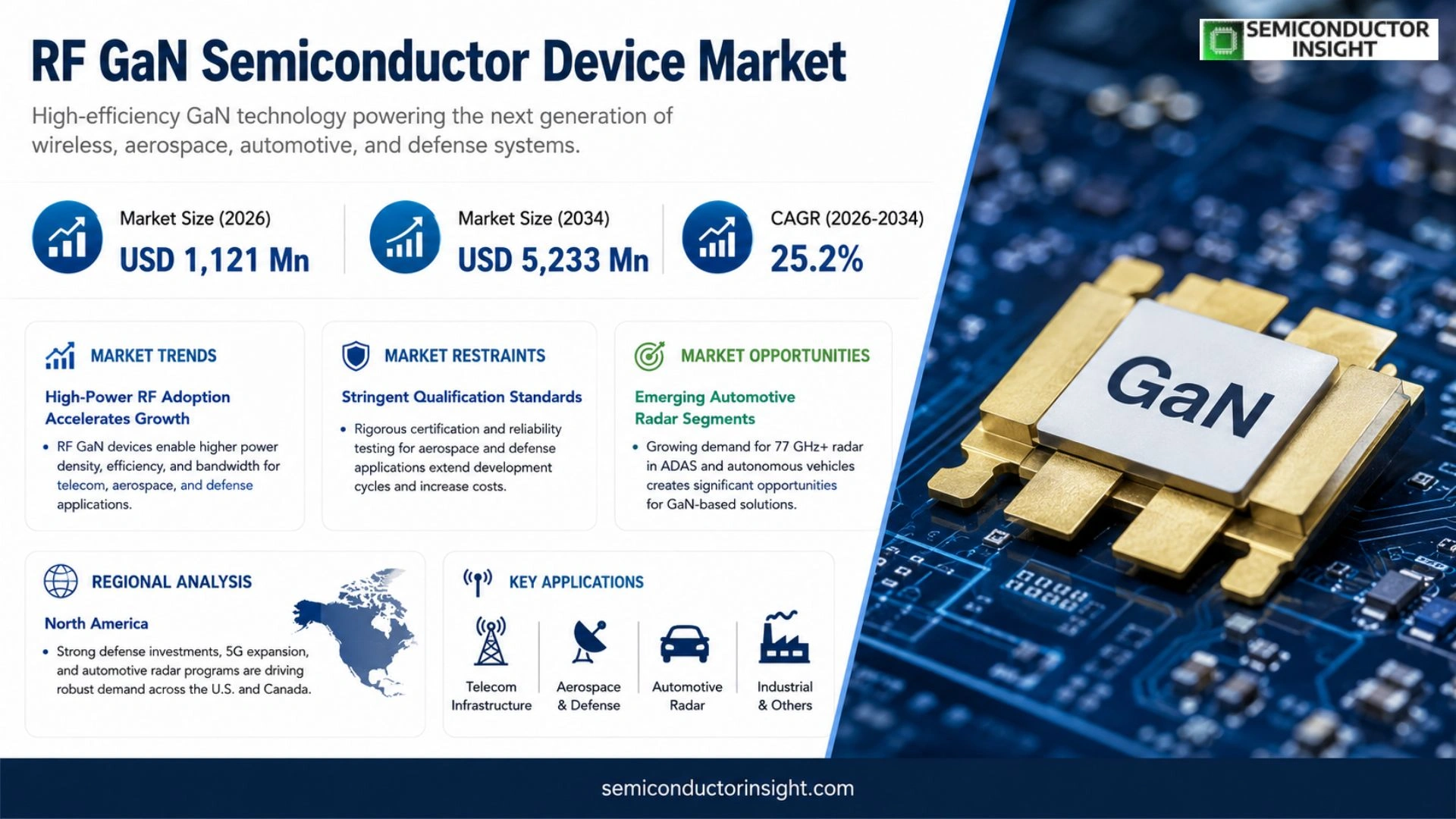
Global RF GaN Semiconductor Device market size was valued at USD 1,121 million in 2026 and will grow to USD 5,233 million by 2034, exhibiting a CAGR of 25.2% during the forecast period.
RF GaN semiconductor devices are power‑amplifier components that exploit the wide bandgap properties of gallium nitride. The material enables higher breakdown voltage, faster switching speed and superior thermal conductivity compared with silicon‑based counterparts. These attributes make RF GaN devices suitable for high‑power radio‑frequency applications such as base‐station transmitters, satellite payloads and automotive radar systems. The product family includes GaN‑on‐SiC, GaN‐on‐silicon and emerging GaN‐on‐diamond technologies.
The market expansion is linked to the rollout of 5G networks, growing demand for high‑frequency millimeter‐wave infrastructure and increasing adoption of electric vehicles that require compact radar modules. Recent strategic moves,such as the September 2023 joint development agreement between Analog Devices and Qorvo to co‐engineer a next‐generation X‑band power amplifier,illustrate how manufacturers are consolidating R&D resources. Supply‐chain pressures on silicon carbide substrates have also prompted customers to evaluate alternative platforms, further supporting the shift toward RF GaN solutions.
MARKET DRIVERS
Performance Advantages Over Silicon
RF GaN Semiconductor Device Market is gaining traction because gallium‑nitride delivers markedly higher power‑added efficiency and frequency capability than traditional silicon. Designers can now achieve ‑3 dB noise figures at Ka‑band frequencies without resorting to bulky heat‑sink architectures, enabling compact antenna modules for 5G base stations. This shift reduces both capital expenditures and operating costs for network operators, creating a clear incentive to adopt GaN‑based front‑ends.
Demand From Defense and Space Applications
Defense contractors are re‑engineering radar and electronic‑warfare suites around GaN technology to meet stringent power‑density and survivability criteria. In low‑Earth‑orbit satellites, the ability to handle high peak‑to‑average power ratios while maintaining a light footprint translates directly into longer mission lifetimes and lower launch costs. These sectoral pressures compel suppliers to prioritize GaN production capacities, reinforcing market momentum.
➤ “GaN’s intrinsic material properties are reshaping RF architectures, allowing system‑level consolidation that was impossible with silicon.” – Senior Analyst, RF Industry Forum
Manufacturing advances, especially the adoption of semi‑automatic epitaxial‑layer deposition and wafer‑scale testing, are narrowing the cost gap with silicon. As yields improve, the total cost of ownership for GaN‑based transmitters becomes comparable to legacy solutions, encouraging OEMs to replace legacy amplifiers in both legacy and greenfield projects.
MARKET CHALLENGES
Thermal Management Complexity
Despite its superior power density, GaN’s high switching speeds generate localized hotspots that demand sophisticated heat‑dissipation strategies. Integrating diamond‑composite substrates or micro‑channel coolers adds design overhead and can erode the cost advantage, especially for low‑volume consumer‑grade products.
Other Challenges
Material Cost and Supply Chain Fragility
Gallium‑nitride wafers remain more expensive than silicon, and the limited number of qualified epitaxy facilities creates a bottleneck. Fluctuations in raw‑material pricing, coupled with geopolitical tensions affecting semiconductor supply chains, can delay project timelines and inflate budgets.
MARKET RESTRAINTS
Stringent Qualification Standards
Regulatory bodies require exhaustive qualification for RF components used in aerospace and defense, mandating burn‑in testing, radiation hardness verification, and long‑term reliability studies. The time‑intensive certification pipeline discourages small‑scale entrants and prolongs time‑to‑market for new GaN designs.
MARKET OPPORTUNITIES
Emerging Automotive Radar Segments
Advanced driver‑assistance systems (ADAS) and upcoming autonomous‑vehicle platforms require millimeter‑wave radar transceivers that can sustain high peak powers while staying within automotive temperature envelopes. GaN’s ability to operate efficiently at 77 GHz and above positions RF GaN Semiconductor Device Market to capture a growing slice of the automotive supply chain, especially as OEMs shift from legacy silicon to higher‑performance solutions.
RF GaN Semiconductor Device Market Trends
High‑Power RF Adoption Accelerates Market Momentum
RF GaN Semiconductor Device Market recorded revenue of roughly US$1.12 billion in 2024 and is slated to surpass US$5.2 billion by 2031. The compound annual increase of around 25 percent reflects a shift among telecom operators, aerospace firms, and automotive manufacturers toward solutions that can sustain higher voltages while preserving linearity. GaN’s wide bandgap enables power densities that silicon‑based RF cannot match, which translates into smaller footprints and lower cooling requirements for base‑station amplifiers and radar modules. As spectrum congestion intensifies, carriers are upgrading to 5G and early‑stage 6G platforms that demand the extra headroom GaN delivers. The financial implications are evident: OEMs that integrate GaN ahead of competitors can command premium pricing and lock in longer product lifecycles, while late adopters risk obsolescence of legacy silicon RF portfolios.
Other Trends
Material‑Platform Shift Toward GaN‑on‑Silicon
Although GaN‑on‑Silicon‑Carbide remains the performance benchmark for extreme power levels, the industry is gradually gravitating to GaN‑on‑Silicon substrates because of cost efficiencies and compatibility with existing silicon fabs. This transition lowers entry barriers for mid‑range applications such as point‑to‑point microwave links and consumer‑grade wireless chargers. Suppliers reporting early 2024 production ramps indicate that wafer yields for silicon‑based GaN have risen above 80 percent, narrowing the gap with SiC processes. The strategic advantage is twofold: manufacturers can diversify their product mix without massive capital outlays, and downstream customers benefit from a broader price spectrum that supports volume growth in emerging markets.
Automotive Radar and Advanced Driver‑Assistance Systems Expand Scope
Automakers are embedding higher‑frequency radar arrays to enable finer resolution for collision‑avoidance and adaptive cruise functions. GaN’s ability to operate efficiently at millimeter‑wave bands (24 GHz and above) makes it the preferred technology for these safety‑critical modules. Recent pilot programs in Europe and North America have shown that GaN‑based radar can reduce system weight by up to 30 percent while delivering a 15 percent boost in detection range. This performance uplift drives a reevaluation of vehicle architecture, prompting tier‑one suppliers to redesign printed‑circuit boards and power‑management schemes around GaN devices. The ripple effect includes a surge in demand for ancillary components,thermal interfaces, bias‑te circuits, and packaging solutions,creating ancillary revenue streams for firms positioned along the supply chain.
COMPETITIVE LANDSCAPE
Key Industry Players
RF GaN Semiconductor Device Market – Competitive Overview
Qorvo Inc. dominates the high‑power RF GaN segment, leveraging its extensive HEMT portfolio and a supply chain that spans silicon carbide substrates to advanced packaging. Recent strategic investments in domestic wafer capacity have allowed Qorvo to tighten lead times, reinforcing its position with major telecom operators and defense contractors. The company’s ability to bundle GaN devices with supporting RF front‑end modules creates a barrier for newer entrants, fostering a market structure where a handful of firms capture the bulk of revenue while smaller players chase niche applications.
Beyond the dominant tier, several manufacturers specialize in differentiated value propositions. Infineon Technologies and Analog Devices concentrate on GaN‑on‑silicon solutions that cater to cost‑sensitive automotive radar modules, while ROHM and Aethercomm focus on compact GaN‑on‑diamond designs for aerospace and satellite communications. Panasonic and Microchip Technology, though not primary volume sellers, provide highly reliable components for consumer‑grade wireless infrastructure. This layered ecosystem enables end‑users to source devices that align with specific performance, reliability, and price constraints, encouraging a competitive climate where innovation often targets narrow, high‑margin niches.
List of Key RF GaN Semiconductor Device Companies Profiled
- Qorvo Inc.
- Infineon Technologies AG
- Analog Devices, Inc.
- ROHM Semiconductor
- STMicroelectronics
- NXP Semiconductors
- Renesas Electronics Corporation
- Microchip Technology
- Panasonic Corporation
- Aethercomm Inc.
- Mitsubishi Electric Corporation
- Sumitomo Electric Industries, Ltd.
Segment Analysis:
| Segment Category | Sub-Segments | Key Insights |
| By Type |
|
GaN-On-SiC
|
| By Application |
|
Telecom
|
| By End User |
|
Infrastructure Providers
|
| By Frequency Range |
|
Mid Frequency
|
| By Functional Role |
|
Power Amplifiers
|
Regional Analysis: RF GaN Semiconductor Device Market
North America
The Department of Defense’s push for high‑power, lightweight RF modules has accelerated adoption of GaN devices for radar and electronic warfare. Procurement cycles favor suppliers offering integrated solutions that meet stringent reliability standards, creating a premium pricing environment for qualified vendors.
Major carriers are upgrading macro‑cell sites to support wider bandwidths, and GaN’s efficiency reduces operating expenses. The transition to massive MIMO architectures deepens the need for high‑power amplifiers that can sustain dense antenna arrays.
Advanced driver‑assistance systems (ADAS) rely on short‑range radar modules where GaN’s fast switching delivers superior resolution. OEMs are locking in supply agreements to ensure a steady pipeline for next‑generation vehicle platforms.
Private equity and strategic investors are targeting GaN fabs with expansion plans, recognizing the device’s role in multiple high‑growth verticals. Funding flows are directed toward wafer‑scale manufacturing and packaging innovations.
Europe
European manufacturers are leveraging GaN technology to meet the EU’s green‑energy directives, which call for more efficient RF power in broadcasting and satellite uplinks. The region’s strong emphasis on standards harmonization enables cross‑border projects, particularly in aerospace and defense, where collaborative procurement reduces unit costs. Meanwhile, the rollout of private‑5G networks in major metros creates a niche for high‑power, low‑loss amplifiers. Companies that can intertwine compliance expertise with scalable production will enjoy a competitive edge in this regulated environment.
Asia‑Pacific
Asia‑Pacific’s market momentum stems from aggressive telecom modernization in China, Japan, and South Korea, coupled with burgeoning automotive radar adoption in India and Southeast Asia. Local governments are investing heavily in research parks focused on wide‑bandgap semiconductors, fostering a pipeline of homegrown talent and IP. The region’s cost‑advantaged manufacturing base allows firms to offer competitive pricing for mass‑market applications while still catering to high‑end defense contracts. Strategic partnerships between foundries and system integrators are accelerating time‑to‑market for new GaN‑based modules.
South America
In South America, the RF GaN device market is anchored by Brazil’s expanding satellite communications network and growing demand for renewable‑energy‑linked RF systems. While overall spending is modest, niche opportunities arise in maritime monitoring and border‑security radar, where performance outweighs price sensitivity. Companies that can provide robust, temperature‑tolerant solutions suited to the region’s varied climate will capture the limited but high‑value contracts available.
Middle East & Africa
The Middle East’s high‑investment defense budgets, particularly in the Gulf Cooperation Council, are driving early adoption of GaN for next‑generation radar and electronic countermeasures. African nations, meanwhile, are focusing on satellite backhaul and remote tele‑education initiatives, where energy‑efficient RF amplifiers are critical. The market here is fragmented, but joint ventures with local technology firms provide a pathway to navigate regulatory landscapes and secure long‑term service agreements.
Report Scope
This market research report provides a comprehensive analysis of the RF GaN Semiconductor Device Market , covering the forecast period 2026–2034. It offers detailed insights into market dynamics, technological advancements, competitive landscape, and key trends shaping the industry.
Key focus areas of the report include:
- Market Overview: The report begins with an overview outlining its current market scenario, key growth indicators, and industry transformation drivers. It discusses macroeconomic factors, demand–supply balance, regulatory landscape, and the strategic role of semiconductors in powering advancements across industries such as automotive, telecommunications, consumer electronics, and industrial automation.
- Market Size & Forecast: Historical data and future projections for revenue, unit shipments, and market value across major regions and segments.
- Segmentation Analysis: Detailed breakdown by product type, technology, application, and end-user industry to identify high-growth segments and investment opportunities.
- Regional Insights: Insights into market performance across North America, Europe, Asia-Pacific, Latin America, and the Middle East & Africa, including country-level analysis where relevant.
- Competitive Landscape: Profiles of leading market participants, including their product offerings, R&D focus, manufacturing capacity, pricing strategies, and recent developments such as mergers, acquisitions, and partnerships.
- Technology Trends & Innovation: Assessment of emerging technologies, integration of AI/IoT, semiconductor design trends, fabrication techniques, and evolving industry standards.
- Market Drivers & Restraints: Evaluation of factors driving market growth along with challenges, supply chain constraints, regulatory issues, and market-entry barriers.
- Stakeholder Insights: Insights for component suppliers, OEMs, system integrators, investors, and policymakers regarding the evolving ecosystem and strategic opportunities.
Primary and secondary research methods are employed, including interviews with industry experts, data from verified sources, and real-time market intelligence to ensure the accuracy and reliability of the insights presented.
FREQUENTLY ASKED QUESTIONS:
What is the current market size of RF GaN Semiconductor Device Market?
-> RF GaN Semiconductor Device Market was valued at USD 1,121 million in 2026 and is expected to reach USD 5,233 million by 2034, representing a CAGR of 25.2% during the forecast period.
Which key companies operate in RF GaN Semiconductor Device Market?
-> Key players include Sumitomo Electric Industries, Ltd; Raytheon Company; Robert Bosch GmbH; STMicroelectronics; Hitachi, Ltd; Toshiba Corporation; Mitsubishi Electric Corporation; Infineon Technologies AG; Renesas Electronics Corporation; Panasonic Corporation; Microchip Technology; Aethercomm Inc.; Cree, Inc.; NXP Semiconductor; Analog Devices Inc.; ROHM Semiconductors; Qorvo Inc..
What are the key growth drivers?
-> Key growth drivers include the wide‑bandgap advantage of GaN enabling high‑power, high‑frequency RF applications, rapid expansion of 5G and other telecom infrastructure, increasing demand for aerospace & defense radar systems, and the shift toward electric‑vehicle power‑train technologies.
Which region dominates the market?
-> Asia‑Pacific remains the largest region by revenue, despite a modest 2.0% decline, driven by strong automotive, telecom and defense spending in China, Japan, and South Korea.
What are the emerging trends?
-> Emerging trends include advancements in GaN‑on‑SiC and GaN‑on‑Diamond substrates, integration of GaN devices in next‑generation 5G/6G base stations, and expanded use of GaN for high‑efficiency power conversion in automotive and renewable‑energy systems.
Get Sample Report PDF for Exclusive Insights
Report Sample Includes
- Table of Contents
- List of Tables & Figures
- Charts, Research Methodology, and more...
 Download Sample Report PDF