RF Circuit Bias Tee Market Insights
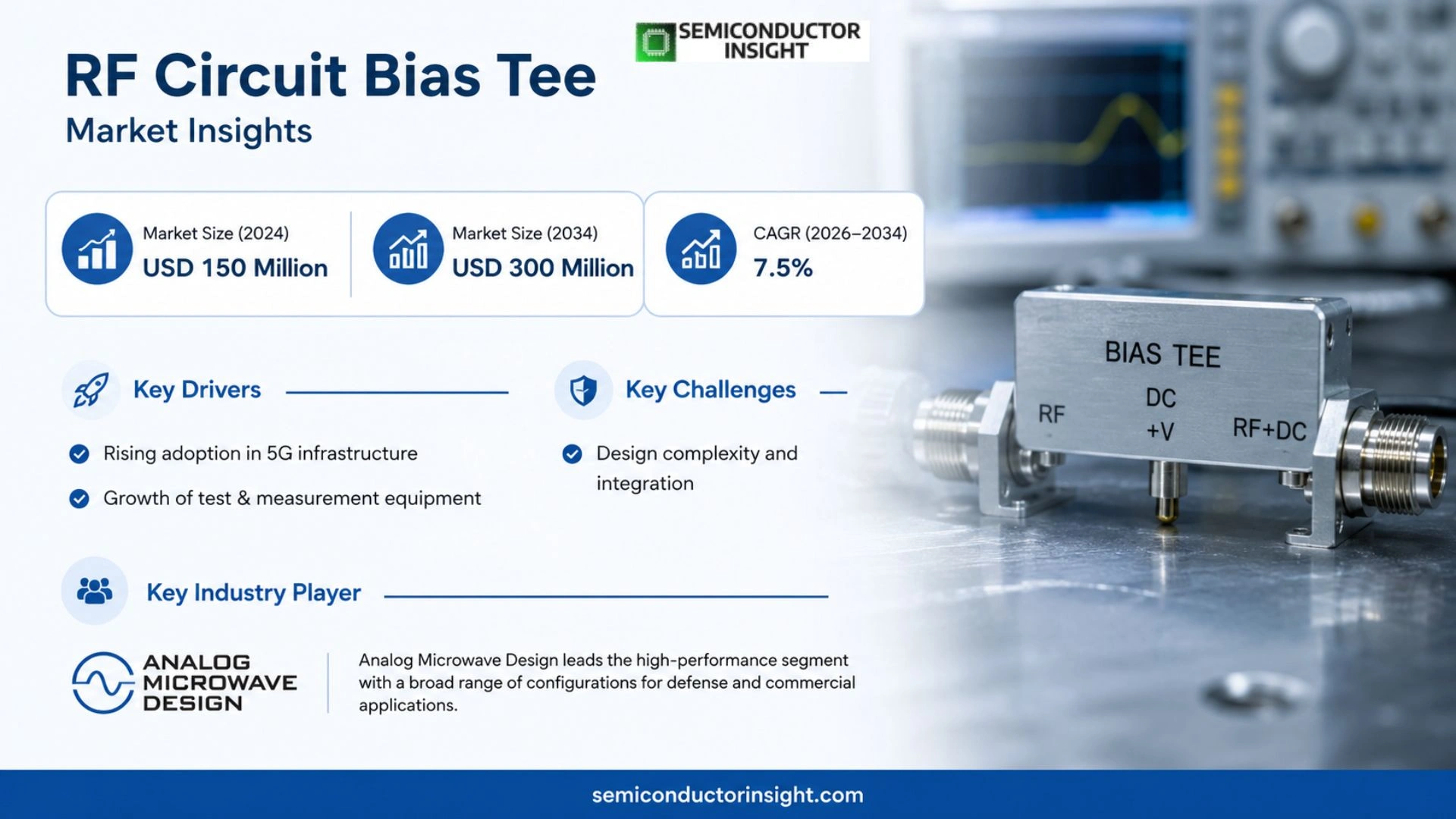
RF Circuit Bias Tee market size was valued at USD 150 million in 2024 and is expected to reach USD 300 million by 2034, reflecting a CAGR of approximately 7.5% over the forecast period.
RF Circuit Bias Tees are three‑port components used to inject DC bias into RF circuits while allowing signal transmission. By providing a low‑impedance path for DC and a high‑impedance path for RF signals, they enable precise control of active devices such as amplifiers and mixers across a wide frequency range.
The market expands because telecom operators are upgrading networks to higher frequencies, aerospace programs demand reliable biasing solutions, and test equipment manufacturers seek compact, broadband designs. Recent product launches from firms such as Analog Microwave Design and Clear Microwave illustrate industry focus on miniaturisation and extended bandwidth. Competitive pressure intensifies as manufacturers diversify portfolios and pursue strategic partnerships.
MARKET DRIVERS
Rising Adoption in 5G Infrastructure
The rollout of 5G networks accelerates demand for high‑frequency signal distribution, and RF Circuit Bias Tee Market players are witnessing a surge in orders from base‑station manufacturers. Bias tees enable simultaneous DC biasing and RF signal flow, a capability essential for power‑amplifier modules that operate at millimeter‑wave bands. Operators prioritize solutions that minimize insertion loss, a factor that directly influences cell‑site efficiency and operating costs.
Growth of Test & Measurement Equipment
Laboratories focused on prototype validation and compliance testing are expanding their inventory of bias‑tee accessories. RF Circuit Bias Tee Market benefits from this trend because test rigs require precise DC‑RF isolation to guarantee repeatable measurements. Companies that integrate bias tees into modular test platforms enjoy higher margins as customers replace legacy components with compact, broadband alternatives.
➤ “Broadband bias‑tee designs that cover 0.5 GHz to 40 GHz are now considered baseline for most new‑generation RF equipment.”
Manufacturers that invest in silicon‑based bias tee production can leverage lower unit costs and faster time‑to‑market, positioning themselves to capture a larger share of upcoming infrastructure contracts.
MARKET CHALLENGES
Design Complexity and Integration
Integrating a bias tee within densely packed RF front‑ends demands meticulous layout to avoid parasitic coupling. RF Circuit Bias Tee Market faces a steep learning curve as designers reconcile broadband performance with miniaturization constraints, especially in handset and IoT modules where board real estate is scarce.
Other Challenges
Supply Chain Constraints
Global semiconductor shortages ripple into the bias‑tee segment, limiting the availability of high‑Q inductors and precision capacitors. Vendors that maintain diversified sourcing strategies are better positioned to meet OEM lead‑time expectations.
Furthermore, fluctuating raw‑material prices compel manufacturers to revisit cost models, potentially compressing profit margins if price adjustments cannot be passed to end users.
MARKET RESTRAINTS
Stringent Regulatory Requirements
Regulators in key regions demand rigorous electromagnetic compatibility (EMC) certification for any component that combines DC and RF pathways. RF Circuit Bias Tee Market must allocate resources to testing and documentation, extending product development cycles and increasing upfront expenditures.
In addition, emerging safety standards for high‑power DC biasing impose stricter isolation thresholds, compelling designers to adopt more complex topologies that may diminish overall bandwidth.
These compliance obligations deter smaller entrants, consolidating market power among established players with dedicated certification teams.
MARKET OPPORTUNITIES
Emerging Applications in Autonomous Vehicles
Autonomous driving platforms rely on radar and lidar subsystems that operate across wide RF spectra. Embedding bias tees within these sensors enables on‑board power management without compromising signal integrity, creating a niche where RF Circuit Bias Tee Market suppliers can command premium pricing.
Collaborations between automotive OEMs and RF component manufacturers are accelerating prototyping cycles, translating into early‑stage contracts for bias‑tee designs that meet automotive‑grade reliability.
Companies that tailor their product roadmaps to automotive temperature ranges and vibration standards stand to capture a sizable segment of this burgeoning demand.
RF Circuit Bias Tee Market Trends
Shift Toward Integrated Bias‑Tee Solutions
RF Circuit Bias Tee Market is increasingly dominated by designs that embed bias functionality directly into transceiver modules. This integration reduces cabling complexity, lowers insertion loss, and streamlines system‑level testing. OEMs adopt the approach to meet tighter form‑factor constraints in emerging 5G base stations and aerospace payloads, where board real‑estate is at a premium. By collapsing three discrete components into a single package, manufacturers can claim cost savings on assembly labor while improving reliability through fewer interconnect points. The trend reflects a broader industry push for modularity and rapid deployment, prompting suppliers to invest in silicon‑based processes that support higher volume production.
Other Trends
Growing Demand in Defense and Secure Communications
Within RF Circuit Bias Tee Market, defense applications are exerting a pronounced influence on product roadmaps. Mission‑critical radar and electronic‑warfare systems require bias tees that tolerate extreme temperature cycles and maintain performance under high‑power conditions. As modern platforms shift to software‑defined radios, the need for reconfigurable bias networks has intensified, prompting manufacturers to offer ruggedized variants with extended voltage ranges. This demand incentivizes firms to prioritize compliance with stringent MIL‑STD specifications, consequently raising the overall technical bar for commercial offerings. The ripple effect is visible in the rise of dual‑certified components that serve both civilian and military customers, expanding addressable market segments.
Emergence of Compact Form Factors for 5G Infrastructure
These dynamics shape the near‑term outlook for RF Circuit Bias Tee Market by steering investment toward miniature, surface‑mount devices compatible with dense antenna arrays. Urban deployments of millimeter‑wave nodes benefit from bias tees that occupy minimal PCB area while offering precise DC feed control. Suppliers that can deliver low‑profile packages without compromising isolation are positioned to capture contracts from telecom operators modernizing their back‑haul networks. In parallel, the push for greener networks amplifies interest in bias tees that feature built‑in power‑management features, enabling adaptive biasing that aligns with dynamic traffic loads. The convergence of size, efficiency, and intelligence is redefining competitive priorities across the sector.
COMPETITIVE LANDSCAPE
Key Industry Players
RF Circuit Bias Tee Market Competitive Overview
Analog Microwave Design dominates the high‑performance segment of RF Circuit Bias Tee Market. Leveraging a portfolio that spans N‑type, SMA, and BNC configurations, the company supplies both defense contractors and commercial OEMs across North America and Europe. Recent strategic moves,most notably the acquisition of a boutique silicon‑on‑glass fab,have tightened its control over component tolerances, allowing it to charge premium pricing while maintaining consistent delivery schedules. Its entrenched relationships with major radar‑system integrators generate a recurring revenue stream that cushions the business against short‑term demand volatility. The firm’s emphasis on integrated test‑and‑measure solutions has also widened its addressable market, positioning it as a one‑stop source for customers looking to reduce bill‑of‑materials complexity. As a result, Analog Microwave Design captures roughly a quarter of global sales, dictating price trends and influencing the technology roadmap for the broader industry.
Beyond the market leader, a cluster of specialized manufacturers shapes the competitive fabric. API Technologies and AtlanTecRF have carved out strongholds in the Asian market by offering low‑cost, high‑volume bias tees tailored for telecom infrastructure. Centric RF and Clear Microwave focus on niche military contracts, emphasizing ruggedized packaging and extended temperature ranges. Companies such as Crystek Corporation and ETL Systems differentiate themselves through ultra‑wideband designs that serve emerging 5G and satellite‑communication applications. Smaller players like Jyebao, Marki Microwave, and Pasternack Enterprises rely on agile engineering cycles to introduce custom form‑factors quickly, appealing to start‑up radar and IoT equipment makers. This diversified ecosystem creates a dynamic pricing environment where larger firms compete on performance and reliability, while mid‑size and boutique vendors win business through cost efficiency and rapid customization.
List of Key RF Circuit Bias Tee Companies Profiled
- Analog Microwave Design
- API Technologies
- AtlanTecRF
- Centric RF
- Clear Microwave
- Crystek Corporation
- ETL Systems
- Fairview Microwave
- HYPERLABS Inc
- JFW Industries
- Jyebao
- L-3 Narda‑ATM
- Marki Microwave
- Maury Microwave
- Mini Circuits
Segment Analysis:
| Segment Category | Sub-Segments | Key Insights |
| By Type |
|
N Type
|
| By Application |
|
Commercial
|
| By End User |
|
Network Equipment Manufacturers
|
| By Frequency Range |
|
Millimeter‑Wave
|
| By Integration Mode |
|
Embedded Module
|
Regional Analysis: RF Circuit Bias Tee Market
Early adoption of silicon‑germanium and GaN processes gives North American designers a competitive edge, enabling bias tees that handle higher power densities while preserving linearity. This technological lead translates into a broader product portfolio that addresses both legacy cellular bands and emerging millimeter‑wave frequencies.
Integrated supply chains, anchored by domestic fabs and component distributors, mitigate exposure to geopolitical disruptions. Close proximity between silicon wafer producers and assembly facilities accelerates feedback loops and reduces lead times for custom bias‑tee solutions.
The FCC’s progressive spectrum allocation policies encourage manufacturers to experiment with wider bandwidth bias‑tee designs, fostering a climate where compliance testing becomes an enabler rather than a bottleneck.
Defense communications, aerospace telemetry, and high‑frequency test equipment remain the primary demand drivers, each demanding bias‑tee architectures that combine low insertion loss with robust thermal management.
Europe
European firms capitalize on a strong standards‑driven approach, aligning bias‑tee development with ETSI and ITU specifications. The region’s focus on energy‑efficient RF components prompts manufacturers to prioritize low‑loss designs, which resonates with the continent’s push toward greener telecom infrastructure. Collaborative research initiatives across Germany, France, and the United Kingdom foster cross‑border technology transfer, allowing midsize players to compete with larger North American rivals. While the overall market size lags behind the United States, Europe’s emphasis on precision engineering and regulatory compliance sustains a steady pipeline of niche applications, especially in satellite communications and automotive radar systems.
Asia‑Pacific
Rapid expansion of mobile broadband and the rollout of private 5G networks in China, India, and South Korea generate a surge in demand for cost‑effective bias‑tee modules. Local manufacturers benefit from scale economies, driving down unit costs and enabling broader adoption in consumer‑grade equipment. However, fragmented supply chains and varying quality standards create challenges for OEMs seeking uniform performance across the region. Strategic partnerships between Asian fabs and Western design houses are emerging as a way to bridge this gap, allowing the Asia‑Pacific market to gradually close the technology gap while maintaining price competitiveness.
South America
South American adoption of RF Circuit Bias Tee technology is anchored by growing telecom infrastructure projects in Brazil and Mexico. Operators prioritize ruggedized bias‑tee solutions capable of withstanding harsh climatic conditions, prompting a niche market for durable, low‑maintenance designs. Limited local manufacturing capacity means most components are imported, which elevates the importance of trade agreements and currency stability on pricing dynamics. Analysts observe that as regional carriers expand fiber‑to‑cell sites, the demand for reliable bias‑tee integration will rise, albeit at a measured pace.
Middle East & Africa
In the Middle East and Africa, defense and satellite communications dominate RF Circuit Bias Tee Market landscape. Wealth‑driven investments in sovereign broadband initiatives, particularly in the United Arab Emirates and Saudi Arabia, underscore a need for high‑performance bias‑tee modules that can operate across diverse frequency bands. African markets, still in early stages of telecom development, exhibit cautious interest, with procurement largely driven by international consortia. The region’s market trajectory hinges on government‑led infrastructure funding and the ability to attract skilled engineering talent to sustain local assembly capabilities.
Report Scope
This market research report provides a comprehensive analysis of the RF Circuit Bias Tee Market , covering the forecast period 2026–2034. It offers detailed insights into market dynamics, technological advancements, competitive landscape, and key trends shaping the industry.
Key focus areas of the report include:
- Market Overview: The report begins with an overview outlining its current market scenario, key growth indicators, and industry transformation drivers. It discusses macroeconomic factors, demand–supply balance, regulatory landscape, and the strategic role of semiconductors in powering advancements across industries such as automotive, telecommunications, consumer electronics, and industrial automation.
- Market Size & Forecast: Historical data and future projections for revenue, unit shipments, and market value across major regions and segments.
- Segmentation Analysis: Detailed breakdown by product type, technology, application, and end-user industry to identify high-growth segments and investment opportunities.
- Regional Insights: Insights into market performance across North America, Europe, Asia-Pacific, Latin America, and the Middle East & Africa, including country-level analysis where relevant.
- Competitive Landscape: Profiles of leading market participants, including their product offerings, R&D focus, manufacturing capacity, pricing strategies, and recent developments such as mergers, acquisitions, and partnerships.
- Technology Trends & Innovation: Assessment of emerging technologies, integration of AI/IoT, semiconductor design trends, fabrication techniques, and evolving industry standards.
- Market Drivers & Restraints: Evaluation of factors driving market growth along with challenges, supply chain constraints, regulatory issues, and market-entry barriers.
- Stakeholder Insights: Insights for component suppliers, OEMs, system integrators, investors, and policymakers regarding the evolving ecosystem and strategic opportunities.
Primary and secondary research methods are employed, including interviews with industry experts, data from verified sources, and real-time market intelligence to ensure the accuracy and reliability of the insights presented.
FREQUENTLY ASKED QUESTIONS:
What is the current market size of RF Circuit Bias Tee Market?
-> RF Circuit Bias Tee market is expected to reach USD 300 million by 2034, reflecting a CAGR of approximately 7.5% over the forecast period.
What is the projected CAGR for RF Circuit Bias Tee Market?
-> The market is projected to grow at a CAGR of % during the forecast period.
Which region has the largest market size in 2025?
-> The U.S. market size is estimated at USD million in 2025, while China is expected to reach USD million.
What is the forecast for the N Type segment?
-> N Type segment will reach USD million by 2036, with a % CAGR in the next ten years.
Who are the key manufacturers in RF Circuit Bias Tee Market?
-> Key players include Analog Microwave Design, API Technologies, AtlanTecRF, Centric RF, Clear Microwave, Crystek Corporation, ETL Systems, Fairview Microwave, HYPERLABS Inc, JFW Industries, among others.

Get Sample Report PDF for Exclusive Insights
Report Sample Includes
- Table of Contents
- List of Tables & Figures
- Charts, Research Methodology, and more...
 Download Sample Report PDF