Resistive RAM (ReRAM, CBRAM) Market Insights
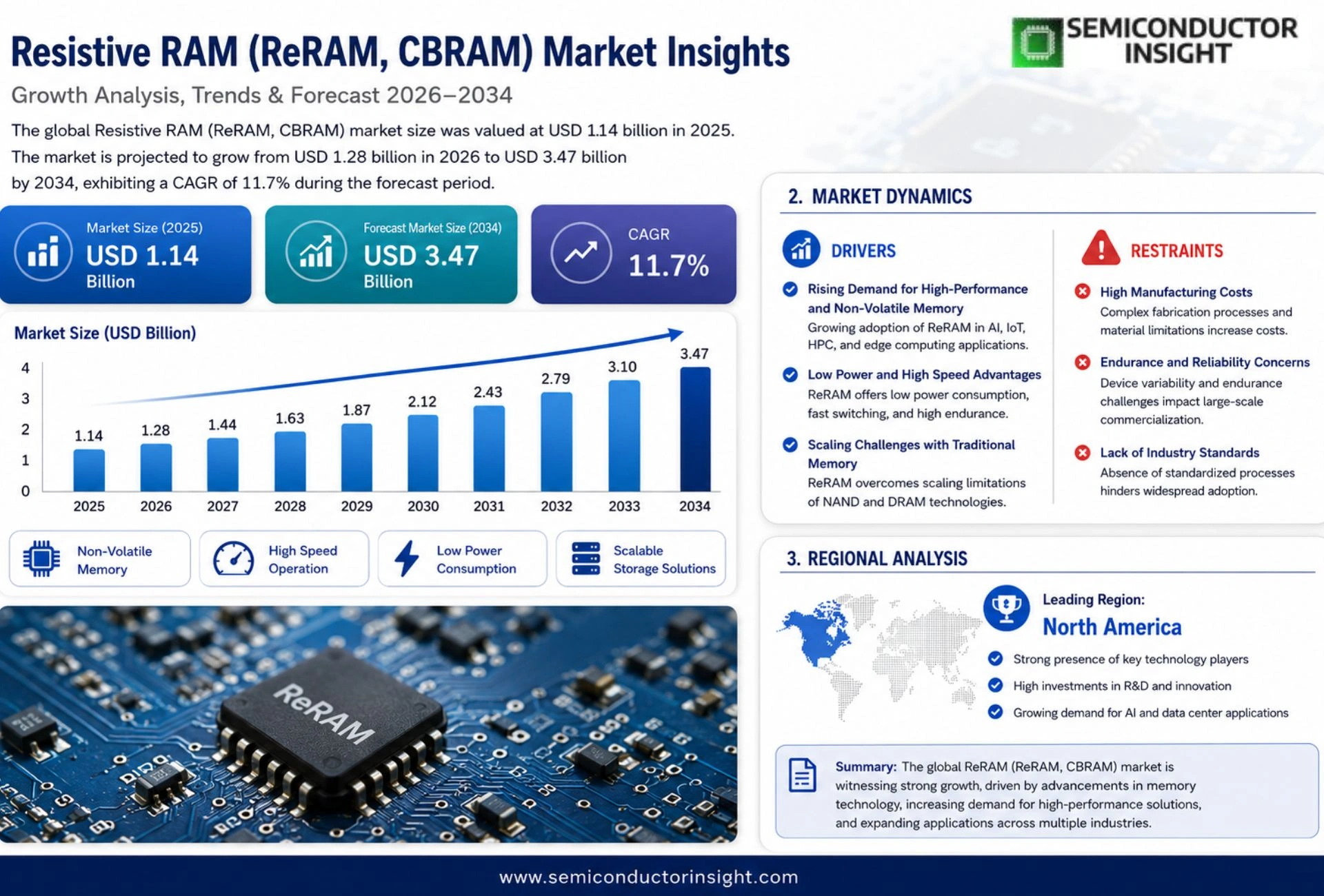
Global Resistive RAM (ReRAM, CBRAM) Market size was valued at USD 1.14 billion in 2025. The market is projected to grow from USD 1.28 billion in 2026 to USD 3.47 billion by 2034, exhibiting a CAGR of 11.7% during the forecast period.
Resistive RAM (ReRAM) and Conductive Bridging RAM (CBRAM) are next-generation non-volatile memory technologies that store data by altering the electrical resistance of a specialized material. ReRAM operates through the formation and rupture of conductive filaments within a metal oxide layer, while CBRAM relies on the electrochemical deposition of metallic ions to create or dissolve a conductive bridge between electrodes. These technologies are increasingly recognized as strong alternatives to Flash memory and DRAM due to their faster switching speeds, lower power consumption, higher endurance, and superior scalability at advanced technology nodes.
The market is witnessing robust momentum driven by surging demand for edge AI computing, IoT devices, and neuromorphic computing architectures that require low-latency, energy-efficient memory solutions. Furthermore, the proliferation of wearable electronics and automotive-grade embedded memory applications has significantly broadened the addressable market. Key industry participants such as Crossbar Inc., Panasonic Corporation, Fujitsu Limited, Adesto Technologies (now part of Dialog Semiconductor), and IMEC continue to advance commercialization efforts through strategic partnerships and technology licensing, reinforcing the competitive landscape of Global Resistive RAM (ReRAM, CBRAM) Market.
MARKET DRIVERS
Surging Demand for Non-Volatile Memory in AI and Edge Computing Applications
Resistive RAM (ReRAM, CBRAM) Market is experiencing robust growth momentum, driven primarily by the accelerating adoption of artificial intelligence, machine learning, and edge computing workloads that demand high-speed, low-power non-volatile memory solutions. Unlike conventional flash memory, ReRAM technology offers significantly faster read/write speeds, lower operating voltages, and superior endurance characteristics, making it highly attractive for next-generation embedded systems and IoT devices. As semiconductor manufacturers pursue more energy-efficient architectures, ReRAM and CBRAM solutions are increasingly being integrated into microcontrollers and system-on-chip designs targeting industrial automation and consumer electronics segments.
Expanding IoT Ecosystem and Connected Device Infrastructure
The proliferation of connected devices across smart manufacturing, healthcare monitoring, smart cities, and automotive telematics is generating unprecedented demand for reliable, low-power memory technologies. Resistive RAM (ReRAM, CBRAM) Market benefits directly from this expansion, as CBRAM and ReRAM cells can retain data without continuous power supply while offering byte-level addressability , a critical advantage over block-erasable NAND flash in resource-constrained applications. Major semiconductor foundries are investing in embedded ReRAM process nodes to serve fabless chip designers targeting wearable devices and medical implantables, further reinforcing demand across the value chain.
➤ Industry analyses indicate that embedded non-volatile memory, including ReRAM variants, is becoming a preferred alternative to embedded flash in advanced process nodes below 28nm, where traditional floating-gate flash scaling faces significant physical limitations , positioning ReRAM and CBRAM as strategic enablers of next-generation semiconductor roadmaps.
Leading memory technology developers and IP licensing firms are actively expanding their ReRAM portfolio partnerships with foundry partners and fabless customers alike. The convergence of neuromorphic computing research with resistive switching memory physics is opening a new frontier for in-memory computing architectures, where ReRAM crossbar arrays can perform matrix multiplication operations directly within the memory fabric, reducing data movement bottlenecks that currently constrain AI inference accelerator performance at the edge.
MARKET CHALLENGES
Device Variability and Reliability Concerns Impeding Large-Scale Commercialization
Despite its promising attributes, Resistive RAM (ReRAM, CBRAM) Market faces significant technical challenges related to device-to-device variability, cycle-to-cycle resistance fluctuation, and long-term data retention reliability. Stochastic switching behavior inherent in filamentary conduction mechanisms introduces read disturb errors and write variability that complicate the design of robust memory controllers, particularly in high-density multi-level cell configurations. Achieving consistent resistance window margins across billions of switching cycles remains a key engineering challenge that memory developers must address before ReRAM can displace established NOR flash in mission-critical embedded applications.
Other Challenges
Integration Complexity with Advanced CMOS Processes
Integrating resistive switching materials such as hafnium oxide, tantalum oxide, and silver-based electrolytes into high-volume CMOS manufacturing flows requires specialized deposition and patterning steps that add process complexity and cost. Achieving BEOL (back-end-of-line) compatibility without compromising transistor performance or introducing contamination risks demands close collaboration between memory material scientists and foundry process engineers, extending development timelines and increasing qualification costs for new ReRAM product generations.
Competition from Established and Emerging NVM Technologies
Resistive RAM (ReRAM, CBRAM) Market competes intensely with well-entrenched embedded NOR flash solutions as well as emerging alternatives including MRAM, PCM, and FeRAM. Each competing technology offers differentiated trade-offs in endurance, speed, temperature range, and process maturity. MRAM in particular has gained significant commercial traction in embedded automotive and industrial applications, backed by substantial foundry investment, posing a competitive challenge to ReRAM adoption in segments where switching endurance and magnetic field immunity are paramount customer requirements.
MARKET RESTRAINTS
High Development Costs and Limited Standardization Constraining Market Penetration
One of the primary restraints affecting Resistive RAM (ReRAM, CBRAM) Market is the substantial capital investment required for process development, IP licensing, and product qualification across target end-use industries. Unlike mature NOR flash technology supported by decades of manufacturing optimization and a broad supplier ecosystem, ReRAM and CBRAM technologies are still navigating the transition from laboratory demonstration to high-volume production reliability. The absence of widely adopted industry standards governing ReRAM interface protocols, reliability test methodologies, and qualification criteria creates friction in customer adoption cycles, particularly in automotive and aerospace segments where component qualification timelines can span multiple years.
Supply Chain Concentration and Limited Foundry Ecosystem Support
The commercial ReRAM and CBRAM supply landscape remains concentrated among a relatively small number of technology developers and licensed foundry partners, creating supply chain risk perceptions among OEM procurement decision-makers who prioritize second-source availability. The limited number of wafer foundries offering qualified embedded ReRAM process options constrains the ability of fabless chip companies to diversify their manufacturing base, which is a critical purchasing criterion particularly following global semiconductor supply disruptions. Until the foundry ecosystem broadens its ReRAM process node offerings across multiple geographies and technology generations, supply concentration will continue to moderate the pace of market expansion for Resistive RAM (ReRAM, CBRAM) solutions.
MARKET OPPORTUNITIES
Neuromorphic and In-Memory Computing Architectures Creating New Growth Frontiers
Resistive RAM (ReRAM, CBRAM) Market stands at the threshold of transformative growth opportunities driven by neuromorphic computing and analog in-memory computing paradigms. ReRAM crossbar arrays uniquely enable synaptic weight storage and analog multiply-accumulate operations within the memory array itself, dramatically reducing the energy and latency penalties associated with conventional von Neumann memory-processor data transfers. Academic and corporate research programs are actively demonstrating ReRAM-based neural network accelerators achieving competitive inference accuracy at a fraction of the power consumption of digital SRAM-based architectures, attracting interest from AI chip startups and established semiconductor companies seeking differentiated edge AI solutions.
Automotive Electronics and Functional Safety Applications Driving Premium Adoption
The electrification and autonomy transformation underway in the automotive industry presents a substantial addressable market opportunity for Resistive RAM (ReRAM, CBRAM) technology vendors. Advanced driver assistance systems, battery management units, over-the-air update modules, and domain controller ECUs require embedded non-volatile memory combining wide operating temperature ranges, high write endurance, fast random-access performance, and resistance to radiation-induced soft errors , a combination where ReRAM offers compelling advantages over incumbent flash solutions. As automotive semiconductor content per vehicle continues to grow with electrification and software-defined vehicle architectures, qualified ReRAM IP and standalone memory solutions targeting AEC-Q100 reliability grades represent a high-value commercial opportunity with strong pricing power and long product lifecycle commitments from Tier-1 automotive suppliers.
Resistive RAM (ReRAM, CBRAM) Market Trends
Rising Demand for Edge AI and IoT Computing Fueling Resistive RAM (ReRAM, CBRAM) Market Adoption
Resistive RAM (ReRAM, CBRAM) Market is experiencing a significant shift driven by the accelerating deployment of edge artificial intelligence and Internet of Things applications. As connected devices proliferate across industrial, consumer, and healthcare sectors, the need for memory solutions that deliver low-latency data access with minimal power consumption has intensified. ReRAM and CBRAM technologies are well-positioned to address these requirements, offering faster switching speeds and superior energy efficiency compared to conventional Flash memory. This trend is reshaping how embedded memory is evaluated and adopted across next-generation device architectures.
Other Trends
Neuromorphic Computing Integration
One of the most transformative trends withResistive RAM (ReRAM, CBRAM) Market is the growing alignment with neuromorphic computing architectures. Neuromorphic chips, designed to mimic the human brain’s neural processing capabilities, require memory elements that can operate as both storage and computational units simultaneously. ReRAM’s ability to function as a memristive element , retaining analog resistance states , makes it a compelling fit for in-memory computing and synaptic emulation. Research institutions and semiconductor developers are actively exploring ReRAM-based crossbar arrays as foundational building blocks for brain-inspired processing systems.
Automotive and Wearable Electronics Expansion
Resistive RAM (ReRAM, CBRAM) Market is witnessing growing traction in automotive-grade embedded memory applications and wearable electronics. In the automotive sector, the demand for reliable, high-endurance non-volatile memory capable of withstanding extreme operating conditions has accelerated interest in ReRAM-based embedded solutions. Meanwhile, wearable devices require compact, energy-efficient memory that can sustain continuous data logging without frequent recharging. Both segments are broadening the addressable market for ReRAM and CBRAM technologies considerably.
Strategic Partnerships and Technology Licensing Shaping the Competitive Landscape
Key participants Resistive RAM (ReRAM, CBRAM) Market, including Crossbar Inc., Panasonic Corporation, Fujitsu Limited, Adesto Technologies, and IMEC, are actively pursuing strategic partnerships and technology licensing arrangements to accelerate commercialization. These collaborations are enabling faster integration of ReRAM and CBRAM technologies into mainstream semiconductor manufacturing processes. As the industry moves toward advanced technology nodes, the scalability advantages of resistive memory over legacy Flash and DRAM architectures are becoming a key competitive differentiator, reinforcing long-term growth prospects for Global Resistive RAM (ReRAM, CBRAM) Market.
COMPETITIVE LANDSCAPE
Key Industry Players
Resistive RAM (ReRAM, CBRAM) Market: Competitive Dynamics and Leading Innovators Shaping Next-Generation Non-Volatile Memory
Global Resistive RAM (ReRAM, CBRAM) Market is characterized by an intensely competitive environment, with a mix of established semiconductor giants, specialized memory startups, and research-driven institutions vying for technological leadership. Crossbar Inc. remains one of the most prominent pure-play ReRAM companies, holding a significant portfolio of patents and actively licensing its technology to foundry and fabless partners. Panasonic Corporation has been a long-standing commercial pioneer, having introduced embedded ReRAM products for microcontrollers in partnership with leading foundries, particularly targeting automotive and industrial IoT applications. Fujitsu Limited brings decades of non-volatile memory expertise to the CBRAM and ReRAM space, offering low-power embedded solutions aimed at wearable and edge computing devices. Adesto Technologies, now integrated into Dialog Semiconductor and subsequently acquired by Renesas Electronics, has contributed meaningfully to CBRAM commercialization, especially within ultra-low-power IoT and smart sensor platforms. These leading players continue to invest heavily in process integration, materials innovation, and strategic licensing arrangements to maintain their competitive edge as the market expands from USD 1.28 billion in 2026 toward USD 3.47 billion by 2034 at a CAGR of 11.7%.
Beyond the frontrunners, a number of niche yet strategically significant players are shaping the competitive fabric of Resistive RAM (ReRAM, CBRAM) Market. Weebit Nano has gained considerable traction through its silicon oxide-based ReRAM technology, securing foundry partnerships and licensing agreements across Asia and Europe. Intel Corporation and SK Hynix have explored ReRAM as a candidate for storage-class memory alongside competing technologies, contributing to broader ecosystem development. IMEC, the Belgium-based interuniversity microelectronics center, plays an influential role in advancing fundamental ReRAM and CBRAM research in collaboration with global semiconductor manufacturers. Macronix International has demonstrated integrated ReRAM solutions targeting embedded NOR Flash replacement, while Microchip Technology has incorporated CBRAM-derived elements into select microcontroller product lines. Emerging contenders such as Rambus Inc., Ememory Technology, and Ccrossbar-affiliated fabless ventures continue to diversify the landscape, particularly in neuromorphic computing and in-memory computing architectures where ReRAM’s analog switching properties offer distinct performance advantages over conventional memory technologies.
List of Key Resistive RAM (ReRAM, CBRAM) Companies Profiled
- Crossbar Inc.
- Panasonic Corporation
- Fujitsu Limited
- Renesas Electronics (Adesto/Dialog Semiconductor)
- Weebit Nano
- Intel Corporation
- SK Hynix Inc.
- Macronix International Co., Ltd.
- Microchip Technology Inc.
- Rambus Inc.
- Ememory Technology Inc.
- IMEC
- Samsung Electronics Co., Ltd.
- Winbond Electronics Corporation
- GlobalFoundries Inc.
Segment Analysis:
| Segment Category | Sub-Segments | Key Insights |
| By Type |
|
Resistive RAM (ReRAM) holds the leading position within the type segment, driven by its broad material compatibility and strong momentum in industrial and consumer-grade memory applications.
CBRAM is emerging as a competitive alternative, especially in ultra-low-power applications such as wearable electronics and secure microcontroller units, where its electrochemical ion-migration mechanism delivers exceptionally low programming energy and compact cell architecture. |
| By Application |
|
Embedded Memory represents the dominant application segment, fueled by the accelerating deployment of IoT-connected devices, automotive electronic control units, and smart edge terminals that demand non-volatile memory with minimal footprint and robust endurance.
Neuromorphic Computing is rapidly gaining momentum as a transformative application, with ReRAM crossbar arrays being explored as synaptic weight storage elements in brain-inspired computing architectures designed for efficient AI inference at the hardware level. |
| By End User |
|
Consumer Electronics leads the end-user segment, underpinned by the massive proliferation of smart devices, connected home appliances, and portable computing platforms that increasingly rely on advanced non-volatile memory to support faster application load times and persistent data storage under stringent power budgets.
Automotive is the fastest-growing end-user vertical, driven by the proliferation of advanced driver-assistance systems, in-vehicle infotainment platforms, and electrification initiatives that collectively demand embedded memory with elevated reliability, extended temperature range performance, and compliance with automotive qualification standards. |
| By Technology Node |
|
Above 28nm currently accounts for the largest share of ReRAM and CBRAM deployments, as the majority of embedded memory integration in microcontrollers, IoT chips, and automotive-grade semiconductors continues to be executed at mature technology nodes where manufacturing costs are well-controlled and process reliability is established.
|
| By Architecture |
|
Embedded ReRAM (eReRAM) represents the most commercially active architectural segment, as the integration of resistive memory directly onto logic chips enables a unified, monolithic design that eliminates the latency and power penalties associated with off-chip memory communication.
|
Regional Analysis: Resistive RAM (ReRAM, CBRAM) Market
Asia-Pacific
Asia-Pacific’s dominance Resistive RAM (ReRAM, CBRAM) Market is deeply rooted in its world-class semiconductor fabrication ecosystem. The region hosts some of the most advanced foundries globally, enabling high-volume, cost-efficient production of ReRAM and CBRAM devices. Tight vertical integration across materials, wafer processing, and packaging gives regional players a decisive competitive edge over counterparts in other geographies.
National semiconductor strategies across China, Japan, South Korea, and Taiwan have channeled significant policy support and funding toward next-generation memory technologies including ReRAM and CBRAM. Subsidies, tax incentives, and state-sponsored research programs are accelerating the commercialization timeline, while regulatory frameworks are being adapted to support domestic innovation and intellectual property development in resistive memory technologies.
The region’s massive consumer electronics sector, rapidly expanding automotive electronics segment, and burgeoning AI hardware ecosystem are generating strong and diversified demand for Resistive RAM (ReRAM, CBRAM) solutions. Edge computing deployments, IoT device proliferation, and the push toward energy-efficient embedded memory in smart devices are amplifying adoption across multiple verticals within the Asia-Pacific market landscape.
Asia-Pacific maintains a vibrant research and development ecosystem for resistive memory technologies, with leading universities, national research institutes, and corporate R&D centers collaborating on materials science, device architecture, and integration methodologies. This innovation pipeline ensures the region remains at the cutting edge of ReRAM and CBRAM performance improvements, including advances in endurance, retention, and multi-level cell storage capabilities.
North America
North America represents a highly significant market for Resistive RAM (ReRAM, CBRAM) technologies, underpinned by a dynamic landscape of fabless semiconductor design companies, well-funded startups, and world-renowned research universities. The United States, in particular, has been instrumental in foundational ReRAM and CBRAM research, with institutions and companies contributing critical intellectual property that shapes global product development roadmaps. The region’s strength lies less in volume manufacturing and more in high-value design innovation, system integration, and the commercialization of ReRAM for specialized applications including neuromorphic computing, aerospace, defense electronics, and data center storage hierarchies. Robust venture capital activity and federal funding for semiconductor competitiveness have further energized the North American Resistive RAM (ReRAM, CBRAM) ecosystem, positioning the region as a key driver of application-level innovation and standards development through the forecast period extending to 2034.
Europe
Europe occupies a strategically important position in Global Resistive RAM (ReRAM, CBRAM) Market, characterized by a strong emphasis on research excellence, sustainability-driven innovation, and the development of memory solutions tailored to industrial and automotive applications. Germany, France, the Netherlands, and the United Kingdom are among the leading contributors to the European resistive memory landscape, supported by collaborative frameworks such as European Union-funded semiconductor research programs and public-private partnerships. The region’s automotive sector, undergoing rapid electrification and digitalization, is emerging as a notable demand driver for embedded non-volatile memory technologies including CBRAM. Europe’s focus on data sovereignty and strategic technological autonomy has also spurred investment in domestic memory technology development, reinforcing the region’s long-term relevance Resistive RAM (ReRAM, CBRAM) Market through 2034.
South America
South America currently represents an emerging and nascent segment of Global Resistive RAM (ReRAM, CBRAM) Market, with market development primarily driven by growing technology adoption rather than indigenous manufacturing or research capabilities. Brazil leads the region in terms of semiconductor consumption and technology infrastructure investment, while other economies are gradually expanding their electronics manufacturing and digital infrastructure bases. The adoption of ReRAM and CBRAM in South America is expected to follow demand from consumer electronics, telecommunications upgrades, and industrial automation applications over the forecast horizon. Increasing foreign direct investment in the region’s technology sector and improving regulatory environments for electronics manufacturing are anticipated to gradually enhance South America’s participation in the broader Resistive RAM market ecosystem through 2034.
Middle East & Africa
The Middle East and Africa region presents a long-term growth opportunity within Global Resistive RAM (ReRAM, CBRAM) Market, currently at an early stage of adoption relative to more mature geographies. Gulf Cooperation Council nations, particularly the United Arab Emirates and Saudi Arabia, are investing heavily in digital infrastructure, smart city technologies, and AI-driven applications , all of which are anticipated to generate downstream demand for advanced non-volatile memory solutions including ReRAM and CBRAM over time. Africa’s expanding mobile connectivity and increasing electronics penetration are laying the foundational demand conditions for next-generation memory technologies. While the region faces challenges related to localized manufacturing capacity and technical talent availability, ongoing investments in technology education and infrastructure development are expected to gradually strengthen the Middle East and Africa’s role Resistive RAM (ReRAM, CBRAM) Market through the 2026–2034 forecast period.
Report Scope
This market research report provides a comprehensive analysis of the Resistive RAM (ReRAM, CBRAM) Market , covering the forecast period 2026–2034. It offers detailed insights into market dynamics, technological advancements, competitive landscape, and key trends shaping the industry.
Key focus areas of the report include:
- Market Overview: The report begins with an overview outlining its current market scenario, key growth indicators, and industry transformation drivers. It discusses macroeconomic factors, demand–supply balance, regulatory landscape, and the strategic role of semiconductors in powering advancements across industries such as automotive, telecommunications, consumer electronics, and industrial automation.
- Market Size & Forecast: Historical data and future projections for revenue, unit shipments, and market value across major regions and segments.
- Segmentation Analysis: Detailed breakdown by product type, technology, application, and end-user industry to identify high-growth segments and investment opportunities.
- Regional Insights: Insights into market performance across North America, Europe, Asia-Pacific, Latin America, and the Middle East & Africa, including country-level analysis where relevant.
- Competitive Landscape: Profiles of leading market participants, including their product offerings, R&D focus, manufacturing capacity, pricing strategies, and recent developments such as mergers, acquisitions, and partnerships.
- Technology Trends & Innovation: Assessment of emerging technologies, integration of AI/IoT, semiconductor design trends, fabrication techniques, and evolving industry standards.
- Market Drivers & Restraints: Evaluation of factors driving market growth along with challenges, supply chain constraints, regulatory issues, and market-entry barriers.
- Stakeholder Insights: Insights for component suppliers, OEMs, system integrators, investors, and policymakers regarding the evolving ecosystem and strategic opportunities.
Primary and secondary research methods are employed, including interviews with industry experts, data from verified sources, and real-time market intelligence to ensure the accuracy and reliability of the insights presented.
FREQUENTLY ASKED QUESTIONS:
What is the current market size of Resistive RAM (ReRAM, CBRAM) Market?
-> Resistive RAM (ReRAM, CBRAM) Market was valued at USD 1.14 billion in 2025 and is projected to grow from USD 1.28 billion in 2026 to reach USD 3.47 billion by 2034, exhibiting a CAGR of 11.7% during the forecast period.
Which key companies operate Resistive RAM (ReRAM, CBRAM) Market?
-> Key players include Crossbar Inc., Panasonic Corporation, Fujitsu Limited, Adesto Technologies (now part of Dialog Semiconductor), and IMEC, among others.
What are the key growth drivers?
-> Key growth drivers include surging demand for edge AI computing, IoT devices, and neuromorphic computing architectures that require low-latency, energy-efficient memory solutions, as well as the proliferation of wearable electronics and automotive-grade embedded memory applications.
Which region dominates the market?
-> Asia-Pacific is a key region in Global Resistive RAM (ReRAM, CBRAM) Market, supported by strong semiconductor manufacturing capabilities, while North America remains a significant market driven by advanced R&D investments and technology commercialization efforts.
What are the emerging trends?
-> Emerging trends include next-generation non-volatile memory adoption, neuromorphic computing integration, strategic partnerships and technology licensing, and the increasing use of ReRAM and CBRAM as alternatives to Flash memory and DRAM due to their faster switching speeds, lower power consumption, higher endurance, and superior scalability at advanced technology nodes.

Get Sample Report PDF for Exclusive Insights
Report Sample Includes
- Table of Contents
- List of Tables & Figures
- Charts, Research Methodology, and more...