Relay Device Market Insights
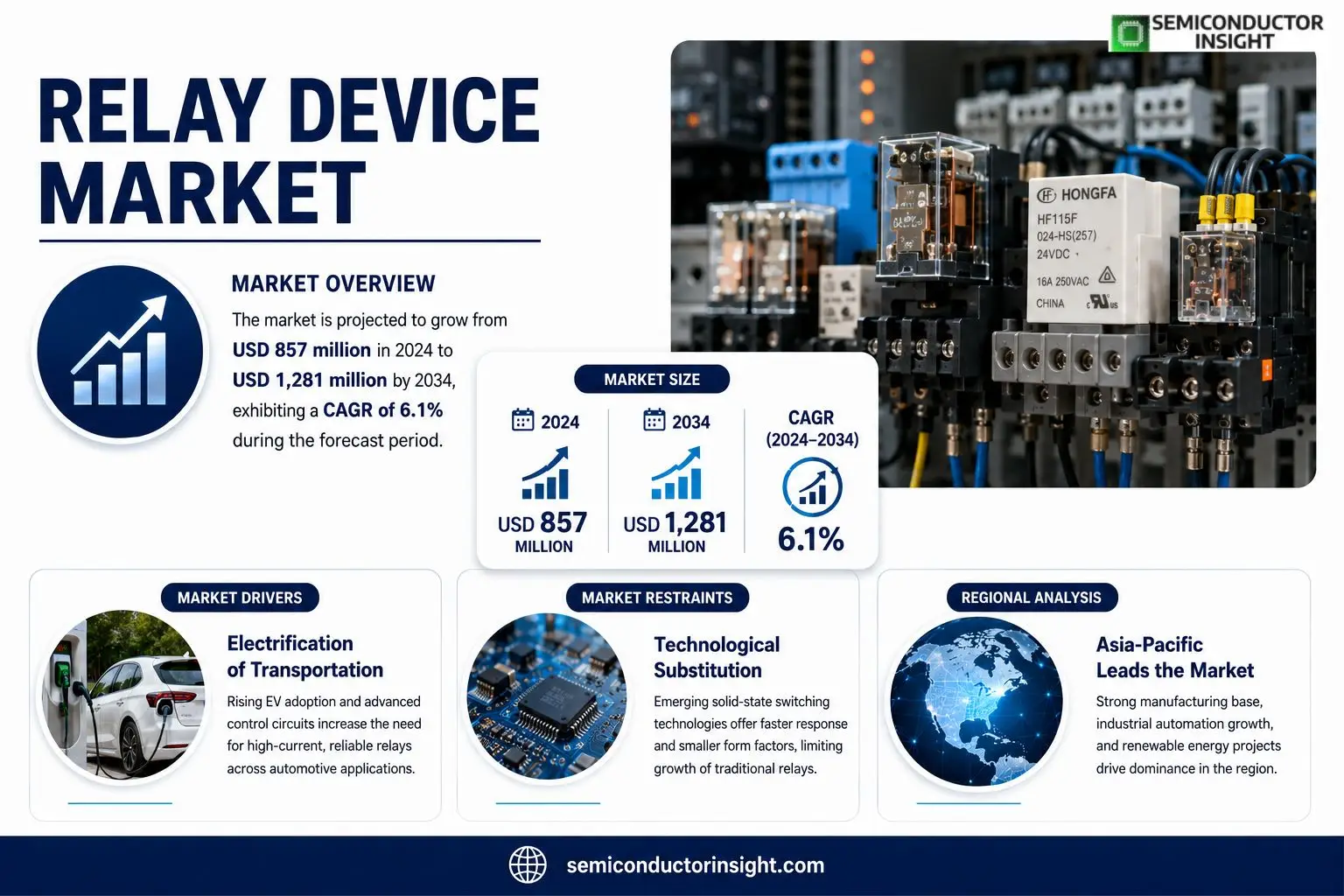
Relay Device market size was valued at USD 857 million in 2024. The market is projected to grow from USD 857 million in 2024 to USD 1,281 million by 2034 exhibiting a CAGR of 6.1% during the forecast period.
A relay device is an electrically operated switch that comprises input terminals for one or multiple control signals and a set of operating contact terminals. It may feature make contacts, break contacts, or combinations thereof, allowing low‑power signals to control higher‑power circuits or several circuits simultaneously. Historically used as signal repeaters in long‑distance telegraph lines and early telephone exchanges, relays later performed logical operations in early computers. Traditional relays employ an electromagnet; solid‑state relays use semiconductor properties for contactless actuation, delivering faster response and longer life spans. Modern protective relaysoften digital instrumentsmonitor overloads and faults across power systems, highlighting the device’s continued importance across automotive, industrial automation, energy infrastructure and telecommunications sectors.
MARKET DRIVERS
Electrification of Transportation
Automakers are integrating increasingly sophisticated control circuits to comply with stricter emissions standards, and relay devices are the mechanical backbone of these circuits. Their ability to handle high current loads while providing isolation makes them indispensable in electric‑drive systems, creating a steady lift in demand across passenger‑car and commercial‑vehicle segments.
Industrial Automation Upgrade
Factories pursuing Industry 4.0 upgrades replace legacy electromechanical switches with intelligent relay assemblies that support remote diagnostics. The shift toward predictive maintenance translates into higher unit sales for relays that can be monitored via IoT gateways, especially in pneumatic and hydraulic control panels.
➤ Customers value reliability: field failure rates for modern solid‑state relays have dropped below 0.2 % per annum, prompting OEMs to specify larger volumes for new product lines.
Another catalyst stems from the rise of renewable‑energy installations, where power‑conversion stations rely on high‑speed relays to protect transformers and inverters. When grid‑level storage expands, the ancillary equipment market expands in lockstep, reinforcing the upward trajectory of the Relay Device Market.
MARKET CHALLENGES
Supply‑Chain Volatility
Fluctuations in copper and semiconductor component availability have raised lead times for relay manufacturers. Price elasticity becomes a concern for cost‑sensitive end users, forcing some projects to adopt lower‑spec alternatives that may compromise performance.
Other Challenges
Regulatory Hurdles
Stringent safety certifications in aerospace and medical devices necessitate extensive testing cycles. Companies that cannot allocate resources to accelerated compliance risk losing market share to better‑funded rivals.
MARKET RESTRAINTS
Technological Substitution
Emerging solid‑state switching technologies, such as silicon‑controlled rectifiers and MOSFET‑based solutions, are eroding the niche once held exclusively by electromechanical relays. When designers prioritize compactness and faster response times, they may bypass traditional relay architectures, dampening overall market expansion.
MARKET OPPORTUNITIES
Smart Relay Integration
Embedding telemetry modules within relay housings opens a revenue stream for manufacturers willing to offer end‑to‑end monitoring platforms. Service contracts tied to condition‑based alerts can generate recurring income, turning a once‑commodity product into a value‑added offering.Geographically, the Southeast Asian manufacturing belt is investing heavily in new assembly plants, with local OEMs expressing preference for relays that meet both IEC and regional standards. A focused sales strategy targeting these operators could capture a sizable share of incremental demand projected over the next three years.
Relay Device Market Trends
Industrial Automation and Smart‑Grid Integration
The Relay Device Market is being reshaped by the surge in programmable logic controllers and distributed‑energy‑resource platforms. Manufacturers are embedding high‑speed electromechanical relays into assembly‑line safety circuits, while solid‑state variants are paired with advanced communication protocols to enable real‑time fault isolation in utility substations. This convergence reduces downtime, improves load balancing, and creates a competitive edge for suppliers that can certify both ruggedness and digital compatibility. Companies that align product roadmaps with modular, remotely updatable firmware are positioned to capture premium contracts from grid operators seeking tighter compliance with emerging reliability standards.
Other Trends
Automotive Electronics Evolution
Vehicle electrification and driver‑assistance systems have amplified the demand for compact, temperature‑tolerant relays. Modern power‑train architectures rely on multiple control loopsbattery management, HVAC, and fast‑charging moduleseach requiring precise signal routing without adding significant mass. Relay manufacturers that invest in miniature solid‑state designs benefit from lower coil‑induced EMI, a critical factor for high‑frequency sensor networks. The ripple effect extends to after‑market services; dealerships that stock standardized relay kits can shorten service cycles, reinforcing brand loyalty for OEMs that prioritize parts availability.
Solid‑State Relay Adoption in Renewable Energy Systems
Renewable installations, particularly utility‑scale solar farms and offshore wind clusters, depend on fast‑acting protective devices to safeguard inverter arrays against transient over‑currents. By replacing traditional electromechanical units with semiconductor‑based relays, operators achieve sub‑millisecond response times, facilitating tighter grid‑code compliance and higher capacity factors. This technical advantage translates into lower operating expenditures, as reduced mechanical wear diminishes maintenance schedules. Vendors that bundle diagnostic analytics with their solid‑state offerings open a revenue stream from predictive‑maintenance contracts, a trend reshaping the business models of legacy relay producers.
COMPETITIVE LANDSCAPE
Key Industry Players
Relay Device Market – Competitive Overview
The relay device sector is anchored by a handful of multinational manufacturers that command the majority of volume in both electromechanical and solid‑state segments. Omron, Schneider Electric and TE Connectivity together account for roughly one‑third of shipments, leveraging deep engineering capabilities and extensive distribution networks to serve automotive, industrial automation and smart‑grid customers. Their product portfolios span high‑performance relays for electric‑vehicle powertrains to rugged devices for oil‑and‑gas control panels, allowing them to capture premium pricing and secure long‑term contracts with OEMs. This concentration creates a competitive moat: scale enables cost efficiencies, while strong R&D pipelines translate into differentiated offerings that are difficult for smaller firms to mimic.Beyond the tier‑one giants, a diverse set of niche specialists fills gaps left by the larger players. Companies such as Finder, Songle Electrical and Xiamen Hongfa Electroacoustic excel in compact, cost‑effective designs for consumer‑grade appliances and telecommunications gear. Regional challengers like CHINT and Zhejiang HKE focus on emerging markets, tailoring relays to local standards and offering faster after‑sales support. These firms sustain a lively second tier, driving incremental innovation in contact materials, coil designs and environmental ratings. Their agility forces the incumbents to continually refine portfolio mix and to consider strategic partnerships or acquisitions to retain market share.
List of Key Relay Device Companies Profiled
- Omron
- TE Connectivity
- Schneider Electric
- ABB
- Panasonic
- Honeywell
- Rockwell Automation
- Finder
- Songle Electrical
- Xiamen Hongfa Electroacoustic
- Fujitsu
- CHINT
- Zhejiang HKE
- CNC Electric
- Song Chuan Precision
Segment Analysis:
| Segment Category | Sub-Segments | Key Insights |
| By Type |
|
Electromechanical Relay remains the core foundation because of its proven reliability in harsh environments.
|
| By Application |
|
Industrial Control drives the majority of adoption due to its central role in automation loops.
|
| By End User |
|
Manufacturing Plants prioritize reliability and ease of field replacement.
|
| By Technology Trend |
|
Smart‑Grid Integration reshapes relay functionality beyond simple switching.
|
| By Market Driver |
|
Renewable Energy Expansion fuels a demand for relays that can handle variable power flows.
|
Regional Analysis: Relay Device Market
North America
Harmonized standards for safety and electromagnetic interference grant suppliers a clearer design brief, reducing iteration cycles and allowing quicker qualification of new relay families across sectors.
Proximity to major silicon fabs and component distributors shortens lead times, while strategic stockpiling of critical alloys mitigates exposure to freight disruptions.
End‑users prioritize reliability in harsh environments, prompting a shift toward sealed, hermetic relay packages that promise longer service intervals and reduced downtime.
Legacy manufacturers defend market share through extensive service networks, while agile newcomers capture niche segments by offering customized PCB‑mount solutions at lower cost.
Europe
European buyers exhibit a strong preference for energy‑efficient relay designs, aligning with regional sustainability initiatives. Manufacturers respond by integrating low‑power coil technologies and recyclable housing materials, which resonate with procurement policies that reward carbon‑footprint reductions. Cross‑border collaborations among automotive clusters accelerate standardization, yet distinct national safety certifications can introduce complexity for vendors seeking pan‑European rollout. As digital twins become commonplace in product development, European firms leverage simulation data to fine‑tune relay response times, thereby enhancing system reliability without extensive physical prototyping.
Asia‑Pacific
In Asia‑Pacific, the Relay Device Market is shaped by rapid industrialization and a burgeoning electronics manufacturing base. Clients in this region emphasize cost competitiveness while insisting on robust performance for high‑density applications such as smart factories and telecommunication back‑haul. Local suppliers gain advantage through close ties with component assemblers, enabling just‑in‑time delivery models that align with lean production philosophies. Meanwhile, emerging standards for 5G infrastructure drive demand for relays that can endure higher switching frequencies, prompting a wave of design revisions focused on thermal management.
South America
South American markets are influenced by expanding renewable‑energy projects, especially hydro and solar farms that require reliable control circuitry. Relay providers tailor offerings to withstand high humidity and temperature fluctuations typical of the region. Distribution channels often involve regional distributors who add value through localized technical support, which helps mitigate the lack of in‑house engineering expertise among end users. Additionally, government incentives for grid modernization encourage utilities to upgrade legacy switching equipment, opening avenues for replacement cycles.
Middle East & Africa
The Middle East & Africa segment reflects a mix of high‑value infrastructure investments and emerging industrial zones. Oil‑and‑gas operators seek rugged relays capable of operating under extreme temperature swings, while newer construction projects favor compact, surface‑mount solutions that simplify installation. Market participants note that logistical constraints, such as long supply routes, elevate the importance of durable packaging. Partnerships with local system integrators become essential for navigating regulatory approvals and for delivering after‑sales services that extend equipment lifespan.
Report Scope
This market research report provides a comprehensive analysis of the Relay Device Market , covering the forecast period 2026–2034. It offers detailed insights into market dynamics, technological advancements, competitive landscape, and key trends shaping the industry.
Key focus areas of the report include:
- Market Overview: The report begins with an overview outlining its current market scenario, key growth indicators, and industry transformation drivers. It discusses macroeconomic factors, demand–supply balance, regulatory landscape, and the strategic role of semiconductors in powering advancements across industries such as automotive, telecommunications, consumer electronics, and industrial automation.
- Market Size & Forecast: Historical data and future projections for revenue, unit shipments, and market value across major regions and segments.
- Segmentation Analysis: Detailed breakdown by product type, technology, application, and end-user industry to identify high-growth segments and investment opportunities.
- Regional Insights: Insights into market performance across North America, Europe, Asia-Pacific, Latin America, and the Middle East & Africa, including country-level analysis where relevant.
- Competitive Landscape: Profiles of leading market participants, including their product offerings, R&D focus, manufacturing capacity, pricing strategies, and recent developments such as mergers, acquisitions, and partnerships.
- Technology Trends & Innovation: Assessment of emerging technologies, integration of AI/IoT, semiconductor design trends, fabrication techniques, and evolving industry standards.
- Market Drivers & Restraints: Evaluation of factors driving market growth along with challenges, supply chain constraints, regulatory issues, and market-entry barriers.
- Stakeholder Insights: Insights for component suppliers, OEMs, system integrators, investors, and policymakers regarding the evolving ecosystem and strategic opportunities.
Primary and secondary research methods are employed, including interviews with industry experts, data from verified sources, and real-time market intelligence to ensure the accuracy and reliability of the insights presented.
FREQUENTLY ASKED QUESTIONS:
What is the current market size of Relay Device Market?
-> Relay Device Market was valued at USD 857 million in 2024 and is expected to reach USD 1281 million by 2034 at a CAGR of 6.1% during the forecast period.
Which key companies operate in Relay Device Market?
-> Key players include Xiamen Hongfa Electroacoustic, Omron, TE Connectivity, Panasonic, Song Chuan Precision, Fujitsu, Schneider Electric, Eaton, Sanyou Relays, Finder, Honeywell, Rockwell Automation, Ningbo Forward Relay, Teledyne, CHINT, ABB, Fuji Electric, Zhejiang HKE, Hella, Guizhou Space Appliance, Coto Technology, Songle Electrical, Meder (Standex Electronics), Radiall, Cabur, Comat Releco, ASHIDA, CNC Electric.
What are the key growth drivers?
-> Key growth drivers include industrial automation, energy infrastructure development, growing demand for renewable energy, smart‑grid deployment, automotive electronics, and expansion of telecommunications and data‑center infrastructure.
Which region dominates the market?
-> Asia holds the largest market share, driven by extensive manufacturing bases and rapid adoption of automation and renewable‑energy projects.
What are the emerging trends?
-> Emerging trends include increased adoption of solid‑state relays, integration of IoT and AI for predictive maintenance, and development of smart‑grid compatible relay solutions.

Get Sample Report PDF for Exclusive Insights
Report Sample Includes
- Table of Contents
- List of Tables & Figures
- Charts, Research Methodology, and more...
 Download Sample Report PDF