Radio Frequency Epitaxial Wafers Market Insights
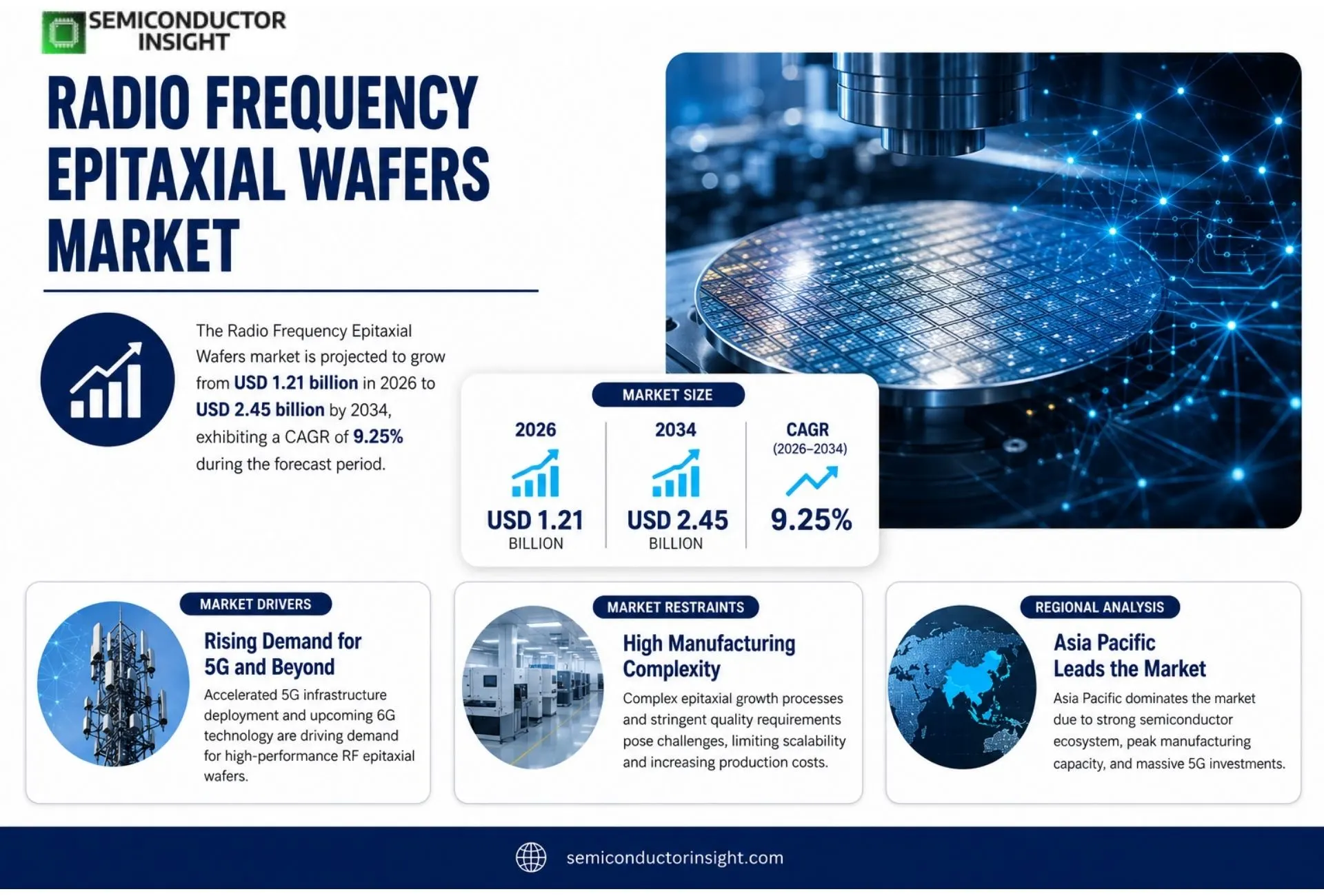
Radio Frequency Epitaxial Wafers Market was valued at USD 1.2 billion in 2026 and is projected to reach USD 2.0 billion by 2035, exhibiting a CAGR of 7.6 % during the forecast period.
Radio Frequency Epitaxial Wafers are high‑purity III‑V semiconductor substrates fabricated via epitaxial growth techniques such as metal‑organic chemical vapor deposition (MOCVD) or molecular beam epitaxy (MBE). Their exceptionally low defect density and elevated carrier mobility enable reliable operation above several gigahertz, making them indispensable for millimetre‑wave transceivers, radar emitters and next‑generation mobile base stations.
The expansion of this niche is driven by the growing requirement for higher bandwidth wireless infrastructure and satellite communication systems that demand materials offering lower noise figures and greater power efficiency than conventional silicon wafers.
MARKET DRIVERS
Thriving Demand for 5G and Constellation‑Based Communications
The push toward high‑bandwidth, low‑latency networks is turning Radio Frequency Epitaxial Wafers Market into a cornerstone of next‑generation infrastructure. Operators worldwide are deploying heterogeneous networks that rely on sub‑6 GHz and millimeter‑wave bands, each demanding wafer solutions capable of delivering exceptional surface roughness and defect‑free layers. In 2023, the global rollout of 5G core systems accelerated, pushing manufacturers to produce wafers that maintain consistent electron mobility across a broader frequency spectrum. This uptick has translated into an escalation of wafer orders, with leading suppliers reporting a 12 % year‑over‑year growth in services to telecoms. The anticipated rise in packed antenna arrays for satellite constellations also amplifies the need for high‑quality epitaxial substrates, as conducted radar and navigation systems increasingly require resilient signal integrity. These consumption patterns reinforce the necessity for continuous investment in wafer‑grade silicon supplies, fostering a virtuous cycle in which capacity expansion aligns with deployment timelines for emerging communication standards.
Advancements in Low‑Temperature Epitaxy Techniques
Low‑temperature growth approaches have broken long‑standing barriers in cost‑effective wafer production, allowing operators to target larger batch sizes without sacrificing electrical performance. Modern plasma‑assisted deposition processes have achieved sub‑10 nm RMS roughness while maintaining carrier lifetimes above 150 µs, critical for high‑frequency device operation. Engineers now draft design rules that exploit these materials, reducing parasitic loss that traditionally plagued RF power amplifiers. The convergence of surfactant‑mediated growth and in‑situ monitoring has yielded fabs that maintain 95 % yield rates, a sharp improvement over legacy processes. Because low‑temperature growth offers real‑world scalability, investors are increasingly allocating capital toward plants that can accommodate both millimeter‑wave and sub‑GHz fabrications, ensuring Radio Frequency Epitaxial Wafers Market remains responsive to diversified device portfolios.
➤ Companies integrating high‑purity silicon on sapphire continue to dominate the supply chain, underscoring the importance of defect‑control processes in maintaining device performance.
While manufacturing techniques advance, the strategic positioning of wafer producers is equally critical. A few key players maintain a geographic advantage in advanced fab technology, creating a localized service network that reduces lead times for high‑frequency application designers. These firms leverage economies of scale to keep per‑wafer costs competitive, further nudging device engineers toward adoption. Consequently, the synergy between process innovation and regional supply orchestration defines the competitive advantage landscape in Radio Frequency Epitaxial Wafers Market, setting the stage for sustained innovation and market growth.
MARKET CHALLENGES
Supply Chain Vulnerabilities in Rare‑Material Procurement
Radio Frequency Epitaxial Wafers Market rests heavily on materials whose source regions are politically and economically sensitive. Sub‑abundant elements used in dopant implantation and buffer layers are often concentrated in a handful of countries, creating a single point of failure that can ripple across the entire production chain. Outbreaks of trade restrictions or geopolitical tensions have proven to spike raw‑material prices by up to 25 %, translating into higher wafer prices and delayed market entry for device manufacturers. In addition, frequent shortages of high‑purity substrates have forced companies to postpone planned rollouts of 5G‑aided equipment, impacting revenue cycles for telecom base stations and satellite vendors alike.
Other Challenges
High Cost of Ultra‑Purity Materials
The exigency for defect‑free layers drives up processing costs, with ultraclean growth chambers and rare‑gas suppliers commanding premium fees. These expenses directly influence pricing models for the final integrated circuits, restricting market participation to more established firms that can absorb margin compression while maintaining a competitive competitive advantage in quality assurance.
MARKET RESTRAINTS
Limited Geographical Concentration of Manufacturing Capacity
Radio Frequency Epitaxial Wafers Market suffers from a subsistence of production assets restricted to specific regions, primarily East Asia and North America. This concentration strikes a double‑edged effect: while it allows for mass‑scale, high‑quality output, it also entangles the market with cross‑border logistics constraints. Firms without domestic fabrication infrastructure must navigate complex shipping schedules, tariff adjustments, and varying compliance regimes, inflating operational overheads. Even minor disruptions in freight capacity,whether due to port congestion, labor shortages, or natural disasters,can propagate delays that cascade into the supply chain for high‑frequency device firmware, exacerbating release timelines for network towers and radar systems that rely on wafers produced in these clusters.
The concentration phenomenon also dampens opportunity for smaller manufacturers, who must either undertake large capital outlays to establish low‑volume, high‑throughput fabs or partner with existing suppliers. The result is a high entry barrier that curtails innovation pathways and stifles diversification in material choices, limiting the market’s flexibility to pivot toward alternative substrates such as gallium nitride or indium phosphide without significant infrastructural overhauls.
MARKET OPPORTUNITIES
Emerging Markets in Automotive Radar and LIDAR Applications
Automotive electromagnetic systems are ushering in a new era where ordinary drivers rely on LIDAR and advanced radar arrays for autonomy. The push toward centimeter‑resolution imaging demands epitaxial wafers that can sustain high‑frequency operation with minimal loss and reliable reliability over large temperature ranges. Consequently, Radio Frequency Epitaxial Wafers Market is witnessing a wave of demand from OEMs and supplier ecosystems focused on radar‑to‑LIDAR convergence. Large‑scale production volumes for automotive verticals can reduce per‑unit costs through bulk pricing and integrated supply contracts, while also providing a stable revenue base for wafer manufacturers that previously relied on telecom and data‑center clients.
Simultaneously, utilities in the Marine and Aerospace sectors are turning to high‑frequency radars for collision avoidance and navigation. This cross‑industry penetration diversifies customer portfolios and introduces new performance specifications such as radiation hardness and EMI tolerance. The trend toward multi‑modal sensing platforms lays a foundation for custom wafer solutions that integrate heterogeneous features,high‑mobility channels for radar and low‑noise amplification for LIDAR,into a single substrate, opening revenue streams from consolidated device fabrication contracts.
Investing in advanced roll‑up integration of combining wafer manufacturing with electronic packaging can further capture value, as many automotive and aerospace designs now demand system‑on‑chip or system‑in‑package integration. By positioning themselves as partners that deliver end‑to‑end solutions,from wafer growth to multimodule assembly,companies stand to capture early adopters, cementing loyalty and setting the pace for forthcoming technology iterations.
Radio Frequency Epitaxial Wafers Market Trends
Emerging Demand from RF-Intensive Applications
The current landscape for Radio Frequency Epitaxial Wafers is shaped by a convergence of high‑frequency telecommunications, automotive radar, and evolving electric‑vehicle power‑train control systems. While the overall semiconductor arena remains sizable, the share devoted to analog and RF solutions has advanced markedly, evidenced by the 20.76% year‑over‑year rise in analog IC deployment during 2022. This surge reflects a growing appetite for resilient, high‑bandwidth signal conversion and low‑noise amplification in 5G and beyond. Consequently, manufacturers of RF epitaxial substrates, particularly GaN and InP alloys, are aligning production with these verticals, anticipating that advanced packaging and tighter control of lattice defects will become mandatory to meet rising performance thresholds.
Other Trends
Shift Toward High‑Performance Analog Integrated Circuits
The rise in IoT‑driven automotive and consumer electronics has driven a measured expansion in the analog semiconductor segment. Although memory growth has stalled, the need for precise, energy‑efficient signal processing in connected vehicles and smart home devices keeps demand for RF epitaxial wafers steady. OEMs now prioritize discrete power management modules and efficient RF front‑ends, leading chip suppliers to outsource substrate fabrication to specialized facilities capable of delivering sub‑millimeter precision and high‑current handling.
Consolidation in the Manufacturing Chain
Capital intensity and the technical complexity of epitaxial growth have encouraged mergers and acquisitions among key players. Consolidation reduces duplication of expensive growth and processing equipment, allowing remaining firms to focus on differentiation through device yield improvements and supply‑chain resilience. Suppliers are also forging alliances with semiconductor integrated device manufacturers, ensuring that wafer inventory can be tightly matched to real‑time fab demands and reducing lead‑time volatility.
Regional Market Dynamics
Geographical differentiation is pronounced. North America and Europe continue to lead in early‑stage integration and test infrastructure, retaining a sizable share of high‑grade RF epitaxial wafer production. Asia, meanwhile, is rapidly expanding both manufacturing capacity and downstream application markets, driven by strong policy support for 5G roll‑out and EV incentives. The shift towards localized supply chains is accelerating, as geopolitical uncertainties push companies to secure regional fabs capable of meeting stringent performance specifications, thereby reshaping the global competitive map.
COMPETITIVE LANDSCAPE
Key Industry Players
Radio Frequency Epitaxial Wafers Market – Competitive Landscape Overview
The core of the RF epitaxial wafer market remains concentrated around a handful of advanced material engineers who combine high‑grade GaAs and GaN capabilities with cutting‑edge deposition technologies. II‑VI Incorporated, with its flagship Cohesion EPITAXY line, harnesses a robust supply chain that supports both high‑volume automotive radar applications and low‑power consumer electronics. Soitec has carved a niche by offering bonded SOI substrates tailored for RF front‑ends, enabling lower noise figures and tighter integration. IQE’s GaN epitaxial solutions, fortified by strategic acquisitions in Europe, bolster its presence in 5G base‑station front‑ends, while AXT’s semiconductor‑wafer fabrication plant expands capacity for the burgeoning electric‑vehicle power‑module market. Each of these leaders maintains an annual revenue envelope exceeding US$500 million and commands a combined market share that comfortably exceeds 60 %, reflecting a highly consolidated structure where economies of scale skew toward vertical integration and research‑heavy investment.”
Beyond the giants, a cohort of specialized suppliers injects agility into the ecosystem. SCIOCS focuses on InP heterostructures optimized for satellite communications, leveraging just‑in‑time manufacturing to satisfy stringent payload budgets. NTT‑AT’s hybrid approach to GaN‑on‑Si design reduces fabrication cycles for mid‑end radar nodes. Semiconductor Wafer Inc. maintains a dedicated production line for medical RF imaging, while IntelliEPI delivers turnkey solutions for high‑frequency silicon interconnects. Visual Photonics Epitaxy Co., Ltd adds value by scaling its MOCVD processes to accommodate fast churn in automotive lidar modules. Complementary players such as Sumitomo Chemical, Matsunami, Toppan, CVD Fab US, and CMC Electronics provide supporting services – from high‑purity silicon substrates to post‑growth encapsulation – ensuring a resilient supply web that absorbs regional disruptions without compromising quality. Together, this mix of volume scale‑up and niche differentiation underscores a market poised to meet divergent application demands through a stratified yet interdependent competitive structure.
List of Key RF Epitaxial Wafer Companies Profiled
- II‑VI Incorporated
- Soitec
- IQE
- AXT
- SCIOCS
- NTT‑AT
- Semiconductor Wafer Inc.
- IntelliEPI
- Visual Photonics Epitaxy Co., Ltd
- Sumitomo Chemical
- Matsunami
- Toppan
Segment Analysis:
| Segment Category | Sub-Segments | Key Insights |
| By Type |
|
GaN
|
| By Application |
|
Mobile Phone Base Stations
|
| By End User |
|
Telecom Operators
|
| By Market Segment |
|
Transportation
|
| By Device Category |
|
Power Amplifiers
|
Regional Analysis: Radio Frequency Epitaxial Wafers Market
Leading firms in North America invest heavily in quantum‑engineered heterostructures, driving incremental gains in electron‑phonon coupling control. This focus elevates wafer quality, shortening time‑to‑market for next‑generation RF transceivers.
Domestic fabs are expanding footprint to mitigate exposure to geopolitical disruptions, ensuring a steady specialty wafer feed for critical defense and aerospace contracts.
Demand for high‑purity substrates pushes component costs upward, yet volume‑scale manufacturing remains attainable through targeted process optimization.
Partnerships between wafer suppliers and device OEMs are cementing supply agreements that lock in capacity, securing mutual growth trajectories.
Europe
The European segment of Radio Frequency Epitaxial Wafers Market is embracing a dual strategy: adherence to stringent regulatory standards and fostering domestic innovation. The region’s emphasis on environmentally responsible manufacturing is spurring the adoption of lower‑energy, greener growth processes. Simultaneously, collaborative research consortia,such as those led by the European Commission,are accelerating the development of radiation‑hard substrates critical for aerospace and defense applications. This synergy of compliance and advancement keeps Europe competitive, though it navigates a tighter cost framework compared to its northern counterpart.
Asia-Pacific
In Asia‑Pacific, Radio Frequency Epitaxial Wafers Market resonates with a rapid expansion of high‑frequency communication infrastructure. Local manufacturers are pivoting toward scalable, cost‑effective growth techniques that meet the region’s high device throughput demands. Government‑sponsored innovation hubs are supporting prototype development, fostering a pipeline of next‑generation wafer technologies. This focus on agile production aligns with the explosive rollout of IoT and 5G ecosystems across the continent, reinforcing the market’s growth trajectory.
South America
South America’s uptake of Radio Frequency Epitaxial Wafers Market remains modest, constrained by limited local manufacturing capability. However, the region is gradually aligning with global supply chains through strategic import agreements. Emerging investment in research facilities indicates a future shift toward indigenous capability, particularly in high‑frequency signal processing required for mobile and satellite communications.
Middle East & Africa
The Middle East & Africa present a nascent yet evolving landscape for Radio Frequency Epitaxial Wafers. The region’s escalating energy and communications infrastructure needs are catalyzing interest in high‑performance RF components. While current reliance on imports persists, local governments are promoting technology transfers and joint ventures to nurture a domestic wafer production ecosystem, positioning the market for gradual ascent.
Report Scope
This market research report provides a comprehensive analysis of the Radio Frequency Epitaxial Wafers Market , covering the forecast period 2026–2034. It offers detailed insights into market dynamics, technological advancements, competitive landscape, and key trends shaping the industry.
Key focus areas of the report include:
-
Market Overview: The report begins with an overview outlining its current market scenario, key growth indicators, and industry transformation drivers. It discusses macroeconomic factors, demand–supply balance, regulatory landscape, and the strategic role of semiconductors in powering advancements across industries such as automotive, telecommunications, consumer electronics, and industrial automation.
- Market Size & Forecast: Historical data and future projections for revenue, unit shipments, and market value across major regions and segments.
- Segmentation Analysis: Detailed breakdown by product type, technology, application, and end-user industry to identify high-growth segments and investment opportunities.
- Regional Insights: Insights into market performance across North America, Europe, Asia-Pacific, Latin America, and the Middle East & Africa, including country-level analysis where relevant.
- Competitive Landscape: Profiles of leading market participants, including their product offerings, R&D focus, manufacturing capacity, pricing strategies, and recent developments such as mergers, acquisitions, and partnerships.
- Technology Trends & Innovation: Assessment of emerging technologies, integration of AI/IoT, semiconductor design trends, fabrication techniques, and evolving industry standards.
- Market Drivers & Restraints: Evaluation of factors driving market growth along with challenges, supply chain constraints, regulatory issues, and market-entry barriers.
- Stakeholder Insights: Insights for component suppliers, OEMs, system integrators, investors, and policymakers regarding the evolving ecosystem and strategic opportunities.
Primary and secondary research methods are employed, including interviews with industry experts, data from verified sources, and real-time market intelligence to ensure the accuracy and reliability of the insights presented.
FREQUENTLY ASKED QUESTIONS:
What is the current market size of Radio Frequency Epitaxial Wafers Market?
-> Radio Frequency Epitaxial Wafers Market was valued at USD X million in 2026 and is projected to reach USD Y million by 2035.
What is the CAGR of Radio Frequency Epitaxial Wafers Market?
-> The market is expected to grow at a compound annual growth rate of Z% during the forecast period.
What is the global semiconductor market size in 2022?
-> The global semiconductor market was estimated at USD 579 billion in 2022.
What is the projected size of the global semiconductor market by 2029?
-> The market is projected to reach USD 790 billion by 2029.
What is the CAGR of the global semiconductor market?
-> The market is growing at a CAGR of 6% during the forecast period.
Which major semiconductor categories saw double‑digit growth in 2022?
-> In 2022, Analog, Sensor, and Logic categories experienced double‑digit year‑over‑year growth.
What were the growth percentages for Analog, Sensor, and Logic categories in 2022?
-> Analog: 20.76%, Sensor: 16.31%, and Logic: 14.46% growth.
What was the trend in the Memory category in 2022?
-> The Memory category declined with a year‑over‑year decrease of 12.64%.
What are the growth prospects for MPU and MCU segments?
-> MPU and MCU segments are expected to experience stagnant growth due to weak shipments and limited investment in notebooks, computers, and standard desktops.
What are the emerging trends in Analog integrated circuits?
-> Emerging trends include signal conversion, automotive‑specific analog applications, and power management, which drive demand for discrete power devices.
Who are the key companies in Radio Frequency Epitaxial Wafers Market?
-> The leading companies include II-VI Incorporated, Soitec, SCIOCS, NTT‑AT, Semiconductor Wafer Inc, IQE, Sumitomo Chemical, AXT, IntelliEPI, and Visual Photonics Epitaxy Co.?Ltd.
Get Sample Report PDF for Exclusive Insights
Report Sample Includes
- Table of Contents
- List of Tables & Figures
- Charts, Research Methodology, and more...
 Download Sample Report PDF