Radar (77GHz, 79GHz) MMIC Market Insights
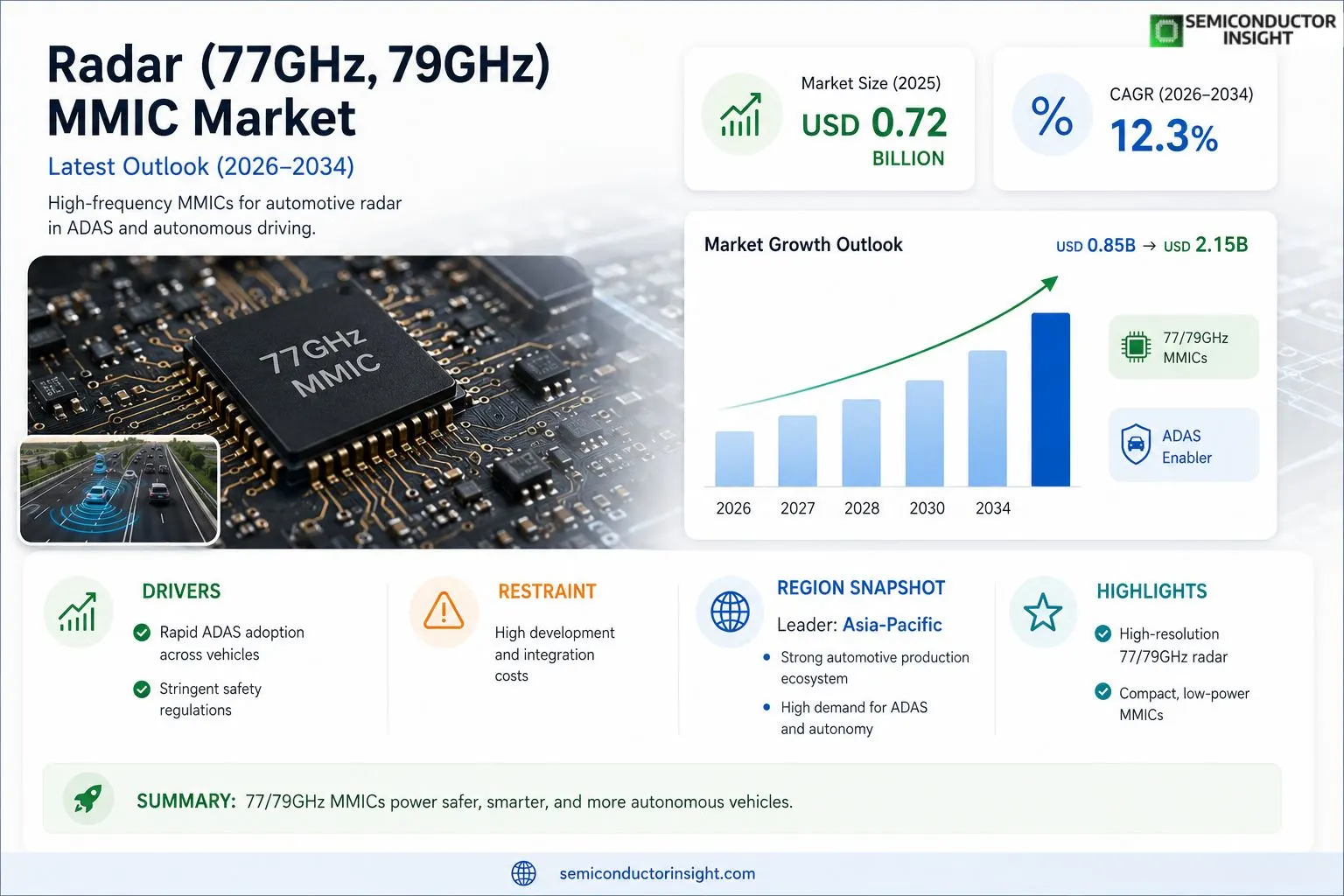
Global Radar (77GHz, 79GHz) MMIC market size was valued at USD 0.72 billion in 2025. The market is projected to grow from USD 0.85 billion in 2026 to USD 2.15 billion by 2034, exhibiting a CAGR of 12.3% during the forecast period.
Radar (77GHz, 79GHz) MMICs are monolithic microwave integrated circuits designed for high-frequency millimeter-wave radar applications, primarily in automotive advanced driver-assistance systems (ADAS) and autonomous driving technologies. These specialized components integrate essential functions such as power amplifiers, low-noise amplifiers, mixers, and voltage-controlled oscillators on a single chip, enabling compact, efficient, and high-performance radar sensors operating in the 76-81 GHz frequency range.
The market is experiencing robust growth due to several factors, including the accelerating adoption of ADAS features across vehicle segments, stringent government safety regulations mandating collision avoidance systems, and the transition toward higher levels of vehicle autonomy. Furthermore, the superior resolution and longer detection range offered by 77GHz and 79GHz bands compared to lower frequencies are driving widespread implementation in both passenger and commercial vehicles. Advancements in semiconductor processes, particularly the shift toward CMOS and SiGe technologies, are enhancing integration levels while reducing costs and power consumption. Initiatives by key players in the market are also expected to fuel the market growth. For instance, in December 2024, Infineon Technologies released the RASIC CTRX8191F, a new 28nm radar MMIC designed to support next-generation 4D and HD imaging radars with improved signal-to-noise ratio. NXP Semiconductors, Infineon Technologies, Texas Instruments, and STMicroelectronics are some of the key players that operate in the market with a wide range of portfolios.
MARKET DRIVERS
Surge in ADAS and Autonomous Driving Adoption
Radar (77GHz, 79GHz) MMIC Market is experiencing robust growth primarily fueled by the rapid integration of Advanced Driver Assistance Systems (ADAS) in modern vehicles. The 77 GHz band has become Global standard for long-range radar applications due to its superior range, resolution, and all-weather performance, enabling features such as adaptive cruise control, automatic emergency braking, and blind spot detection. Market data indicates strong double-digit CAGR projections through the early 2030s as OEMs equip vehicles with multiple radar units to support higher levels of vehicle automation.
Regulatory Mandates and Frequency Standardization
Government regulations across major automotive markets, including Europe, North America, and China, have standardized the 76-81 GHz spectrum for automotive radar use, accelerating the phase-out of legacy 24 GHz systems. This regulatory push has directly benefited 77GHz and 79GHz MMIC solutions, which offer enhanced precision for multi-object detection and imaging capabilities critical for safety compliance. The 77 GHz segment continues to dominate with over 50% market share in automotive radar semiconductors, supported by consistent global adoption.
➤ The transition to 77-79 GHz radar enables higher accuracy and supports advanced functions like highway pilot and cross-traffic detection while maintaining reliability in adverse conditions.
Additionally, advancements in semiconductor processes such as SiGe BiCMOS and RF CMOS have improved integration levels and reduced power consumption of MMICs, making them more viable for mass-market deployment in both passenger cars and commercial vehicles.
MARKET CHALLENGES
High Development and Integration Costs
Producing high-performance 77GHz and 79GHz MMICs requires advanced fabrication processes and precise engineering, resulting in elevated costs compared to lower-frequency alternatives. These expenses impact broader adoption, particularly in price-sensitive vehicle segments, where OEMs face pressure to balance advanced safety features with overall vehicle affordability.
Other Challenges
Supply Chain Complexity and Talent Shortages
The specialized nature of mmWave semiconductor manufacturing creates dependencies on limited foundry capacity and raw materials, exposing the market to disruptions. A shortage of engineers skilled in high-frequency RF design further complicates rapid scaling of production for Radar (77GHz, 79GHz) MMIC solutions.
Technical Integration and Spectrum Management
Integrating multiple radar units with other vehicle sensors and electronics demands sophisticated calibration and electromagnetic compatibility measures. Spectrum congestion and varying regional power limits also require ongoing optimization of MMIC designs to maintain performance.
MARKET RESTRAINTS
Intense Competition and Price Pressure
Radar (77GHz, 79GHz) MMIC Market faces significant restraints from fierce competition among established players and emerging Chinese suppliers, leading to pricing pressures that compress margins. While demand grows, the need for continuous R&D investment in next-generation integration and 4D imaging capabilities strains resources for smaller participants.
Geopolitical factors and supply chain vulnerabilities in advanced semiconductor nodes further limit scalability, particularly for manufacturers reliant on specialized processes capable of sustaining performance at these millimeter-wave frequencies.
MARKET OPPORTUNITIES
Expansion in Autonomous Vehicle Platforms and Emerging Applications
Significant opportunities exist as the industry shifts toward higher levels of autonomy, where 79 GHz solutions are gaining traction for their ultra-high resolution essential for complex urban environments and full mapping of vehicle surroundings. The ongoing development of Radar-on-Chip architectures promises greater integration and cost efficiencies, opening doors for broader deployment across vehicle tiers. Emerging markets in Asia-Pacific, driven by local OEMs and supportive policies, present substantial growth potential for Radar (77GHz, 79GHz) MMIC providers. Innovations in heterogeneous integration and AI-enhanced signal processing further expand applications beyond traditional automotive uses into industrial and smart infrastructure sensing.
Radar (77GHz, 79GHz) MMIC Market Trends
Robust Demand Driven by ADAS and Vehicle Autonomy Adoption
Radar (77GHz, 79GHz) MMIC Market continues to expand as automotive manufacturers accelerate the integration of advanced driver-assistance systems (ADAS) and progress toward higher levels of vehicle autonomy. These monolithic microwave integrated circuits serve as critical components in millimeter-wave radar sensors, delivering the precision required for collision avoidance and environmental perception in the 76-81 GHz frequency range. Their ability to provide superior resolution and extended detection range compared to lower frequency alternatives has positioned 77GHz and 79GHz solutions as the preferred choice for both passenger vehicles and commercial fleets.
Other Trends
Technological Advancements in Semiconductor Integration
Significant progress in semiconductor manufacturing processes is reshaping the Radar (77GHz, 79GHz) MMIC landscape. The ongoing transition toward CMOS and SiGe technologies enables higher levels of functional integration while simultaneously reducing power consumption and overall system costs. By combining power amplifiers, low-noise amplifiers, mixers, and voltage-controlled oscillators onto a single chip, manufacturers achieve more compact and efficient radar modules suitable for widespread deployment across diverse vehicle platforms.
Innovation and Product Development by Leading Players
Industry leaders are actively introducing next-generation solutions to meet evolving performance requirements for 4D and high-definition imaging radars. For example, Infineon Technologies launched the RASIC CTRX8191F in late 2024, a 28nm Radar (77GHz, 79GHz) MMIC engineered to deliver improved signal-to-noise ratio and enhanced imaging capabilities. Such developments underscore the competitive focus on performance optimization and system-level integration. Key participants including NXP Semiconductors, Infineon Technologies, Texas Instruments, and STMicroelectronics maintain extensive portfolios tailored to the specific demands of modern radar applications, driving continuous improvement in Radar (77GHz, 79GHz) MMIC performance and reliability.
Government mandates for enhanced vehicle safety features further reinforce sustained momentum in Radar (77GHz, 79GHz) MMIC Market. As regulatory requirements for collision avoidance systems become more stringent globally, automakers are prioritizing the deployment of high-frequency radar solutions. This regulatory push, combined with consumer demand for advanced safety and autonomous capabilities, creates a favorable environment for ongoing innovation and market expansion in Radar (77GHz, 79GHz) MMIC technologies.
COMPETITIVE LANDSCAPE
Key Industry Players
Radar (77GHz, 79GHz) MMIC Market Competitive Analysis
Radar (77GHz, 79GHz) MMIC Market is dominated by a concentrated group of semiconductor leaders with deep expertise in high-frequency RF technologies. Infineon Technologies and NXP Semiconductors stand out as frontrunners, commanding significant market share through their advanced 28nm and RF-CMOS platforms tailored for automotive ADAS and imaging radar applications. These companies benefit from strong vertical integration, extensive automotive qualifications, and long-standing relationships with Tier-1 suppliers and OEMs, creating a high barrier to entry in this specialized segment.
Other notable players include Texas Instruments, STMicroelectronics, Analog Devices, and Renesas Electronics, which offer competitive MMIC solutions emphasizing power efficiency, integration, and scalability. Emerging and niche participants such as Calterah and Uhnder are gaining traction with innovative digital radar architectures and cost-effective Asian manufacturing capabilities, contributing to dynamic pricing and technology differentiation in the expanding 76-81 GHz ecosystem.
List of Key Radar (77GHz, 79GHz) MMIC Companies Profiled
- Infineon Technologies
- NXP Semiconductors
- Texas Instruments
- STMicroelectronics
- Analog Devices (ADI)
- Renesas Electronics
- Calterah Semiconductor
- Uhnder
- Qorvo
- Robert Bosch GmbH
- Continental AG
- Denso Corporation
- ZF Friedrichshafen
- Valeo SA
- Hella GmbH
Segment Analysis:
| Segment Category | Sub-Segments | Key Insights |
| By Type |
|
77GHz MMICs represent the foundational choice for many radar implementations due to their established performance in long-range detection and mature ecosystem support. These circuits deliver excellent signal clarity for highway-speed applications while maintaining compatibility with existing vehicle architectures. Manufacturers favor their balance of power efficiency and robust output in varying environmental conditions, making them ideal for widespread integration across multiple vehicle platforms. Their design advantages support seamless fusion with other sensor modalities in modern safety suites. |
| By Application |
|
Advanced Driver Assistance Systems (ADAS) emerge as the dominant application area where these MMICs excel by enabling precise object detection and tracking essential for features like automatic emergency braking and adaptive cruise control. The high-frequency operation allows compact sensor modules that integrate effortlessly into vehicle bumpers and mirrors without compromising aesthetics or aerodynamics. System designers appreciate the enhanced angular resolution that supports multi-target scenarios in complex urban environments. Continuous innovation in MMIC functionality drives more sophisticated ADAS capabilities, improving overall vehicle safety intelligence and driver confidence. |
| By End User |
|
Passenger Vehicles constitute the primary end-user segment leveraging these MMICs to elevate everyday driving experiences through reliable environmental perception. Integration into family sedans, SUVs, and premium models allows for comprehensive 360-degree awareness that anticipates potential hazards proactively. Automotive engineers value the low power consumption profiles that preserve vehicle battery efficiency and thermal management. The technology supports evolving consumer expectations for intuitive safety features, accelerating the shift toward more intelligent personal mobility solutions with enhanced comfort and protection. |
| By Technology |
|
SiGe BiCMOS MMICs stand out for delivering superior high-frequency performance characteristics required in demanding radar scenarios. This technology platform offers excellent noise figures and power handling capabilities that translate into clearer target discrimination even at extended ranges. Design teams select SiGe solutions for their proven reliability in automotive-grade temperature extremes and vibration profiles. Ongoing refinements in material science continue to push the boundaries of what these circuits can achieve in next-generation imaging radar systems. |
| By Radar Functionality |
|
4D Imaging Radars benefit tremendously from these MMICs through elevated elevation resolution and detailed environmental mapping that goes beyond traditional sensing. The integrated architecture supports rich data output for sophisticated AI-driven decision making in real time. Developers prioritize this functionality for its ability to distinguish between static and dynamic objects with remarkable accuracy. Such advanced capabilities pave the way for smoother autonomous navigation and more nuanced safety interventions across diverse driving conditions. |
Regional Analysis: Radar (77GHz, 79GHz) MMIC Market
Asia-Pacific
Asia-Pacific excels through concentrated R&D investments in compound semiconductor materials essential for high-frequency MMIC performance. Collaborative ecosystems between academia and industry accelerate breakthroughs in power efficiency and signal clarity for automotive radar systems.
The region maintains sophisticated fabrication facilities optimized for Radar (77GHz, 79GHz) MMIC volume production. Established supply networks ensure reliable access to critical materials while supporting rapid prototyping for evolving autonomous driving applications.
Proactive regulatory frameworks across key nations encourage widespread ADAS integration, directly boosting demand for advanced MMIC-based radar sensors that enhance vehicle safety and operational intelligence in smart mobility solutions.
Growing consumer preference for premium safety features in vehicles fuels steady expansion. Regional players leverage vertical integration strategies to deliver competitive Radar (77GHz, 79GHz) MMIC solutions tailored to local automotive requirements.
North America
North America demonstrates strong momentum in Radar (77GHz, 79GHz) MMIC Market through its focus on innovation and premium vehicle segments. The United States leads with significant investments in autonomous vehicle technology, where high-resolution radar MMICs play a crucial role in environmental perception systems. Strategic partnerships between semiconductor firms and automotive giants drive the development of integrated solutions that prioritize reliability and advanced functionality. The region’s emphasis on safety regulations and consumer demand for sophisticated driver assistance features sustains healthy growth. Companies here excel in software-hardware co-design, enhancing MMIC performance for complex driving scenarios. While production volumes may be lower compared to Asia, the focus remains on cutting-edge applications and quality differentiation in Radar (77GHz, 79GHz) MMIC technologies.
Europe
Europe maintains a prominent position in Radar (77GHz, 79GHz) MMIC Market, anchored by its stringent automotive safety standards and leadership in luxury vehicle manufacturing. Germany and other key nations prioritize research into next-generation radar systems that support highly automated driving. The collaborative environment between OEMs, Tier-1 suppliers, and technology providers fosters specialized MMIC development for precise, multi-mode radar operations. Regional strategies emphasize sustainability and integration with broader sensor fusion architectures. European expertise in materials science contributes to improved thermal management and miniaturization of MMIC components. The market benefits from clear regulatory pathways that accelerate adoption of advanced radar solutions across passenger and commercial vehicles.
South America
South America is emerging gradually in Radar (77GHz, 79GHz) MMIC Market as automotive modernization initiatives gain traction. Brazil and other countries witness increasing interest in safety technologies amid growing vehicle fleets. While infrastructure development remains a priority, select manufacturers are beginning to incorporate basic ADAS features that utilize 77GHz radar MMICs. The region shows potential through international partnerships that facilitate technology transfer and localized assembly. Market dynamics focus on affordability and adaptation to regional road conditions, creating opportunities for cost-optimized MMIC solutions. Future growth will depend on economic stability and policy incentives promoting safer transportation systems.
Middle East & Africa
The Middle East and Africa region presents developing opportunities in Radar (77GHz, 79GHz) MMIC Market, primarily driven by smart city projects and premium automotive imports. Gulf nations invest in advanced mobility solutions where radar MMICs enhance traffic management and vehicle safety. The market is characterized by technology adoption through global collaborations rather than domestic manufacturing. Growing urbanization and focus on reducing road incidents support demand for reliable detection systems. Regional players explore integration of MMIC radar with other intelligent transport technologies. Long-term prospects remain positive as economic diversification efforts include investments in high-tech automotive components.
Report Scope
This market research report provides a comprehensive analysis of the Radar (77GHz, 79GHz) MMIC Market , covering the forecast period 2026–2034. It offers detailed insights into market dynamics, technological advancements, competitive landscape, and key trends shaping the industry.
Key focus areas of the report include:
- Market Overview: The report begins with an overview outlining its current market scenario, key growth indicators, and industry transformation drivers. It discusses macroeconomic factors, demand–supply balance, regulatory landscape, and the strategic role of semiconductors in powering advancements across industries such as automotive, telecommunications, consumer electronics, and industrial automation.
- Market Size & Forecast: Historical data and future projections for revenue, unit shipments, and market value across major regions and segments.
- Segmentation Analysis: Detailed breakdown by product type, technology, application, and end-user industry to identify high-growth segments and investment opportunities.
- Regional Insights: Insights into market performance across North America, Europe, Asia-Pacific, Latin America, and the Middle East & Africa, including country-level analysis where relevant.
- Competitive Landscape: Profiles of leading market participants, including their product offerings, R&D focus, manufacturing capacity, pricing strategies, and recent developments such as mergers, acquisitions, and partnerships.
- Technology Trends & Innovation: Assessment of emerging technologies, integration of AI/IoT, semiconductor design trends, fabrication techniques, and evolving industry standards.
- Market Drivers & Restraints: Evaluation of factors driving market growth along with challenges, supply chain constraints, regulatory issues, and market-entry barriers.
- Stakeholder Insights: Insights for component suppliers, OEMs, system integrators, investors, and policymakers regarding the evolving ecosystem and strategic opportunities.
Primary and secondary research methods are employed, including interviews with industry experts, data from verified sources, and real-time market intelligence to ensure the accuracy and reliability of the insights presented.
FREQUENTLY ASKED QUESTIONS:
What is the current market size of Radar (77GHz, 79GHz) MMIC Market?
-> Radar (77GHz, 79GHz) MMIC Market was valued at USD 0.72 billion in 2025 and is expected to reach USD 2.15 billion by 2034.
Which key companies operate in Radar (77GHz, 79GHz) MMIC Market?
-> Key players include NXP Semiconductors, Infineon Technologies, Texas Instruments, and STMicroelectronics, among others.
What are the key growth drivers?
-> Key growth drivers include accelerating adoption of ADAS features, stringent government safety regulations mandating collision avoidance systems, and the transition toward higher levels of vehicle autonomy.
Which region dominates the market?
-> Asia-Pacific is the fastest-growing region with strong automotive production, while Europe remains a dominant market due to stringent safety regulations.
What are the emerging trends?
-> Emerging trends include advancements in CMOS and SiGe technologies, 28nm radar MMICs for 4D imaging radars, and higher integration levels for compact ADAS sensors.

Get Sample Report PDF for Exclusive Insights
Report Sample Includes
- Table of Contents
- List of Tables & Figures
- Charts, Research Methodology, and more...
 Download Sample Report PDF