Pulse Oximeter (SpO₂) Sensor & LED Driver Market Insights
Pulse Oximeter (SpO₂) Sensor & LED Driver Market size was valued at USD 2.18 billion in 2024. The market is projected to grow from USD 2.34 billion in 2025 to USD 4.61 billion by 2034, exhibiting a CAGR of 7.8% during the forecast period.
Pulse oximeter SpO₂ sensors and LED drivers are critical electronic components used to measure blood oxygen saturation levels non-invasively. These components work together , the SpO₂ sensor detects the differential absorption of red and infrared light through perfused tissue, while the LED driver precisely controls the light-emitting diodes that emit the wavelengths required for accurate readings. The broader product ecosystem encompasses reflectance and transmittance sensor types, analog and digital LED drivers, and integrated sensor modules designed for clinical, wearable, and remote patient monitoring applications.
The market is experiencing robust growth driven by the rising global prevalence of chronic respiratory conditions such as COPD and sleep apnea, coupled with accelerating adoption of wearable health monitoring devices. Furthermore, the post-pandemic emphasis on continuous and remote patient monitoring has significantly expanded demand for compact, low-power SpO₂ sensor and LED driver solutions. Strategic initiatives by key industry participants are further strengthening market development. Notable players operating across this space include Texas Instruments Inc., ams-OSRAM AG, Maxim Integrated (now part of Analog Devices), Silicon Laboratories Inc., and ROHM Semiconductor, each offering differentiated portfolios spanning integrated analog front-ends, multi-wavelength LED drivers, and system-on-chip solutions tailored for medical-grade and consumer wearable segments.
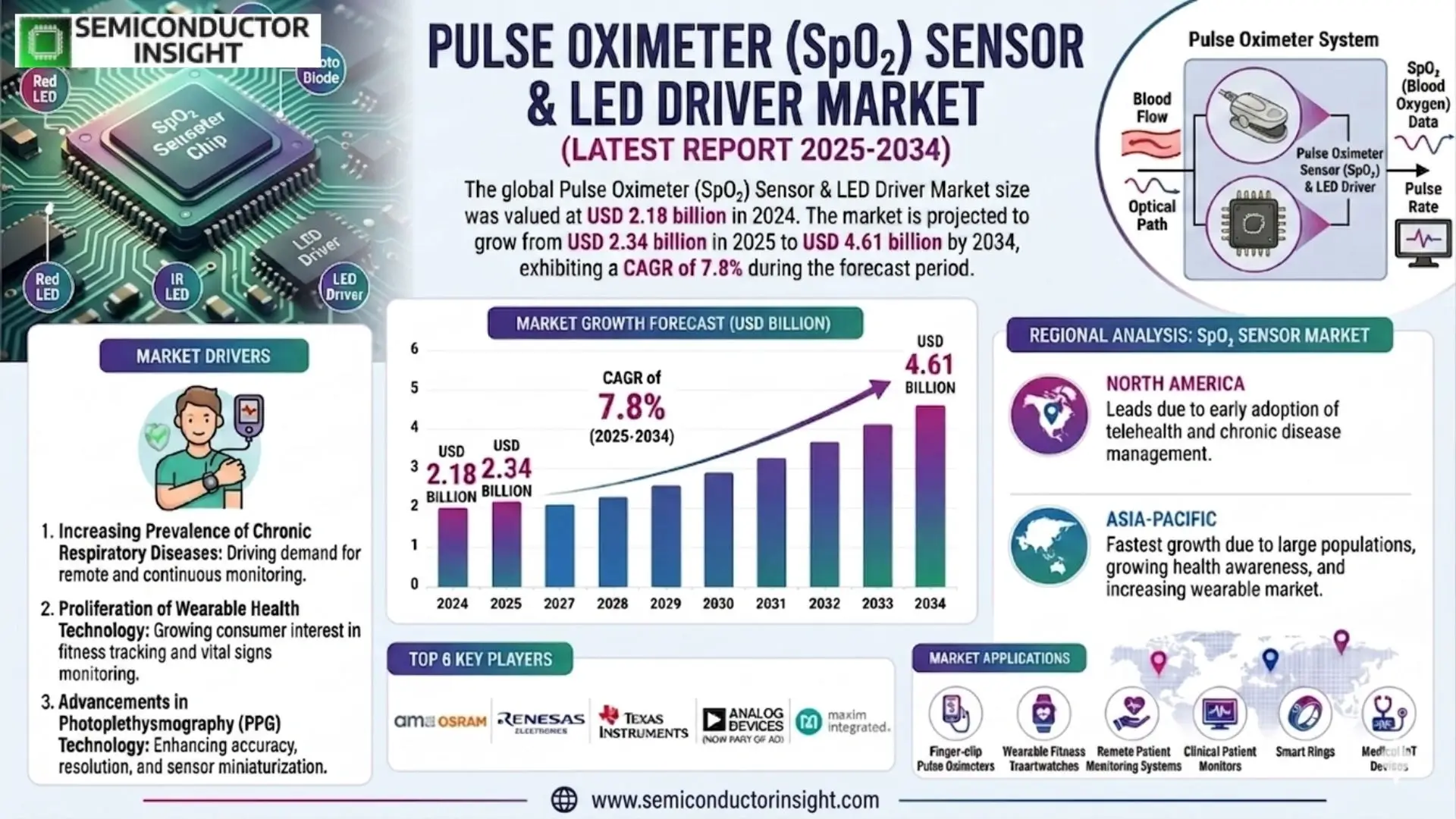
MARKET DRIVERS
Rising Prevalence of Respiratory and Cardiovascular Diseases Fueling Demand for Pulse Oximeter SpO2 Sensor and LED Driver Technologies
The global Pulse Oximeter (SpO2) Sensor & LED Driver Market is experiencing robust growth, primarily driven by the escalating burden of chronic respiratory conditions such as chronic obstructive pulmonary disease (COPD), asthma, and sleep apnea, as well as cardiovascular disorders that require continuous non-invasive oxygen saturation monitoring. Healthcare providers worldwide are increasingly adopting advanced pulse oximetry solutions to enable real-time, accurate SpO2 measurement at the point of care. The integration of high-sensitivity photodetector sensors paired with precision LED driver integrated circuits has become a clinical standard, accelerating technology adoption across hospital settings, home healthcare environments, and ambulatory care units.
Post-Pandemic Healthcare Infrastructure Expansion and Telehealth Proliferation Accelerating Market Growth
The COVID-19 pandemic fundamentally reshaped global healthcare priorities, placing pulse oximetry at the forefront of patient triage and remote monitoring protocols. Governments and healthcare institutions significantly increased procurement of SpO2 monitoring devices, creating sustained demand for advanced sensor and LED driver components. The rapid expansion of telehealth platforms and remote patient monitoring (RPM) ecosystems has further reinforced the need for compact, low-power, high-accuracy Pulse Oximeter (SpO2) Sensor & LED Driver solutions that can be seamlessly embedded into wearable and portable diagnostic devices. This structural shift in healthcare delivery continues to serve as a powerful long-term market driver.
➤ The convergence of wearable health technology and clinical-grade SpO2 monitoring is redefining the performance benchmarks for sensor sensitivity and LED driver efficiency, compelling semiconductor manufacturers to innovate at an accelerated pace withPulse Oximeter (SpO2) Sensor & LED Driver Market.
Consumer electronics giants and specialized medical device manufacturers are investing heavily in miniaturized multi-wavelength LED driver architectures capable of driving both red and infrared LEDs with precise current modulation, ensuring reliable SpO2 and pulse rate readings even in motion-artifact-prone environments. The growing adoption of smartwatches, fitness bands, and connected health patches embedded with medical-grade pulse oximetry functionality is expanding the addressable market well beyond traditional clinical applications, introducing new high-volume demand channels that are sustaining momentum across Pulse Oximeter (SpO2) Sensor & LED Driver Market value chain.
MARKET CHALLENGES
Measurement Accuracy Limitations and Algorithmic Variability Posing Clinical and Regulatory Challenges for SpO2 Sensor and LED Driver Manufacturers
One of the most significant challenges confronting Pulse Oximeter (SpO2) Sensor & LED Driver Market is the persistent concern over measurement accuracy across diverse patient populations. Clinical studies and regulatory scrutiny have highlighted that SpO2 sensors may yield inaccurate readings in individuals with darker skin pigmentation, as well as in patients with poor peripheral perfusion, hypothermia, or significant motion artifacts. These accuracy gaps have prompted regulatory bodies, including the U.S. Food and Drug Administration (FDA), to call for more rigorous clinical validation standards and broader demographic testing protocols for pulse oximetry devices. LED driver circuit designers and sensor manufacturers must address these challenges by developing adaptive algorithms and multi-wavelength sensing approaches capable of delivering consistent accuracy across heterogeneous patient populations.
Other Challenges
Component Miniaturization and Power Consumption Constraints
As wearable and implantable medical devices demand increasingly compact form factors, engineers face substantial technical hurdles in miniaturizing SpO2 sensor assemblies and LED driver circuits without compromising signal-to-noise ratio or optical performance. Achieving ultra-low power consumption while maintaining high LED drive current precision is a critical design challenge, particularly for battery-powered continuous monitoring devices where energy efficiency directly determines device usability and patient compliance.
Supply Chain Vulnerabilities and Component Sourcing Pressures
Pulse Oximeter (SpO2) Sensor & LED Driver Market is exposed to global semiconductor supply chain disruptions that can lead to component shortages, extended lead times, and cost inflation for critical photodetector and LED driver ICs. Geopolitical tensions, concentration of semiconductor fabrication capacity in select regions, and raw material dependencies for specialized optical components create ongoing supply chain risk that manufacturers must strategically mitigate through dual sourcing, inventory buffering, and regional supply diversification initiatives.
MARKET RESTRAINTS
Stringent Regulatory Compliance Requirements and Extended Medical Device Approval Timelines Constraining Speed-to-Market for SpO2 Sensor and LED Driver Solutions
Pulse Oximeter (SpO2) Sensor & LED Driver Market faces considerable restraint from the complex and evolving regulatory landscape governing medical-grade pulse oximetry devices across major markets including the United States, European Union, Japan, and China. Manufacturers must navigate rigorous pre-market approval or clearance processes, extensive biocompatibility testing, electromagnetic compatibility assessments, and clinical performance validation requirements before their sensor and LED driver integrated solutions can reach the market. These regulatory obligations significantly extend product development cycles and increase commercialization costs, creating barriers that disproportionately affect small and mid-sized component suppliers and system integrators operating within the pulse oximetry value chain.
Pricing Pressure and Commoditization Trends Eroding Margins Across the Pulse Oximeter SpO2 Sensor and LED Driver Supply Chain
Intense competitive dynamics among established semiconductor manufacturers and emerging regional players have led to accelerating commoditization of standard pulse oximetry sensor and LED driver components, particularly at the lower end of the performance spectrum. This commoditization trend is exerting sustained downward pressure on average selling prices, compressing gross margins for component suppliers and driving consolidation activity across the market. While premium differentiation through advanced features such as multi-wavelength sensing, integrated analog front-end processing, and AI-assisted signal conditioning can support higher price points, the majority of high-volume consumer-grade applications remain price-sensitive, limiting revenue growth potential for undifferentiated product lines Pulse Oximeter (SpO2) Sensor & LED Driver Market.
MARKET OPPORTUNITIES
Integration of Artificial Intelligence and Advanced Signal Processing Creating High-Value Growth Opportunities in the Pulse Oximeter SpO2 Sensor and LED Driver Market
The convergence of artificial intelligence, machine learning-based signal processing, and next-generation SpO2 sensor architectures is unlocking significant new value creation opportunities across Pulse Oximeter (SpO2) Sensor & LED Driver Market. AI-driven adaptive algorithms are enabling substantial improvements in motion artifact rejection, perfusion index compensation, and cross-demographic measurement accuracy, addressing key clinical limitations that have historically constrained broader adoption. Semiconductor companies that successfully embed intelligent signal conditioning capabilities directly into LED driver and analog front-end ICs are well-positioned to capture premium market segments in clinical wearables, continuous patient monitoring platforms, and next-generation hospital telemetry systems.
Expanding Healthcare Access in Emerging Economies Presenting Substantial Untapped Market Potential for Affordable SpO2 Sensor and LED Driver Solutions
Rapidly developing healthcare infrastructures across Asia-Pacific, Latin America, the Middle East, and Sub-Saharan Africa represent a substantial and largely underpenetrated growth opportunity for Pulse Oximeter (SpO2) Sensor & LED Driver Market. Rising government healthcare expenditures, expanding health insurance coverage, and growing awareness of non-invasive patient monitoring benefits are driving demand for cost-effective yet reliable pulse oximetry solutions tailored to resource-constrained clinical environments. Manufacturers capable of engineering high-performance SpO2 sensor and LED driver platforms optimized for affordability, durability, and ease of use in low-resource settings are strategically positioned to capture significant first-mover advantages in these high-growth regional markets.
Next-Generation Wearable and Implantable Device Ecosystems Driving Innovation Demand Across the Pulse Oximeter SpO2 Sensor and LED Driver Technology Landscape
The rapid proliferation of advanced wearable health monitoring platforms, including smartwatches, continuous health patches, smart rings, and emerging implantable biosensors, is creating a compelling and sustained innovation demand cycle withPulse Oximeter (SpO2) Sensor & LED Driver Market. Device OEMs are actively seeking highly integrated, ultra-miniaturized sensor and driver solutions that deliver clinical-grade SpO2 accuracy within extreme size, weight, and power constraints. This design imperative is driving collaborative innovation between optical sensor specialists, LED component manufacturers, and mixed-signal semiconductor designers, generating a rich pipeline of differentiated product opportunities that are expected to sustain above-market growth rates across Pulse Oximeter (SpO2) Sensor & LED Driver Market through the coming decade.
Pulse Oximeter (SpO₂) Sensor & LED Driver Market Trends
Rising Demand for Wearable Health Monitoring Driving Pulse Oximeter SpO₂ Sensor & LED Driver Market Growth
Pulse Oximeter (SpO₂) Sensor & LED Driver Market is witnessing a significant shift toward miniaturized, low-power components integrated into consumer wearable devices. Smartwatches, fitness bands, and continuous health monitors now routinely incorporate SpO₂ sensing capabilities, compelling semiconductor manufacturers to develop highly efficient LED driver ICs and compact sensor modules that balance accuracy with minimal energy consumption. This trend is particularly prominent among leading players such as Texas Instruments Inc., ams-OSRAM AG, and Silicon Laboratories Inc., which have expanded their portfolios to address both medical-grade and consumer wearable segments with differentiated solutions.
Other Trends
Post-Pandemic Acceleration of Remote Patient Monitoring
The sustained emphasis on remote and continuous patient monitoring following the COVID-19 pandemic has materially expanded adoption of SpO₂ sensor and LED driver solutions beyond clinical settings. Healthcare providers and technology companies are increasingly deploying telehealth-compatible pulse oximetry devices, spurring demand for integrated analog front-ends and multi-wavelength LED drivers capable of delivering hospital-grade accuracy in portable form factors. This transition has encouraged semiconductor suppliers to develop system-on-chip solutions that consolidate sensor signal processing and LED control into single-package devices, reducing board space and overall system cost.
Growing Prevalence of Chronic Respiratory Conditions
Escalating global incidence of chronic respiratory diseases, including chronic obstructive pulmonary disease (COPD) and sleep apnea, is reinforcing steady clinical demand for reliable pulse oximetry components. Patients managing these conditions require ongoing oxygen saturation monitoring, driving procurement of both standalone clinical oximeters and home-use monitoring devices. This clinical need is prompting manufacturers to prioritize precision-engineered reflectance and transmittance sensor types alongside analog and digital LED driver variants that meet stringent medical device standards.
Integration of Multi-Wavelength and Digital LED Driver Technologies
A notable technological trend reshaping Pulse Oximeter (SpO₂) Sensor & LED Driver Market is the transition from single-wavelength to multi-wavelength LED driver architectures. By incorporating additional light wavelengths beyond standard red and infrared, next-generation sensor modules can measure additional physiological parameters alongside blood oxygen saturation, enhancing the diagnostic utility of a single device. Companies such as Maxim Integrated (now part of Analog Devices) and ROHM Semiconductor are actively developing advanced LED driver platforms supporting multi-channel operation, precise current control, and digital interfaces that simplify integration into sophisticated wearable and clinical monitoring systems.
COMPETITIVE LANDSCAPE
Key Industry Players
Pulse Oximeter (SpO₂) Sensor & LED Driver Market: Competitive Dynamics and Leading Innovators
Pulse Oximeter (SpO₂) Sensor & LED Driver Market is characterized by a moderately consolidated competitive landscape, with a handful of well-established semiconductor and photonics companies commanding significant market share. Texas Instruments Inc. and ams-OSRAM AG stand out as dominant forces, each leveraging extensive portfolios of integrated analog front-ends, multi-wavelength LED drivers, and system-on-chip solutions optimized for both medical-grade clinical devices and consumer wearables. Analog Devices Inc., which acquired Maxim Integrated, has further consolidated its position by offering high-precision SpO₂ signal chain solutions that address stringent accuracy and low-power requirements. Silicon Laboratories Inc. and ROHM Semiconductor also maintain strong footholds through differentiated offerings in digital LED driver ICs and compact sensor modules tailored for remote patient monitoring and fitness wearable applications. The overall competitive intensity is amplified by the rapid shift toward miniaturized, energy-efficient components capable of supporting continuous monitoring in next-generation wearable form factors.
Beyond the leading players, the market features a diverse set of specialized and regional competitors contributing to innovation across reflectance and transmittance sensor technologies. Companies such as Microchip Technology, ON Semiconductor (onsemi), Renesas Electronics, and STMicroelectronics are actively expanding their SpO₂-capable analog front-end and LED driver product lines, targeting both OEM medical device manufacturers and consumer electronics integrators. Meanwhile, photonics-focused firms including Vishay Intertechnology and Broadcom Inc. supply high-performance optical sensor components critical to SpO₂ measurement accuracy. The post-pandemic surge in demand for remote patient monitoring platforms has further incentivized new product development, driving competitive differentiation around low-noise signal processing, multi-wavelength capability, and seamless integration with wireless health monitoring ecosystems. As the market is projected to grow from USD 2.34 billion in 2025 to USD 4.61 billion by 2034 at a CAGR of 7.8%, competitive strategies are increasingly focused on strategic partnerships, product portfolio expansion, and regulatory compliance for medical-grade applications.
List of Key Pulse Oximeter (SpO₂) Sensor & LED Driver Companies Profiled
- Texas Instruments Inc.
- ams-OSRAM AG
- Analog Devices Inc. (including Maxim Integrated)
- Silicon Laboratories Inc.
- ROHM Semiconductor
- Microchip Technology Inc.
- onsemi (ON Semiconductor)
- Renesas Electronics Corporation
- STMicroelectronics
- Vishay Intertechnology Inc.
- Broadcom Inc.
- Osram Opto Semiconductors
- Nonin Medical Inc.
- Masimo Corporation
- Nellcor (Medtronic)
Segment Analysis:
| Segment Category | Sub-Segments | Key Insights |
| By Type |
|
Integrated Sensor Modules represent the leading segment due to their seamless combination of sensing and driving capabilities in compact designs that enhance signal accuracy and reduce system complexity. These modules enable superior noise rejection and consistent performance across varying tissue perfusion conditions. Manufacturers favor them for enabling rapid product development cycles while maintaining medical-grade reliability. They also support advanced features like multi-wavelength emission for richer physiological data extraction. |
| By Application |
|
Wearable Health Devices emerge as the dominant application segment driven by consumer demand for unobtrusive, continuous oxygen saturation tracking during daily activities and exercise. This segment benefits from the need for ultra-low power consumption and miniaturized components that maintain accuracy during motion. Solutions in this area prioritize comfort and long battery life while delivering real-time data integration with mobile ecosystems. The emphasis on preventive health monitoring further accelerates innovation in flexible and skin-friendly sensor interfaces. |
| By End User |
|
Home Healthcare stands out as the leading end user segment owing to the growing preference for personalized, self-managed care solutions among patients with chronic respiratory conditions. This segment values easy-to-use, durable components that support long-term monitoring without frequent calibration. Integration with telehealth platforms enhances caregiver oversight while empowering patients with actionable insights. The focus remains on reliability, user-friendly interfaces, and compatibility with various home environments to ensure consistent performance. |
| By Form Factor |
|
Wrist-worn Bands lead this segment through their ability to provide continuous monitoring with minimal disruption to daily routines. These form factors excel in balancing sensor placement stability with user comfort during extended wear. Advanced driver circuitry ensures stable light emission despite movement artifacts common in wrist-based applications. This configuration supports broader adoption in both medical and lifestyle contexts by combining SpO₂ capabilities with other vital sign tracking. |
| By Technology |
|
Digital Signal Processing dominates due to its superior ability to filter motion artifacts and ambient light interference while delivering precise SpO₂ readings. This technology facilitates real-time algorithm adjustments for different skin tones and perfusion levels. It also enables seamless data fusion with other sensors for comprehensive health profiling. The enhanced processing power supports predictive analytics features that alert users to potential desaturation events before they become critical. |
Regional Analysis: Pulse Oximeter (SpO2) Sensor & LED Driver Market
North America
North America leads in pioneering sensor miniaturization and advanced LED driver architectures that improve power efficiency and measurement reliability. Emphasis on AI-enhanced signal processing helps filter motion artifacts, making devices suitable for diverse clinical environments and supporting the overall growth of Pulse Oximeter (SpO2) Sensor & LED Driver Market.
Well-established hospital networks and expanding home care services drive consistent demand for high-quality SpO2 sensors and LED drivers. Integration with electronic health records and telemedicine platforms positions the region at the forefront of connected monitoring solutions.
Stringent yet supportive regulatory frameworks ensure product safety and performance standards, encouraging manufacturers to invest in compliant designs. This environment promotes trust and facilitates smoother market entry for innovative Pulse Oximeter (SpO2) Sensor & LED Driver technologies.
Close collaboration between semiconductor firms, sensor specialists, and medical device OEMs accelerates product development cycles and customization, strengthening North America’s competitive edge in global supply chains.
Europe
Europe demonstrates significant maturity Pulse Oximeter (SpO2) Sensor & LED Driver Market with a strong focus on sustainable and energy-efficient designs. Countries across the region prioritize patient safety and device interoperability within unified healthcare systems. Manufacturers adapt to diverse clinical needs by offering versatile LED drivers that support multi-parameter monitoring. Emphasis on aging populations drives demand for reliable home-use devices featuring advanced SpO2 sensors. Collaborative research initiatives between academic institutions and industry players foster innovation in biocompatible materials and noise-reduction technologies, enhancing overall market dynamics while maintaining strict adherence to regional compliance requirements.
Asia-Pacific
Asia-Pacific emerges as a dynamic player Pulse Oximeter (SpO2) Sensor & LED Driver Market, characterized by expanding healthcare access and rising awareness of respiratory health monitoring. Rapid urbanization and growth in medical facilities create opportunities for cost-effective yet high-performance solutions. Local manufacturers increasingly invest in LED driver optimization to meet both domestic and export demands. The region benefits from robust electronics manufacturing capabilities that support scalable production of SpO2 sensors. Government initiatives promoting digital health further accelerate adoption, positioning Asia-Pacific as an important contributor to global supply and innovation in pulse oximetry technology.
South America
South America shows steady progress in adopting Pulse Oximeter (SpO2) Sensor & LED Driver technologies amid improving healthcare infrastructure. Focus remains on enhancing emergency and critical care capabilities through dependable monitoring equipment. Regional players emphasize affordability and durability to address varied economic conditions while integrating modern LED driver features. Partnerships with international technology providers help bridge knowledge gaps and introduce advanced sensor designs. Growing emphasis on public health programs supports wider deployment of these devices, fostering gradual market expansion and localized adaptation strategies tailored to specific regional healthcare challenges.
Middle East & Africa
The Middle East & Africa region exhibits emerging potential Pulse Oximeter (SpO2) Sensor & LED Driver Market driven by investments in modern healthcare facilities and medical tourism. Demand centers on high-reliability solutions suitable for challenging environmental conditions. Initiatives to strengthen hospital networks and primary care increase the need for efficient SpO2 monitoring tools. Regional stakeholders focus on training programs and technology transfer to build local expertise. Strategic distribution networks and service-oriented business models help overcome infrastructure limitations, gradually building a foundation for sustained growth in pulse oximetry sensor and driver applications across diverse healthcare settings.
Report Scope
This market research report provides a comprehensive analysis of the Pulse Oximeter (SpO?) Sensor & LED Driver Market , covering the forecast period 2026–2034. It offers detailed insights into market dynamics, technological advancements, competitive landscape, and key trends shaping the industry.
Key focus areas of the report include:
- Market Overview: The report begins with an overview outlining its current market scenario, key growth indicators, and industry transformation drivers. It discusses macroeconomic factors, demand–supply balance, regulatory landscape, and the strategic role of semiconductors in powering advancements across industries such as automotive, telecommunications, consumer electronics, and industrial automation.
- Market Size & Forecast: Historical data and future projections for revenue, unit shipments, and market value across major regions and segments.
- Segmentation Analysis: Detailed breakdown by product type, technology, application, and end-user industry to identify high-growth segments and investment opportunities.
- Regional Insights: Insights into market performance across North America, Europe, Asia-Pacific, Latin America, and the Middle East & Africa, including country-level analysis where relevant.
- Competitive Landscape: Profiles of leading market participants, including their product offerings, R&D focus, manufacturing capacity, pricing strategies, and recent developments such as mergers, acquisitions, and partnerships.
- Technology Trends & Innovation: Assessment of emerging technologies, integration of AI/IoT, semiconductor design trends, fabrication techniques, and evolving industry standards.
- Market Drivers & Restraints: Evaluation of factors driving market growth along with challenges, supply chain constraints, regulatory issues, and market-entry barriers.
- Stakeholder Insights: Insights for component suppliers, OEMs, system integrators, investors, and policymakers regarding the evolving ecosystem and strategic opportunities.
Primary and secondary research methods are employed, including interviews with industry experts, data from verified sources, and real-time market intelligence to ensure the accuracy and reliability of the insights presented.
FREQUENTLY ASKED QUESTIONS:
What is the current market size of Pulse Oximeter (SpO2) Sensor & LED Driver Market?
-> Pulse Oximeter (SpO2) Sensor & LED Driver Market was valued at USD 2.34 billion in 2025 and is expected to reach USD 4.61 billion by 2034.
Which key companies operate Pulse Oximeter (SpO2) Sensor & LED Driver Market?
-> Key players include Texas Instruments Inc., ams-OSRAM AG, Maxim Integrated (now part of Analog Devices), Silicon Laboratories Inc., and ROHM Semiconductor, among others.
What are the key growth drivers?
-> Key growth drivers include rising global prevalence of chronic respiratory conditions such as COPD and sleep apnea, accelerating adoption of wearable health monitoring devices, and post-pandemic emphasis on continuous and remote patient monitoring.
Which region dominates the market?
-> Asia-Pacific is the fastest-growing region with strong demand for wearable devices, while North America remains a dominant market due to advanced healthcare infrastructure.
What are the emerging trends?
-> Emerging trends include integrated sensor modules, multi-wavelength LED drivers, low-power solutions for wearables, and reflectance/transmittance sensor advancements.

Get Sample Report PDF for Exclusive Insights
Report Sample Includes
- Table of Contents
- List of Tables & Figures
- Charts, Research Methodology, and more...
 Download Sample Report PDF