Key Statistics
Key Takeaways
- Market value: Power SiC components generated USD 4,594 million in 2026, with a projected USD 63,331 million in 2036 at 30.0% CAGR over 2027–2036; demand reflects traction, grid conversion and high-frequency power design rather than sales of entire electric vehicles or inverter systems.
- Module leadership: SiC MOSFET modules hold a modeled ~44% of 2026 component revenue, ahead of discrete MOSFETs at ~33%, SiC Schottky diodes at ~19% and other JFET/FET products at ~4%; modules benefit from integrated high-current switching and controlled thermal interfaces.
- Automotive concentration: Automotive and EV/HEV applications account for an estimated ~43% of 2026 demand, followed by EV charging at ~16%, renewable and storage conversion at ~16%, industrial drives at ~10%, UPS and data centres at ~9%, rail at ~3% and other uses at ~3%.
- Regional leadership: Asia-Pacific commands an estimated ~53% of 2026 component revenue, North America ~24%, Europe ~17%, the Middle East and Africa ~3% and South America ~3%, reflecting manufacturing location, vehicle programmes and power-converter qualification.
- Device engineering: The commercial premium for SiC arises from lower switching losses, high-temperature capability and smaller magnetics, but only when package inductance, gate control and cooling are engineered as a single system.
- Growth opportunities: Higher-voltage vehicle platforms, fast chargers, utility-scale storage, solar string conversion and solid-state power distribution create distinct sockets for 650 V, 750 V, 1200 V, 1700 V and emerging 2300 V classes.
- Competitive structure: Infineon, STMicroelectronics, onsemi, ROHM, Wolfspeed and other established manufacturers compete through automotive qualification, module footprints, process yields, supply commitments and application engineering rather than headline device efficiency alone.
- Coverage: The study evaluates 2021–2025 history, the 2026 base year, the 2027 estimate and forecasts to 2036 across device type, application and five regions, while excluding separately sold substrates, epitaxy, gate-driver ICs and complete power systems.
Power SiC Component Market Overview
Power SiC component market was valued at USD 4,594 million in 2026 and is projected to reach USD 63,331 million by 2036, advancing at a CAGR of 30.0% across 2027–2036. Asia-Pacific is the largest 2026 region at an estimated ~53%, supported by electric-vehicle powertrain manufacturing and industrial converter supply chains.
Power silicon carbide components are semiconductor switching and rectification devices whose wide-bandgap material enables power stages to operate at higher switching frequency and temperature than conventional silicon solutions. Commercial products include MOSFET modules, discrete MOSFETs, SiC Schottky barrier diodes and specialized JFET devices. Their economic value comes from reduced conversion losses, smaller passive components and improved cooling architecture, not from replacing the entire electrical system.
Revenue covers SiC power MOSFET modules, discrete MOSFET devices, SiC Schottky barrier diodes and JFET/FET components supplied into automotive, charging, industrial, energy, data-centre and rail equipment. Merchant SiC crystal substrates and epitaxial wafer services are upstream inputs, while isolated gate drivers, complete converters, traction inverters, batteries, charging stations and vehicles are downstream equipment and therefore outside the component revenue boundary.
A 650 V or 750 V device can address high-frequency power-factor correction and certain onboard charging architectures, whereas 1200 V parts commonly target traction, fast charging and industrial conversion. For demanding grid or transport equipment, 1700 V and 2300 V components can reduce the number of series-connected switches. Selection is governed by bus voltage, surge margin, short-circuit ruggedness, thermal impedance and switching behaviour under the actual operating profile.
Module packaging matters as much as die performance. An automotive traction inverter needs low-inductance current paths, reliable die attach, substrate isolation and repeatable cooling contact through many temperature cycles. Discrete products give designers greater layout flexibility and often suit lower-current stages, but require more parallel-device management when current rises. These differences explain why the modeled 2026 mix assigns ~44% to modules and ~33% to discrete MOSFETs rather than treating every SiC transistor as equivalent.
Demand signals span several independent purchasing cycles. Vehicle manufacturers qualify SiC devices for traction and onboard charging, charger suppliers select power stages for high-voltage DC output, and renewable developers buy conversion equipment whose makers may specify different SiC generations. Industrial drive builders prioritize reliability and field serviceability, while data-centre power architects evaluate high-frequency operation and fault isolation. The same manufacturer can serve each segment with different package and qualification families.
Asia-Pacific leads with an estimated ~53% of 2026 revenue because much of the vehicle electronics and power-device assembly chain is based in China, Japan and South Korea, alongside growing demand in India. North America contributes ~24% through automotive engineering, data-centre power and industrial design programmes; Europe accounts for ~17% through automotive OEMs, power equipment and industrial automation. The remaining regions are smaller markets where imports and project timing shape adoption.
The 2027 market estimate of USD 5,972 million reflects continued SiC design penetration as manufacturers expand device portfolios and reduce losses at system level. The projected 2036 market value is driven by adoption across multiple converter classes, but device pricing can decline as larger wafers, higher yields and more suppliers improve supply economics. Revenue growth therefore depends on unit adoption and package value offsetting average selling-price pressure.
Segment Analysis: By Type
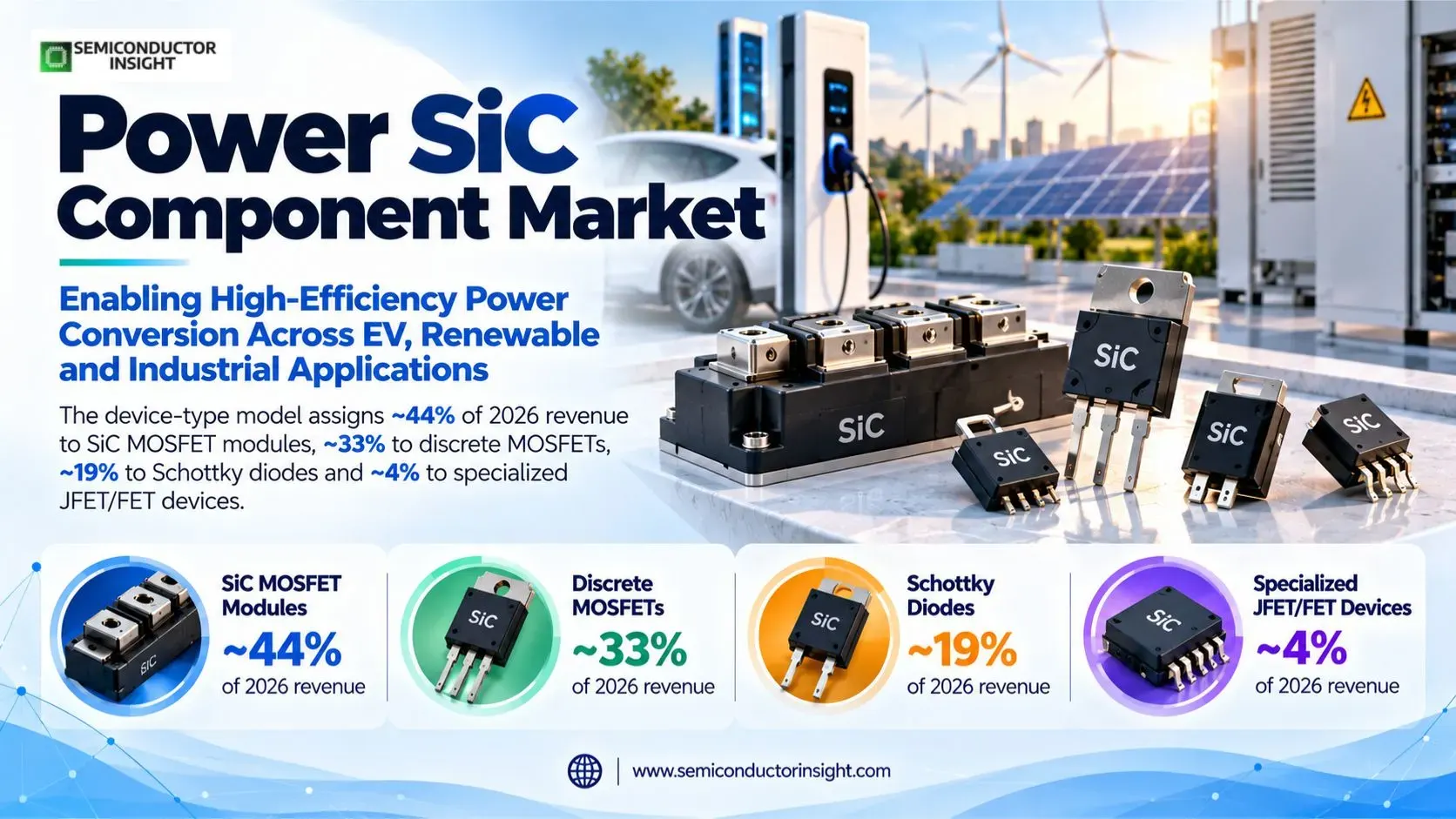
The device-type model assigns ~44% of 2026 revenue to SiC MOSFET modules, ~33% to discrete MOSFETs, ~19% to Schottky diodes and ~4% to specialized JFET/FET devices. Each group serves different current, thermal and fault-management requirements; its modeled CAGR reflects application mix rather than a universal device-level growth rate, while packaging economics change with rated current and switching frequency.
| Device type | Functional and packaging characteristics | Market position and adoption |
|---|---|---|
| SiC MOSFET Module | High-current switch assemblies combine several SiC chips with insulating substrates, electrical terminals and heat-spreading structures. Their strongest positions are vehicle traction, high-power chargers, renewable converters and grid storage. Integrated footprints simplify qualification for equipment manufacturers that cannot build multi-die assemblies internally. The estimated 2026 share is ~44% and the modeled 2027–2036 growth rate is ~32.1% CAGR. | Modeled share ~44%. Module sales benefit when an inverter architecture shifts from individual TO-247 switches to qualified half-bridge or multi-switch power blocks, because thermal interfaces and current distribution become system-critical. For procurement of SiC MOSFET Module, 650 V, 750 V, 1200 V and 1700 V specifications carry different qualification and thermal trade-offs, so suppliers need application-specific samples and long-life reliability data. |
| SiC MOSFET Discrete | Discrete SiC transistors are offered in through-hole and surface-mount packages for power-factor correction, isolated conversion, auxiliary traction supplies and industrial power stages. They allow flexible board placement, but paralleling introduces gate-loop and thermal-balancing challenges. The estimated 2026 share is ~33% and the modeled 2027–2036 growth rate is ~28.3% CAGR. For device engineering, design teams must translate the specific requirements of discrete sic transistors are offered into qualification evidence for switching, cooling and production continuity. Evaluating 650 V, 750 V, 1200 V and 1700 V choices within device engineering also means testing isolation, transient behaviour and lifetime costs for discrete sic transistors are offered before selecting the semiconductor package. | Modeled share ~33%. Discrete designs are attractive when a power supply needs multiple low- to medium-current stages, independent heat sinks or a board-level upgrade without redesigning the entire mechanical assembly. For procurement of SiC MOSFET Discrete, 650 V, 750 V, 1200 V and 1700 V specifications carry different qualification and thermal trade-offs, so suppliers need application-specific samples and long-life reliability data. |
| SiC Diode (SiC SBD) | Schottky barrier diodes provide fast recovery and low reverse-recovery charge in rectification and freewheeling positions. They are common in power-factor correction, charging and solar conversion, although synchronous MOSFET arrangements can displace some diode sockets. The estimated 2026 share is ~19% and the modeled 2027–2036 growth rate is ~27.3% CAGR. For device engineering, design teams must translate the specific requirements of schottky barrier diodes provide fast into qualification evidence for switching, cooling and production continuity. Evaluating 650 V, 750 V, 1200 V and 1700 V choices within device engineering also means testing isolation, transient behaviour and lifetime costs for schottky barrier diodes provide fast before selecting the semiconductor package. | Modeled share ~19%. Rectifier design wins depend on reverse voltage, surge handling, leakage at elevated temperature and package thermal resistance rather than on transistor switching frequency alone. For procurement of SiC Diode (SiC SBD), 650 V, 750 V, 1200 V and 1700 V specifications carry different qualification and thermal trade-offs, so suppliers need application-specific samples and long-life reliability data. |
| Others (SiC JFETs & FETs) | SiC junction FETs and specialized field-effect switches serve power protection, solid-state breakers, hot-swap and high-reliability industrial equipment. Normally-on, normally-off and cascode implementations impose different gate-drive and safety requirements. The estimated 2026 share is ~4% and the modeled 2027–2036 growth rate is ~30.6% CAGR. For device engineering, design teams must translate the specific requirements of sic junction fets and specialized into qualification evidence for switching, cooling and production continuity. Evaluating 650 V, 750 V, 1200 V and 1700 V choices within device engineering also means testing isolation, transient behaviour and lifetime costs for sic junction fets and specialized before selecting the semiconductor package. | Modeled share ~4%. New JFET packaging and fault-interruption architectures support targeted growth from a small base, but they do not yet match the broad automotive qualification base of SiC MOSFET modules. For procurement of Others (SiC JFETs & FETs), 650 V, 750 V, 1200 V and 1700 V specifications carry different qualification and thermal trade-offs, so suppliers need application-specific samples and long-life reliability data. |
Switching architecture and package economics
Within every device type, the distinction between chip capability and usable system performance is decisive. A 1200 V MOSFET can offer excellent intrinsic switching characteristics, yet poor layout inductance can create voltage overshoot and switching stress. Module producers therefore compete on integrated gate loops, insulation, bond or sinter attachment, thermal cycling and repeatable current sharing. Discrete devices are more customizable but shift more of the engineering burden to the customer.
Module pricing incorporates substrate ceramics, encapsulation, terminals, testing and engineering support; discrete pricing more closely tracks die area, yield, package and screening. A power-converter designer should not compare the two solely on price per chip because installation, cooling, qualification and field failure costs differ. SiC Schottky diodes and JFETs likewise require separate evaluation of leakage, fault response and switching duty cycle.
Segment Analysis: By Application
The application mix is led by automotive and EV/HEV at ~43% of 2026 revenue. Charging and renewable-energy conversion each contribute ~16%, followed by industrial motor drives at ~10%, UPS/data centres at ~9%, rail at ~3% and other uses at ~3%. Each category has a different engineering qualification, operating duty and purchasing channel.
| Application | Demand characteristics |
|---|---|
| Automotive & EV/HEV | 2026 modeled share ~43%; 2027–2036 modeled CAGR ~31.0%. Traction inverters and onboard charging systems reward high-efficiency SiC switches because heat rejection, packaging volume and range are design constraints. Vehicle programmes have long qualification cycles, which makes early design wins valuable but exposes suppliers to vehicle-platform scheduling. Automotive OEMs prefer documented thermal cycling, traceability, AEC-oriented qualification and continuity across vehicle generations. |
| EV Charging | 2026 modeled share ~16%; 2027–2036 modeled CAGR ~31.5%. DC fast chargers use SiC power stages in AC-DC front ends and high-voltage DC-DC conversion. Higher charging output can increase demand for efficient 1200 V modules and discrete switches, especially where cabinet space and cooling are restricted. Charger operators value field availability, modular replacement, power-factor performance and high-load efficiency over a wide charging-power range. |
| Industrial Motor/Drive | 2026 modeled share ~10%; 2027–2036 modeled CAGR ~26.9%. Industrial motor drives, welding systems and factory converters use SiC where efficiency and switching frequency outweigh the additional semiconductor cost. Reliability under electrical transients and dusty or hot operating conditions is essential. Motor-drive suppliers often retain silicon IGBTs in price-sensitive ranges and adopt SiC first in high-duty-cycle or space-constrained equipment. |
| PV, Energy Storage, Wind Power | 2026 modeled share ~16%; 2027–2036 modeled CAGR ~29.5%. Solar inverters, battery storage conversion and wind-power electronics can benefit from high-voltage SiC modules and lower magnetic losses. Utility applications emphasize lifetime energy yield and thermal management, with 1700 V and 2300 V devices relevant to higher-voltage designs. Hybrid Si/SiC modules are an intermediate option and should not be counted as entirely SiC-die products without confirming the semiconductor content. |
| UPS, Data Center & Server | 2026 modeled share ~9%; 2027–2036 modeled CAGR ~27.6%. Uninterruptible power supplies and data-centre distribution systems use efficient rectifiers, converters and protection devices. SiC enables compact high-frequency stages and rapid interruption, but system architects also evaluate GaN and high-performance silicon alternatives. Power density and service continuity dominate purchasing decisions, particularly where equipment runs continuously and downtime is expensive. |
| Rail Transport | 2026 modeled share ~3%; 2027–2036 modeled CAGR ~26.4%. Rail traction and auxiliary converters demand rugged switches that tolerate long maintenance intervals and high-voltage stress. The design cycle is lengthy, and certification can be more important than short-term device cost. Rail suppliers prioritize high-voltage modules, vibration endurance, thermal cycling and consistent availability for rolling-stock fleets. For application engineering, design teams must translate the specific requirements of 2026 modeled share ~3%; 2027–2036 into qualification evidence for switching, cooling and production continuity. Evaluating 650 V, 750 V, 1200 V and 1700 V choices within application engineering also means testing isolation, transient behaviour and lifetime costs for 2026 modeled share ~3%; 2027–2036 before selecting the semiconductor package. |
| Others | 2026 modeled share ~3%; 2027–2036 modeled CAGR ~28.6%. Specialized aerospace ground equipment, solid-state protection and laboratory power supplies form a fragmented set of lower-volume applications. Their power ratings and qualification needs differ widely, limiting the value of a single standard package. This residual segment supports custom products and high-reliability margins, but its volumes remain smaller than automotive or renewable-energy conversion. |
Application economics explain why the fastest-growing component is not always the most widely shipped package. A 750 V discrete transistor in an onboard charger and a 2300 V module in utility storage both use SiC, but the number of dies, current ratings, isolation design and procurement price are very different. Consequently the market mix reflects system power ratings and the proportion of semiconductor value retained by the device supplier.
Inverters for traction, photovoltaic plants and wind turbines are downstream assemblies and are not counted as power SiC components. Only the SiC MOSFET, diode or JFET semiconductor value belongs in the component category, including modules sold as integrated semiconductor packages. This distinction prevents a vehicle, charging station or energy-storage installation from being counted at its complete-system sales price.
Regional Analysis
Asia-Pacific leads 2026 revenue with a modeled ~53% share and ~31.4% regional CAGR through 2036. North America accounts for ~24% at ~27.9% modeled CAGR, Europe ~17% at ~28.1%, the Middle East and Africa ~3% at ~30.3%, and South America ~3% at ~30.6%. These regional allocations describe semiconductor component demand, not the location of every finished inverter or electric vehicle.
Where are SiC power components designed, qualified and consumed?
The five-region split combines end-use power electronics demand with the geographic concentration of component manufacturing and qualification. Asia-Pacific has the broadest industrial and vehicle supply chains, North America combines device design with power infrastructure, and Europe brings deep automotive and industrial engineering. South America and the Middle East and Africa have smaller but project-driven converter demand. Cross-border supply means a module assembled in one region may be integrated into a system sold elsewhere.
Regional growth rates are not simply electric-vehicle sales rates. A 1200 V SiC module qualified for an automotive platform can ship into several countries, while 1700 V or 2300 V devices may be bought by a global inverter manufacturer for utility projects on another continent. Regional revenue reflects the semiconductor purchase and supply chain location, with estimated shares serving as a consistent planning model rather than a count of vehicles or installed megawatts.
| Region | Position | Growth outlook | Demand profile | What decides supplier selection |
|---|---|---|---|---|
| Asia-Pacific | Largest (~53% share) | ~31.4% CAGR | vehicle power electronics, module packaging and high-volume industrial conversion | automotive qualification and local production partnerships |
| North America | Second-largest (~24% share) | ~27.9% CAGR | vehicle electrification programmes, AI data-centre power and industrial engineering | design-in support, supply assurance and traceability |
| Europe | Third-largest (~17% share) | ~28.1% CAGR | premium vehicle platforms, industrial drives and renewable-energy power conversion | long-term product support and stringent qualification |
| Middle East & Africa | Developing (~3% share) | ~30.3% CAGR | utility storage, solar conversion and industrial infrastructure projects | project approvals, thermal design and distributor support |
| South America | Developing (~3% share) | ~30.6% CAGR | distributed solar, charging networks and industrial replacement demand | import economics, local service and converter reliability |
Power SiC Component Manufacturers and Competitive Landscape
Competition combines established integrated device manufacturers with specialists in SiC dies, power modules and industrial rectification. The leading suppliers offer broad MOSFET and diode catalogues, but customer wins depend on qualified packages, sustained wafer yields, design-in support and the ability to supply compatible devices for successive converter generations. Module footprints, gate-driver recommendations and thermal interfaces often determine whether a second supplier can replace the incumbent.
Infineon, STMicroelectronics, onsemi, ROHM and Wolfspeed compete through integrated SiC process development, automotive design programmes and extensive voltage portfolios. Infineon markets CoolSiC MOSFETs and modules, ST offers SiC MOSFET and Schottky diode families, and onsemi supplies EliteSiC products for vehicles, storage and industrial conversion. Their broader corporate revenues are not a direct measure of this product category because each also sells silicon devices, sensors and other semiconductors.
Navitas markets GeneSiC technology and SiCPAK modules, while Microchip, Mitsubishi Electric, Fuji Electric, Semikron Danfoss and several Asian manufacturers provide specialized devices or integrated packages. A module supplier can win a programme through mechanical compatibility and thermal performance even without the largest wafer capacity. Conversely a discrete-device producer may be selected for low gate charge and switching characteristics when the customer retains control of the power-board design.
Supplier positions are sensitive to historical acquisitions and the distinction between chip maker, module assembler and downstream inverter supplier. UnitedSiC is associated with Qorvo, while GeneSiC operates within Navitas; treating these names as unrelated independent manufacturers would exaggerate the number of competitors. Industrial equipment companies may be influential SiC customers without manufacturing the SiC semiconductor itself. Competitive comparisons should therefore identify the actual device technology and commercial product offered.
Price competition is not determined solely by nominal on-resistance. Automotive customers demand qualification records, failure analysis, manufacturing-change control and consistent delivery over long production cycles; industrial customers additionally assess surge resilience, insulation and field repair. Smaller specialists can compete through application engineering, unusual voltage classes or short lead times, while large suppliers spread wafer-process investment across a much wider portfolio.
Tier structure
| Tier | Companies | Basis of competition |
|---|---|---|
| Integrated leaders | Infineon, STMicroelectronics, onsemi, ROHM, Wolfspeed | These manufacturers combine broad 650 V to 1700 V device families with application engineering, automotive qualification and investment in SiC manufacturing processes. They supply both discrete products and integrated modules, giving customers a path from early prototypes to production hardware while supporting change control and long-term reliability. Their competitive strength is the ability to connect semiconductor performance to validated system-level switching and cooling behaviour. |
| Module and device specialists | Navitas (GeneSiC), Microchip, Mitsubishi Electric, Fuji Electric, Semikron Danfoss, SemiQ | This group competes in high-voltage or high-current niches, specialized packaging and industrial power architectures. A product win may be based on an established module outline, short-circuit capability or service life rather than the lowest die cost. Product portfolios overlap but are not identical, and individual suppliers may source wafers or chips while controlling packaging, test and customer qualification. |
| Regional and diversified suppliers | BYD Semiconductor, Sanan, BASiC Semiconductor, Vishay, Nexperia, Littelfuse, Diodes Incorporated | These participants address automotive supply chains, discrete rectification, power protection or region-specific sourcing requirements. Their offerings span different levels of SiC integration and should be evaluated by actual qualified part numbers, voltage ratings and semiconductor content. The presence of a company in the wider power-electronics ecosystem does not establish a leading share in every SiC component category. |
Key companies profiled
- STMicroelectronics
- Infineon Technologies
- Wolfspeed
- ROHM Semiconductor
- onsemi
- BYD Semiconductor
- Microchip Technology
- Mitsubishi Electric
- Semikron Danfoss
- Fuji Electric
- Navitas Semiconductor (GeneSiC)
- Toshiba
- Qorvo (UnitedSiC)
- Sanan Optoelectronics
- Littelfuse
- Vishay
- Nexperia
- SemiQ
Power SiC Component Production Capacity and Qualification Analysis
SiC component supply is shaped by crystal and epitaxial quality, power-device fabrication yield, packaging capacity and the lengthy qualification of high-reliability products. Moving from 150 mm to 200 mm wafer platforms can increase die output per wafer, but commercial benefits depend on defect density, usable die area and line utilization. Semiconductor module assembly adds separate bottlenecks in ceramic substrates, die attachment, encapsulation and end-of-line electrical testing.
The upstream process begins with SiC boule growth, slicing, polishing and epitaxial deposition before device fabrication and final test. Defect control affects breakdown voltage and long-term reliability, particularly for 1200 V and 1700 V power devices. Suppliers with vertical integration can coordinate wafer specifications with device design, but capital intensity is high and production ramp-up can initially pressure yields. Merchant substrate revenue is not included in this component market, even though it affects semiconductor cost.
Device assembly differs between discrete and module products. Discrete switches are packaged for board-level soldering or mechanical mounting, while modules combine multiple chips, insulating substrates and terminals in a package that must withstand thermal cycling and high current. An automotive module programme may require extended reliability testing and manufacturing traceability before volume production. These activities add value beyond bare die fabrication and help explain the larger modeled module share.
Capacity investment has a geographical dimension: Asia-Pacific hosts substantial electronics manufacturing and vehicle supply chains, while European and North American companies retain important design, wafer processing and automotive qualification capabilities. Supply contracts increasingly specify change-notification rules, alternate assembly locations and long-term availability. Capacity announcements should be assessed against qualified output, not equated directly with market sales, because a fab can serve several semiconductor families and customers.
Power SiC Component Market Dynamics: Drivers, Restraints and Opportunities
The market expands as SiC displaces silicon in high-value power conversion sockets and opens new architectures in charging, traction, energy storage and solid-state protection. The growth trajectory reflects adoption and higher semiconductor content, partly offset by device cost, yield constraints and the time required for qualification. Contribution estimates express the directional effect of each factor over the 2027–2036 forecast period, not a claim that every customer experiences the same economics.
MARKET DRIVERS
Drivers Impact Analysis*
| Market Drivers | Impact Rank | CAGR Contribution (%) | 2027–2029 | 2030–2032 | 2033–2036 |
|---|---|---|---|---|---|
| EV traction inverters and onboard chargers | High | +11.20% | High | High | Medium |
| Fast-charging power architecture upgrades | High | +7.30% | High | High | Medium |
| Solar, storage and grid conversion adoption | Medium-High | +6.40% | Medium | High | High |
| Industrial drives and automation | Medium | +4.60% | Medium | Medium | High |
| Data-centre efficiency and solid-state protection | Low-Medium | +3.20% | Low | Medium | High |
| Others (rail, specialized high-voltage conversion) | Low | +2.10% | Low | Medium | Medium |
Automotive electrification expands qualified sockets
Traction inverters and onboard charging systems place a premium on high-voltage switching efficiency and manageable heat rejection. A vehicle platform that adopts 1200 V SiC MOSFET modules can sustain device demand across multiple model years, provided the supplier meets reliability and manufacturing-change requirements. Automotive electrification contributes an estimated +11.20 percentage points to the market growth bridge, reflecting both component content per vehicle and continued conversion from silicon designs.
Fast charging raises semiconductor power density
High-output charging cabinets require efficient rectification and DC-DC conversion while keeping installation space and cooling practical. SiC devices support high-frequency switching and compact magnetic components, although the economic advantage depends on charger utilization and service life. The charging architecture contributes a modeled +7.30 points to the market growth bridge as 750 V, 1200 V and higher-voltage solutions penetrate new charging platforms.
Renewable conversion broadens the high-voltage mix
Solar string inverters, battery storage converters and wind power systems create demand for robust semiconductor modules across 1200 V, 1700 V and emerging 2300 V classes. Lower switching and conduction losses can raise lifetime energy yield, but module cost and converter topology determine the achievable savings. Renewable and storage conversion is assigned +6.40 growth points, supported by announced SiC module adoption in energy storage equipment.
Industrial efficiency extends SiC beyond transport
Industrial motor drives, robotics and factory power supplies can use SiC to reduce cabinet size and cooling demand. Adoption is selective because established silicon IGBT platforms remain economical for many lower-frequency or cost-sensitive applications. The modeled +4.60-point contribution reflects expansion into duty cycles where electricity losses, operating temperature and service availability justify a higher device purchase price.
Power distribution creates specialized switching demand
Data centres and industrial distribution systems increasingly evaluate solid-state protection and compact high-frequency conversion. SiC JFETs and MOSFETs can reduce interruption time and conduction losses in suitable designs, but safety qualification and coordination with upstream protection remain essential. This factor contributes an estimated +3.20 points, while smaller rail and specialist uses add another +2.10 points in the forecast bridge.
MARKET RESTRAINTS
Restraints Impact Analysis*
| Market Restraints | Impact Rank | CAGR Contribution (%) | 2027–2029 | 2030–2032 | 2033–2036 |
|---|---|---|---|---|---|
| Substrate and device processing cost | High | -2.10% | High | Medium | Medium |
| Qualification and reliability lead times | Medium-High | -1.40% | High | Medium | Low |
| Silicon and GaN price competition | Medium | -0.90% | Medium | High | High |
| Others (package supply, export and project delays) | Low | -0.40% | Medium | Medium | Low |
High processing cost delays price-sensitive adoption
SiC crystal growth and epitaxy require stringent defect control, and device processing must deliver acceptable yield at demanding voltage ratings. Even where a SiC design lowers operating losses, its higher initial semiconductor cost can make silicon IGBTs or MOSFETs preferable in equipment with low duty cycles. A modeled −2.10 percentage-point restraint captures the economic friction created by wafer and device cost.
Long qualification cycles slow design transitions
Automotive and rail customers qualify devices against thermal cycling, electrical stress and field-life requirements that cannot be compressed simply by increasing factory output. A replacement part may need fresh validation when its die process, module substrate or assembly location changes. The modeled −1.40-point effect reflects delays between prototype performance and stable production revenue, especially for safety-relevant converter architectures.
Competing technologies remain economically credible
Modern silicon devices retain advantages in many low-frequency and cost-sensitive converters, while GaN can be attractive in compact high-frequency power stages. A buyer selects among SiC, silicon and GaN using total system cost, thermal limits and switching duty rather than material preference alone. Competitive alternatives are assigned a −0.90-point restraint, with other supply and project disruptions contributing −0.40 points.
MARKET OPPORTUNITIES
High-voltage modules for storage and grid systems
New 1700 V and 2300 V SiC module offerings allow power-converter designers to address higher DC-link voltages with fewer series devices or altered converter topologies. Renewable energy equipment manufacturers can use this flexibility to balance efficiency, magnetics and insulation. Commercial opportunity depends on qualification of the full converter, including cooling and protection, rather than on a single semiconductor specification.
Automotive platform standardization
OEMs that standardize on a qualified SiC package across vehicle families can reduce redesign effort and increase purchasing volume. Suppliers able to offer compatible devices, stable electrical characteristics and documented manufacturing changes may gain repeat business. A common module footprint also gives second-source candidates a clearer qualification path, although differences in switching behaviour still require testing.
Compact charging and industrial retrofits
Higher-frequency SiC stages can reduce magnetic component size in chargers and industrial power supplies, creating opportunities where equipment footprint or cooling cost limits installation. Retrofit economics are more demanding than new design economics because existing controls, insulation and service procedures must be retained. Suppliers that provide application reference designs and reliability data can reduce these barriers.
Solid-state protection for high-density power
Power distribution in data centres and industrial facilities increasingly values rapid fault isolation and compact protection hardware. SiC JFET and MOSFET technologies offer possible switching advantages, but the device must be coordinated with sensing, control and mechanical protection systems. This niche creates opportunities for specialized packaging and high-reliability components rather than a simple substitution of one transistor for another.
Power SiC Component Supply Chain Analysis
The value chain begins with high-purity SiC crystal and epitaxial wafer production, moves through device fabrication and packaging, and ends with qualification by converter and equipment manufacturers. Revenue recognized as power SiC components occurs at the device or semiconductor module sale, while merchant substrates and complete inverters are separate markets. Yield, package integrity and engineering support determine where suppliers capture margin.
Materials. SiC substrates and epitaxial layers determine the starting defect density and voltage capability of power-device manufacturing. Crystal quality, wafer diameter and epi uniformity influence die yield and switching reliability, while specialty processing tools add capital cost. These materials are economically important but are not independently counted in the semiconductor component revenue once the finished device is sold.
Device fabrication. Fabrication builds the MOSFET gate structure, termination, contacts and passivation needed for controlled switching under high voltage. Process yield is sensitive to defects and device design, particularly when customers require consistent threshold voltage, leakage and short-circuit response. Wafer-level test and die sorting help keep unsuitable chips out of module assembly, protecting field reliability and manufacturing economics.
Packaging. Power module manufacturing joins multiple SiC dies to insulating substrates and terminals with carefully managed heat flow and parasitic inductance. Discrete packages instead prioritize board compatibility, mounting and compact thermal paths. The chosen interconnect and encapsulation system affects lifetime under thermal cycling, so package quality can be a more important purchasing criterion than small differences in laboratory switching loss.
Customers. Automotive, charging, industrial and renewable equipment manufacturers convert semiconductor characteristics into system value. They validate device operation with real gate drivers, cooling hardware and protection schemes, then require dependable supply through production and service life. Qualification decisions often lock in a package family for several years, giving semiconductor suppliers an incentive to invest in application engineering and controlled manufacturing changes.
Recent Developments in the Power SiC Component Market
- 14 October 2026 Adoption
onsemi said Sungrow selected its EliteSiC hybrid power integrated modules for the PowerTitan 3.0 storage platform. The hybrid design improves inverter-level efficiency in the announced configuration and demonstrates a route for SiC adoption in utility storage. Because the module combines silicon and SiC technologies, it is evidence of SiC-containing power-component demand rather than proof that every chip in the assembly is silicon carbide. Source - 2 June 2026 Product
Infineon expanded its CoolSiC JFET family with 750 V and 1200 V package options and normally-off configurations for industrial and data-centre protection. The company discussed Q-DPAK, TO-247-4 and TOLL formats, linking semiconductor choice to switching and fault isolation. This development broadens the specialized JFET segment without suggesting that JFETs have overtaken automotive MOSFET module volumes. Source - 11 May 2026 Product
Infineon introduced 2300 V CoolSiC MOSFET variants in the XHP 2 module family for high-voltage renewable and energy systems. The announced devices support DC-link voltages up to 1500 V and offer several module configurations. The relevance is a wider voltage design space for grid converters and storage equipment, not a direct measure of worldwide SiC semiconductor revenue. Source - 28 April 2026 Collaboration
onsemi described an expanded relationship with Geely involving advanced automotive power semiconductors and vehicle electrification architectures. Automotive design relationships are important because device qualification precedes vehicle production and tends to carry through multiple purchasing periods. The announcement supports demand visibility for qualified power devices, while the eventual mix of SiC and other semiconductor content depends on the specific vehicle platform. Source - 31 March 2026 Adoption
onsemi reported the use of its EliteSiC hybrid power modules in Sineng Electric solar and energy storage solutions. Hybrid modules combine SiC capability with other semiconductor elements, creating a practical adoption step for converters balancing efficiency and system cost. The event demonstrates a real customer application but does not establish an all-SiC module design or a global shipment total. Source - 9 February 2026 Design win
Infineon announced that Toyota selected CoolSiC power semiconductors for the updated bZ4X onboard charger and DC-DC converter. The design illustrates how a qualified SiC device can enter more than one vehicle power stage, with different current and thermal requirements. It is a customer-specific design decision and should not be extrapolated into a universal SiC penetration rate across every automotive platform. Source - 17 April 2025 Product
Navitas introduced SiCPAK power modules using its GeneSiC technology with emphasis on high-temperature reliability and power conversion performance. The announcement illustrates specialist competition in module packaging and device design, especially for demanding industrial and energy applications. GeneSiC is part of Navitas rather than a separate independent manufacturer, and the product release should be evaluated by its stated package and voltage specifications. Source
REPORT SCOPE & SEGMENTATION
| Attribute | Details |
|---|---|
| Study Period | 2021–2036 |
| Base Year | 2026 |
| Estimated Year | 2027 |
| Forecast Period | 2027–2036 |
| Historical Period | 2021–2025 |
| Market Size 2026 | USD 4,594 million |
| Market Size 2027 | USD 5,972 million |
| Market Size 2036 | USD 63,331 million |
| Growth Rate | CAGR of 30.0% from 2027–2036 |
| Unit | Revenue (USD million); device and module shipments |
| Segmentation | By Type, By Application, By Region |
| By Type | SiC MOSFET Module · SiC MOSFET Discrete · SiC Diode (SiC SBD) · Others (SiC JFETs & FETs) |
| By Application | Automotive & EV/HEV · EV Charging · Industrial Motor/Drive · PV, Energy Storage, Wind Power · UPS, Data Center & Server · Rail Transport · Others |
| By Region | Each region analysed by type, application and key country markets North AmericaUnited States, Canada, Mexico EuropeGermany, France, United Kingdom, Italy, Rest of Europe Asia-PacificChina, Japan, South Korea, India, Southeast Asia, Rest of Asia-Pacific South AmericaBrazil, Argentina, Chile, Rest of South America Middle East & AfricaSaudi Arabia, United Arab Emirates, South Africa, Rest of Middle East & Africa |
| Key Companies Profiled | STMicroelectronics, Infineon Technologies, Wolfspeed, ROHM Semiconductor, onsemi, BYD Semiconductor, Microchip Technology, Mitsubishi Electric, Semikron Danfoss, Fuji Electric, Navitas Semiconductor (GeneSiC), Toshiba, Qorvo (UnitedSiC), Sanan Optoelectronics, Littelfuse, Vishay, Nexperia, SemiQ |
| Customization Scope | Report customization may expand country, device voltage, end-user and supplier scope to support procurement planning and power-converter product strategy. |
Frequently Asked Questions
How large is the power SiC component market?
The global market is valued at USD 4,594 million in 2026 and is projected to reach USD 63,331 million by 2036 with 30.0% CAGR during 2027–2036. The category includes SiC MOSFET modules, discrete MOSFETs, Schottky diodes and specialized JFET/FET devices, rather than finished electric vehicles, charging stations or complete converter systems. For market definition, design teams must translate the specific requirements of the global market is valued into qualification evidence for switching, cooling and production continuity. Evaluating 650 V, 750 V, 1200 V and 1700 V choices within market definition also means testing isolation, transient behaviour and lifetime costs for the global market is valued before selecting the semiconductor package.
Which type holds the largest market share?
SiC MOSFET modules lead with a modeled ~44% of 2026 component revenue, compared with discrete MOSFETs at ~33%, Schottky diodes at ~19% and JFET/FET products at ~4%. Modules command value through multi-die integration, isolation, current capacity and thermal engineering, particularly in traction, charging and renewable power conversion. For market definition, design teams must translate the specific requirements of sic mosfet modules lead with into qualification evidence for switching, cooling and production continuity. Evaluating 650 V, 750 V, 1200 V and 1700 V choices within market definition also means testing isolation, transient behaviour and lifetime costs for sic mosfet modules lead with before selecting the semiconductor package.
Which application accounts for the most revenue?
Automotive and EV/HEV systems lead at an estimated ~43% of 2026 revenue, ahead of EV charging at ~16% and photovoltaic, storage and wind applications at ~16%. Vehicle traction inverters and onboard chargers place high value on conversion efficiency, compact packaging and sustained thermal reliability, creating multi-year qualification opportunities for component manufacturers. For market definition, design teams must translate the specific requirements of automotive and ev/hev systems lead into qualification evidence for switching, cooling and production continuity. Evaluating 650 V, 750 V, 1200 V and 1700 V choices within market definition also means testing isolation, transient behaviour and lifetime costs for automotive and ev/hev systems lead before selecting the semiconductor package.
Which region leads SiC component demand?
Asia-Pacific represents a modeled ~53% of 2026 component demand, with North America at ~24%, Europe ~17%, the Middle East and Africa ~3% and South America ~3%. Manufacturing concentration, automotive power-electronics supply chains and industrial converter production explain the regional distribution, while finished-equipment assembly can occur in a different country from device fabrication. For market definition, design teams must translate the specific requirements of asia-pacific represents a modeled ~53% into qualification evidence for switching, cooling and production continuity. Evaluating 650 V, 750 V, 1200 V and 1700 V choices within market definition also means testing isolation, transient behaviour and lifetime costs for asia-pacific represents a modeled ~53% before selecting the semiconductor package.
What is included in the component revenue boundary?
The market includes sales of SiC power semiconductor components and integrated semiconductor modules: MOSFET modules, discrete MOSFETs, Schottky barrier diodes and SiC JFET/FET devices. Separately sold substrates, epitaxial wafers, gate-driver integrated circuits, complete traction inverters, charging cabinets, renewable-energy systems and vehicles are outside the revenue scope to prevent counting downstream system prices. For market definition, design teams must translate the specific requirements of the market includes sales of into qualification evidence for switching, cooling and production continuity. Evaluating 650 V, 750 V, 1200 V and 1700 V choices within market definition also means testing isolation, transient behaviour and lifetime costs for the market includes sales of before selecting the semiconductor package.
How do modules differ from discrete SiC MOSFETs?
A module integrates multiple switching dies, insulation and electrical terminals in a tested assembly, making it suitable for higher-current traction and industrial converters. A discrete device is packaged as an individual switch and gives the circuit designer more board-level flexibility. Both require thermal and gate-drive design, but modules transfer more integration and qualification work to the semiconductor supplier.
What voltage ratings matter most in applications?
The 650 V and 750 V classes are common candidates for compact power supplies and selected charging stages, while 1200 V devices are important for traction, charging and industrial conversion. Higher-voltage 1700 V and 2300 V products address specialized energy and grid systems. Voltage rating alone is insufficient: short-circuit capability, cooling, insulation and switching transients determine suitability.
What drives SiC component market growth?
Growth reflects electric-vehicle traction adoption, fast-charging architectures, renewable and storage converters, industrial efficiency and solid-state power distribution. The forecast growth trajectory combines rising device content and penetration with constraints from wafer processing costs, long qualification cycles and alternative silicon or GaN technologies. Design wins may translate into sales over several years rather than immediately. For market definition, design teams must translate the specific requirements of growth reflects electric-vehicle traction adoption, into qualification evidence for switching, cooling and production continuity. Evaluating 650 V, 750 V, 1200 V and 1700 V choices within market definition also means testing isolation, transient behaviour and lifetime costs for growth reflects electric-vehicle traction adoption, before selecting the semiconductor package.
Which manufacturers compete in power SiC components?
Prominent suppliers include Infineon, STMicroelectronics, onsemi, ROHM, Wolfspeed, Navitas, Microchip, Mitsubishi Electric, Fuji Electric and other specialized device and module producers. Competition centers on proven voltage classes, thermal performance, manufacturing yield, automotive qualification and long-term delivery. Historical names such as GeneSiC and UnitedSiC should be understood within their current corporate ownership. For market definition, design teams must translate the specific requirements of prominent suppliers include infineon, stmicroelectronics, into qualification evidence for switching, cooling and production continuity. Evaluating 650 V, 750 V, 1200 V and 1700 V choices within market definition also means testing isolation, transient behaviour and lifetime costs for prominent suppliers include infineon, stmicroelectronics, before selecting the semiconductor package.
What years and segments does the study cover?
The study uses 2026 as its base year, 2027 as the estimate and 2027–2036 as the forecast period, supported by 2021–2025 history. It segments revenue by device type, application and five regions, including country-level market drivers and competitive structure. Figures describe SiC semiconductor components rather than the total value of complete power-electronics equipment. For market definition, design teams must translate the specific requirements of the study uses 2026 as into qualification evidence for switching, cooling and production continuity. Evaluating 650 V, 750 V, 1200 V and 1700 V choices within market definition also means testing isolation, transient behaviour and lifetime costs for the study uses 2026 as before selecting the semiconductor package.
Research Sources & Evidence Base
Get Sample Report PDF for Exclusive Insights
Report Sample Includes
- Table of Contents
- List of Tables & Figures
- Charts, Research Methodology, and more...
 Download Sample Report PDF