SEMICONDUCTOR INSIGHT
MARKET RESEARCH REPORT

SiC Schottky Diodes Bare Dies Market

2026 to 2034
MARKET INTELLIGENCE
ACROSS KEY REGIONS
2026 EDITION
DIODES Semiconductor Market Research

SiC Schottky Diodes Bare Dies Market

◷
UPDATED 27 October 2026
▤
REPORT LENGTH Detailed Report
▣
REPORT CODE aca4de118b37
▯
FORMATS PDF

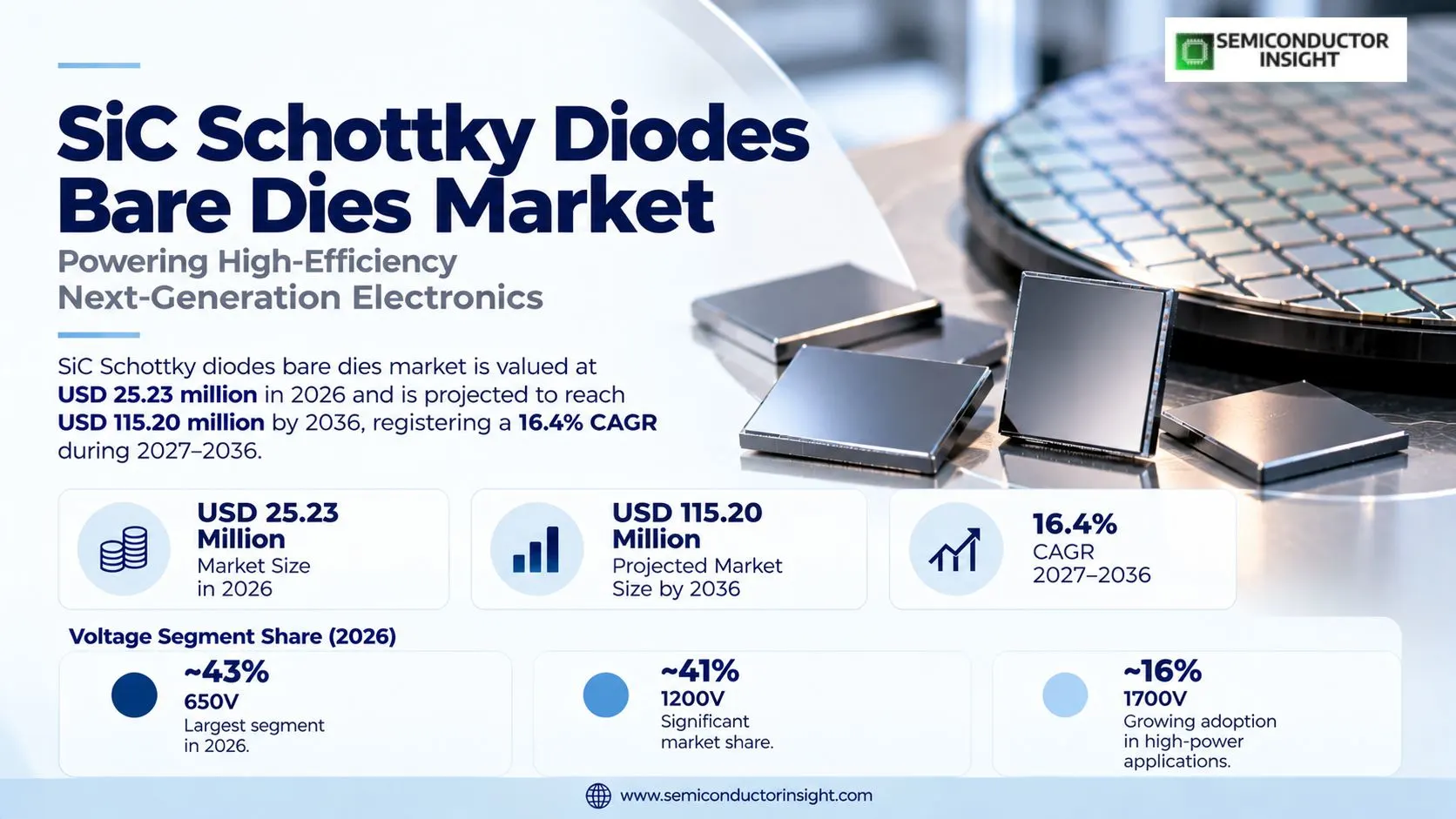
SiC Schottky diodes bare dies market covers externally invoiced, unpackaged silicon-carbide Schottky barrier diode chips supplied to electronics manufacturers and specialist module assemblers. Its modeled 2026 revenue is USD 25.23 million, rising to USD 115.20 million by 2036 at a 16.4% CAGR. Unlike a packaged rectifier or power module, a bare die is delivered before final interconnection, encapsulation and external terminal assembly, so its economics depend on wafer yield, screening grade and the buyer's integration capability. by 2030, exhibiting a CAGR of 16.40% during the forecast period.

Get the sample PDF with study scope, segmentation and methodology details.

Key Statistics

2026 Market Size
USD 25.23 million
2036 Market Forecast
USD 115.20 million
2026–2036 CAGR
16.4%
Largest Region (2026)
Asia-Pacific · ~44% modeled

Key Takeaways

  • Revenue boundary. The market counts merchant unpackaged silicon-carbide Schottky diode chips sold at factory gate; packaged diodes, finished modules and internally transferred captive dies are excluded from the same revenue denominator.
  • 2026 baseline. The estimated merchant market stands at USD 25.23 million, following the publisher’s 2023 value of USD 16 million and the consistent 2030 endpoint of USD 46.32 million.
  • 2036 outlook. The extrapolated market reaches USD 115.20 million, equivalent to a 16.4% compound annual growth rate across 2026–2036; the final six years extend beyond the publisher’s 2030 horizon.
  • Voltage leadership. The 650V class accounts for a modeled ~43% of 2026 sales, while 1200V represents ~41% and 1700V ~16%; these are product-class allocations, not supplier-reported shipment statistics.
  • Application structure. Industrial motor drives account for a modeled ~28% of merchant bare-die demand; vehicle conversion, charging, solar rectification and UPS designs make up the remaining identified application mix.
  • Geographic concentration. Asia-Pacific leads with a modeled ~44% of merchant revenue, compared with ~24% each for North America and Europe and ~4% each for South America and Middle East & Africa.
  • Qualified supplier base. Current exact-fit documentation supports Wolfspeed, SemiQ and ROHM; competing companies that publish only packaged-diode or SiC MOSFET material are not counted as confirmed merchant SBD bare-die suppliers.
  • Commercial decision. Known-good-die screening, reverse-recovery performance, die attach compatibility and reliable shipment form are important procurement filters; a modeled ~72% of sales use wafer-screened or otherwise known-good-die qualification.

SiC Schottky Diodes Bare Dies Market Overview

SiC Schottky diodes bare dies market covers externally invoiced, unpackaged silicon-carbide Schottky barrier diode chips supplied to electronics manufacturers and specialist module assemblers. Its modeled 2026 revenue is USD 25.23 million, rising to USD 115.20 million by 2036 at a 16.4% CAGR. Unlike a packaged rectifier or power module, a bare die is delivered before final interconnection, encapsulation and external terminal assembly, so its economics depend on wafer yield, screening grade and the buyer’s integration capability.

2026 market baseline · 2027 interim estimate · 2036 forecast horizon · factory-gate merchant die revenue · shares shown as analyst-modeled allocations

Silicon carbide Schottky junctions enable rectification with negligible reverse-recovery current in power-conversion circuits. A purchaser of 650V, 1200V or 1700V bare dies receives semiconductor chips rather than a finished TO-247 discrete, dual-diode module or complete inverter. SemiQ identifies 650V devices at 6A, 8A, 10A, 12A, 20A, 30A and 50A, while its 1200V catalogue spans 10A to 50A and its 1700V offering includes higher-voltage die options.

Wolfspeed publishes active 1700V Gen6 packageless products with 10A, 25A and 50A current ratings and 175°C maximum junction-temperature specifications. Its 650V Gen2 bare-die family is labeled Last Time Buy, illustrating why current catalogue status matters when profiling suppliers. ROHM’s October 2025 device numbering note explicitly distinguishes SiC Schottky bare dies from packaged diodes, MOSFET bare dies and power modules; those are not interchangeable sales categories.

The publisher’s 2023 base of USD 16 million and 2030 endpoint of USD 46.32 million imply growth of 16.399% per year over seven years, consistent with its stated 16.40%. Carrying that same endpoint-consistent rate forward gives an estimated 2027 value of USD 29.37 million. The additional 2031–2036 interval is an extrapolation of the earlier trajectory, not an audited order book, so purchasing decisions should also consider screening requirements, packaging yield and changes in product status.

Market boundaries are deliberately narrow: externally sold unpackaged SiC SBD chips qualify, whereas captive wafer-to-module transfers, packaged discretes, completed power modules, upstream bulk SiC substrates, epitaxial wafer sales and outsourced packaging fees do not. Finished SiC power-device markets in adjacent tracker rows include some of the same physical semiconductors at later processing stages. Adding the merchant bare-die total to those downstream device or module totals would overstate the economic value of the supply chain.

Segment Analysis: By Type

Voltage segmentation follows the original 650V, 1200V and 1700V bare-die classes. The 650V class leads with a modeled ~43% of 2026 merchant sales, followed closely by 1200V at ~41%, while 1700V contributes ~16%. The allocation reflects the breadth of documented supplier catalogues and likely application sockets; it is not an audited split of global shipments or a count of all silicon-carbide power products.

Voltage class Modeled 2026 share Documented product envelope
650V SiC SBD Bare Dies ~43% modeled; 6A–50A examples SemiQ documents 650V known-good-die current grades from 6A through 50A. The class is relevant to compact power supplies and converters where designers prioritize efficient high-frequency rectification. A Wolfspeed 650V Gen2 family is designated Last Time Buy and therefore represents historical availability, not a current active product promise. For 650V SiC SBD Bare Dies, design qualification also considers junction temperature, assembly yield, shipping form, device lifecycle and the distinction between a tested die and the completed rectifier package.
1200V SiC SBD Bare Dies ~41% modeled; 10A–50A examples SemiQ lists 1200V Schottky die options between 10A and 50A; Wolfspeed also publishes 1200V Gen6 bare-die families. The voltage margin is relevant to industrial bus designs, energy conversion and module customization, but end-application sales must remain separate from the value of the unpackaged chips used within them. For 1200V SiC SBD Bare Dies, design qualification also considers junction temperature, assembly yield, shipping form, device lifecycle and the distinction between a tested die and the completed rectifier package.
1700V SiC SBD Bare Dies ~16% modeled; 10A–50A active Wolfspeed examples Wolfspeed identifies active 1700V Gen6 bare-die options at 10A, 25A and 50A, and SemiQ separately identifies a 1700V/50A die. Higher blocking voltage is valuable in selected industrial designs; the modeled share is lower than the two mainstream classes because qualification and integration requirements narrow its buyer pool. For 1700V SiC SBD Bare Dies, design qualification also considers junction temperature, assembly yield, shipping form, device lifecycle and the distinction between a tested die and the completed rectifier package.

650V bare dies — high-volume design flexibility

The 650V segment is modeled at ~43% of 2026 revenue because it combines broad catalogue availability with multiple moderate-voltage rectifier sockets. SemiQ identifies 6A, 8A, 10A, 12A, 20A, 30A and 50A die grades, letting integrators select current capability without buying an entire packaged discrete. The availability of several current ratings does not prove equal sales volumes across SKUs, and obsolete or last-time-buy devices must be distinguished from current commercial offerings.

1200V bare dies — industrial conversion designs

The 1200V segment is modeled at ~41% of 2026 revenue and is associated with industrial conversion, higher-voltage power supplies, energy systems and charging equipment. SemiQ’s 10A, 15A, 20A, 30A and 50A catalogue positions illustrate current-rating flexibility, while Wolfspeed’s Gen6 portfolio establishes a separate current supplier option. Buyers must still validate operating margins, transient stress, mechanical die handling and reliability qualification for the final assembled circuit.

1700V bare dies — high-voltage niche

The 1700V segment represents a modeled ~16% of 2026 merchant sales, with demand linked to higher-voltage power conversion and custom module engineering. Wolfspeed lists active 10A, 25A and 50A Gen6 devices, and SemiQ’s 2024 PCIM announcement separated its 1700V/50A bare die from TO-247 and SOT-227 packaged products. Those formats have different sales values, even when the underlying semiconductor function is similar.

Segment Analysis: By Application

Industrial motor drives lead the modeled application allocation at ~28% of 2026 merchant bare-die revenue, with automotive and commercial vehicles at ~22%, fast EV charging at ~20%, solar power converters at ~15%, UPS at ~10% and other uses at ~5%. Each percentage describes the end equipment into which separately purchased dies are eventually assembled; the value of complete equipment and downstream modules is not counted again.

Application Demand characteristics
Industrial Motor Drives ~28% modeled 2026 share. Variable-frequency industrial drives require predictable diode behavior under switching transients, with module designers weighing 650V and 1200V device selection against junction-temperature limits and thermal cycling. Drive control designers can use Schottky rectification in auxiliary and freewheel functions where zero-recovery behavior improves switching performance, but the finished motor drive is excluded from the die sales boundary.
Automotive & Commercial Vehicles ~22% modeled 2026 share. Automotive conversion platforms may incorporate diode dies within custom power stages, yet supplier approval and system-level reliability are more demanding than a simple catalogue match. A supplier’s industrial-qualified die cannot automatically be described as automotive-qualified; procurement often requires explicit application-specific testing and supplier approval. For automotive & commercial vehicles, component purchasing is influenced by voltage class, current grade, die attachment and final product testing rather than only by the headline end-market growth rate.
Fast EV Charging ~20% modeled 2026 share. High-power charging converters benefit from rectifier efficiency and compact heat removal, with 1200V and 1700V options relevant to certain high-voltage topologies. Charger equipment revenue, packaged rectifiers and completed modules are excluded, leaving only separately sold unpackaged Schottky chips in this application slice. For fast ev charging, component purchasing is influenced by voltage class, current grade, die attachment and final product testing rather than only by the headline end-market growth rate.
Solar Systems Power Converters ~15% modeled 2026 share. Solar DC/DC and inverter auxiliary stages value low reverse-recovery behavior because switching losses affect conversion efficiency over long duty cycles. Photovoltaic modules, complete inverters and SiC MOSFET dies are separate revenue objects even where the same converter contains both switching and rectifying chips. For solar systems power converters, component purchasing is influenced by voltage class, current grade, die attachment and final product testing rather than only by the headline end-market growth rate.
UPS ~10% modeled 2026 share. Uninterruptible power systems place emphasis on conversion losses, long-life thermal management and availability during repeated grid events. Bare-die orders follow the chosen module and rectifier assembly design, not the full value of batteries, cabinet electronics or maintenance contracts. For ups, component purchasing is influenced by voltage class, current grade, die attachment and final product testing rather than only by the headline end-market growth rate.
Others ~5% modeled 2026 share. The residual includes specialized power supplies, laboratory converters and rail-adjacent industrial assemblies where catalogued voltage grades may be useful. The residual share is modeled to complete the application denominator and must not be interpreted as a verified supplier disclosure about any single niche end use. For others, component purchasing is influenced by voltage class, current grade, die attachment and final product testing rather than only by the headline end-market growth rate.

Industrial motor-drive demand is modeled at ~28% because industrial converter designs offer repeated rectification sockets and a comparatively stable qualification process. The ~22% automotive allocation and ~20% charging allocation depend more heavily on qualification and platform selection; the ~15% solar and ~10% UPS allocations are shaped by system-efficiency requirements. These shares classify the same merchant chip invoices by eventual use and must not be summed with completed inverter or charger revenue.
Regional Analysis

Asia-Pacific is the modeled largest region at ~44% of 2026 merchant bare-die revenue; North America and Europe each represent ~24%, while South America and Middle East & Africa each represent ~4%. The modeled regional growth paths are ~17.4%, ~16.1%, ~15.5%, ~14.2% and ~13.8% CAGR respectively. These figures allocate the global merchant die denominator and should not be confused with the geographic value of finished converters or with manufacturer-confirmed national shipments.

Where are merchant SiC Schottky diode bare dies purchased and integrated?

Regional demand follows the location of component procurement and module integration rather than the location of every final vehicle, solar plant or industrial motor. Asia-Pacific’s modeled ~44% position reflects electronics manufacturing and component assembly channels; North America’s ~24% position reflects specialized design and qualification; Europe’s ~24% position reflects industrial conversion and energy applications. South America and Middle East & Africa each hold modeled ~4% positions, with sourcing often linked to imported parts and distributor relationships.

Region Position Growth outlook Demand profile What decides supplier selection
Asia-Pacific ~44% modeled ~17.4% CAGR Regional electronics assembly and downstream module integration Procurement scale, die screening and multi-voltage assembly
North America ~24% modeled ~16.1% CAGR Supplier qualification and specialized power-module design Current supplier status and traceable industrial qualification
Europe ~24% modeled ~15.5% CAGR Industrial drives, renewable conversion and custom power electronics Application validation, traceability and thermal-reliability documentation
South America ~4% modeled ~14.2% CAGR Import-led conversion-equipment supply chains Distributor availability, exchange exposure and lead-time management
Middle East & Africa ~4% modeled ~13.8% CAGR Energy infrastructure and industrial conversion projects Approved-vendor access, maintenance support and climate robustness

Asia-Pacific ~44% SHARE · ~17.4% CAGR · ANALYST MODEL

How does the Asia-Pacific merchant bare-die channel differ from other regions?

Asia-Pacific represents a modeled ~44% of 2026 merchant SiC Schottky bare-die revenue and grows at an indicative ~17.4% CAGR through 2036. Its market position reflects regional electronics assembly and downstream module integration. Direct-fit supplier documentation covers 650V, 1200V and 1700V products, but it does not break out sales for Asia-Pacific. In Asia-Pacific, buyers therefore compare tested current grades, wafer-screening status, die handling and delivery support rather than assuming the share is a supplier-reported figure.

Market position~44% modeled share
Growth outlook~17.4% CAGR
Demand profileRegional electronics assembly and downstream module integration
Market access gateProcurement scale, die screening and multi-voltage assembly
Country Position in region What drives demand
China Principal design market In China, purchases of unpackaged SiC Schottky chips are assessed through local industrial electronics supply chains rather than by the value of finished power systems. In China, buyers evaluating 650V rectifiers and 10A grades consider the modeled regional ~44% revenue position in 2026, supplier delivery status and end-equipment qualification. For China, the 2026 planning horizon affects procurement schedules, but it does not convert an individual national equipment budget into verified die revenue.
Japan Specialized buyer base In Japan, purchases of unpackaged SiC Schottky chips are assessed through local industrial electronics supply chains rather than by the value of finished power systems. In Japan, buyers evaluating 1200V rectifiers and 20A grades consider the modeled regional ~44% revenue position in 2026, supplier delivery status and end-equipment qualification. For Japan, the 2027 planning horizon affects procurement schedules, but it does not convert an individual national equipment budget into verified die revenue.
South Korea Developing integration channel In South Korea, purchases of unpackaged SiC Schottky chips are assessed through local industrial electronics supply chains rather than by the value of finished power systems. In South Korea, buyers evaluating 1700V rectifiers and 50A grades consider the modeled regional ~44% revenue position in 2026, supplier delivery status and end-equipment qualification. For South Korea, the 2036 planning horizon affects procurement schedules, but it does not convert an individual national equipment budget into verified die revenue.

Market instances

  • Voltage portfolio fit. For Asia-Pacific, Wolfspeed publishes 1700V Gen6 bare die in 10A, 25A and 50A active grades, while SemiQ publishes 650V, 1200V and 1700V catalogue options. In Asia-Pacific, that breadth supports module designers comparing thermal budgets, switching duty and screening needs. The Asia-Pacific modeled regional ~44% share is an allocation of merchant chip sales and not a disclosure from either manufacturer.
  • Screening and die format. In Asia-Pacific, SemiQ describes wafer-level known-good-die screening, while Wolfspeed identifies packageless devices suitable for custom module design. In Asia-Pacific, customers may require traceability, tested breakdown characteristics and repeatable assembly results before committing to a 2027 or 2036 design program. A modeled ~44% allocation for Asia-Pacific cannot establish a supplier’s national shipment volumes.
  • Nonadditive market boundary. A 650V, 1200V or 1700V chip may eventually appear inside a packaged discrete or a completed power module sold in Asia-Pacific. In Asia-Pacific, the merchant bare-die transaction is counted once, before downstream assembly; its modeled ~44% regional share is not additional to finished-device turnover. For Asia-Pacific, this distinction is necessary when comparing supplier product catalogues with power electronics end-market forecasts.
In the full report: Country-specific buyer-channel splits, qualification pathways, 650V/1200V/1700V voltage demand and merchant bare-die invoice flows for Asia-Pacific; modeled ~44% regional share is not an audited supplier disclosure.

North America ~24% SHARE · ~16.1% CAGR · ANALYST MODEL

How does the North America merchant bare-die channel differ from other regions?

North America represents a modeled ~24% of 2026 merchant SiC Schottky bare-die revenue and grows at an indicative ~16.1% CAGR through 2036. Its market position reflects supplier qualification and specialized power-module design. Direct-fit supplier documentation covers 650V, 1200V and 1700V products, but it does not break out sales for North America. In North America, buyers therefore compare tested current grades, wafer-screening status, die handling and delivery support rather than assuming the share is a supplier-reported figure.

Market position~24% modeled share
Growth outlook~16.1% CAGR
Demand profileSupplier qualification and specialized power-module design
Market access gateCurrent supplier status and traceable industrial qualification
Country Position in region What drives demand
United States Principal design market In United States, purchases of unpackaged SiC Schottky chips are assessed through local industrial electronics supply chains rather than by the value of finished power systems. In United States, buyers evaluating 1200V rectifiers and 20A grades consider the modeled regional ~24% revenue position in 2026, supplier delivery status and end-equipment qualification. For United States, the 2026 planning horizon affects procurement schedules, but it does not convert an individual national equipment budget into verified die revenue.
Canada Specialized buyer base In Canada, purchases of unpackaged SiC Schottky chips are assessed through local industrial electronics supply chains rather than by the value of finished power systems. In Canada, buyers evaluating 1700V rectifiers and 50A grades consider the modeled regional ~24% revenue position in 2026, supplier delivery status and end-equipment qualification. For Canada, the 2027 planning horizon affects procurement schedules, but it does not convert an individual national equipment budget into verified die revenue.
Mexico Developing integration channel In Mexico, purchases of unpackaged SiC Schottky chips are assessed through local industrial electronics supply chains rather than by the value of finished power systems. In Mexico, buyers evaluating 650V rectifiers and 10A grades consider the modeled regional ~24% revenue position in 2026, supplier delivery status and end-equipment qualification. For Mexico, the 2036 planning horizon affects procurement schedules, but it does not convert an individual national equipment budget into verified die revenue.

Market instances

  • Voltage portfolio fit. For North America, Wolfspeed publishes 1700V Gen6 bare die in 10A, 25A and 50A active grades, while SemiQ publishes 650V, 1200V and 1700V catalogue options. In North America, that breadth supports module designers comparing thermal budgets, switching duty and screening needs. The North America modeled regional ~24% share is an allocation of merchant chip sales and not a disclosure from either manufacturer.
  • Screening and die format. In North America, SemiQ describes wafer-level known-good-die screening, while Wolfspeed identifies packageless devices suitable for custom module design. In North America, customers may require traceability, tested breakdown characteristics and repeatable assembly results before committing to a 2027 or 2036 design program. A modeled ~24% allocation for North America cannot establish a supplier’s national shipment volumes.
  • Nonadditive market boundary. A 650V, 1200V or 1700V chip may eventually appear inside a packaged discrete or a completed power module sold in North America. In North America, the merchant bare-die transaction is counted once, before downstream assembly; its modeled ~24% regional share is not additional to finished-device turnover. For North America, this distinction is necessary when comparing supplier product catalogues with power electronics end-market forecasts.
In the full report: Country-specific buyer-channel splits, qualification pathways, 650V/1200V/1700V voltage demand and merchant bare-die invoice flows for North America; modeled ~24% regional share is not an audited supplier disclosure.

Europe ~24% SHARE · ~15.5% CAGR · ANALYST MODEL

How does the Europe merchant bare-die channel differ from other regions?

Europe represents a modeled ~24% of 2026 merchant SiC Schottky bare-die revenue and grows at an indicative ~15.5% CAGR through 2036. Its market position reflects industrial drives, renewable conversion and custom power electronics. Direct-fit supplier documentation covers 650V, 1200V and 1700V products, but it does not break out sales for Europe. In Europe, buyers therefore compare tested current grades, wafer-screening status, die handling and delivery support rather than assuming the share is a supplier-reported figure.

Market position~24% modeled share
Growth outlook~15.5% CAGR
Demand profileIndustrial drives, renewable conversion and custom power electronics
Market access gateApplication validation, traceability and thermal-reliability documentation
Country Position in region What drives demand
Germany Principal design market In Germany, purchases of unpackaged SiC Schottky chips are assessed through local industrial electronics supply chains rather than by the value of finished power systems. In Germany, buyers evaluating 1700V rectifiers and 50A grades consider the modeled regional ~24% revenue position in 2026, supplier delivery status and end-equipment qualification. For Germany, the 2026 planning horizon affects procurement schedules, but it does not convert an individual national equipment budget into verified die revenue.
France Specialized buyer base In France, purchases of unpackaged SiC Schottky chips are assessed through local industrial electronics supply chains rather than by the value of finished power systems. In France, buyers evaluating 650V rectifiers and 10A grades consider the modeled regional ~24% revenue position in 2026, supplier delivery status and end-equipment qualification. For France, the 2027 planning horizon affects procurement schedules, but it does not convert an individual national equipment budget into verified die revenue.
Italy Developing integration channel In Italy, purchases of unpackaged SiC Schottky chips are assessed through local industrial electronics supply chains rather than by the value of finished power systems. In Italy, buyers evaluating 1200V rectifiers and 20A grades consider the modeled regional ~24% revenue position in 2026, supplier delivery status and end-equipment qualification. For Italy, the 2036 planning horizon affects procurement schedules, but it does not convert an individual national equipment budget into verified die revenue.

Market instances

  • Voltage portfolio fit. For Europe, Wolfspeed publishes 1700V Gen6 bare die in 10A, 25A and 50A active grades, while SemiQ publishes 650V, 1200V and 1700V catalogue options. In Europe, that breadth supports module designers comparing thermal budgets, switching duty and screening needs. The Europe modeled regional ~24% share is an allocation of merchant chip sales and not a disclosure from either manufacturer.
  • Screening and die format. In Europe, SemiQ describes wafer-level known-good-die screening, while Wolfspeed identifies packageless devices suitable for custom module design. In Europe, customers may require traceability, tested breakdown characteristics and repeatable assembly results before committing to a 2027 or 2036 design program. A modeled ~24% allocation for Europe cannot establish a supplier’s national shipment volumes.
  • Nonadditive market boundary. A 650V, 1200V or 1700V chip may eventually appear inside a packaged discrete or a completed power module sold in Europe. In Europe, the merchant bare-die transaction is counted once, before downstream assembly; its modeled ~24% regional share is not additional to finished-device turnover. For Europe, this distinction is necessary when comparing supplier product catalogues with power electronics end-market forecasts.
In the full report: Country-specific buyer-channel splits, qualification pathways, 650V/1200V/1700V voltage demand and merchant bare-die invoice flows for Europe; modeled ~24% regional share is not an audited supplier disclosure.

South America ~4% SHARE · ~14.2% CAGR · ANALYST MODEL

How does the South America merchant bare-die channel differ from other regions?

South America represents a modeled ~4% of 2026 merchant SiC Schottky bare-die revenue and grows at an indicative ~14.2% CAGR through 2036. Its market position reflects import-led conversion-equipment supply chains. Direct-fit supplier documentation covers 650V, 1200V and 1700V products, but it does not break out sales for South America. In South America, buyers therefore compare tested current grades, wafer-screening status, die handling and delivery support rather than assuming the share is a supplier-reported figure.

Market position~4% modeled share
Growth outlook~14.2% CAGR
Demand profileImport-led conversion-equipment supply chains
Market access gateDistributor availability, exchange exposure and lead-time management
Country Position in region What drives demand
Brazil Principal design market In Brazil, purchases of unpackaged SiC Schottky chips are assessed through local industrial electronics supply chains rather than by the value of finished power systems. In Brazil, buyers evaluating 650V rectifiers and 10A grades consider the modeled regional ~4% revenue position in 2026, supplier delivery status and end-equipment qualification. For Brazil, the 2026 planning horizon affects procurement schedules, but it does not convert an individual national equipment budget into verified die revenue.
Argentina Specialized buyer base In Argentina, purchases of unpackaged SiC Schottky chips are assessed through local industrial electronics supply chains rather than by the value of finished power systems. In Argentina, buyers evaluating 1200V rectifiers and 20A grades consider the modeled regional ~4% revenue position in 2026, supplier delivery status and end-equipment qualification. For Argentina, the 2027 planning horizon affects procurement schedules, but it does not convert an individual national equipment budget into verified die revenue.
Chile Developing integration channel In Chile, purchases of unpackaged SiC Schottky chips are assessed through local industrial electronics supply chains rather than by the value of finished power systems. In Chile, buyers evaluating 1700V rectifiers and 50A grades consider the modeled regional ~4% revenue position in 2026, supplier delivery status and end-equipment qualification. For Chile, the 2036 planning horizon affects procurement schedules, but it does not convert an individual national equipment budget into verified die revenue.

Market instances

  • Voltage portfolio fit. For South America, Wolfspeed publishes 1700V Gen6 bare die in 10A, 25A and 50A active grades, while SemiQ publishes 650V, 1200V and 1700V catalogue options. In South America, that breadth supports module designers comparing thermal budgets, switching duty and screening needs. The South America modeled regional ~4% share is an allocation of merchant chip sales and not a disclosure from either manufacturer.
  • Screening and die format. In South America, SemiQ describes wafer-level known-good-die screening, while Wolfspeed identifies packageless devices suitable for custom module design. In South America, customers may require traceability, tested breakdown characteristics and repeatable assembly results before committing to a 2027 or 2036 design program. A modeled ~4% allocation for South America cannot establish a supplier’s national shipment volumes.
  • Nonadditive market boundary. A 650V, 1200V or 1700V chip may eventually appear inside a packaged discrete or a completed power module sold in South America. In South America, the merchant bare-die transaction is counted once, before downstream assembly; its modeled ~4% regional share is not additional to finished-device turnover. For South America, this distinction is necessary when comparing supplier product catalogues with power electronics end-market forecasts.
In the full report: Country-specific buyer-channel splits, qualification pathways, 650V/1200V/1700V voltage demand and merchant bare-die invoice flows for South America; modeled ~4% regional share is not an audited supplier disclosure.

Middle East & Africa ~4% SHARE · ~13.8% CAGR · ANALYST MODEL

How does the Middle East & Africa merchant bare-die channel differ from other regions?

Middle East & Africa represents a modeled ~4% of 2026 merchant SiC Schottky bare-die revenue and grows at an indicative ~13.8% CAGR through 2036. Its market position reflects energy infrastructure and industrial conversion projects. Direct-fit supplier documentation covers 650V, 1200V and 1700V products, but it does not break out sales for Middle East & Africa. In Middle East & Africa, buyers therefore compare tested current grades, wafer-screening status, die handling and delivery support rather than assuming the share is a supplier-reported figure.

Market position~4% modeled share
Growth outlook~13.8% CAGR
Demand profileEnergy infrastructure and industrial conversion projects
Market access gateApproved-vendor access, maintenance support and climate robustness
Country Position in region What drives demand
United Arab Emirates Principal design market In United Arab Emirates, purchases of unpackaged SiC Schottky chips are assessed through local industrial electronics supply chains rather than by the value of finished power systems. In United Arab Emirates, buyers evaluating 1200V rectifiers and 20A grades consider the modeled regional ~4% revenue position in 2026, supplier delivery status and end-equipment qualification. For United Arab Emirates, the 2026 planning horizon affects procurement schedules, but it does not convert an individual national equipment budget into verified die revenue.
Saudi Arabia Specialized buyer base In Saudi Arabia, purchases of unpackaged SiC Schottky chips are assessed through local industrial electronics supply chains rather than by the value of finished power systems. In Saudi Arabia, buyers evaluating 1700V rectifiers and 50A grades consider the modeled regional ~4% revenue position in 2026, supplier delivery status and end-equipment qualification. For Saudi Arabia, the 2027 planning horizon affects procurement schedules, but it does not convert an individual national equipment budget into verified die revenue.
South Africa Developing integration channel In South Africa, purchases of unpackaged SiC Schottky chips are assessed through local industrial electronics supply chains rather than by the value of finished power systems. In South Africa, buyers evaluating 650V rectifiers and 10A grades consider the modeled regional ~4% revenue position in 2026, supplier delivery status and end-equipment qualification. For South Africa, the 2036 planning horizon affects procurement schedules, but it does not convert an individual national equipment budget into verified die revenue.

Market instances

  • Voltage portfolio fit. For Middle East & Africa, Wolfspeed publishes 1700V Gen6 bare die in 10A, 25A and 50A active grades, while SemiQ publishes 650V, 1200V and 1700V catalogue options. In Middle East & Africa, that breadth supports module designers comparing thermal budgets, switching duty and screening needs. The Middle East & Africa modeled regional ~4% share is an allocation of merchant chip sales and not a disclosure from either manufacturer.
  • Screening and die format. In Middle East & Africa, SemiQ describes wafer-level known-good-die screening, while Wolfspeed identifies packageless devices suitable for custom module design. In Middle East & Africa, customers may require traceability, tested breakdown characteristics and repeatable assembly results before committing to a 2027 or 2036 design program. A modeled ~4% allocation for Middle East & Africa cannot establish a supplier’s national shipment volumes.
  • Nonadditive market boundary. A 650V, 1200V or 1700V chip may eventually appear inside a packaged discrete or a completed power module sold in Middle East & Africa. In Middle East & Africa, the merchant bare-die transaction is counted once, before downstream assembly; its modeled ~4% regional share is not additional to finished-device turnover. For Middle East & Africa, this distinction is necessary when comparing supplier product catalogues with power electronics end-market forecasts.
In the full report: Country-specific buyer-channel splits, qualification pathways, 650V/1200V/1700V voltage demand and merchant bare-die invoice flows for Middle East & Africa; modeled ~4% regional share is not an audited supplier disclosure.

Competitive Landscape and Supplier Qualification

The confirmed direct-fit merchant bare-die supplier set comprises Wolfspeed, SemiQ and ROHM, based on explicit SiC Schottky bare-die documentation. Wolfspeed lists active 1200V and 1700V Gen6 devices, SemiQ lists 650V through 1700V known-good-die options, and ROHM’s October 2025 part-number guide identifies separate SiC SBD bare-die families. These product records establish availability, not market shares, supplier revenues or leadership rankings.

Wolfspeed competes on published Gen6 bare-die voltage and current choices, including 1700V devices at 10A, 25A and 50A with industrial qualification and a 175°C maximum junction-temperature specification. Its historical 650V Gen2 family is marked Last Time Buy, making product-life-cycle screening an essential part of competitive assessment. The existence of an active SKU supports supply-fit verification but does not reveal customer volumes, prices or a global merchant market-share percentage.

SemiQ publishes an unusually explicit known-good-die catalogue spanning 650V, 1200V and 1700V Schottky variants, including 650V grades from 6A to 50A. Its June 2024 PCIM communication differentiated a 1700V/50A bare die from packaged TO-247 and SOT-227 products. The format distinction matters commercially because die-level testing, shipment and integration costs differ from those of the finished package; none of those catalogue details audits SemiQ’s revenue share.

ROHM’s revised October 2025 device-numbering note explicitly includes SiC Schottky bare-die categories separate from MOSFET bare die and power modules. Its current SBD die product listings can be used to check voltage, current and status at the part-number level. However, a broad semiconductor supplier roster should not be expanded into an exact-fit supplier list without a direct Schottky bare-die product or commercial statement.

Tier structure

Tier Companies Basis of competition
Documented merchant bare-die suppliers Wolfspeed, SemiQ, ROHM Explicit bare SiC Schottky die product or part-number documentation; evaluate active status, voltage and current range, screening and technical support. The documented merchant bare-die suppliers classification requires part-level evidence, explicit commercial format and procurement validation. For the documented merchant bare-die suppliers tier, buyer teams should check current status, rated voltage, screened quality, product documentation, delivery conditions and downstream assembly responsibilities before inferring revenue or competitive position from the listed companies.
Adjacent SiC device suppliers Other packaged-diode, MOSFET-die and module suppliers Potential competitors in downstream device architectures, but direct merchant Schottky bare-die fit is not independently established by adjacent portfolios. The adjacent sic device suppliers classification requires part-level evidence, explicit commercial format and procurement validation. For the adjacent sic device suppliers tier, buyer teams should check current status, rated voltage, screened quality, product documentation, delivery conditions and downstream assembly responsibilities before inferring revenue or competitive position from the listed companies.
Integration and procurement channels Custom power-module integrators, discrete-packaging specialists and industrial distributors Buyer roles rather than manufacturers; compete on procurement service, traceability, tested-die acceptance and die-to-package assembly yield. The integration and procurement channels classification requires part-level evidence, explicit commercial format and procurement validation. For the integration and procurement channels tier, buyer teams should check current status, rated voltage, screened quality, product documentation, delivery conditions and downstream assembly responsibilities before inferring revenue or competitive position from the listed companies.

Key companies profiled

  • Wolfspeed
  • SemiQ
  • ROHM

Production Technology, Screening and Product Qualification

A SiC Schottky bare die is produced through wafer processing, junction formation, metallization, wafer-level electrical screening, singulation and shipment in a format compatible with die attachment. SemiQ identifies 150mm wafer fabrication for its 650V bare-die examples, while Wolfspeed publishes active 1700V Gen6 die grades. The merchant market captures the chip sold before package interconnection or encapsulation, so downstream module manufacturing and converter sales do not belong in the same revenue figure.

Wafer screening is central to merchant die procurement because a purchaser must integrate the chip into a separate assembly flow. SemiQ describes wafer-level electrical testing and optical inspection for known-good-die selection; the model assigns ~72% of 2026 merchant revenue to wafer-screened or known-good-die supply and ~28% to standard production-tested die. Those percentages are modeled commercial categories, not disclosed yields or company-specific shipment splits.

Current grades and voltage classes define different engineering trade-offs. Wolfspeed’s 1700V Gen6 examples include 10A, 25A and 50A devices and list 175°C maximum junction temperature; SemiQ’s 650V known-good-die list includes 6A, 8A, 10A, 12A, 20A, 30A and 50A. These values help engineers narrow die selection, but current rating alone does not specify final package thermal resistance, bond-wire design or converter efficiency.

The boundary between bare die and completed package remains economically material. Wolfspeed’s May 2025 application note on package-induced failures discusses the downstream interconnect and assembly considerations that can affect finished-device reliability. The note does not establish merchant Schottky die sales; it clarifies why die supply, packaging services and completed module revenue must be recorded separately. A module containing several purchased dies is not a new independent source of upstream die sales.

The supply chain also has product-life-cycle risk: Wolfspeed marks its 650V Gen2 bare-die family Last Time Buy while continuing to list active higher-voltage Gen6 devices. A buyer planning a 2027 production start or a 2036 service life must therefore confirm available replacement grades, screening documentation and assembly qualification, rather than extrapolating historical catalogue coverage indefinitely.

Market Dynamics, Drivers, Restraints and Opportunities

The merchant bare-die market is shaped by switching-efficiency requirements, custom module adoption, availability of tested die and downstream industrial power conversion. Its modeled impact bridge attributes +23.20 percentage points to positive forces and -6.80 percentage points to restraints, producing the 16.40 percentage-point headline annual growth contribution. These impact weights are analytical allocations rather than causal coefficients estimated from a disclosed manufacturer transaction dataset.

MARKET DRIVERS

Drivers Impact Analysis

Market Drivers Impact Rank CAGR Contribution (%) 2026–2029 2030–2032 2033–2036
Power-conversion efficiency and zero-recovery demand High +8.00% High High High
Custom module integration and bare-die procurement Medium-High +5.80% Medium High High
Expansion of 1200V and 1700V design sockets Medium +4.30% Medium High High
Wafer-level screening and known-good-die acceptance Low-Medium +3.00% High Medium Medium
Others (industrial UPS, solar auxiliaries and specialized charging rectifiers) Low +2.10% Medium Medium Low

Low-recovery rectification supports efficient converters

SiC Schottky diodes offer negligible reverse-recovery current, an advantage for high-frequency rectification in selected industrial and power-supply designs. Wolfspeed and SemiQ explicitly describe fast switching and low-recovery performance in their bare-die materials. A manufacturer choosing to integrate 650V, 1200V or 1700V dies into a custom assembly can control its thermal and electrical layout more closely than when constrained to a standard packaged discrete.

Custom modules create direct die procurement routes

Wolfspeed describes its packageless 1700V Gen6 Schottky devices as suitable for custom module designs, and SemiQ distinguishes bare die from TO-247 and SOT-227 finished products. The modeled buyer-channel allocation assigns ~64% of merchant revenue to custom power-module integrators, ~26% to discrete-packaging specialists and ~10% to industrial design houses or distributors. These are distinct routes to purchase the same underlying chips.

Higher-voltage design options broaden technical fit

Documented 1200V and 1700V SiC Schottky bare dies allow engineers to consider rectification in higher-voltage power systems while evaluating surge and temperature margins. Wolfspeed publishes active 1700V Gen6 grades at 10A, 25A and 50A, and SemiQ identifies a separate 1700V/50A die. Higher-voltage device availability does not guarantee that every converter will use a merchant bare die, but it expands the feasible set of module configurations.

Screening reduces integration risk

Wafer-level screening can reduce the chance that a defective chip is attached and interconnected inside an expensive custom power assembly. SemiQ publishes known-good-die information for SiC products, and Wolfspeed identifies industrial qualification for current Gen6 bare-die listings. The model assigns ~72% of merchant revenue to known-good-die or wafer-screened supply, compared with ~28% to standard tested dies.

Additional industrial rectification sockets sustain demand

Industrial drives, charging systems, solar conversion and UPS designs create multiple rectification functions that may use Schottky dies where their efficiency and thermal characteristics justify the integration cost. The application model assigns ~28% to industrial motor drives, ~22% to automotive and commercial vehicles, ~20% to fast EV charging, ~15% to solar converters and ~10% to UPS, with ~5% residual demand.

MARKET RESTRAINTS

Restraints Impact Analysis

Market Restraints Impact Rank CAGR Contribution (%) 2026–2029 2030–2032 2033–2036
Qualification delays and assembly yield losses High -2.60% High Medium Medium
Price pressure and changing device architecture Medium-High -1.90% Medium High High
Concentration of documented merchant suppliers Medium -1.40% High Medium Medium
Others (last-time-buy products, packaging alternatives and sourcing volatility) Low -0.90% Medium Medium Low

Die-level qualification can delay design wins

A bare chip must pass through customer-specific die attachment, interconnection, insulation and final-product testing before the finished assembly is accepted. Wolfspeed’s package reliability materials identify downstream interconnect and packaging failure modes, while SemiQ’s known-good-die screening addresses only part of the risk. Qualification can therefore extend beyond a simple 650V, 1200V or 1700V catalogue comparison, particularly for automotive or high-reliability industrial designs.

Alternative packages compress merchant die opportunities

Many buyers can purchase a finished TO-247 rectifier or integrated power module instead of sourcing unpackaged chips and taking responsibility for assembly. SemiQ’s 2024 1700V introduction included bare die, discrete and module formats, demonstrating this practical substitution. If more designs adopt finished packages, semiconductor content can still grow while the merchant bare-die share of the value chain develops more slowly.

Supplier verification and lifecycle status restrict procurement

Only three current exact-fit supplier portfolios were confirmed through direct documentation in the reviewed evidence: Wolfspeed, SemiQ and ROHM. That is not proof that no other manufacturer sells SiC Schottky bare dies; it indicates the limits of the inspected product record. Wolfspeed’s 650V Gen2 family carries a Last Time Buy designation, showing why buyer forecasts should use active orderable parts rather than historical catalogue breadth.

Price and yield uncertainty affect realized value

Merchant die revenue depends on qualified wafer yield, tested die mix, order size and negotiated selling price, none of which is independently audited in the cited global market figures. Packaging specialists also incur assembly costs that are excluded from the die-only denominator. A nominal 10A or 50A current grade cannot establish the average price of a sale, and different voltage classes can have different screening burdens.

MARKET OPPORTUNITIES

Qualified high-voltage custom modules

A custom power-module integrator can combine active 1700V Schottky dies with selected switching devices and its own thermal architecture. Wolfspeed lists 10A, 25A and 50A Gen6 options and SemiQ lists a 1700V/50A die, offering alternative starting points for design evaluation. The opportunity is strongest where standard packaged rectifiers do not match the desired current sharing or mechanical envelope.

Screening-led supplier differentiation

Known-good-die screening can help differentiate merchant chips in projects where a failed downstream assembly is costly. SemiQ describes wafer-level testing and die classification, while Wolfspeed publishes industrial qualification information for selected active Gen6 parts. Suppliers able to provide traceable test records, controlled die handling and stable product status may improve acceptance among specialized integrators.

Voltage-class cross-selling

A supplier with 650V, 1200V and 1700V Schottky die families can support several design teams inside the same customer organization, from lower-voltage auxiliary converters to high-voltage industrial modules. SemiQ’s catalogue provides examples at 6A through 50A, while Wolfspeed’s current 1700V family includes 10A, 25A and 50A options. Cross-selling depends on application qualification and supply continuity, not simply the number of SKUs displayed online.

Regional assembly diversification

Regional module integrators may seek alternative suppliers or qualified distributors to reduce reliance on a single procurement channel. North America and Europe each hold modeled ~24% regional merchant revenue shares, while Asia-Pacific holds ~44%, leaving smaller modeled positions in South America and Middle East & Africa. These shares are scenario allocations, not evidence of manufacturer production by country.

Supply Chain and Revenue Boundary

The supply chain begins with SiC crystal and wafer production, moves through device fabrication and wafer-level testing, and then separates into externally sold bare dies, captive internal use and downstream packaged devices. This market measures only the merchant bare-die transaction. A packaged rectifier, a completed module or a full power converter may contain the same silicon-carbide chip, but those later products are not additional bare-die factory-gate sales.

Upstream SiC waferBulk substrates, epitaxial structures and wafer materials; excluded from the merchant bare-die invoice.
Device fabricationSchottky junction processing, metallization and electrical wafer testing; embodied in the chip cost.
Merchant bare dieExternally sold unpackaged 650V, 1200V or 1700V SiC SBD chip; included once.
Package and module assemblyDie attachment, bonds, encapsulation and module terminals; separately invoiced downstream value excluded.
Finished converterIndustrial drive, charger, solar power stage or UPS equipment; equipment sales excluded.

Materials boundary. Bulk SiC substrates and epitaxial wafer inputs precede the formation of the Schottky device. Their merchant sales are separate upstream markets and cannot be added to a die-only total as if they were different end uses. The same principle applies when a vertically integrated supplier transfers a wafer internally to fabricate chips; a captive accounting movement is not an externally sold Schottky bare-die transaction.

Qualification boundary. SemiQ publishes known-good-die screening and current grades across 650V, 1200V and 1700V, while Wolfspeed lists active Gen6 1700V products with industrial qualification. These records describe the condition of a chip before final assembly. A customer may then attach the die to a substrate, wire bond it or integrate it into a power module, with additional reliability testing and process yield at the assembly stage.

Buyer-channel boundary. The modeled ~64% custom-module-integrator channel purchases chips for specialized assemblies, while ~26% discrete-packaging specialists and ~10% industrial design houses or distributors represent other routes to market. These percentages partition one merchant invoice pool rather than describing additional market layers. A reseller that transfers the same die to a module assembler does not create new factory-gate chip production merely by issuing another invoice.

Lifecycle boundary. Wolfspeed identifies its 650V Gen2 bare-die family as Last Time Buy and separately lists active 1200V and 1700V Gen6 offerings. A historical product reference is useful for understanding voltage evolution but should not be extrapolated into current supply availability. A 2026 purchasing decision may require different qualified part numbers from a 2023 design, and a 2036 service requirement can demand a replacement strategy.

Recent Technical and Commercial Developments

  • 13 September 2023 Direct bare die
    SemiQ published a 650V/20A SiC Schottky bare-die product entry, identifying 150mm wafer fabrication and zero-recovery behavior. This is direct evidence that the merchant form factor was offered in a defined current grade, not merely as a packaged discrete. For industrial power-stage integrators, the development provides a documented 650V reference for sample evaluation, die attachment and screening decisions; it does not disclose sales volume or regional revenue share. Source
  • 13 September 2023 Direct bare die
    SemiQ separately published a 650V/50A SiC Schottky bare-die product, widening the documented current range beyond its 20A offering. A 50A die changes the current-capability choice available to module engineers, although package-level thermal performance still depends on the buyer’s assembly. This direct product record supports the existence of multiple merchant current grades in the 650V class and does not constitute an audited global market-size or supplier-share statement. Source
  • 1 May 2024 Adjacent screening
    SemiQ announced a known-good-die screening program for its SiC MOSFET portfolio, describing electrical sorting and optical inspection before downstream attachment. The announcement concerns MOSFET chips rather than Schottky bare-die revenue, so it is used only as adjacent evidence of wafer-level screening capabilities and the economics of preventing costly assembly failures. It does not establish an SBD product launch, an SBD qualification percentage or a change in the worldwide Schottky merchant-die revenue denominator. Source
  • 11 June 2024 Direct 1700V die
    At PCIM 2024, SemiQ identified a 1700V/50A SiC Schottky bare die alongside separate TO-247 and SOT-227 products. This format separation directly supports the factory-gate revenue boundary: the same device family can be marketed as an unpackaged chip, a discrete or a module, but those formats cannot be added together as independent merchant bare-die sales. The announcement also extends the documented voltage choices for custom industrial power conversion. Source
  • 11 February 2025 Adjacent MOSFET
    SemiQ announced a third-generation 1200V SiC MOSFET offering, discussing switching losses and compact high-power design. This is an adjacent transistor development rather than a SiC Schottky bare-die introduction, and it is not counted as direct diode supply evidence. It matters because module integrators may co-design switching devices and rectifiers within one assembly, changing packaging and qualification decisions without automatically increasing the value of externally sold Schottky chips. Source
  • May 2025 Adjacent packaging
    Wolfspeed revised an application note addressing package-induced failure mechanisms, highlighting the downstream reliability work that follows semiconductor die fabrication. The technical note is not a Schottky bare-die sales announcement and provides no audited market revenue. Its relevance is the clear separation between merchant chip supply and the later die-attach, bond and encapsulation processes that can determine the yield of a finished power device. Source
  • October 2025 Direct classification
    ROHM revised its SiC power-device part-number information note, explicitly identifying SiC Schottky barrier diode bare-die families separately from packaged diodes, MOSFET dies and modules. This direct classification supports exact-fit supplier screening and helps prevent the mistaken use of a packaged-product roster as proof of merchant diode die sales. The note provides voltage-family context, but it does not disclose aggregate shipments, prices, regional market shares or global 2036 revenue. Source
  • November 2025 Adjacent reliability
    Wolfspeed published technical material on advanced silicon-carbide packaging and system durability, addressing interconnect and thermal design considerations after die fabrication. The material is adjacent to merchant Schottky bare dies rather than evidence of a new SBD product or quantified demand. It matters because buyers integrating 10A, 25A or 50A chips into custom modules must validate the complete assembly, even when the purchased die has already passed wafer-level tests. Source

REPORT SCOPE & SEGMENTATION

Attribute Details
Study Period 2023–2036
Publisher Anchor Year 2023
Base Year 2026
Estimated Year 2027
Forecast Period 2026–2036
Historical Period 2023–2025
Market Size 2026 USD 25.23 million
Market Size 2027 USD 29.37 million
Market Size 2036 USD 115.20 million
Growth Rate CAGR of 16.4% from 2026–2036
Revenue Unit USD million, merchant factory-gate sales of unpackaged SiC Schottky diode dies
Revenue Exclusions Packaged discretes, modules, upstream SiC wafers, captive dies, packaging services, converters and vehicles
By Type 650V SiC SBD Bare Dies · 1200V SiC SBD Bare Dies · 1700V SiC SBD Bare Dies
By Application Industrial Motor Drives · Automotive & Commercial Vehicles · Fast EV Charging · Solar Systems Power Converters · UPS · Others
By Buyer Channel Custom Power Module Integrators · Discrete Diode Packaging Specialists · Industrial Design Houses & Distributors
By Qualification Known-Good-Die / Wafer-Screened · Standard Production-Tested Die
By Region Five mutually exclusive modeled regions; region, type, application, buyer channel and qualification are different views of one nonadditive merchant die revenue total.
North AmericaUnited States, Canada, Mexico
EuropeGermany, France, Italy, United Kingdom, Rest of Europe
Asia-PacificChina, Japan, South Korea, India, Southeast Asia, Rest of Asia-Pacific
South AmericaBrazil, Argentina, Chile, Rest of South America
Middle East & AfricaUnited Arab Emirates, Saudi Arabia, South Africa, Rest of Middle East & Africa
Key Companies Profiled Wolfspeed; SemiQ; ROHM (exact-fit direct product evidence). Other semiconductor brands require part-level verification before being represented as merchant SBD bare-die suppliers.
Customization Scope Optional country, voltage-class, qualification and buyer-channel customization, with nonadditive revenue-boundary controls.

Frequently Asked Questions

How large is the merchant SiC Schottky diode bare-die market?

The 2026 merchant factory-gate market is USD 25.23 million, with a modeled 2036 level of USD 115.20 million and a 16.4% CAGR. These figures apply only to externally sold unpackaged Schottky chips and exclude finished rectifiers and modules. The 2036 level extends six years beyond the publisher’s 2030 endpoint, so it is an extrapolation rather than an independently audited manufacturer forecast.

What qualifies as a SiC Schottky bare die?

A qualifying product is an unpackaged silicon-carbide Schottky barrier diode chip sold externally before die attachment, bonding, encapsulation or finished-package assembly. A 650V, 1200V or 1700V die may later be integrated into an industrial converter or power module, but the completed device is a separate downstream revenue object. Captive dies transferred internally by a vertically integrated manufacturer are excluded from merchant sales.

Which manufacturers have confirmed current exact-fit offerings?

Wolfspeed, SemiQ and ROHM have direct SiC Schottky bare-die documentation in the inspected official evidence. Wolfspeed publishes active Gen6 1700V devices, SemiQ provides known-good-die voltage and current grades, and ROHM identifies SBD bare-die families separately from MOSFET chips. This is a verified product-fit shortlist, not a global supplier ranking or proof that other manufacturers lack comparable products.

Which voltage class leads the modeled market?

The 650V class leads at a modeled ~43% of 2026 merchant sales, followed by 1200V at ~41% and 1700V at ~16%. SemiQ documents several 650V grades from 6A to 50A, while Wolfspeed publishes active 1700V Gen6 devices at 10A, 25A and 50A. The percentage allocation is analytical and cannot be inferred directly from the number of catalogue SKUs.

Which applications use these unpackaged diode chips?

The modeled application mix allocates ~28% to industrial motor drives, ~22% to automotive and commercial vehicles, ~20% to fast EV charging, ~15% to solar power converters, ~10% to UPS and ~5% to other applications. These are final-use classifications of externally sold semiconductor dies, not the sales values of complete chargers, inverters, vehicles or industrial equipment.

Which region has the largest modeled share?

Asia-Pacific leads at a modeled ~44% of 2026 merchant bare-die revenue. North America and Europe each account for ~24%, while South America and Middle East & Africa each account for ~4%. The model reflects likely module-integration and electronics procurement channels; it is not an audited supplier geographic revenue disclosure, and it should not be compared directly with regional finished-converter sales.

Why does known-good-die qualification matter?

A buyer attaching bare semiconductor chips to a custom module incurs downstream assembly and testing costs. Wafer-level electrical screening and optical inspection can help identify suitable chips before those costs are committed. The model assigns ~72% of merchant sales to known-good-die or wafer-screened formats and ~28% to standard production-tested die, but these are analyst allocations rather than manufacturer-disclosed yields or shipment shares.

What are the main commercial restraints?

Merchant die buyers face customer-specific qualification cycles, die-attach and bond reliability requirements, pricing pressure, changing preferences for finished packages and supplier lifecycle risks. Wolfspeed identifies a 650V Gen2 bare-die family as Last Time Buy, illustrating why historical catalogue availability cannot substitute for current procurement confirmation. The completed-module alternative can reduce merchant die purchases even when silicon-carbide semiconductor use grows in power systems.

Can merchant bare-die sales be added to finished SiC module markets?

No. A Schottky die can be sold externally and later appear inside a packaged diode or power module; summing both transaction values as separate semiconductor demand double counts physical content across stages. The market therefore excludes packaged discretes, finished modules, upstream wafers and internally consumed captive dies. The nonadditive rule also applies when comparing this report with other wide-bandgap power-device and module categories.

How should the 2036 projection be interpreted?

The publisher’s 2023 value of USD 16 million and 2030 endpoint of USD 46.32 million imply an annual growth rate near 16.399%, consistent with its printed 16.40%. Applying that endpoint-consistent rate beyond 2030 produces a 2027 intermediate estimate of USD 29.37 million and a 2036 extrapolation. The extra six years are not audited purchase commitments, so users should test price, yield, qualification and package-substitution scenarios.

Research Sources & Evidence Base

View research sources used for this overview
  1. SemiQ. Known Good Die catalogue, Published current-class offerings and wafer-level qualification of SiC die.
  2. SemiQ. 650V 20A bare Schottky diode, Product entry dated 13 September 2023 for an unpackaged diode.
  3. SemiQ. 650V 50A bare Schottky diode, Separate 13 September 2023 current-grade product entry.
  4. SemiQ. PCIM 2024 1700V diode formats, Dated 11 June 2024; separates bare die from discrete and module.
  5. SemiQ. 1700V Schottky diode family, Current 1700V/50A die product information.
  6. SemiQ. Commodity classification, Commercial distinction between bare dies, packaged parts and modules.
  7. Wolfspeed. Bare die Schottky product category, Current active families and historical SKU status.
  8. Wolfspeed. 1200V Gen6 bare die Schottky family, Voltage class and industrial applications.
  9. Wolfspeed. 1700V Gen6 bare die Schottky family, Active 10A, 25A and 50A industrial-qualified product listings.
  10. Wolfspeed. CPW6-1700-Z010A product, Active 1700V/10A industrial-qualified bare die.
  11. Wolfspeed. CPW6-1700-Z025A product, Active 1700V/25A industrial-qualified bare die.
  12. Wolfspeed. CPW6-1700-Z050A product, Active 1700V/50A industrial-qualified bare die.
  13. Wolfspeed. 650V Gen2 lifecycle notice, Last Time Buy status; not represented as current active supply.
  14. ROHM. SiC power-device part-number information, October 2025 revision distinguishes SBD bare dies from other devices.
  15. SemiQ. 1200V SiC MOSFET technical update, Adjacent transistor development dated 11 February 2025; not direct SBD revenue.
  16. SemiQ. 1700V SiC MOSFET product news, Adjacent transistor development dated 21 January 2025.
  17. Infineon. CoolSiC MOSFET bare die portfolio, Adjacent device category; not used to claim merchant SBD bare-die fit.
  18. Wolfspeed. Mitigating Package Induced Failures, May 2025 application note on downstream assembly risks.
  19. Wolfspeed. Advanced packaging and durability, November 2025 packaging technology, not a diode bare-die launch.
  20. Wolfspeed. Designed to Last reliability note, November 2025 technical context, not audited market shares.
  21. SemiQ. Known-good-die program announcement, 1 May 2024 MOSFET-specific screening announcement; adjacent evidence, not direct SBD revenue.
  22. ROHM. S6203 650V 20A SiC SBD Bare Die, Active exact-fit Schottky bare-die product listing, inspected 18 October 2026.
  23. ROHM. S6602 1200V 10A SiC SBD Bare Die, Active exact-fit Schottky bare-die product listing, inspected 18 October 2026.
SiC Schottky Diodes Bare Dies Market

Get Sample Report PDF for Exclusive Insights

Report Sample Includes

  • Table of Contents
  • List of Tables & Figures
  • Charts, Research Methodology, and more...

PDF Icon Download Sample Report PDF

Download Sample Report

Table of Content

Table of Contents
1 Research Methodology and Statistical Scope
1.1 Market Definition and Statistical Scope of SiC Schottky Diodes Bare Dies
1.2 Key Market Segments
1.2.1 SiC Schottky Diodes Bare Dies Segment by Type
1.2.2 SiC Schottky Diodes Bare Dies Segment by Application
1.3 Methodology & Sources of Information
1.3.1 Research Methodology
1.3.2 Research Process
1.3.3 Market Breakdown and Data Triangulation
1.3.4 Base Year
1.3.5 Report Assumptions & Caveats
2 SiC Schottky Diodes Bare Dies Market Overview
2.1 Global Market Overview
2.1.1 Global SiC Schottky Diodes Bare Dies Market Size (M USD) Estimates and Forecasts (2026-2034)
2.1.2 Global SiC Schottky Diodes Bare Dies Sales Estimates and Forecasts (2026-2034)
2.2 Market Segment Executive Summary
2.3 Global Market Size by Region
3 SiC Schottky Diodes Bare Dies Market Competitive Landscape
3.1 Global SiC Schottky Diodes Bare Dies Sales by Manufacturers (2019-2025)
3.2 Global SiC Schottky Diodes Bare Dies Revenue Market Share by Manufacturers (2019-2025)
3.3 SiC Schottky Diodes Bare Dies Market Share by Company Type (Tier 1, Tier 2, and Tier 3)
3.4 Global SiC Schottky Diodes Bare Dies Average Price by Manufacturers (2019-2025)
3.5 Manufacturers SiC Schottky Diodes Bare Dies Sales Sites, Area Served, Product Type
3.6 SiC Schottky Diodes Bare Dies Market Competitive Situation and Trends
3.6.1 SiC Schottky Diodes Bare Dies Market Concentration Rate
3.6.2 Global 5 and 10 Largest SiC Schottky Diodes Bare Dies Players Market Share by Revenue
3.6.3 Mergers & Acquisitions, Expansion
4 SiC Schottky Diodes Bare Dies Industry Chain Analysis
4.1 SiC Schottky Diodes Bare Dies Industry Chain Analysis
4.2 Market Overview of Key Raw Materials
4.3 Midstream Market Analysis
4.4 Downstream Customer Analysis
5 The Development and Dynamics of SiC Schottky Diodes Bare Dies Market
5.1 Key Development Trends
5.2 Driving Factors
5.3 Market Challenges
5.4 Market Restraints
5.5 Industry News
5.5.1 New Product Developments
5.5.2 Mergers & Acquisitions
5.5.3 Expansions
5.5.4 Collaboration/Supply Contracts
5.6 Industry Policies
6 SiC Schottky Diodes Bare Dies Market Segmentation by Type
6.1 Evaluation Matrix of Segment Market Development Potential (Type)
6.2 Global SiC Schottky Diodes Bare Dies Sales Market Share by Type (2019-2025)
6.3 Global SiC Schottky Diodes Bare Dies Market Size Market Share by Type (2019-2025)
6.4 Global SiC Schottky Diodes Bare Dies Price by Type (2019-2025)
7 SiC Schottky Diodes Bare Dies Market Segmentation by Application
7.1 Evaluation Matrix of Segment Market Development Potential (Application)
7.2 Global SiC Schottky Diodes Bare Dies Market Sales by Application (2019-2025)
7.3 Global SiC Schottky Diodes Bare Dies Market Size (M USD) by Application (2019-2025)
7.4 Global SiC Schottky Diodes Bare Dies Sales Growth Rate by Application (2019-2025)
8 SiC Schottky Diodes Bare Dies Market Segmentation by Region
8.1 Global SiC Schottky Diodes Bare Dies Sales by Region
8.1.1 Global SiC Schottky Diodes Bare Dies Sales by Region
8.1.2 Global SiC Schottky Diodes Bare Dies Sales Market Share by Region
8.2 North America
8.2.1 North America SiC Schottky Diodes Bare Dies Sales by Country
8.2.2 U.S.
8.2.3 Canada
8.2.4 Mexico
8.3 Europe
8.3.1 Europe SiC Schottky Diodes Bare Dies Sales by Country
8.3.2 Germany
8.3.3 France
8.3.4 U.K.
8.3.5 Italy
8.3.6 Russia
8.4 Asia Pacific
8.4.1 Asia Pacific SiC Schottky Diodes Bare Dies Sales by Region
8.4.2 China
8.4.3 Japan
8.4.4 South Korea
8.4.5 India
8.4.6 Southeast Asia
8.5 South America
8.5.1 South America SiC Schottky Diodes Bare Dies Sales by Country
8.5.2 Brazil
8.5.3 Argentina
8.5.4 Columbia
8.6 Middle East and Africa
8.6.1 Middle East and Africa SiC Schottky Diodes Bare Dies Sales by Region
8.6.2 Saudi Arabia
8.6.3 UAE
8.6.4 Egypt
8.6.5 Nigeria
8.6.6 South Africa
9 Key Companies Profile
9.1 Wolfspeed
9.1.1 Wolfspeed SiC Schottky Diodes Bare Dies Basic Information
9.1.2 Wolfspeed SiC Schottky Diodes Bare Dies Product Overview
9.1.3 Wolfspeed SiC Schottky Diodes Bare Dies Product Market Performance
9.1.4 Wolfspeed Business Overview
9.1.5 Wolfspeed SiC Schottky Diodes Bare Dies SWOT Analysis
9.1.6 Wolfspeed Recent Developments
9.2 ROHM Semiconductor
9.2.1 ROHM Semiconductor SiC Schottky Diodes Bare Dies Basic Information
9.2.2 ROHM Semiconductor SiC Schottky Diodes Bare Dies Product Overview
9.2.3 ROHM Semiconductor SiC Schottky Diodes Bare Dies Product Market Performance
9.2.4 ROHM Semiconductor Business Overview
9.2.5 ROHM Semiconductor SiC Schottky Diodes Bare Dies SWOT Analysis
9.2.6 ROHM Semiconductor Recent Developments
9.3 SemiQ
9.3.1 SemiQ SiC Schottky Diodes Bare Dies Basic Information
9.3.2 SemiQ SiC Schottky Diodes Bare Dies Product Overview
9.3.3 SemiQ SiC Schottky Diodes Bare Dies Product Market Performance
9.3.4 SemiQ SiC Schottky Diodes Bare Dies SWOT Analysis
9.3.5 SemiQ Business Overview
9.3.6 SemiQ Recent Developments
9.4 Infineon Technologies
9.4.1 Infineon Technologies SiC Schottky Diodes Bare Dies Basic Information
9.4.2 Infineon Technologies SiC Schottky Diodes Bare Dies Product Overview
9.4.3 Infineon Technologies SiC Schottky Diodes Bare Dies Product Market Performance
9.4.4 Infineon Technologies Business Overview
9.4.5 Infineon Technologies Recent Developments
9.5 Central Semiconductor Corp.
9.5.1 Central Semiconductor Corp. SiC Schottky Diodes Bare Dies Basic Information
9.5.2 Central Semiconductor Corp. SiC Schottky Diodes Bare Dies Product Overview
9.5.3 Central Semiconductor Corp. SiC Schottky Diodes Bare Dies Product Market Performance
9.5.4 Central Semiconductor Corp. Business Overview
9.5.5 Central Semiconductor Corp. Recent Developments
9.6 Microchip Technology
9.6.1 Microchip Technology SiC Schottky Diodes Bare Dies Basic Information
9.6.2 Microchip Technology SiC Schottky Diodes Bare Dies Product Overview
9.6.3 Microchip Technology SiC Schottky Diodes Bare Dies Product Market Performance
9.6.4 Microchip Technology Business Overview
9.6.5 Microchip Technology Recent Developments
9.7 Mersen
9.7.1 Mersen SiC Schottky Diodes Bare Dies Basic Information
9.7.2 Mersen SiC Schottky Diodes Bare Dies Product Overview
9.7.3 Mersen SiC Schottky Diodes Bare Dies Product Market Performance
9.7.4 Mersen Business Overview
9.7.5 Mersen Recent Developments
9.8 Comchip Technology
9.8.1 Comchip Technology SiC Schottky Diodes Bare Dies Basic Information
9.8.2 Comchip Technology SiC Schottky Diodes Bare Dies Product Overview
9.8.3 Comchip Technology SiC Schottky Diodes Bare Dies Product Market Performance
9.8.4 Comchip Technology Business Overview
9.8.5 Comchip Technology Recent Developments
9.9 STMicroelectronics
9.9.1 STMicroelectronics SiC Schottky Diodes Bare Dies Basic Information
9.9.2 STMicroelectronics SiC Schottky Diodes Bare Dies Product Overview
9.9.3 STMicroelectronics SiC Schottky Diodes Bare Dies Product Market Performance
9.9.4 STMicroelectronics Business Overview
9.9.5 STMicroelectronics Recent Developments
9.10 Onsemi
9.10.1 Onsemi SiC Schottky Diodes Bare Dies Basic Information
9.10.2 Onsemi SiC Schottky Diodes Bare Dies Product Overview
9.10.3 Onsemi SiC Schottky Diodes Bare Dies Product Market Performance
9.10.4 Onsemi Business Overview
9.10.5 Onsemi Recent Developments
9.11 Littelfuse
9.11.1 Littelfuse SiC Schottky Diodes Bare Dies Basic Information
9.11.2 Littelfuse SiC Schottky Diodes Bare Dies Product Overview
9.11.3 Littelfuse SiC Schottky Diodes Bare Dies Product Market Performance
9.11.4 Littelfuse Business Overview
9.11.5 Littelfuse Recent Developments
9.12 WeEn Semiconductors
9.12.1 WeEn Semiconductors SiC Schottky Diodes Bare Dies Basic Information
9.12.2 WeEn Semiconductors SiC Schottky Diodes Bare Dies Product Overview
9.12.3 WeEn Semiconductors SiC Schottky Diodes Bare Dies Product Market Performance
9.12.4 WeEn Semiconductors Business Overview
9.12.5 WeEn Semiconductors Recent Developments
9.13 Green InnoCore Electronics Technology
9.13.1 Green InnoCore Electronics Technology SiC Schottky Diodes Bare Dies Basic Information
9.13.2 Green InnoCore Electronics Technology SiC Schottky Diodes Bare Dies Product Overview
9.13.3 Green InnoCore Electronics Technology SiC Schottky Diodes Bare Dies Product Market Performance
9.13.4 Green InnoCore Electronics Technology Business Overview
9.13.5 Green InnoCore Electronics Technology Recent Developments
9.14 Shenzhen BASiC Semiconductor Ltd
9.14.1 Shenzhen BASiC Semiconductor Ltd SiC Schottky Diodes Bare Dies Basic Information
9.14.2 Shenzhen BASiC Semiconductor Ltd SiC Schottky Diodes Bare Dies Product Overview
9.14.3 Shenzhen BASiC Semiconductor Ltd SiC Schottky Diodes Bare Dies Product Market Performance
9.14.4 Shenzhen BASiC Semiconductor Ltd Business Overview
9.14.5 Shenzhen BASiC Semiconductor Ltd Recent Developments
10 SiC Schottky Diodes Bare Dies Market Forecast by Region
10.1 Global SiC Schottky Diodes Bare Dies Market Size Forecast
10.2 Global SiC Schottky Diodes Bare Dies Market Forecast by Region
10.2.1 North America Market Size Forecast by Country
10.2.2 Europe SiC Schottky Diodes Bare Dies Market Size Forecast by Country
10.2.3 Asia Pacific SiC Schottky Diodes Bare Dies Market Size Forecast by Region
10.2.4 South America SiC Schottky Diodes Bare Dies Market Size Forecast by Country
10.2.5 Middle East and Africa Forecasted Consumption of SiC Schottky Diodes Bare Dies by Country
11 Forecast Market by Type and by Application (2025-2030)
11.1 Global SiC Schottky Diodes Bare Dies Market Forecast by Type (2025-2030)
11.1.1 Global Forecasted Sales of SiC Schottky Diodes Bare Dies by Type (2025-2030)
11.1.2 Global SiC Schottky Diodes Bare Dies Market Size Forecast by Type (2025-2030)
11.1.3 Global Forecasted Price of SiC Schottky Diodes Bare Dies by Type (2025-2030)
11.2 Global SiC Schottky Diodes Bare Dies Market Forecast by Application (2025-2030)
11.2.1 Global SiC Schottky Diodes Bare Dies Sales (K Units) Forecast by Application
11.2.2 Global SiC Schottky Diodes Bare Dies Market Size (M USD) Forecast by Application (2025-2030)
12 Conclusion and Key FindingsList of Tables
Table 1. Introduction of the Type
Table 2. Introduction of the Application
Table 3. Market Size (M USD) Segment Executive Summary
Table 4. SiC Schottky Diodes Bare Dies Market Size Comparison by Region (M USD)
Table 5. Global SiC Schottky Diodes Bare Dies Sales (K Units) by Manufacturers (2019-2025)
Table 6. Global SiC Schottky Diodes Bare Dies Sales Market Share by Manufacturers (2019-2025)
Table 7. Global SiC Schottky Diodes Bare Dies Revenue (M USD) by Manufacturers (2019-2025)
Table 8. Global SiC Schottky Diodes Bare Dies Revenue Share by Manufacturers (2019-2025)
Table 9. Company Type (Tier 1, Tier 2, and Tier 3) & (based on the Revenue in SiC Schottky Diodes Bare Dies as of 2022)
Table 10. Global Market SiC Schottky Diodes Bare Dies Average Price (USD/Unit) of Key Manufacturers (2019-2025)
Table 11. Manufacturers SiC Schottky Diodes Bare Dies Sales Sites and Area Served
Table 12. Manufacturers SiC Schottky Diodes Bare Dies Product Type
Table 13. Global SiC Schottky Diodes Bare Dies Manufacturers Market Concentration Ratio (CR5 and HHI)
Table 14. Mergers & Acquisitions, Expansion Plans
Table 15. Industry Chain Map of SiC Schottky Diodes Bare Dies
Table 16. Market Overview of Key Raw Materials
Table 17. Midstream Market Analysis
Table 18. Downstream Customer Analysis
Table 19. Key Development Trends
Table 20. Driving Factors
Table 21. SiC Schottky Diodes Bare Dies Market Challenges
Table 22. Global SiC Schottky Diodes Bare Dies Sales by Type (K Units)
Table 23. Global SiC Schottky Diodes Bare Dies Market Size by Type (M USD)
Table 24. Global SiC Schottky Diodes Bare Dies Sales (K Units) by Type (2019-2025)
Table 25. Global SiC Schottky Diodes Bare Dies Sales Market Share by Type (2019-2025)
Table 26. Global SiC Schottky Diodes Bare Dies Market Size (M USD) by Type (2019-2025)
Table 27. Global SiC Schottky Diodes Bare Dies Market Size Share by Type (2019-2025)
Table 28. Global SiC Schottky Diodes Bare Dies Price (USD/Unit) by Type (2019-2025)
Table 29. Global SiC Schottky Diodes Bare Dies Sales (K Units) by Application
Table 30. Global SiC Schottky Diodes Bare Dies Market Size by Application
Table 31. Global SiC Schottky Diodes Bare Dies Sales by Application (2019-2025) & (K Units)
Table 32. Global SiC Schottky Diodes Bare Dies Sales Market Share by Application (2019-2025)
Table 33. Global SiC Schottky Diodes Bare Dies Sales by Application (2019-2025) & (M USD)
Table 34. Global SiC Schottky Diodes Bare Dies Market Share by Application (2019-2025)
Table 35. Global SiC Schottky Diodes Bare Dies Sales Growth Rate by Application (2019-2025)
Table 36. Global SiC Schottky Diodes Bare Dies Sales by Region (2019-2025) & (K Units)
Table 37. Global SiC Schottky Diodes Bare Dies Sales Market Share by Region (2019-2025)
Table 38. North America SiC Schottky Diodes Bare Dies Sales by Country (2019-2025) & (K Units)
Table 39. Europe SiC Schottky Diodes Bare Dies Sales by Country (2019-2025) & (K Units)
Table 40. Asia Pacific SiC Schottky Diodes Bare Dies Sales by Region (2019-2025) & (K Units)
Table 41. South America SiC Schottky Diodes Bare Dies Sales by Country (2019-2025) & (K Units)
Table 42. Middle East and Africa SiC Schottky Diodes Bare Dies Sales by Region (2019-2025) & (K Units)
Table 43. Wolfspeed SiC Schottky Diodes Bare Dies Basic Information
Table 44. Wolfspeed SiC Schottky Diodes Bare Dies Product Overview
Table 45. Wolfspeed SiC Schottky Diodes Bare Dies Sales (K Units), Revenue (M USD), Price (USD/Unit) and Gross Margin (2019-2025)
Table 46. Wolfspeed Business Overview
Table 47. Wolfspeed SiC Schottky Diodes Bare Dies SWOT Analysis
Table 48. Wolfspeed Recent Developments
Table 49. ROHM Semiconductor SiC Schottky Diodes Bare Dies Basic Information
Table 50. ROHM Semiconductor SiC Schottky Diodes Bare Dies Product Overview
Table 51. ROHM Semiconductor SiC Schottky Diodes Bare Dies Sales (K Units), Revenue (M USD), Price (USD/Unit) and Gross Margin (2019-2025)
Table 52. ROHM Semiconductor Business Overview
Table 53. ROHM Semiconductor SiC Schottky Diodes Bare Dies SWOT Analysis
Table 54. ROHM Semiconductor Recent Developments
Table 55. SemiQ SiC Schottky Diodes Bare Dies Basic Information
Table 56. SemiQ SiC Schottky Diodes Bare Dies Product Overview
Table 57. SemiQ SiC Schottky Diodes Bare Dies Sales (K Units), Revenue (M USD), Price (USD/Unit) and Gross Margin (2019-2025)
Table 58. SemiQ SiC Schottky Diodes Bare Dies SWOT Analysis
Table 59. SemiQ Business Overview
Table 60. SemiQ Recent Developments
Table 61. Infineon Technologies SiC Schottky Diodes Bare Dies Basic Information
Table 62. Infineon Technologies SiC Schottky Diodes Bare Dies Product Overview
Table 63. Infineon Technologies SiC Schottky Diodes Bare Dies Sales (K Units), Revenue (M USD), Price (USD/Unit) and Gross Margin (2019-2025)
Table 64. Infineon Technologies Business Overview
Table 65. Infineon Technologies Recent Developments
Table 66. Central Semiconductor Corp. SiC Schottky Diodes Bare Dies Basic Information
Table 67. Central Semiconductor Corp. SiC Schottky Diodes Bare Dies Product Overview
Table 68. Central Semiconductor Corp. SiC Schottky Diodes Bare Dies Sales (K Units), Revenue (M USD), Price (USD/Unit) and Gross Margin (2019-2025)
Table 69. Central Semiconductor Corp. Business Overview
Table 70. Central Semiconductor Corp. Recent Developments
Table 71. Microchip Technology SiC Schottky Diodes Bare Dies Basic Information
Table 72. Microchip Technology SiC Schottky Diodes Bare Dies Product Overview
Table 73. Microchip Technology SiC Schottky Diodes Bare Dies Sales (K Units), Revenue (M USD), Price (USD/Unit) and Gross Margin (2019-2025)
Table 74. Microchip Technology Business Overview
Table 75. Microchip Technology Recent Developments
Table 76. Mersen SiC Schottky Diodes Bare Dies Basic Information
Table 77. Mersen SiC Schottky Diodes Bare Dies Product Overview
Table 78. Mersen SiC Schottky Diodes Bare Dies Sales (K Units), Revenue (M USD), Price (USD/Unit) and Gross Margin (2019-2025)
Table 79. Mersen Business Overview
Table 80. Mersen Recent Developments
Table 81. Comchip Technology SiC Schottky Diodes Bare Dies Basic Information
Table 82. Comchip Technology SiC Schottky Diodes Bare Dies Product Overview
Table 83. Comchip Technology SiC Schottky Diodes Bare Dies Sales (K Units), Revenue (M USD), Price (USD/Unit) and Gross Margin (2019-2025)
Table 84. Comchip Technology Business Overview
Table 85. Comchip Technology Recent Developments
Table 86. STMicroelectronics SiC Schottky Diodes Bare Dies Basic Information
Table 87. STMicroelectronics SiC Schottky Diodes Bare Dies Product Overview
Table 88. STMicroelectronics SiC Schottky Diodes Bare Dies Sales (K Units), Revenue (M USD), Price (USD/Unit) and Gross Margin (2019-2025)
Table 89. STMicroelectronics Business Overview
Table 90. STMicroelectronics Recent Developments
Table 91. Onsemi SiC Schottky Diodes Bare Dies Basic Information
Table 92. Onsemi SiC Schottky Diodes Bare Dies Product Overview
Table 93. Onsemi SiC Schottky Diodes Bare Dies Sales (K Units), Revenue (M USD), Price (USD/Unit) and Gross Margin (2019-2025)
Table 94. Onsemi Business Overview
Table 95. Onsemi Recent Developments
Table 96. Littelfuse SiC Schottky Diodes Bare Dies Basic Information
Table 97. Littelfuse SiC Schottky Diodes Bare Dies Product Overview
Table 98. Littelfuse SiC Schottky Diodes Bare Dies Sales (K Units), Revenue (M USD), Price (USD/Unit) and Gross Margin (2019-2025)
Table 99. Littelfuse Business Overview
Table 100. Littelfuse Recent Developments
Table 101. WeEn Semiconductors SiC Schottky Diodes Bare Dies Basic Information
Table 102. WeEn Semiconductors SiC Schottky Diodes Bare Dies Product Overview
Table 103. WeEn Semiconductors SiC Schottky Diodes Bare Dies Sales (K Units), Revenue (M USD), Price (USD/Unit) and Gross Margin (2019-2025)
Table 104. WeEn Semiconductors Business Overview
Table 105. WeEn Semiconductors Recent Developments
Table 106. Green InnoCore Electronics Technology SiC Schottky Diodes Bare Dies Basic Information
Table 107. Green InnoCore Electronics Technology SiC Schottky Diodes Bare Dies Product Overview
Table 108. Green InnoCore Electronics Technology SiC Schottky Diodes Bare Dies Sales (K Units), Revenue (M USD), Price (USD/Unit) and Gross Margin (2019-2025)
Table 109. Green InnoCore Electronics Technology Business Overview
Table 110. Green InnoCore Electronics Technology Recent Developments
Table 111. Shenzhen BASiC Semiconductor Ltd SiC Schottky Diodes Bare Dies Basic Information
Table 112. Shenzhen BASiC Semiconductor Ltd SiC Schottky Diodes Bare Dies Product Overview
Table 113. Shenzhen BASiC Semiconductor Ltd SiC Schottky Diodes Bare Dies Sales (K Units), Revenue (M USD), Price (USD/Unit) and Gross Margin (2019-2025)
Table 114. Shenzhen BASiC Semiconductor Ltd Business Overview
Table 115. Shenzhen BASiC Semiconductor Ltd Recent Developments
Table 116. Global SiC Schottky Diodes Bare Dies Sales Forecast by Region (2025-2030) & (K Units)
Table 117. Global SiC Schottky Diodes Bare Dies Market Size Forecast by Region (2025-2030) & (M USD)
Table 118. North America SiC Schottky Diodes Bare Dies Sales Forecast by Country (2025-2030) & (K Units)
Table 119. North America SiC Schottky Diodes Bare Dies Market Size Forecast by Country (2025-2030) & (M USD)
Table 120. Europe SiC Schottky Diodes Bare Dies Sales Forecast by Country (2025-2030) & (K Units)
Table 121. Europe SiC Schottky Diodes Bare Dies Market Size Forecast by Country (2025-2030) & (M USD)
Table 122. Asia Pacific SiC Schottky Diodes Bare Dies Sales Forecast by Region (2025-2030) & (K Units)
Table 123. Asia Pacific SiC Schottky Diodes Bare Dies Market Size Forecast by Region (2025-2030) & (M USD)
Table 124. South America SiC Schottky Diodes Bare Dies Sales Forecast by Country (2025-2030) & (K Units)
Table 125. South America SiC Schottky Diodes Bare Dies Market Size Forecast by Country (2025-2030) & (M USD)
Table 126. Middle East and Africa SiC Schottky Diodes Bare Dies Consumption Forecast by Country (2025-2030) & (Units)
Table 127. Middle East and Africa SiC Schottky Diodes Bare Dies Market Size Forecast by Country (2025-2030) & (M USD)
Table 128. Global SiC Schottky Diodes Bare Dies Sales Forecast by Type (2025-2030) & (K Units)
Table 129. Global SiC Schottky Diodes Bare Dies Market Size Forecast by Type (2025-2030) & (M USD)
Table 130. Global SiC Schottky Diodes Bare Dies Price Forecast by Type (2025-2030) & (USD/Unit)
Table 131. Global SiC Schottky Diodes Bare Dies Sales (K Units) Forecast by Application (2025-2030)
Table 132. Global SiC Schottky Diodes Bare Dies Market Size Forecast by Application (2025-2030) & (M USD)
List of Figures
Figure 1. Product Picture of SiC Schottky Diodes Bare Dies
Figure 2. Data Triangulation
Figure 3. Key Caveats
Figure 4. Global SiC Schottky Diodes Bare Dies Market Size (M USD), 2026-2034
Figure 5. Global SiC Schottky Diodes Bare Dies Market Size (M USD) (2026-2034)
Figure 6. Global SiC Schottky Diodes Bare Dies Sales (K Units) & (2026-2034)
Figure 7. Evaluation Matrix of Segment Market Development Potential (Type)
Figure 8. Evaluation Matrix of Segment Market Development Potential (Application)
Figure 9. Evaluation Matrix of Regional Market Development Potential
Figure 10. SiC Schottky Diodes Bare Dies Market Size by Country (M USD)
Figure 11. SiC Schottky Diodes Bare Dies Sales Share by Manufacturers in 2023
Figure 12. Global SiC Schottky Diodes Bare Dies Revenue Share by Manufacturers in 2023
Figure 13. SiC Schottky Diodes Bare Dies Market Share by Company Type (Tier 1, Tier 2 and Tier 3): 2023
Figure 14. Global Market SiC Schottky Diodes Bare Dies Average Price (USD/Unit) of Key Manufacturers in 2023
Figure 15. The Global 5 and 10 Largest Players: Market Share by SiC Schottky Diodes Bare Dies Revenue in 2023
Figure 16. Evaluation Matrix of Segment Market Development Potential (Type)
Figure 17. Global SiC Schottky Diodes Bare Dies Market Share by Type
Figure 18. Sales Market Share of SiC Schottky Diodes Bare Dies by Type (2019-2025)
Figure 19. Sales Market Share of SiC Schottky Diodes Bare Dies by Type in 2023
Figure 20. Market Size Share of SiC Schottky Diodes Bare Dies by Type (2019-2025)
Figure 21. Market Size Market Share of SiC Schottky Diodes Bare Dies by Type in 2023
Figure 22. Evaluation Matrix of Segment Market Development Potential (Application)
Figure 23. Global SiC Schottky Diodes Bare Dies Market Share by Application
Figure 24. Global SiC Schottky Diodes Bare Dies Sales Market Share by Application (2019-2025)
Figure 25. Global SiC Schottky Diodes Bare Dies Sales Market Share by Application in 2023
Figure 26. Global SiC Schottky Diodes Bare Dies Market Share by Application (2019-2025)
Figure 27. Global SiC Schottky Diodes Bare Dies Market Share by Application in 2023
Figure 28. Global SiC Schottky Diodes Bare Dies Sales Growth Rate by Application (2019-2025)
Figure 29. Global SiC Schottky Diodes Bare Dies Sales Market Share by Region (2019-2025)
Figure 30. North America SiC Schottky Diodes Bare Dies Sales and Growth Rate (2019-2025) & (K Units)
Figure 31. North America SiC Schottky Diodes Bare Dies Sales Market Share by Country in 2023
Figure 32. U.S. SiC Schottky Diodes Bare Dies Sales and Growth Rate (2019-2025) & (K Units)
Figure 33. Canada SiC Schottky Diodes Bare Dies Sales (K Units) and Growth Rate (2019-2025)
Figure 34. Mexico SiC Schottky Diodes Bare Dies Sales (Units) and Growth Rate (2019-2025)
Figure 35. Europe SiC Schottky Diodes Bare Dies Sales and Growth Rate (2019-2025) & (K Units)
Figure 36. Europe SiC Schottky Diodes Bare Dies Sales Market Share by Country in 2023
Figure 37. Germany SiC Schottky Diodes Bare Dies Sales and Growth Rate (2019-2025) & (K Units)
Figure 38. France SiC Schottky Diodes Bare Dies Sales and Growth Rate (2019-2025) & (K Units)
Figure 39. U.K. SiC Schottky Diodes Bare Dies Sales and Growth Rate (2019-2025) & (K Units)
Figure 40. Italy SiC Schottky Diodes Bare Dies Sales and Growth Rate (2019-2025) & (K Units)
Figure 41. Russia SiC Schottky Diodes Bare Dies Sales and Growth Rate (2019-2025) & (K Units)
Figure 42. Asia Pacific SiC Schottky Diodes Bare Dies Sales and Growth Rate (K Units)
Figure 43. Asia Pacific SiC Schottky Diodes Bare Dies Sales Market Share by Region in 2023
Figure 44. China SiC Schottky Diodes Bare Dies Sales and Growth Rate (2019-2025) & (K Units)
Figure 45. Japan SiC Schottky Diodes Bare Dies Sales and Growth Rate (2019-2025) & (K Units)
Figure 46. South Korea SiC Schottky Diodes Bare Dies Sales and Growth Rate (2019-2025) & (K Units)
Figure 47. India SiC Schottky Diodes Bare Dies Sales and Growth Rate (2019-2025) & (K Units)
Figure 48. Southeast Asia SiC Schottky Diodes Bare Dies Sales and Growth Rate (2019-2025) & (K Units)
Figure 49. South America SiC Schottky Diodes Bare Dies Sales and Growth Rate (K Units)
Figure 50. South America SiC Schottky Diodes Bare Dies Sales Market Share by Country in 2023
Figure 51. Brazil SiC Schottky Diodes Bare Dies Sales and Growth Rate (2019-2025) & (K Units)
Figure 52. Argentina SiC Schottky Diodes Bare Dies Sales and Growth Rate (2019-2025) & (K Units)
Figure 53. Columbia SiC Schottky Diodes Bare Dies Sales and Growth Rate (2019-2025) & (K Units)
Figure 54. Middle East and Africa SiC Schottky Diodes Bare Dies Sales and Growth Rate (K Units)
Figure 55. Middle East and Africa SiC Schottky Diodes Bare Dies Sales Market Share by Region in 2023
Figure 56. Saudi Arabia SiC Schottky Diodes Bare Dies Sales and Growth Rate (2019-2025) & (K Units)
Figure 57. UAE SiC Schottky Diodes Bare Dies Sales and Growth Rate (2019-2025) & (K Units)
Figure 58. Egypt SiC Schottky Diodes Bare Dies Sales and Growth Rate (2019-2025) & (K Units)
Figure 59. Nigeria SiC Schottky Diodes Bare Dies Sales and Growth Rate (2019-2025) & (K Units)
Figure 60. South Africa SiC Schottky Diodes Bare Dies Sales and Growth Rate (2019-2025) & (K Units)
Figure 61. Global SiC Schottky Diodes Bare Dies Sales Forecast by Volume (2026-2034) & (K Units)
Figure 62. Global SiC Schottky Diodes Bare Dies Market Size Forecast by Value (2026-2034) & (M USD)
Figure 63. Global SiC Schottky Diodes Bare Dies Sales Market Share Forecast by Type (2025-2030)
Figure 64. Global SiC Schottky Diodes Bare Dies Market Share Forecast by Type (2025-2030)
Figure 65. Global SiC Schottky Diodes Bare Dies Sales Forecast by Application (2025-2030)
Figure 66. Global SiC Schottky Diodes Bare Dies Market Share Forecast by Application (2025-2030)